

Under a blazing sun in the Maipo River basin, a simple soil probe and a data platform are quietly changing how Chilean orchards use water — and showing a clear, repeatable path for managing scarce river basins with machine intelligence, satellite imagery, and boots-on-the-ground agronomy. The story is not just about one farm or one startup: it ties together precision irrigation, cloud computing, and outcome-based verification to deliver measurable water savings in one of the world’s most water-stressed agricultural regions.
Chile’s Maipo River basin supplies Santiago and is a critical agricultural artery in a country that faces recurring drought and seasonal water stress. In that context, efforts to reduce irrigation waste and improve scheduling carry outsized value for municipalities, agribusiness and ecosystems alike. Technology firms and agritech startups are racing to make irrigation decisions data-driven: combining remotely sensed imagery, weather forecasts, evapotranspiration models, and field-validated soil probes to tell farmers when, where and how much to irrigate. Microsoft’s cloud tools and spatial‑AI research have been an enabling layer in projects that pair corporate platforms with local partners and startups.
Kilimo, an irrigation and water‑stewardship platform operating across the Americas, is one prominent example. Kilimo’s tool integrates satellite images, weather and soil data, field agronomy inputs and evapotranspiration estimates to recommend irrigation schedules, monitor plots and verify water savings against baselines — a commercial design that converts efficiency gains into verified credits and incentives for growers. Local agronomists validate model outputs with plot checks and advise farmers on timing and runtime adjustments, closing the loop between algorithm and action.
Caveat and verification note: some project-level metrics reported in partner communications — for example the exact cubic‑foot figures sometimes cited in corporate stories — may come from company reporting and should be treated as company-verified unless independently audited. Readers should treat headline numbers as reported outcomes rather than independently validated scientific claims unless accompanied by third‑party audits. The core technical claim — that ET-guided irrigation plus agronomic validation reduces applied water and pump runtime compared to traditional schedules — is consistent across multiple case studies and vendor descriptions.
That said, converting farm-level water savings into durable river-basin improvements requires governance: volumetric metering, transparent reporting, enforceable water rights and coordination between agricultural users, utilities and municipalities. Technology alone cannot resolve allocation tensions; it is a tool that must sit within clear policy frameworks to avoid unintended redistribution of scarce resources. This lesson emerges consistently from global pilots where technical gains outstrip institutional readiness.
Yet technology is not a panacea. The approach’s long-term success depends on robust science (well-calibrated models and independent audits), sound governance (transparent metering and basin planning), and equitable data and financing arrangements that return value to the farmers and communities bearing the changes in practice. The most durable programs will pair rigorous technical stacks with clear policy frameworks and local capacity building.
To accelerate positive outcomes, funders and policymakers should insist on: standardized baseline methodologies, third‑party verification, public reporting of aggregated water metrics, and participatory data governance that secures farmer consent and agency. When those elements are in place, data-driven irrigation becomes not just an efficiency play but a practical tool for water stewardship in stressed basins worldwide.
Conclusion
Data-driven agriculture in Chile’s Maipo basin highlights what’s possible when modern spatial‑AI tooling meets agronomic expertise and verifiable outcome financing. The combination reduces waste, lowers costs for growers and creates verifiable water savings that can be directed toward community resilience — but only when paired with rigorous verification, transparent governance and clear farmer benefits. The technical toolkit exists; the next challenge is scaling responsibly, transparently and equitably so that the water saved in one field becomes a sustainable gain for the entire basin.
Source: Microsoft Source Data-driven farming and AI are transforming water management in Chile
 Background
Chile’s Maipo River basin supplies Santiago and is a critical agricultural artery in a country that faces recurring drought and seasonal water stress. In that context, efforts to reduce irrigation waste and improve scheduling carry outsized value for municipalities, agribusiness and ecosystems alike. Technology firms and agritech startups are racing to make irrigation decisions data-driven: combining remotely sensed imagery, weather forecasts, evapotranspiration models, and field-validated soil probes to tell farmers when, where and how much to irrigate. Microsoft’s cloud tools and spatial‑AI research have been an enabling layer in projects that pair corporate platforms with local partners and startups.Kilimo, an irrigation and water‑stewardship platform operating across the Americas, is one prominent example. Kilimo’s tool integrates satellite images, weather and soil data, field agronomy inputs and evapotranspiration estimates to recommend irrigation schedules, monitor plots and verify water savings against baselines — a commercial design that converts efficiency gains into verified credits and incentives for growers. Local agronomists validate model outputs with plot checks and advise farmers on timing and runtime adjustments, closing the loop between algorithm and action.
What the project did — the mechanics of data-driven irrigation
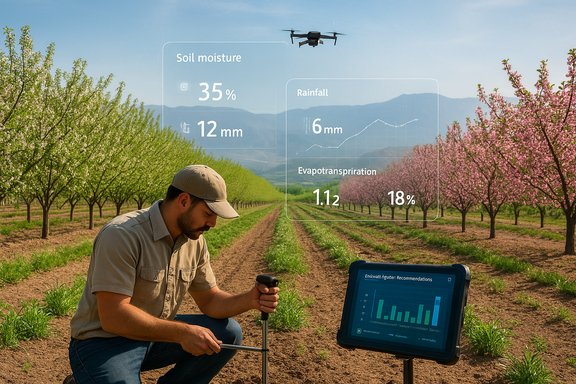
The field-level workflow that Kilimo and its partners deploy distills into a small set of repeatable technical components:- Sensor fusion: combine satellite imagery (frequent but coarse), drone captures (episodic high-resolution) and targeted soil or moisture sensors to create continuous maps of soil moisture and crop stress.
- Evapotranspiration (ET) modelling: use weather data + crop coefficients to estimate daily crop water use and translate that into irrigation needs by plot. ET is central to moving from “how wet is the soil?” to “how much water did the crop actually need?”
- Cloud processing and traceability: ingest telemetry and imagery into a data fabric that normalizes the farm hierarchy (farm/field/block/sensor/activity) and records recommendations and actions with timestamps for auditability. Microsoft’s Azure Data Manager for Agriculture and FarmVibes toolkits are commonly referenced components in these stacks.
- Field agronomist validation: agronomists make spot checks—digging soil pits, inspecting roots and scheduling adjustments—and log their findings alongside the platform’s recommendations, ensuring the model remains grounded in local realities.
- Outcome verification: compare water withdrawals or applied irrigation against a pre-project baseline using agreed methodology to quantify savings; verified savings finance incentives or corporate water‑security credits. Kilimo ties these verified outcomes to commercial incentives that help fund future projects.
Results reported on the ground
Field reports from pilots in Chile and elsewhere show measurable reductions in irrigation input and improved scheduling. Kilimo and associated project accounts state that a three-year irrigation management program in the Maipo River basin — covering a cluster of plots including almond and cherry blocks managed by forward-looking farmers — saved significant volumes of water. The platform’s methodology aggregates satellite-derived ET, meter readings and field confirmations to quantify reductions and translate them into verifiable savings. Public accounts of Microsoft-partnered projects and Kilimo’s commercial reporting highlight water savings and localized productivity benefits as the primary outcomes.Caveat and verification note: some project-level metrics reported in partner communications — for example the exact cubic‑foot figures sometimes cited in corporate stories — may come from company reporting and should be treated as company-verified unless independently audited. Readers should treat headline numbers as reported outcomes rather than independently validated scientific claims unless accompanied by third‑party audits. The core technical claim — that ET-guided irrigation plus agronomic validation reduces applied water and pump runtime compared to traditional schedules — is consistent across multiple case studies and vendor descriptions.
Why this approach works: technical strengths
- High signal-to-noise in critical metrics
Evapotranspiration and soil moisture are directly linked to plant water stress. Estimates based on ET remove much of the ambiguity inherent in simple soil moisture thresholds by accounting for atmospheric demand, crop stage and local weather. Paired with meter readings and spot checks, ET becomes a reliable control variable for irrigation scheduling. - Cost-effective scaling with satellite imagery
Satellites provide repeated global coverage; modern spatial‑AI tools denoise cloud cover and fuse multiple sources to create near‑continuous field-level signals without cost‑prohibitive sensor density. This reduces per‑farm sensor costs and enables cluster-level scaling. Microsoft research toolkits such as FarmVibes enable this kind of async fusion. - Auditable, outcome-focused financing
Turning verified water savings into auditable outcomes allows corporate water buyers and sustainability programs to fund conservation projects in basins where water has systemic value — aligning farmer incentives with watershed resilience. Kilimo’s commercial model ties verification to incentives, creating a funding loop for expansion. - Human-in-the-loop for agronomic safety
AI recommendations are field-checked by local agronomists who add nuance (e.g., recent root problems, pest pressures or soil compaction) that pure remote sensing would miss. This reduces the risk of erroneous model recommendations that could harm yields.
The policy and watershed implications
When a project reduces pump runtime and applied water on dozens of farms, the aggregated effect matters for downstream users and municipal supply during drought. In the Maipo River basin and similar stressed watersheds, modest percentage reductions across many irrigators can translate into significant volumes for cities, ecosystems and groundwater recharge. Because Kilimo’s approach is explicitly designed to create verifiable outcomes, it can inform basin-scale allocation strategies and corporate water stewardship commitments when linked to transparent metering and public reporting.That said, converting farm-level water savings into durable river-basin improvements requires governance: volumetric metering, transparent reporting, enforceable water rights and coordination between agricultural users, utilities and municipalities. Technology alone cannot resolve allocation tensions; it is a tool that must sit within clear policy frameworks to avoid unintended redistribution of scarce resources. This lesson emerges consistently from global pilots where technical gains outstrip institutional readiness.
Risks and failure modes — what to watch for
- Model and calibration bias: spatial models trained in one cropping system or climatic regime can produce biased estimates when moved to a different soil type, crop variety or irrigation system. Local calibration and ongoing field checks are essential.
- Data quality and sensor gaps: satellites can be occluded by clouds; in small parcels or heavily irrigated micro-zones, coarse pixels can miss variability. Overreliance on remote signals without spot validation risks mis-estimating water needs.
- Perverse incentives and rebound effects: efficiency gains can reduce per-unit water costs and increase planted area or intensify production, offsetting basin benefits. Outcome-based programs must guard against rebound with basin-level caps or complementary policy levers.
- Data governance and farmer control: who owns the data, who can use it, and how it affects farmer autonomy matters. Clear consent frameworks and cooperative data ownership models reduce the risk of vendor lock‑in and ensure benefits accrue to growers.
- Greenwashing risk: corporate narratives sometimes extrapolate pilot savings into basin-wide claims without third‑party audit. Independent verification and publication of methods should be mandatory for claims used in corporate reporting.
A practical checklist for operators and municipalities
- Require volumetric metering for projects claiming basin benefits and publish aggregated monthly metrics to a municipal portal.
- Insist on third‑party verification of claimed water savings that includes meter calibration logs and field audit notes.
- Fund capacity-building for local agronomists to perform field validation and model calibration—this is critical for tech adoption and correct recommendations.
- Design incentive programs to avoid rebound: tie incentives to net basin outcomes or cap the acreage eligible for payments.
- Implement clear data-governance templates specifying farmer consent, permitted uses, retention periods and data portability.
Business model and economic implications
Kilimo’s approach converts water-efficiency into a verifiable asset that can support corporate water-security goals or sustainability commitments. The commercial pathway typically looks like:- Farmer signs up to a stewardship program.
- Platform establishes a baseline water profile.
- AI-driven recommendations plus agronomic validation reduce applied water.
- Verified savings generate payouts/incentives for growers and evidentiary reports for corporate buyers.
Technological evolution and where AI matters most
There are several technical layers where AI adds disproportionate value:- Spatial denoising and gap-filling: AI improves satellite imagery usability by removing clouds and harmonizing multi-sensor inputs, which is crucial in intermittent observation environments.
- Microclimate modelling: blending local sensors and weather forecasts to generate short-horizon risk signals (frost, heat stress) that influence irrigation timing.
- Decision support by interface: delivering recommendations in farmer-friendly channels — mobile apps, SMS, or via extension agronomists — is a practical use of AI to translate model outputs into action.
Human factors and the adoption curve
Technology adoption in agriculture is rarely instantaneous. Key non‑technical factors determine whether a farm will adopt and sustain a data-driven irrigation program:- Trust in recommendations: farmers expect to see yield preservation or improvements; early adopters are more willing to trial changes, but scaling requires demonstrable ROI.
- Language and literacy: local-language delivery and vernacular interfaces materially increase adoption, as demonstrated in other Microsoft-backed agri‑AI pilots.
- Labor and logistics: splitting irrigation runs or changing schedules has operational costs—labor availability, pump scheduling and maintenance must be factored into recommendations. Field agronomy remains essential to translate algorithmic recommendations into practical schedules.
Lessons from Chile that apply globally
- Integrate tech with local agronomy: models that ignore local management realities fail. Chile’s pilots place agronomists at the center of model validation—this human-in-the-loop model is essential for safe, adoptable recommendations.
- Prioritize auditable outcomes: corporate funding is more likely when savings are verifiable. Outcome verification builds long-term fundability for stewardship programs by converting water efficiency into auditable deliverables.
- Design for intermittent connectivity: solutions that depend solely on constant high-bandwidth links restrict adoption. Assembling advisory pipelines that work offline, sync intermittently, and use SMS/voice for delivery increases reach.
- Guard against single-point narratives: while pilot stories can be compelling, scaling requires multi-stakeholder governance. Municipalities, utilities and farmer cooperatives must be at the table to translate farm-level savings into watershed benefits.
Final assessment: strengths, limitations and the road ahead
The Chilean pilots demonstrate a compelling pattern: when spatial‑AI, cloud-based processing and field agronomy are combined with rigorous verification, measurable water savings are possible without sacrificing yields. This model addresses the perennial problem of agricultural water being effectively low-priced and therefore undervalued by creating an auditable mechanism that assigns economic value to conserved water. In practical terms, that alignment—between farmer incentives and basin outcomes—is the real innovation.Yet technology is not a panacea. The approach’s long-term success depends on robust science (well-calibrated models and independent audits), sound governance (transparent metering and basin planning), and equitable data and financing arrangements that return value to the farmers and communities bearing the changes in practice. The most durable programs will pair rigorous technical stacks with clear policy frameworks and local capacity building.
To accelerate positive outcomes, funders and policymakers should insist on: standardized baseline methodologies, third‑party verification, public reporting of aggregated water metrics, and participatory data governance that secures farmer consent and agency. When those elements are in place, data-driven irrigation becomes not just an efficiency play but a practical tool for water stewardship in stressed basins worldwide.
Conclusion
Data-driven agriculture in Chile’s Maipo basin highlights what’s possible when modern spatial‑AI tooling meets agronomic expertise and verifiable outcome financing. The combination reduces waste, lowers costs for growers and creates verifiable water savings that can be directed toward community resilience — but only when paired with rigorous verification, transparent governance and clear farmer benefits. The technical toolkit exists; the next challenge is scaling responsibly, transparently and equitably so that the water saved in one field becomes a sustainable gain for the entire basin.
Source: Microsoft Source Data-driven farming and AI are transforming water management in Chile
