

DataSnipper’s new AI Extractions capability promises to turn the slow, error-prone chore of pulling numbers and facts from messy documents into a faster, traceable workflow directly inside Excel — and the feature is explicitly built on Microsoft Azure’s Content Understanding stack to do it at enterprise scale.
DataSnipper began as an Excel-native tool that lets auditors “snip” figures from source documents and link them back to cells in workpapers; since its founding it has aggressively expanded its automation and AI surface, raised a major Series B round and deepened commercial ties with Microsoft. The vendor’s public filings and press pages document a $100 million Series B led by Index Ventures in February 2024 that valued the company at about $1 billion — a claim corroborated across multiple trade outlets. Over 2024–25 DataSnipper moved from basic extraction features into more advanced AI suites and agentic tooling, acquiring complementary technologies and publishing products that emphasize Excel-native evidence linking, traceability, and enterprise deployment options such as an Azure Marketplace listing. The company’s messaging has shifted to emphasize being “workflow-native” for audit and finance teams rather than a separate platform auditors must flee Excel to use.
AI Extractions targets three persistent pain points:
However, the headline value depends on disciplined rollout: firms must treat this as an operational change, not only a technology upgrade. That means piloting with real documents, configuring conservative confidence thresholds, enforcing provenance and logging, and embedding human approval points into the workflow. Vendor marketing figures on user counts and geographic reach vary across public statements; procurement and compliance teams should validate those claims directly rather than relying on press materials. DataSnipper’s move also illustrates a broader industry pattern: enterprise-ready agentic and document-understanding tooling is coalescing around a few cloud primitives (identity, agent registries, RAG grounding, and provenance-first analyzers). The firms that combine these primitives with disciplined AgentOps and audit-grade controls will extract the most value; those that skip the governance lift risk compliance headaches, unexpected costs, and reputational exposure.
In short: AI Extractions looks like a meaningful productivity lever for document-heavy audit work — but it requires the same professional skepticism, oversight and controls that auditors apply to any evidence-gathering tool.
Source: Morningstar https://www.morningstar.com/news/pr...-extractions-in-collaboration-with-microsoft/
 Background
DataSnipper began as an Excel-native tool that lets auditors “snip” figures from source documents and link them back to cells in workpapers; since its founding it has aggressively expanded its automation and AI surface, raised a major Series B round and deepened commercial ties with Microsoft. The vendor’s public filings and press pages document a $100 million Series B led by Index Ventures in February 2024 that valued the company at about $1 billion — a claim corroborated across multiple trade outlets. Over 2024–25 DataSnipper moved from basic extraction features into more advanced AI suites and agentic tooling, acquiring complementary technologies and publishing products that emphasize Excel-native evidence linking, traceability, and enterprise deployment options such as an Azure Marketplace listing. The company’s messaging has shifted to emphasize being “workflow-native” for audit and finance teams rather than a separate platform auditors must flee Excel to use. What the announcement says — the essentials
- What launched: AI Extractions, a capability that interprets unstructured documents (payroll reports, tax files, vendor packs, medical evaluations, etc. and extracts structured, auditable data directly into Excel workbooks.
- Built-on: DataSnipper positions the feature as powered by Microsoft Azure services — specifically Azure Content Understanding — so document layout interpretation, OCR/layout parsing, and field extraction are handled with Foundry/Content Understanding pipelines.
- Key user benefits advertised:
- Speed & scale: prompts and reusable templates to accelerate extraction across many documents and engagements.
- Quality & trust: live, traceable links from each extracted value back to the source evidence for defensible reviews.
- Flexibility: language support and the ability to adapt to diverse, irregular layouts without rigid templates.
- Excel-native productivity: users remain inside Excel to avoid workflow fragmentation.
Why this matters for audit and finance teams
Audit and finance workloads are intensely document-driven. Evidence lives in hundreds or thousands of PDFs, scanned images, and vendor spreadsheets that arrive in different formats, languages, and layouts. The manual approach — look up a value, copy it into Excel, annotate the evidence — scales poorly and creates audit trail risk.AI Extractions targets three persistent pain points:
- Routine extraction time and costs: repetitive manual work that consumes junior staff hours and increases margin for human error.
- Traceability and defensibility: regulators and quality reviewers demand evidence links and clean audit trails; automated extraction that keeps links intact changes the cost dynamics of producing defensible workpapers.
- Workflow fragmentation: moving documents in and out of the spreadsheet for analysis damages productivity and introduces reconciliation risk; keeping work in Excel reduces context switching and simplifies change control.
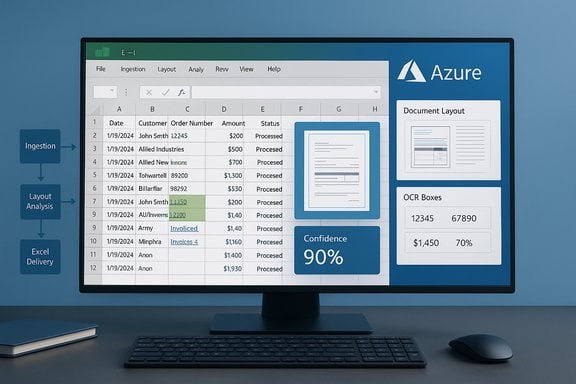
Technical anatomy — how AI Extractions appears to work
1. Ingestion and layout analysis
Files (PDFs, images, DOCX, etc. are fed into an Azure Content Understanding pipeline that performs OCR, layout parsing, and multimodal analysis. Content Understanding’s layout models can extract text, tables, images, and positional metadata, producing structured representations that preserve where each item sits on a page. This positional metadata is critical to link extractions back to evidence locations for audit trails.2. Field extraction and inference
Content Understanding augments raw extraction with generative-model-based field inference: it can produce inferred fields, normalized values, and enriched outputs (e.g., parse a payroll table into per-employee gross/net pay fields). The product exposes confidence scores and grounding snippets that allow downstream systems — and auditors — to review how confident the extraction is and to see the exact snippet that supports a value.3. Excel-native delivery with traceability
DataSnipper maps each extracted value into Excel cells and, crucially, attaches a live link or reference to the source evidence — an approach the vendor describes as “traceable” and “audit-ready.” In practice this means clicks in a workbook should bring reviewers back to the original document and the precise location where the value was found. That evidence-first posture is table stakes for regulated reviews.4. Templateing, prompts and reusable workflows
To scale extraction across engagements, DataSnipper supports reusable templates and prompt-driven extraction flows. Templates codify the fields you care about (for example, payroll line items, tax box numbers, or vendor contract clauses) and let teams apply the same extraction logic across multiple files with lower setup time. Prompt templates help nudge the generative components toward consistent outputs in varied layouts.Cross-checks and verifications
- Funding and scale: DataSnipper’s $100M Series B led by Index Ventures and unicorn valuation is validated by the company’s press material and multiple independent outlets.
- Azure dependence: Microsoft’s Foundry blog and documentation explicitly describe Azure Content Understanding’s new GA features, its prebuilt finance analyzers, confidence/grounding controls and cite DataSnipper as a customer using Content Understanding for Excel-native extraction. This confirms the technical underpinnings reported in the vendor PR.
- Customer footprint: DataSnipper’s public claims about customer counts and geographic reach vary across company pages and press releases (figures read 125+ countries / 400–600k users in different places). Those discrepancies mean any blanket statement about “600k users in 175 countries” should be treated as vendor-provided and worth direct verification for procurement contracts or regulatory filings. Treat public figures as directional until confirmed with sales or an executed contract.
Strengths — what this release gets right
- Product-market fit in Excel. Audit teams still live in Excel; building extraction that returns actionable, traceable values into that environment reduces friction and shortens change management. DataSnipper’s Excel-native UX is a major adoption accelerant.
- Enterprise-grade foundation. By running on Azure Content Understanding and Foundry primitives, DataSnipper inherits enterprise controls for identity, regional deployments, and observability — capabilities big firms need for procurement sign-off. Microsoft documentation shows Content Understanding provides confidence scores, grounding, and prebuilt analyzers that suit finance documents.
- Traceability-first design. Maintaining live links from extracted values back to precise evidence is the difference between “automation” and “audit automation.” This traceability is necessary for defensible audit conclusions and regulator-ready documentation.
- Multimodal and multilingual capability. Content Understanding supports many document formats and a range of languages; Azure Translator and Foundry tools provide translation options where needed — helpful for global audits. Microsoft warns that non-English performance varies and requires validation, but the base tooling supports many locales.
Risks, limitations and governance concerns
- Model risk and hallucination. Generative components (used for inferred fields and normalization) lower manual effort but introduce model error risk. Even with grounding, inferred fields can be wrong or misaligned with local accounting conventions. Human-in-the-loop validation remains essential for high-stakes assertions. Microsoft’s guidance likewise recommends human review in sensitive domains.
- Data residency and compliance. Firms operating under strict data residency rules must validate the Azure region and Foundry deployment model used by DataSnipper, confirm retention policies for documents and prompts, and ensure logs meet retention/audit requirements. Azure Foundry offers regional choices, but tenant-level configuration is the customer’s responsibility.
- Vendor claims need verification. Public numbers on customers, country coverage, and “Fortune 500” footprint vary between DataSnipper press materials. Those marketing statements should be validated during vendor selection or procurement due diligence.
- Licensing and downstream controls. When outputs combine licensed third-party content, client data, and model inferences, contracts must prohibit unauthorized downstream training or redistribution. Firms should require explicit contractual protections and DLP controls to prevent leakage.
- Operational costs and metering. Large-volume extraction workflows can become expensive (model calls, storage, Copilot/Foundry usage). Budgeting and metering are essential; Microsoft and third-party reports emphasize predictable throughput units and provisioned options to manage costs.
Practical adoption checklist for IT and Audit leaders
- Define the high-value smoke tests: pick 2–3 document types (payroll, vendor invoices, tax forms) where manual effort is high.
- Pilot scope: run a time-boxed pilot with a sample of real client documents, including non-English items if applicable.
- Verify evidence linking: confirm that each extracted value includes a navigable link to the original document and the exact bounding box or page reference.
- Validate confidence thresholds: tune automated acceptance rules by field confidence; require manual review above or below thresholds as appropriate.
- Confirm data residency & retention: map content to the Azure region and ensure retention/archiving meets legal and firm policies.
- Contract controls: include clauses on prompt/document retention, model training prohibition, and audit logging; confirm SLAs for data deletion and breach notification.
- DLP and access controls: integrate DLP with Entra/Azure AD roles to limit who can export extracted content or re-route it to external services.
- Cost modeling: estimate throughput, per-document costs, and forecast monthly spend under expected document volumes; consider provisioned throughput units for predictability.
How AI Extractions compares to alternatives
- Traditional IDP (template-based) solutions excel at highly regular documents but fail with heterogeneous layouts. Content Understanding + DataSnipper’s approach targets the opposite problem: high variation with fewer template constraints, leveraging generative inference and layout-aware analyzers. Microsoft’s docs explicitly frame Content Understanding as the go-to for varied, unstructured inputs and RAG readiness.
- Homegrown LLM+OCR stacks can provide flexibility but place the governance, provenance, and retention burden on the buyer. Using Azure Foundry tools plus a vendor that integrates into Excel reduces engineering lift but transfers trust to the vendor-cloud combination; governance must follow.
Vendor and platform governance — practical guardrails
- Force provenance: require any automated output used in an audit to include the retrieval ID or document snippet and a stored log of the agent’s decision path.
- Retain immutable logs: capture document ingestion, model calls, user approvals and exports in tamper-evident storage aligned to retention policies.
- Human signoff gating: automate clerical extraction but gate conclusion-level or opinionated statements behind explicit auditor approval.
- RAG controls: ensure retrieval-augmented generation always surfaces the grounding snippet for any substantive claim; forbid “synthesized” statements without provenance.
- Multi-tenant isolation & Least Privilege: verify tenant isolation and apply least-privilege roles for any team handling sensitive client documents.
The competitive and market context
Enterprise AI for audit and finance is entering a phase where platform partnerships matter as much as raw feature sets. Microsoft’s investments in Foundry, Copilot Studio, and Content Understanding have produced a set of platform primitives (model choice, MCP-style tooling, agent registries, enterprise identity/gov) that make partner integrations like DataSnipper’s faster to adopt for large firms. Other vendors — both audit-focused platforms and general-purpose IDP vendors — are racing to embed into the same Microsoft ecosystem or to provide comparable governance primitives on other clouds. This is an important market dynamic: buyers in regulated industries prefer vendor solutions that align with their cloud and governance choices rather than isolated point solutions.Final assessment
AI Extractions is a timely, pragmatic move: it brings modern, layout-aware extraction and LLM-based inference into the spreadsheet environment where auditors already work, and it does so on an enterprise cloud platform that provides many necessary governance primitives. The pairing — DataSnipper’s Excel-first UX plus Azure Content Understanding’s layout, grounding, and confidence features — addresses both the usability and defensibility needs auditors demand.However, the headline value depends on disciplined rollout: firms must treat this as an operational change, not only a technology upgrade. That means piloting with real documents, configuring conservative confidence thresholds, enforcing provenance and logging, and embedding human approval points into the workflow. Vendor marketing figures on user counts and geographic reach vary across public statements; procurement and compliance teams should validate those claims directly rather than relying on press materials. DataSnipper’s move also illustrates a broader industry pattern: enterprise-ready agentic and document-understanding tooling is coalescing around a few cloud primitives (identity, agent registries, RAG grounding, and provenance-first analyzers). The firms that combine these primitives with disciplined AgentOps and audit-grade controls will extract the most value; those that skip the governance lift risk compliance headaches, unexpected costs, and reputational exposure.
In short: AI Extractions looks like a meaningful productivity lever for document-heavy audit work — but it requires the same professional skepticism, oversight and controls that auditors apply to any evidence-gathering tool.
Source: Morningstar https://www.morningstar.com/news/pr...-extractions-in-collaboration-with-microsoft/
