

DataSnipper’s new AI Extractions capability promises to turn messy, unstructured documents into structured, traceable data directly inside Excel — a release positioned as the next practical step in embedding enterprise-grade AI into everyday audit and finance workflows. The feature, announced in partnership with Microsoft and built on Microsoft Azure’s document understanding stack, aims to accelerate document-heavy procedures while maintaining the evidence-first controls auditors and finance professionals require.
Audit and finance teams remain uniquely dependent on spreadsheet-driven processes and document evidence. Manual extraction from variable, unstructured sources — payroll reports, scanned tax documents, vendor files, medical evaluations — is expensive, error-prone, and time-consuming. DataSnipper launched as an Excel-native tool to “snip” values from source documents and link them to workpapers; over recent product cycles the company has expanded its AI surface from simple extraction helpers to agentic features and richer document understanding. Its latest capability, AI Extractions, is explicitly positioned to interpret irregular layouts, extract the correct fields, and attach live links back to source evidence — all inside Excel.
DataSnipper’s public materials and third‑party trade coverage corroborate key business facts cited alongside the product announcement: the company previously closed a $100 million Series B (reported in early 2024), led by Index Ventures, which positioned the firm near unicorn valuation territory. DataSnipper also emphasizes a broad global footprint and enterprise customers across major accounting firms and large enterprises, though public figures for user counts and country reach vary between statements and therefore merit direct procurement verification.
Where the announcement is explicit about technical foundations — that AI Extractions uses Azure Content Understanding and surfaces confidence/grounding metadata — supporting Azure documentation and partner materials align with those claims. This reduces the risk of exaggerated technical promises, but it does not remove the operational diligence required to confirm tenant configuration, regional placement, and SLA commitments.
However, the technology is not a one-click fix. Responsible adoption requires careful pilots, conservative confidence gating, explicit contractual protections around data handling and model use, clear logging and provenance procedures, and rigorous cost forecasting. Firms that treat AI Extractions as an operational change rather than a simple software upgrade are far more likely to realize the promised productivity and quality gains without exposing themselves to undue compliance or model-risk liabilities.
In short: AI Extractions is a significant step forward for audit and finance automation, but its value will be realized only where governance, procurement diligence, and human review are treated as first‑class components of the deployment.
Conclusion
AI Extractions crystallizes a sensible product strategy: bring trustworthy, traceable AI to the spreadsheet where auditors and finance teams already spend their time, and anchor the capability on an enterprise cloud that supplies the necessary governance primitives. For many firms this will shorten tedious extraction work and strengthen audit trails; for IT and procurement leaders it poses a familiar set of responsibilities — verify the vendor’s operational claims, secure data residency and retention guarantees, and bake human review into the automated workflow. When those conditions are met, this kind of Excel-native, Azure-powered document understanding can move clerical hours back toward judgment and insight — which is exactly where audit and finance professionals should focus their expertise.
Source: Lelezard DataSnipper Launches AI Extractions in Collaboration with Microsoft
 Background
Audit and finance teams remain uniquely dependent on spreadsheet-driven processes and document evidence. Manual extraction from variable, unstructured sources — payroll reports, scanned tax documents, vendor files, medical evaluations — is expensive, error-prone, and time-consuming. DataSnipper launched as an Excel-native tool to “snip” values from source documents and link them to workpapers; over recent product cycles the company has expanded its AI surface from simple extraction helpers to agentic features and richer document understanding. Its latest capability, AI Extractions, is explicitly positioned to interpret irregular layouts, extract the correct fields, and attach live links back to source evidence — all inside Excel.DataSnipper’s public materials and third‑party trade coverage corroborate key business facts cited alongside the product announcement: the company previously closed a $100 million Series B (reported in early 2024), led by Index Ventures, which positioned the firm near unicorn valuation territory. DataSnipper also emphasizes a broad global footprint and enterprise customers across major accounting firms and large enterprises, though public figures for user counts and country reach vary between statements and therefore merit direct procurement verification.
What AI Extractions does — the essentials
AI Extractions is designed to handle highly variable, unstructured inputs and deliver structured, auditable outputs inside Excel. Key advertised capabilities are:- Layout-aware extraction: interprets the structure of PDFs, images, DOCX, and mixed-format bundles to find and extract relevant values without rigid templates.
- Generative inference for normalization: infers and normalizes values (for example, parsing payroll tables into per‑employee gross/net pay) using modern generative components in the extraction pipeline.
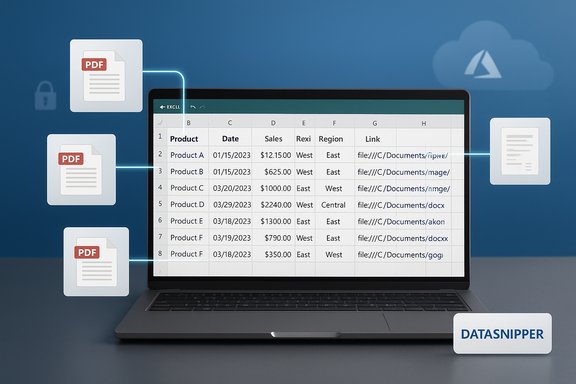
- Traceability and evidence linking: attaches live links or references to the exact location in the original document for every extracted value so reviewers can jump back to source evidence.
- Reusable templates and prompts: supports prompt-driven templates and extraction templates so teams can scale extraction logic across engagements.
- Excel-native delivery: results land in Excel workbooks — cells are populated and remain linked to evidence to preserve workflow continuity for auditors.
How it appears to work (technical anatomy)
AI Extractions can be understood as a multi-stage pipeline:- Ingestion and OCR — documents (PDFs, scans, images, DOCX) are ingested and passed through layout-aware OCR and page-structure parsers to retain positional metadata. This metadata underpins evidence linking.
- Field extraction and inference — layout outputs feed field extraction models and generative inference layers that identify, normalize, and, where required, infer missing or implicit fields. Confidence scores and grounding snippets are exposed so reviewers can validate results.
- Excel mapping and traceability — extracted data is mapped to Excel cells and each value is linked back to the precise document location (bounding box, page, or snippet), enabling defensible audit trails.
- Templates & prompts — teams create reusable templates for document types and prompt patterns that standardize extraction across engagements and reduce setup time.
Why the Microsoft collaboration matters
Placing the extraction engine on Azure Content Understanding is a deliberate enterprise play. Azure Foundry and Content Understanding provide:- Prebuilt finance analyzers and layout models that are tuned for common document classes auditors use.
- Provenance and confidence controls that surface grounding snippets and model confidence, which are essential for audit defensibility.
- Enterprise governance primitives (Entra/Azure AD identity integration, regional tenancy, logging/observability) that large audit firms and regulated enterprises require.
Strengths: where AI Extractions legitimately advances audit automation
- True Excel-native workflow: By returning structured data directly into Excel with live evidence links, DataSnipper reduces context switching and the reconciliation risk that comes from moving data across tools. This practical UX advantage materially reduces adoption friction.
- Traceability-first approach: The emphasis on attaching evidence snippets and confidence metadata converts automation from a mere time-saver into an audit automation tool that supports defensible conclusions — a non-trivial difference in regulated audits.
- Handling of heterogeneous layouts: Using Azure’s layout models and generative inference makes the solution viable for highly variable inputs where template-based IDP breaks down. This is a strong fit for consolidated audit work across jurisdictions and formats.
- Enterprise readiness: Integration with Azure enables customers to apply their existing identity and governance controls, which signficantly eases procurement for the largest firms. The partnership with Microsoft is therefore not just technical — it’s strategic.
- Familiar procurement path: Listing on Azure Marketplace and an Azure-first architecture reduces procurement friction for Microsoft-centric enterprises and provides built-in options for regional deployment and compliance configuration.
Risks, limitations, and governance concerns
The feature set is compelling, but practical deployment requires discipline. The announcement and independent analyses flag several real-world caveats that audit and IT leaders must treat seriously.Model risk and hallucination
Generative inference that normalizes or infers fields can be wrong. Even when grounding snippets are available, automated normalizations may misinterpret local accounting terminology or jurisdiction-specific formats. Human-in-the-loop validation remains necessary for high-stakes assertions. The vendor and Microsoft materials explicitly recommend conservative confidence thresholds and manual review gating for critical fields.Data residency and retention
Large audit clients often operate under strict data residency and retention mandates. While Azure offers regional deployments, customers must verify where ingestion, storage, model calls, and logs reside for their tenant. Contract terms about prompt/document retention, deletion SLAs, and non-training clauses should be negotiated up front. Public marketing claims about global footprints should not substitute for these contractual guarantees.Provenance and immutable logging
For regulatory defensibility, customers should insist on immutable, tamper-evident logs that capture document ingestion, model calls (with model versioning), user approvals, and exports. The existence of evidence links is necessary but not sufficient — tamper-evident audit logs and retention settings are mandatory controls.Cost and metering
Large-volume extraction workflows can become expensive when model calls, OCR, and storage scale. Budgeting must include Azure consumption and any per-request or throughput metering the vendor applies. Customers should test cost at anticipated scale and consider provisioned throughput units if available to manage predictability.Vendor claims vs. verifiable facts
Public numbers on customers, country coverage, and Fortune 500 reach sometimes vary between press materials. Procurement teams should treat these as directional marketing claims and require proof during vendor diligence (customer references, contracts, or audit reports). The vendor’s reported $100M Series B and valuation are corroborated by trade coverage, but operational customer metrics should be validated separately.Practical adoption checklist for audit and IT leaders
Organizations evaluating AI Extractions should follow a disciplined pilot and governance playbook:- Define scope — select 2–3 high-value document types (payroll, vendor invoices, tax forms) with diverse layouts to test capability and edge cases.
- Pilot with real data — include non-English documents if applicable to validate multilingual performance and confirm extraction quality.
- Verify traceability — ensure each extracted value links to the exact document region (bounding box or page) and that reviewers can navigate from workbook cell to source evidence.
- Tune confidence thresholds — adopt acceptance rules based on field-level confidence; require manual review for low-confidence or high-risk fields.
- Confirm data residency & retention — map ingestion, processing, and logs to Azure regions that satisfy legal and firm policies; negotiate retention and deletion SLAs.
- Contract safeguards — require non-training clauses, explicit DLP and export controls, breach notification SLAs, and rights to audit vendor controls.
- Logging and immutability — insist on tamper-evident logs of ingestion, model calls, human approvals, and exports; integrate logs with corporate SIEM/archival as needed.
- Cost modeling — run a cost pilot to understand per-document and monthly consumption; plan for spikes in seasonal audit demand.
Competitive and market context
Enterprise AI for audit and finance is rapidly coalescing around a set of cloud primitives — model selection, retrieval/grounding, agent frameworks, and provenance tooling — that major cloud vendors provide as building blocks. Microsoft’s push with Azure AI Foundry, Content Understanding, and Copilot tooling makes it a natural host for partner solutions that must meet strict governance requirements. Vendors that integrate with these primitives can lower engineering and procurement barriers for the largest audit firms, but they also hand buyers the responsibility to validate configuration and contractual protections. DataSnipper is positioning itself in this ecosystem as an Excel-first partner with deep integration into Microsoft stacks — an approach that competes directly with template-based IDP vendors and homegrown OCR+LLM stacks.What this means for auditors, finance teams, and enterprise buyers
- For auditors, AI Extractions can materially reduce the time spent on clerical evidence extraction, allowing teams to reallocate hours to risk assessment and interpretation. The traceability model helps preserve defensibility if control points and logging are enforced.
- For finance teams, Excel-native extraction removes a common friction point in month-end and regulatory reporting — the chore of copying values from varied source documents into centralized sheets while preserving evidence links. This reduces reconciliation drift and supports faster close cycles.
- For procurement and IT, the Microsoft tie-in simplifies procurement for Azure customers but raises the need for diligence around data residency, retention, and contractual restrictions on downstream use of client data. Large clients should insist on demonstrable SOC 2 or equivalent attestations and the right to audit.
Vendor posture and public claims — verification and caution
DataSnipper’s announcement highlights enterprise-scale ambitions and customer uptake. The company’s prior fundraising (a $100M Series B led by Index Ventures) and its product roadmap toward agentic, Excel-native tooling are corroborated across vendor materials and independent coverage. Still, several numbers and marketing claims—user counts, global reach, and “Fortune 500” usage—vary across public statements and should be validated during vendor selection. Procurement teams must demand corroborating evidence such as references, audited customer counts, and contract-level territory coverage before relying on headline metrics.Where the announcement is explicit about technical foundations — that AI Extractions uses Azure Content Understanding and surfaces confidence/grounding metadata — supporting Azure documentation and partner materials align with those claims. This reduces the risk of exaggerated technical promises, but it does not remove the operational diligence required to confirm tenant configuration, regional placement, and SLA commitments.
Final assessment
DataSnipper’s AI Extractions is a pragmatic, well-positioned advancement in audit automation: it combines a pragmatic user experience (Excel-native, evidence-linked outputs) with modern, layout-aware document understanding provided through Azure Content Understanding. That combination addresses two of the industry’s most persistent frictions — document heterogeneity and audit traceability — in a way that aligns with how auditors work today.However, the technology is not a one-click fix. Responsible adoption requires careful pilots, conservative confidence gating, explicit contractual protections around data handling and model use, clear logging and provenance procedures, and rigorous cost forecasting. Firms that treat AI Extractions as an operational change rather than a simple software upgrade are far more likely to realize the promised productivity and quality gains without exposing themselves to undue compliance or model-risk liabilities.
In short: AI Extractions is a significant step forward for audit and finance automation, but its value will be realized only where governance, procurement diligence, and human review are treated as first‑class components of the deployment.
Conclusion
AI Extractions crystallizes a sensible product strategy: bring trustworthy, traceable AI to the spreadsheet where auditors and finance teams already spend their time, and anchor the capability on an enterprise cloud that supplies the necessary governance primitives. For many firms this will shorten tedious extraction work and strengthen audit trails; for IT and procurement leaders it poses a familiar set of responsibilities — verify the vendor’s operational claims, secure data residency and retention guarantees, and bake human review into the automated workflow. When those conditions are met, this kind of Excel-native, Azure-powered document understanding can move clerical hours back toward judgment and insight — which is exactly where audit and finance professionals should focus their expertise.
Source: Lelezard DataSnipper Launches AI Extractions in Collaboration with Microsoft
