

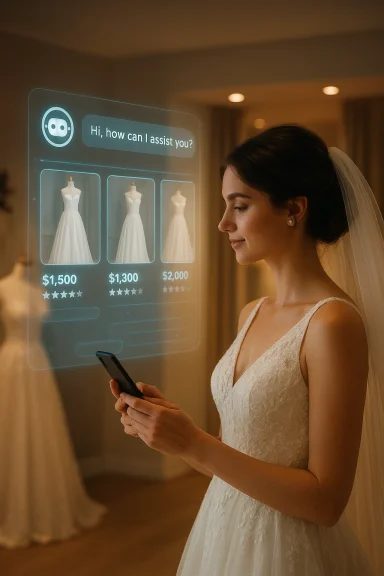
David’s Bridal’s move into chatbots for wedding dress shopping is less a gimmick than a signal flare: AI has become a bona fide retail channel, and one of America’s best-known bridal brands now wants a seat at the table. The company is using Shopify’s agentic storefronts to surface dresses in ChatGPT and Microsoft Copilot, allowing shoppers to describe what they want and receive tailored options with images, pricing, and ratings. For a category that is equal parts emotional, time-consuming, and high-stakes, that shift could reshape how brides begin the buying journey.
Wedding dress shopping has always lived at the intersection of aspiration and anxiety. Unlike buying a pair of shoes or a sweater, a bridal gown is tied to an event with a fixed deadline, a social spotlight, and usually a very specific budget. That combination makes the category unusually sensitive to both discovery and reassurance, which is exactly why AI-assisted shopping is so attractive here.
David’s Bridal has long occupied a central position in that experience. The company built its reputation by serving a broad audience with accessible pricing, a large physical footprint, and a “see it, try it, buy it” model that still matters in bridal retail. Even as ecommerce has expanded, dress shopping remains deeply tactile, which is why the company’s digital strategy has always had to complement, not replace, the in-store appointment.
That context helps explain the significance of the latest announcement. Rather than treating ChatGPT or Copilot as novelty channels, David’s Bridal is using them as discovery engines in a category where inspiration often starts long before a customer reaches a website. The retailer’s strategy is to meet shoppers earlier, when they are still narrowing style, silhouette, size, and price, then move them into the fitting-room moment that remains central to conversion.
This is also happening against a broader retail backdrop in which generative AI shopping is no longer theoretical. Shopify has been rolling out agentic storefronts that let merchants surface products inside AI conversations, while Adobe and Retail Brew have reported dramatic growth in AI-driven traffic to retail sites. The exact numbers matter less than the direction of travel: consumers are increasingly willing to ask an AI where to buy something, not just how to describe it.
For David’s Bridal, the timing is especially important because the brand has spent years rebuilding after financial distress. The company’s recent bankruptcy history forced it to rethink store count, staffing, and operating model, making efficiency and reach more valuable than ever. In that environment, AI is not simply a tech add-on; it is a way to extend the lifecycle of a customer relationship without relying entirely on conventional ad spend or website navigation.
The mechanics matter. According to Shopify’s own materials, agentic storefronts are designed to expose eligible merchants across AI channels, with ChatGPT already available for eligible stores and Copilot still in early access for some merchants. That suggests David’s Bridal is leaning into an emerging infrastructure layer, not building a custom one-off integration that could become obsolete in a year.
There is also a strategic narrative here. David’s Bridal has been framing its AI efforts under an “Aisle to Algorithm” concept, which is meant to connect wedding planning, dress discovery, vendor recommendations, and eventual in-store or checkout conversion. The company is trying to create a loop in which AI helps identify the right product sooner, while the brand retains ownership of the relationship across channels.
This matters because bridal shopping has historically been fragmented. Inspiration comes from social media, advice from friends, fit confirmation in stores, and purchase completion in a separate channel. AI commerce promises to unify those steps by compressing discovery and decision-making into a conversational interface that feels less like browsing and more like consultation.
There is also a platform battle underway. If shoppers begin asking AI assistants where to buy dresses, retailers risk losing visibility unless their product data is structured for those environments. David’s Bridal is effectively betting that the next generation of product discovery will be mediated by assistant interfaces, and that brands that wait will be harder to find later.
The move is also a smart response to how consumers increasingly shop for complex purchases. AI does especially well when the buyer knows the category but not the exact item. Wedding dresses fit that pattern perfectly because the customer usually has a vision, but not a SKU.
That said, the story is not only about conversion. It is about data. By tracking which AI platforms drive traffic and which prompts lead to purchase, David’s Bridal can learn a lot about consumer intent. That data can inform merchandising, inventory planning, and even the design of future planning tools.
This is a meaningful shift for commerce architecture. For years, retailers optimized for search engines, marketplaces, and social platforms. Agentic storefronts suggest a future where AI assistants become another front door, one that can mediate product discovery without sending the customer through multiple intermediate pages.
For customers, the experience is likely to feel smoother than traditional site navigation. For retailers, the backend implication is more important: catalog quality, metadata consistency, inventory accuracy, and pricing discipline become even more critical. If AI is going to recommend products credibly, the data feeding it has to be structured, current, and complete.
David’s Bridal is wisely not pretending that the chatbot replaces the fitting room. Instead, the company is using the AI channel to help shoppers arrive at the store with a better sense of what they want. That is a subtle but important distinction, because it preserves the tactile, social, and emotional value of the physical appointment.
The practical benefit is obvious. If a bride can narrow down options before she visits a store, she may feel less overwhelmed and more prepared. That can improve appointment efficiency, reduce decision fatigue, and potentially increase the likelihood of purchase.
The broader implication is that AI may extend the bridal sales cycle rather than shorten it. Instead of replacing the human experience, the technology can make the human experience better targeted and more satisfying. In a category where confidence is part of the product, that is not a small advantage.
Seen that way, the new chatbot shopping integration is a logical extension. Pearl Planner handles upstream planning, while agentic storefronts handle product discovery and shopping. Together they create a more connected funnel from engagement to purchase.
That approach could be especially powerful for a retailer that serves customers across multiple planning stages. If the same brand helps a couple choose vendors, manage tasks, and find attire, it can become embedded in the wedding planning process far beyond a single transaction. That creates a stronger customer relationship and potentially better lifetime value.
Still, the strategy depends on execution. AI tools can impress users with novelty, but retention comes from relevance and reliability. If David’s Bridal wants this to be more than marketing theater, it has to prove that the recommendations are genuinely useful and that the handoff to stores is seamless.
For David’s Bridal, the upside is brand reinforcement. Because the company already has name recognition in bridal, it can potentially convert AI-assisted discovery into a curated, trusted experience. Smaller rivals may not have the same brand equity, but they could still compete on agility, niche style, or faster product updates.
There is also a platform-level consequence. If Shopify’s agentic storefronts gain traction, more merchants will follow, and AI commerce may become normalized much faster than many retailers expected. That could compress the time available for laggards to build structured product data and AI-ready catalogs.
The competitive lesson is blunt: if customers are asking AI where to buy, being absent from the answer set is a risk. In a category as emotionally charged as bridal, missing the first recommendation can mean losing the sale before the customer ever visits a site.
For the enterprise side, the benefits are more strategic than emotional. AI storefronts can improve product discovery, collect channel-level attribution data, and support better allocation of marketing resources. They may also help the company understand which styles, sizes, and price points resonate in a specific conversational context.
The consumer risk is over-reliance on algorithmic suggestions. If the AI favors only a narrow set of products, shoppers may miss better alternatives. The enterprise risk is more complicated: if the AI layer becomes the default discovery mechanism, the retailer may become dependent on platform rules it does not control.
That tension is why the most successful AI retail strategies will likely combine automation with human service. The chatbot can narrow the field, but stylists, merchandisers, and store associates still need to close the loop. In bridal, the emotional finish still matters.
The second risk is channel dependency. Retailers that become too reliant on external AI platforms may find themselves vulnerable to interface changes, ranking shifts, or policy changes they do not control. What feels like reach today can turn into gatekeeping tomorrow.
The third issue is privacy and data use. Consumers may not always understand how their prompts, preferences, or engagement history are being stored or analyzed. In a shopping context, that may be acceptable to some customers, but transparency remains essential if brands want long-term trust.
There is also the human factor. Bridal shopping is often about reassurance, not just optimization. If AI makes the experience feel too transactional, the brand may lose some of the warmth and intimacy that drives loyalty in the first place. That would be a costly trade, even if short-term conversion improved.
The opportunity is to turn AI from a search shortcut into a relationship engine. If the company can connect planning, discovery, and store visits in a coherent flow, it could create a much stronger customer journey than a generic ecommerce funnel. That kind of orchestration is especially compelling in a category where the purchase decision unfolds over weeks or months.
The most important metric may not be raw traffic but the quality of the journey. Are shoppers finding better matches sooner? Are in-store appointments more productive? Do AI-sourced customers convert at higher rates, or at least with lower friction? Those are the questions that will determine whether this becomes a model for bridal retail or just another well-marketed experiment.
A few indicators will be worth watching closely:
The bigger story is that commerce is becoming conversational, and bridal may be one of the clearest examples of why that matters. When the product is personal, the deadline is fixed, and the buyer wants reassurance, the retailer that can answer the question first may win the sale before anyone ever steps into the showroom.
Source: AOL.com Say yes to the AI: David’s Bridal introduces chatbots to help with wedding dress shopping
 Background
Wedding dress shopping has always lived at the intersection of aspiration and anxiety. Unlike buying a pair of shoes or a sweater, a bridal gown is tied to an event with a fixed deadline, a social spotlight, and usually a very specific budget. That combination makes the category unusually sensitive to both discovery and reassurance, which is exactly why AI-assisted shopping is so attractive here.David’s Bridal has long occupied a central position in that experience. The company built its reputation by serving a broad audience with accessible pricing, a large physical footprint, and a “see it, try it, buy it” model that still matters in bridal retail. Even as ecommerce has expanded, dress shopping remains deeply tactile, which is why the company’s digital strategy has always had to complement, not replace, the in-store appointment.
That context helps explain the significance of the latest announcement. Rather than treating ChatGPT or Copilot as novelty channels, David’s Bridal is using them as discovery engines in a category where inspiration often starts long before a customer reaches a website. The retailer’s strategy is to meet shoppers earlier, when they are still narrowing style, silhouette, size, and price, then move them into the fitting-room moment that remains central to conversion.
This is also happening against a broader retail backdrop in which generative AI shopping is no longer theoretical. Shopify has been rolling out agentic storefronts that let merchants surface products inside AI conversations, while Adobe and Retail Brew have reported dramatic growth in AI-driven traffic to retail sites. The exact numbers matter less than the direction of travel: consumers are increasingly willing to ask an AI where to buy something, not just how to describe it.
For David’s Bridal, the timing is especially important because the brand has spent years rebuilding after financial distress. The company’s recent bankruptcy history forced it to rethink store count, staffing, and operating model, making efficiency and reach more valuable than ever. In that environment, AI is not simply a tech add-on; it is a way to extend the lifecycle of a customer relationship without relying entirely on conventional ad spend or website navigation.
Why bridal retail is different
Bridal is not a normal apparel category. Customers often shop with a specific event date, multiple stakeholders, and strong emotional expectations, which means discovery tools must be both precise and empathetic. AI can help filter noise, but it cannot remove the need for confidence, fit, and physical try-on.- The purchase journey is longer than typical ecommerce.
- Style preferences are often vague at the start.
- Price sensitivity is high, even for premium shoppers.
- Trust matters more because the dress must work in real life, not just on a screen.
Overview
The headline development is straightforward: David’s Bridal is now selling dresses through AI-powered storefronts tied to ChatGPT and Copilot. The customer can describe desired traits, and the system returns product options drawn from the retailer’s catalog. In practical terms, this means the brand is trying to become visible at the exact moment a shopper asks the question, rather than waiting for her to search through Google, browse a retailer homepage, or scroll a marketplace.The mechanics matter. According to Shopify’s own materials, agentic storefronts are designed to expose eligible merchants across AI channels, with ChatGPT already available for eligible stores and Copilot still in early access for some merchants. That suggests David’s Bridal is leaning into an emerging infrastructure layer, not building a custom one-off integration that could become obsolete in a year.
There is also a strategic narrative here. David’s Bridal has been framing its AI efforts under an “Aisle to Algorithm” concept, which is meant to connect wedding planning, dress discovery, vendor recommendations, and eventual in-store or checkout conversion. The company is trying to create a loop in which AI helps identify the right product sooner, while the brand retains ownership of the relationship across channels.
This matters because bridal shopping has historically been fragmented. Inspiration comes from social media, advice from friends, fit confirmation in stores, and purchase completion in a separate channel. AI commerce promises to unify those steps by compressing discovery and decision-making into a conversational interface that feels less like browsing and more like consultation.
What the shopper actually sees
The promise is simple enough to understand. A bride can ask for a dress by style, color family, size, or price range, and the AI surfaces matching products with imagery, ratings, and purchase pathways. That makes the AI experience less like a search engine and more like a digital stylist.- Product discovery becomes conversational.
- Filtering becomes more intuitive for non-expert shoppers.
- Saved items can move from AI discovery to in-store appointment.
- The retailer can learn which prompts and platforms drive interest.
Why This Matters Now
The retail industry has spent years talking about personalization, but AI is starting to make that phrase operational instead of aspirational. When a shopper can describe an event, a budget, and a vibe in plain language, the system can do a better job of reducing choice overload. In bridal, where too many options can be as paralyzing as too few, that reduction in friction is a real commercial advantage.There is also a platform battle underway. If shoppers begin asking AI assistants where to buy dresses, retailers risk losing visibility unless their product data is structured for those environments. David’s Bridal is effectively betting that the next generation of product discovery will be mediated by assistant interfaces, and that brands that wait will be harder to find later.
The move is also a smart response to how consumers increasingly shop for complex purchases. AI does especially well when the buyer knows the category but not the exact item. Wedding dresses fit that pattern perfectly because the customer usually has a vision, but not a SKU.
That said, the story is not only about conversion. It is about data. By tracking which AI platforms drive traffic and which prompts lead to purchase, David’s Bridal can learn a lot about consumer intent. That data can inform merchandising, inventory planning, and even the design of future planning tools.
The retail logic
The real value is not just that AI can show dresses. It is that AI can move the earliest stage of the purchase funnel closer to intent, where the brand can still shape the outcome. That is especially important in a category where the consumer may compare dozens of gowns before ever stepping into a store.- AI reduces search friction.
- It increases the odds of first-party engagement.
- It may improve the quality of in-store appointments.
- It helps brands identify demand signals earlier.
Shopify, ChatGPT, and Copilot
The technical enabler here is Shopify’s agentic storefronts, which are designed to make products discoverable inside AI conversations. Shopify says eligible merchants can surface products through ChatGPT, while other channels such as Microsoft Copilot are in early access. That detail matters because it means David’s Bridal is participating in a broader commerce standard, not building a closed system that only works for one use case.This is a meaningful shift for commerce architecture. For years, retailers optimized for search engines, marketplaces, and social platforms. Agentic storefronts suggest a future where AI assistants become another front door, one that can mediate product discovery without sending the customer through multiple intermediate pages.
For customers, the experience is likely to feel smoother than traditional site navigation. For retailers, the backend implication is more important: catalog quality, metadata consistency, inventory accuracy, and pricing discipline become even more critical. If AI is going to recommend products credibly, the data feeding it has to be structured, current, and complete.
The infrastructure race
Shopify’s push here gives retailers a standardized way to participate in AI commerce without rebuilding their stack from scratch. That is especially attractive to a brand like David’s Bridal, which needs to balance innovation with operational discipline after years of restructuring.- Product data must be machine-readable.
- Inventory visibility becomes more important.
- Ratings and images need to be accurate.
- Checkout needs to remain reliable across channels.
The Bridal Customer Journey
Bridal shopping is a particularly good fit for AI because the journey is emotionally dense but commercially measurable. Customers may begin with vague inspiration and end with a highly specific dress, but the transition between those stages is often messy. AI can act as the bridge between aspiration and shortlist.David’s Bridal is wisely not pretending that the chatbot replaces the fitting room. Instead, the company is using the AI channel to help shoppers arrive at the store with a better sense of what they want. That is a subtle but important distinction, because it preserves the tactile, social, and emotional value of the physical appointment.
The practical benefit is obvious. If a bride can narrow down options before she visits a store, she may feel less overwhelmed and more prepared. That can improve appointment efficiency, reduce decision fatigue, and potentially increase the likelihood of purchase.
The broader implication is that AI may extend the bridal sales cycle rather than shorten it. Instead of replacing the human experience, the technology can make the human experience better targeted and more satisfying. In a category where confidence is part of the product, that is not a small advantage.
From browsing to booking
The strongest use case is not instant conversion. It is orchestration. AI helps the customer form a shortlist, then the store and its stylists take over where fit, fabric, and tailoring matter most.- The shopper starts with natural-language prompts.
- The AI returns a refined set of options.
- The customer saves favorites for later.
- The in-store appointment becomes more productive.
David’s Bridal’s AI Strategy
This launch did not come out of nowhere. David’s Bridal has already been building AI-oriented tools through its Pearl Planner platform, which is designed to organize wedding tasks, vendor discovery, and planning timelines. That earlier investment matters because it shows the company is not just chasing a single trend; it is trying to own more of the planning journey around weddings.Seen that way, the new chatbot shopping integration is a logical extension. Pearl Planner handles upstream planning, while agentic storefronts handle product discovery and shopping. Together they create a more connected funnel from engagement to purchase.
That approach could be especially powerful for a retailer that serves customers across multiple planning stages. If the same brand helps a couple choose vendors, manage tasks, and find attire, it can become embedded in the wedding planning process far beyond a single transaction. That creates a stronger customer relationship and potentially better lifetime value.
Still, the strategy depends on execution. AI tools can impress users with novelty, but retention comes from relevance and reliability. If David’s Bridal wants this to be more than marketing theater, it has to prove that the recommendations are genuinely useful and that the handoff to stores is seamless.
Building a wedding operating system
The long-term ambition appears to be a wedding-planning ecosystem rather than a single shopping funnel. That could make David’s Bridal more resilient, but it also raises the bar for product quality and user trust.- Pearl Planner covers planning and organization.
- Agentic storefronts cover dress discovery.
- In-store appointments cover final selection.
- Data connects the whole journey.
Competitive Implications
The immediate competitor set includes bridal retailers, wedding marketplaces, and general apparel brands that may soon use similar AI integrations. The longer-term competition, however, is with any retailer that wants to intercept shoppers before they reach a search engine or a marketplace. If AI becomes the place where people ask shopping questions, visibility inside those systems becomes as important as search ranking once was.For David’s Bridal, the upside is brand reinforcement. Because the company already has name recognition in bridal, it can potentially convert AI-assisted discovery into a curated, trusted experience. Smaller rivals may not have the same brand equity, but they could still compete on agility, niche style, or faster product updates.
There is also a platform-level consequence. If Shopify’s agentic storefronts gain traction, more merchants will follow, and AI commerce may become normalized much faster than many retailers expected. That could compress the time available for laggards to build structured product data and AI-ready catalogs.
The competitive lesson is blunt: if customers are asking AI where to buy, being absent from the answer set is a risk. In a category as emotionally charged as bridal, missing the first recommendation can mean losing the sale before the customer ever visits a site.
What rivals will have to decide
The question for competitors is not whether AI shopping matters. It is whether they want to lead, follow, or resist. Each choice has tradeoffs, but standing still is probably the worst option.- Lead with structured product feeds.
- Follow by integrating AI into existing catalogs.
- Differentiate through styling expertise.
- Resist only if the channel is strategically irrelevant.
Enterprise vs. Consumer Impact
For consumers, the benefit is convenience with less confusion. Brides can describe what they want in everyday language and quickly get a curated set of options. That is especially valuable for shoppers who feel intimidated by bridal retail or who simply want to use their time more efficiently.For the enterprise side, the benefits are more strategic than emotional. AI storefronts can improve product discovery, collect channel-level attribution data, and support better allocation of marketing resources. They may also help the company understand which styles, sizes, and price points resonate in a specific conversational context.
The consumer risk is over-reliance on algorithmic suggestions. If the AI favors only a narrow set of products, shoppers may miss better alternatives. The enterprise risk is more complicated: if the AI layer becomes the default discovery mechanism, the retailer may become dependent on platform rules it does not control.
That tension is why the most successful AI retail strategies will likely combine automation with human service. The chatbot can narrow the field, but stylists, merchandisers, and store associates still need to close the loop. In bridal, the emotional finish still matters.
A split-screen view
Consumer value and enterprise value overlap, but they are not identical. The customer wants clarity and confidence, while the retailer wants data, conversion, and repeatable margins.- Consumers gain faster discovery.
- Brands gain better attribution.
- Stores gain more qualified appointments.
- Platforms gain more commerce activity.
Risks and Concerns
No matter how polished the rollout looks, AI commerce introduces meaningful risks. The first is accuracy. If a chatbot surfaces dresses that are out of stock, incorrectly priced, or poorly matched to the customer’s request, it can quickly erode trust. That is especially dangerous in bridal, where the purchase is tied to a hard date and the emotional stakes are unusually high.The second risk is channel dependency. Retailers that become too reliant on external AI platforms may find themselves vulnerable to interface changes, ranking shifts, or policy changes they do not control. What feels like reach today can turn into gatekeeping tomorrow.
The third issue is privacy and data use. Consumers may not always understand how their prompts, preferences, or engagement history are being stored or analyzed. In a shopping context, that may be acceptable to some customers, but transparency remains essential if brands want long-term trust.
There is also the human factor. Bridal shopping is often about reassurance, not just optimization. If AI makes the experience feel too transactional, the brand may lose some of the warmth and intimacy that drives loyalty in the first place. That would be a costly trade, even if short-term conversion improved.
Key concerns to monitor
- Inventory and pricing accuracy in AI results.
- Dependence on third-party platform rules.
- Potential privacy concerns around prompt data.
- Over-automation of a highly emotional purchase.
- Bias in recommendation rankings.
- Inconsistent experiences across devices or channels.
Strengths and Opportunities
David’s Bridal has several genuine advantages here. It has a recognizable brand in a category where trust matters, a physical store base that can still convert intent into revenue, and an early bet on AI tooling through Pearl Planner. Just as importantly, it is entering the AI commerce wave at a moment when the infrastructure is finally becoming usable, not merely experimental.The opportunity is to turn AI from a search shortcut into a relationship engine. If the company can connect planning, discovery, and store visits in a coherent flow, it could create a much stronger customer journey than a generic ecommerce funnel. That kind of orchestration is especially compelling in a category where the purchase decision unfolds over weeks or months.
- Brand recognition in a high-trust category.
- Physical store presence for final conversion.
- AI planning tools already in the mix.
- Better attribution across channels.
- More personalized discovery for shoppers.
- Potential for higher-quality appointments in stores.
- Stronger cross-sell opportunities across wedding services.
Looking Ahead
The next phase will be less about the launch itself and more about whether shoppers actually use it at meaningful scale. If the AI channel reliably drives qualified traffic, David’s Bridal may be able to prove that conversational commerce belongs in high-consideration categories. If not, the move could still be useful as a learning exercise, but the strategic payoff would be smaller.The most important metric may not be raw traffic but the quality of the journey. Are shoppers finding better matches sooner? Are in-store appointments more productive? Do AI-sourced customers convert at higher rates, or at least with lower friction? Those are the questions that will determine whether this becomes a model for bridal retail or just another well-marketed experiment.
A few indicators will be worth watching closely:
- Whether AI-assisted shoppers convert at a higher rate.
- How often customers move from chat to store appointment.
- Which platform, ChatGPT or Copilot, produces stronger engagement.
- Whether Pearl Planner and storefront AI start reinforcing each other.
- How quickly competitors copy the same playbook.
The bigger story is that commerce is becoming conversational, and bridal may be one of the clearest examples of why that matters. When the product is personal, the deadline is fixed, and the buyer wants reassurance, the retailer that can answer the question first may win the sale before anyone ever steps into the showroom.
Source: AOL.com Say yes to the AI: David’s Bridal introduces chatbots to help with wedding dress shopping
