

Washington, D.C. has taken a decisive step to institutionalize AI governance inside city government by mandating responsible AI training for every District employee and contractor, a move announced on February 12, 2026 that formalizes workforce readiness as a central plank of municipal AI strategy.
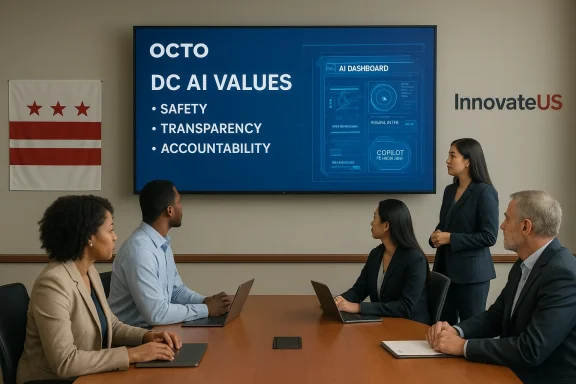
Washington’s training mandate grows directly out of Mayor’s Order 2024-028, the administration’s signature policy establishing six core DC AI Values—Clear Benefit to Residents, Safety and Equity, Accountability, Transparency, Sustainability, and Privacy & Cybersecurity. The Order, signed on February 8, 2024, set expectations for how AI should be evaluated and approved across agencies and identified workforce training as a required pillar for turning policy into practice.
The newly announced program is a no-cost, self-paced course delivered in partnership with InnovateUS and rolled out under the oversight of the Office of the Chief Technology Officer (OCTO) and the District’s AI Taskforce. All employees and contractors will be notified and expected to complete the training within 90 days of notification. The training emphasizes a humans-in-the-loop approach, clarifies when and how generative AI tools may be used in everyday work, and reinforces the District’s enterprise guardrails for approved technologies—one example being Microsoft Copilot Chat within the District’s Microsoft 365 tenancy, configured to keep data in the District domain and not to feed inputs into vendor model training.
This requirement positions Washington, D.C. as an early adopter among large U.S. municipalities that have moved beyond high-level AI policy statements toward mandatory, operational workforce upskilling tied to governance and procurement practices.
Two civic risks deserve special attention:
But the measure of success will not be a completion certificate; it will be demonstrable changes in behavior, measurable reductions in risky data exposures, enforceable vendor commitments, and transparent accountability when AI is used in public decision-making. Training is the hinge; the door opens on governance only when technical controls, procurement discipline, continuous learning, and civic transparency act together.
If the District can maintain that integrated posture—pairing mandate with measurement, education with enforcement, and innovation with auditable protections—this will be more than a symbolic first: it will be a practical roadmap other cities can adapt to govern AI in the public interest.
Source: BABL AI Washington, D.C. Becomes First Major U.S. City to Mandate Responsible AI Training for Government Workforce
 Background / Overview
Washington’s training mandate grows directly out of Mayor’s Order 2024-028, the administration’s signature policy establishing six core DC AI Values—Clear Benefit to Residents, Safety and Equity, Accountability, Transparency, Sustainability, and Privacy & Cybersecurity. The Order, signed on February 8, 2024, set expectations for how AI should be evaluated and approved across agencies and identified workforce training as a required pillar for turning policy into practice.The newly announced program is a no-cost, self-paced course delivered in partnership with InnovateUS and rolled out under the oversight of the Office of the Chief Technology Officer (OCTO) and the District’s AI Taskforce. All employees and contractors will be notified and expected to complete the training within 90 days of notification. The training emphasizes a humans-in-the-loop approach, clarifies when and how generative AI tools may be used in everyday work, and reinforces the District’s enterprise guardrails for approved technologies—one example being Microsoft Copilot Chat within the District’s Microsoft 365 tenancy, configured to keep data in the District domain and not to feed inputs into vendor model training.
This requirement positions Washington, D.C. as an early adopter among large U.S. municipalities that have moved beyond high-level AI policy statements toward mandatory, operational workforce upskilling tied to governance and procurement practices.
Why a mandatory training? The policy logic and its practical aim
The District’s approach answers three interlocking governance problems:- Public servants increasingly encounter AI tools in routine workflows. Without consistent guidance, usage will be uneven, risky, and politically fraught.
- Policy-level principles—like those in Mayor’s Order 2024-028—fail unless they are operationalized into who does what, when, and how. Training is the most direct way to translate values into behavior.
- Technical and contractual controls (approved-tool lists, procurement clauses, data-residency guarantees) are necessary but not sufficient. Human decisions—prompting, vetting outputs, deciding whether to rely on AI for a particular case—remain the proximate cause of many real-world harms and must be governed through education and accountability.
What the training covers (and what it deliberately does not)
The District’s program foregrounds practical guidance for everyday use while emphasizing accountability. Key instructional themes reportedly include:- Capabilities and limitations of generative AI — what large language models can and cannot reliably do.
- Data handling and classification — what content can never be pasted into public models, and when to use enterprise-approved tools.
- Human oversight and decision responsibility — reinforcing that AI supports but does not replace human judgment.
- Prompt safety and basic adversarial awareness — recognizing prompt injection, hallucinations, and indicators of unreliable outputs.
- Privacy, cybersecurity, and public-records implications — how AI interactions intersect with legal and records-management obligations.
Strengths: Why this is meaningful progress for municipal AI governance
There are several concrete strengths to Washington’s approach that other cities would do well to note.- Policy-to-practice alignment. The mandatory training closes a common gap between high-level AI principles and daily operations. By tying education to Mayor’s Order 2024-028’s six values and embedding the program in the AI Taskforce’s governance work, the District anchors learning in an explicit policy framework.
- Enterprise-safe tool posture. Restricting AI usage to vendor tools that meet the District’s privacy and cybersecurity standards (for example, a configured Microsoft Copilot Chat in the government tenant) reduces the most immediate data-exfiltration risks that arise from employees pasting sensitive information into arbitrary public tools.
- Inclusive delivery model. A no-cost, self-paced program available to employees and contractors lowers practical barriers to compliance and can be scaled without the friction of synchronous classroom delivery.
- Community-informed governance. The AI Values Alignment Advisory Group (AIVA) gives the public and stakeholder perspectives a seat at the table, increasing legitimacy and providing a feedback loop between community expectations and administrative practice.
- Clear deadlines and accountability. A 90-day completion window is tangible and actionable; it allows OCTO and agency leadership to measure completion and follow up with lagging units. Embedding the requirement into routine HR and contractor management workflows makes compliance operationally enforceable.
Risks and limitations: Why training alone is not the silver bullet
Training is necessary but not sufficient. There are several important limitations and risks that the District—and any government that copies this model—must manage actively.1. The performance gap: knowledge vs. behavior
Training increases awareness but does not guarantee correct or consistent behavior. People may complete modules but continue unsafe practices, especially under time pressure or without easy alternatives. Training must be paired with technological controls (DLP, scoped tokens, blocked features) and managerial oversight to close the behavior gap.2. Measurement and outcomes
A completion metric (percent trained) is easy to measure, but it is a weak proxy for impact. The District will need to define and measure outcome metrics—reduction in accidental data exposures, adoption of approved tools, incidents tied to AI misuse—to prove the program’s efficacy.3. Accessibility and equity of learning
A one-size-fits-all course risks leaving behind staff with limited digital literacy, non-native English speakers, or contractors with variable onboarding processes. Training must be available in accessible formats, with role-specific modules and accommodations, to avoid uneven protection and unequal benefits.4. Vendor reliance and procurement risk
The District’s reliance on approved commercial tools (for example, Copilot) raises vendor-risk questions: contractual guarantees about non-training of models, data residency, audit rights, and incident response must be explicit and enforceable. Technical configuration promises (keeping data in-district and out of vendor training) must be backed by contractual terms, logging, and the ability to audit vendor compliance.5. Narrow focus vs. continuous learning
Generative AI changes fast. A one-off course risks becoming stale within months. The District must plan for continuous refresher training, scenario-based tabletop exercises, and push updates tied to new threat vectors (prompt injection, agentic agents, model updates).6. Governance without enforcement fragility
A training mandate needs credible enforcement and integration with HR/contract management. If completion is merely symbolic, the policy risks becoming performative—useful for PR but ineffective operationally.What success looks like: recommended operational guardrails
A compelling municipal AI training program should be embedded inside a broader operational playbook. Here are concrete, ranked recommendations that translate policy into durable practice.- Integrate completion with HR and contractor systems
- Make training completion part of mandatory onboarding and periodic certification for roles that handle sensitive data.
- Tie contractor access to the District’s systems to proof of completion and to role-based permissions.
- Pair learning with technical enforcement
- Deploy AI-aware data-loss-prevention (DLP) rules, token scoping for model APIs, and inline inspection where legally feasible.
- Block or sandbox high-risk tools until they are assessed.
- Measure outcomes, not just completions
- Track metrics such as incidents involving AI-caused data exposure, percentage of workflows using approved tools, and reduction in off-policy AI queries.
- Run baseline time-and-motion studies for pilot teams to quantify where AI saves time or introduces new risks.
- Contractual hardening of vendor relationships
- Require non-training clauses, data-residency guarantees, signed model artifacts (model SBOM), audit rights, and timely breach notification.
- Insist on exportable logs and prompt histories for auditability.
- Role-based and accessible curricula
- Provide specialized modules for frontline staff, legal/compliance teams, procurement, and IT/security.
- Offer multilingual and low-bandwidth versions and provide assistive formats for those with disabilities.
- Red-team and tabletop exercises
- Simulate adversarial scenarios (prompt injection, hallucination-driven decisions, data-exfiltration pathways) to test human + technical controls.
- Update training content based on learnings from these exercises.
- Public transparency and reporting
- Publish periodic reports on AI use-cases, approvals, incidents, and training outcomes to maintain public trust.
- Continuous content refresh cadence
- Establish a schedule for updating training (for example, quarterly micro-updates) and maintain a short newsletter or push-notification channel to highlight new threats and controls.
How Washington’s model can scale—or not—to other cities
Washington’s population size, technology budget, and existing digital infrastructure give it advantages that smaller municipalities may lack. Yet the model offers replicable structural lessons:- A clear policy foundation (six values or similar) gives training ethical anchoring.
- Centralized oversight (an AI Taskforce under a CTO-like office) provides coordination and procurement leverage.
- Partnerships with experienced public-sector learning providers (e.g., InnovateUS-style organizations) help tailor content to government realities.
- Regional shared-service agreements for training procurement and tool vetting.
- Tiered training requirements—basic for all staff, advanced for high-risk roles.
- Lightweight technical controls and configuration templates for commonly used SaaS copilots.
The political and civic dimension: trust, transparency, and scrutiny
Cities deploy AI inside a legal and political context distinct from private-sector settings. Public trust depends not just on technical safeguards but on transparent governance and mechanisms for redress. The District’s AIVA advisory group is a constructive step: community input must map into the approvals process, public reporting, and mechanisms for residents to challenge or inquire about AI-driven decisions that affect them.Two civic risks deserve special attention:
- Public-records and freedom-of-information tensions. Interactions with AI tools—prompts, outputs, decision logs—may be subject to public-records requests. Agencies must create retention and redaction policies that respect transparency without exposing sensitive information.
- Accountability in human-in-the-loop models. When AI supports decision-making, agencies must be able to show who reviewed, approved, or overruled AI suggestions. Audit trails must tie outputs to accountable humans and explain why AI outputs were accepted or rejected.
A realistic timeline and what to watch next
The District has framed the training rollout to scale quickly: notification followed by a 90-day completion window. The near-term milestones to watch are:- Completion rates across agencies and contractor categories.
- First public reporting on outcome metrics: incidents, tool adoption patterns, and procurement changes.
- Contractual disclosures from vendors chosen as approved tools—do contracts include non-training clauses, audit rights, and explicit data-residency terms?
- Evidence of technical controls being deployed in parallel: AI-aware DLP rules, token scoping, and SIEM instrumentation for Copilot interactions.
- Any reported operational friction—productivity claims vs. real-world staff experiences—and how agencies balance safety with efficiency.
What this means for public-sector IT leaders and policymakers
Washington’s decision is a practical blueprint for translating AI policy into operational practice. For IT leaders and policymakers elsewhere, the key takeaways are:- Treat training as part of a layered defense—not the entire defense. Human literacy, technical controls, contractual terms, and governance must operate in concert.
- Define measurable outcomes and instrument them from day one.
- Use procurement as a governance lever: insist on auditable commitments from vendors and make approvals contingent on verifiable technical and contractual safeguards.
- Design training to be role-specific, accessible, and continuously updated.
- Engage the public early. Advisory groups and published reports build trust and pre-empt backlash when incidents inevitably occur.
Conclusion
Washington, D.C.’s mandate for responsible AI training is a consequential step—one that moves municipal AI governance from principle into practice. It recognizes that workforce readiness is a foundational element of safe AI adoption and that a human-centered approach to oversight must be taught, measured, and enforced.But the measure of success will not be a completion certificate; it will be demonstrable changes in behavior, measurable reductions in risky data exposures, enforceable vendor commitments, and transparent accountability when AI is used in public decision-making. Training is the hinge; the door opens on governance only when technical controls, procurement discipline, continuous learning, and civic transparency act together.
If the District can maintain that integrated posture—pairing mandate with measurement, education with enforcement, and innovation with auditable protections—this will be more than a symbolic first: it will be a practical roadmap other cities can adapt to govern AI in the public interest.
Source: BABL AI Washington, D.C. Becomes First Major U.S. City to Mandate Responsible AI Training for Government Workforce
