

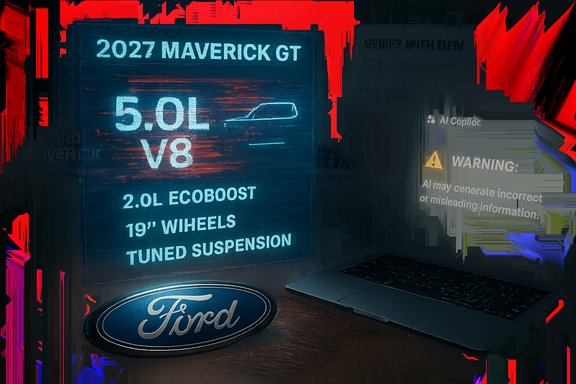
Unsuspecting Blue Oval fans who typed “2027 Ford Maverick GT” into a search box and found page-after-page of confident-sounding specifics were served something far less solid than they thought: an AI‑generated fabrication that stitched together real Ford model names, engine families, and wishful engineering into a convincingly detailed — but entirely imaginary — vehicle. The rumor, amplified by a Microsoft Copilot response and called out by Ford Authority in a November 15, 2025 piece, claimed a Mustang‑style “GT” version of the compact Maverick with a 5.0L Coyote V8, a lighter but stiffer chassis, and bespoke styling. None of that exists in Ford’s roadmap, and the underlying technical and product realities make the manufactured story highly implausible.
Background / Overview
The Ford Maverick arrived as an affordable, unibody compact pickup positioned between passenger cars and midsize trucks. It’s built on Ford’s C2 platform — the same architecture that underpins the Escape and Bronco Sport — and in its real, marketed configurations the Maverick offers a 2.5L hybrid system and a 2.0L EcoBoost turbo four as the performance option. Those are the production powertrains customers and dealers can order today; nothing in Ford’s official materials or major automotive press reporting supports a factory 5.0L V8 Maverick. In late‑model refreshes and the 2025 lineup, Ford also introduced a performance‑focused Maverick called Lobo — a genuine, factory‑backed trim that emphasizes sharper handling, tuned suspension, a more aggressive look, and the 2.0L EcoBoost as its heart. The Lobo demonstrates Ford’s market approach to giving Maverick a “fun” variant without up‑powering it to full‑size pickup levels. That fact is central to sorting fantasy from reality: there is a performance Maverick in the product catalog, and it looks and behaves like a compact, turbocharged street truck — not a shrunken Mustang GT.How the “2027 Maverick GT” Rumor Spread (and Why AI Was the Vector)
The anatomy of the fake rumor
- An AI assistant (Microsoft Copilot in the example cited by Ford Authority) was prompted or queried about a “2027 Ford Maverick GT.”
- The assistant acknowledged there was no official Ford announcement — then proceeded to generate a detailed spec sheet anyway, describing a 5.0L Coyote V8 option, a lighter but stiffer chassis, a longer wheelbase, and unique styling cues.
- The output combined legitimate Ford product language (Maverick, EcoBoost, Coyote, “GT” branding) with invented engineering claims and quantified changes (e.g., “shaves off 100 pounds”) that were not supported by any primary source.
Why generative assistants produce this kind of output
Generative AI assistants are designed to produce plausible, contextually appropriate responses. When asked about something that doesn’t exist, they often synthesize a “best guess” by blending patterns from similar concepts found during training. In practice, this leads to “hallucinations” — confident‑looking but false claims — especially when a user’s prompt is open‑ended or taps into a widely desired product variant (a compact pickup with a V8, for example). Independent reporting has repeatedly shown Microsoft Copilot and other copilots can hallucinate dates, quotations, facts, and even whole legal cases; the problem is well documented and remains an active area of mitigation.Fact‑checking the key claims in the AI output
Claim: Maverick will have a 5.0L Coyote V8 option
This is the headline generator — and the easiest claim to disprove. The 5.0L Coyote V8 is a large, longitudinal V8 used by Ford in rear‑drive platforms such as the Mustang and in certain F‑Series derivatives. The Maverick is built on a transverse‑engine C2 unibody platform that supports compact I4 and hybrid layouts; it uses transverse engine mounting and is engineered around much smaller packaging envelopes. Converting the Maverick to accept a longitudinal 5.0L would require an entirely new architecture or an aftermarket, heavy‑structural rework that Ford has not announced. In short: a factory 5.0 Coyote in a Maverick is not consistent with platform engineering or current product planning.Claim: The GT will still offer the 2.5L hybrid and the turbo 2.0L EcoBoost
This part of the AI response borrows from reality. The Maverick’s production lineup currently consists of:- Standard 2.5L hybrid (FWD standard; AWD available in some trims),
- Optional 2.0L EcoBoost turbocharged four (available with AWD on performance trims),
and the Lobo trim builds on the 2.0L EcoBoost to deliver sport‑oriented behavior. Those are documented on Ford’s site and corroborated by contemporary reviews. What’s false is the simultaneous inclusion of a 5.0L V8 alongside these existing options in a factory roadmap — the three‑engine lineup the assistant described is inconsistent with platform limits and Ford’s public specifications.
Claim: Lighter chassis, 100‑pound reduction, longer wheelbase, and added torsional rigidity
These are the precise kinds of technical details generative models invent when trying to sound authoritative. Weight, torsional rigidity, and wheelbase are measurable engineering attributes that reflect whole‑car architecture decisions. A claim of “100 pounds lighter” while adding a longer wheelbase and a V8 contradicts basic physics and packaging tradeoffs: adding a physically larger engine and strengthening structures to handle greater torque typically increases mass, not reduces it. Any meaningful chassis redesign to alter wheelbase or rigidity would be announced as an architectural change, with supplier contracts, safety testing, and press releases to match — none of which exist.The Lobo — the real “performance” Maverick
Rather than a mythical “Maverick GT,” Ford’s production response to customers wanting a sportier Maverick is the Maverick Lobo. Lobo is an official performance‑oriented trim that retains the 2.0L EcoBoost turbo four while adding:- Performance‑tuned springs and dampers,
- A twin‑clutch torque‑vectoring rear unit for sharper handling,
- Upgraded brakes and cooling hardware,
- Unique trim, 19‑inch wheels, and a distinctive interior treatment,
- A performance “Lobo” drive mode that reconfigures shift logic, throttle, and handling characteristics for aggressive driving.
Independent tests and early reviews show the Lobo gives the Maverick genuine sporty credentials in the compact‑truck segment — and it does so without pretending to be a V8 sports car. If you want a compact Ford truck with verifiable factory performance upgrades, Lobo is the legitimate choice.
A technical reality check: why a 5.0 Coyote V8 is functionally impractical in a Maverick
- Engine architecture and orientation
- The Maverick (C2 platform) is designed around transverse engine layouts for compact I4 and hybrid systems. The Coyote V8 in its factory installs is oriented longitudinally; fitting it into a transverse bay would require a bespoke engine rotation/positioning, custom subframe, and major firewall and crash‑structure redesign. That’s essentially a new vehicle program, not a trim upgrade.
- Packaging and weight balance
- A Coyote V8 is physically larger and heavier than the turbo I4s the Maverick is engineered for. Adding it would require re‑engineering suspension rates, brakes, steering, and cooling systems — and would degrade the packaging that makes the Maverick compact and city‑friendly. Claims that a V8 Maverick would be lighter than a regular model are mechanically inconsistent.
- Transmissions, drivetrain, and warranty
- The transmissions and driveline hardware compatible with the Coyote V8 (e.g., Mustang‑grade transmissions and rear‑drive differentials) are not plug‑and‑play with the Maverick’s transverse AWD/torque‑vectoring architecture. Supporting a V8 would require a robust powertrain integration project, new suppliers, and warranty implications that manufacturers typically don’t pursue in a single trim.
- Regulatory and crash-safety validation
- Any structural changes large enough to accommodate a different engine layout trigger extensive crash testing and homologation. That testing is visible in regulatory filings, safety agency databases, and OEM program documents — none of which point to a planned V8 Maverick. The absence of such indicators is a practical red flag.
Why the rumor matters: risks of AI‑driven misinformation for car shoppers and brands
- Consumer confusion: Shoppers might delay purchases or place faith in features that won’t exist, altering buying behavior on false premises.
- Dealer headaches: Dealership staff receive questions and leads based on nonexistent models; correcting expectations becomes routine and time‑consuming.
- Brand dilution: OEMs invest in carefully staged product launches. AI‑manufactured rumors can create reputational noise that dilutes the impact of real product announcements.
- Secondary market distortions: Pricing expectations and trade‑in values can be affected by viral rumors, especially if those rumors imply rare or sought‑after performance packages.
The Ford Authority piece is a useful example of how a single conveniently detailed AI answer can ripple outward and look like credible intelligence to casual readers; it’s a cautionary tale for all automotive journalists and buyers.
How to verify car rumors — a concise checklist for buyers and enthusiasts
- Check the OEM first: Visit the official Ford model pages and corporate press release center for announced trims and specifications. Manufacturer pages are the authority for what’s actually for sale.
- Look for multiple independent confirmations: Reputable outlets (Car and Driver, MotorTrend, Autoweek, etc. typically corroborate major product changes before treating them as fact.
- Watch regulatory filings: Vehicle certifications, VIN ranges, or homologation entries often show up months before production changes. These are primary evidence of structural program changes.
- Scrutinize the details: If a rumor mixes incompatible technical claims (e.g., “adds a V8 but cuts 100 pounds”), treat it skeptically and demand independent validation.
- Ask the dealer — carefully: Dealers can confirm factory order guides and availability, but they may not know corporate plans beyond published materials.
- Treat single AI outputs as tips, not facts: Use AI answers for hypothesis generation, then verify against primary sources. Public coverage of AI “hallucinations” makes clear that assistants sometimes prioritize plausibility over accuracy.
Editorial analysis: the strengths and risks of AI in automotive reporting
Notable strengths
- Speed and synthesis: AI assistants can quickly summarize disparate press releases, interview transcripts, and forum chatter into a single narrative — a valuable tool for initial research and trend spotting.
- Idea generation: For creative exercises (designing hypothetical trims, imagining aftermarket conversions), AI can be a helpful brainstorming partner that speeds up ideation.
- Accessibility: Casual users can test “what‑if” scenarios — for example, how a hypothetical Maverick GT might be positioned relative to existing Ford products.
Significant risks
- Hallucination and fabrication: AI systems often produce plausible but false specifics. When a false claim involves a brand and a vehicle people care about, the result is a believable rumor that can spread quickly.
- False authority: Because generative assistants use fluent, authoritative language, readers may treat fabricated outputs as vetted facts unless they check sources.
- Amplification loops: AI outputs can be scraped by search engines and re‑indexed, creating the illusion of corroboration. That’s the precise pattern Ford Authority identified when “punching the phrase” into a search engine and receiving fabricated summaries that referenced the nonexistent GT.
Practical takeaways for WindowsForum readers and car buyers
- If it sounds too neat — like a compact truck magically swapping in a full‑sized 5.0‑liter V8 without architectural changes — it probably is. Apply engineering common sense before accepting a detailed AI reply as fact.
- When AI reports unfamiliar but specific specs, treat the output as a lead to verify, not a finished story. Cross‑check with the OEM and two independent reputable outlets before treating the detail as confirmed.
- Remember the real, factory performance Maverick: Lobo. If you’re shopping for a street‑tuned compact truck backed by Ford’s production program, Lobo is the verifiable option, and early reviews and official spec pages outline what it delivers on the road and track.
Closing analysis: why this episode matters beyond one fake trim
The 2027 Maverick GT “scoop” is more than a meme‑worthy mistake; it’s a clear demonstration of where generative AI excels and where it fails. Models are excellent at producing fluent, contextually matched narratives — including vehicle spec sheets — but they do not possess source‑level verification by default. The result is plausible fiction: the perfect format for a social rumor.For the auto industry, journalists, and enthusiasts, the lesson is twofold. First, embrace the productivity boost AI can provide for research and drafting. Second, institutionalize verification: every technical claim, every engine swap, and every chassis redesign must be validated with primary OEM materials or corroborated reporting before circulation. When you see a high‑confidence claim about a vehicle that would require structural rework, think like an engineer — ask how it would be packaged, what safety testing would be required, and which parts suppliers would be impacted. Those pragmatic questions are far more revealing than any single AI generated paragraph.
In the case of the Maverick, the real story is compelling enough: a widely accessible compact pickup with hybrid efficiency, optional AWD, and a bona fide factory performance trim in Lobo. That genuine narrative should remain the focal point — and it’s one buyers can act on today.
Practical verification checklist (single line)
- Check Ford’s official Maverick pages, confirm engine options and trims; consult major outlets (Car and Driver, MotorTrend, Autoweek) before acting on social or AI‑driven rumors.
Source: Ford Authority Clankers Believe 2027 Ford Maverick GT Rumors: AI Slop Report
