

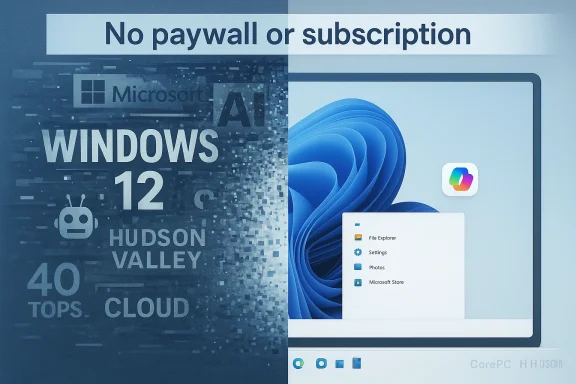
Microsoft isn’t shipping a subscription‑only, AI‑first “Windows 12” in 2026 — and the viral story that it is has all the hallmarks of a modern internet hallucination: recycled past leaks, misunderstood internal strings, and automated content engines feeding on one another until rumor passed for fact.
The past two years have produced an unusual mixture of real engineering work inside Microsoft and persistent, self‑reinforcing rumor cycles outside it. On the engineering side there are legitimate projects, internal codenames, and experimentations — names like Hudson Valley, concepts such as CorePC, and corporate shifts in leadership and platform strategy that seeded public speculation. On the rumor side, a wave of short, copy‑heavy articles and AI‑generated pages, amplified by social media and forum threads, assembled those fragments into a single, dramatic narrative: Windows 12 arriving in 2026, built from the ground up around on‑device AI, gated behind subscription meters and demanding new dedicated NPUs measured in tens of TOPS.
That narrative sounds plausible at first glance because it lines up with two big trends: Microsoft’s visible AI push and an industry move toward subscription business models. But plausibility is not proof. The available public evidence does not support the claim that Microsoft will launch a subscription‑based Windows 12 in 2026, and many of the core assertions powering the headlines are either outdated, misinterpreted, or unverified.
Put simply: Microsoft already sells subscriptions tied to Windows in specific contexts. That does not mean every PC buyer will be required to pay a monthly fee to boot the desktop.
The real work ahead for Microsoft is not the marketing spectacle of a new major version number. It is regaining trust by shipping dependable, transparent improvements to the Windows millions of people depend on every day.
Microsoft’s next big public move on the Windows front may still surprise us — but we should judge announcements by verifiable documentation, not by the momentum of recycled leaks and AI echo chambers. Until Microsoft says otherwise, the responsible assumption is simple: Windows 11 remains the platform to be fixed and improved; wild claims of a subscription‑only Windows 12 in 2026 are, at best, premature and, at worst, modern internet hallucinations.
Source: Windows Latest Microsoft isn’t launching a subscription-based Windows 12 AI OS in 2026. The rumors are just AI hallucinations.
 Background
The past two years have produced an unusual mixture of real engineering work inside Microsoft and persistent, self‑reinforcing rumor cycles outside it. On the engineering side there are legitimate projects, internal codenames, and experimentations — names like Hudson Valley, concepts such as CorePC, and corporate shifts in leadership and platform strategy that seeded public speculation. On the rumor side, a wave of short, copy‑heavy articles and AI‑generated pages, amplified by social media and forum threads, assembled those fragments into a single, dramatic narrative: Windows 12 arriving in 2026, built from the ground up around on‑device AI, gated behind subscription meters and demanding new dedicated NPUs measured in tens of TOPS.That narrative sounds plausible at first glance because it lines up with two big trends: Microsoft’s visible AI push and an industry move toward subscription business models. But plausibility is not proof. The available public evidence does not support the claim that Microsoft will launch a subscription‑based Windows 12 in 2026, and many of the core assertions powering the headlines are either outdated, misinterpreted, or unverified.
What actually happened — a concise summary
- Hudson Valley has been used as an internal codename in Microsoft’s Windows roadmap, but it has been associated with large Windows 11 feature releases (not a guaranteed product called “Windows 12”). What the codename labeled in earlier reporting largely maps to the Windows 11 24H2 family and related platform work rather than a clean‑slate OS shipping immediately to consumers.
- CorePC is a recurring engineering concept — a modular, state‑separated platform idea that echoes earlier Microsoft experiments — that has appeared in reporting and insider chatter for years. It’s a concept and internal project, not a published product roadmap for consumers.
- The more sensational claims — a subscription‑only consumer OS, a 2026 launch, and hardware gating requiring a minimum 40 TOPS NPU for core functionality — are not supported by verifiable Microsoft documentation or official public roadmaps. Those points should be treated as unverified rumor or speculation, not established fact.
- Microsoft’s short‑term public focus remains on stabilizing and improving Windows 11 — including platform updates for ARM devices and targeted feature/enhancement releases — rather than a full consumer OS reboot in 2026.
How the rumor formed and why it spread so fast
The anatomy of a modern tech rumor
Three dynamics combined to turn isolated fragments into a widely believed story:- Fragmentation of facts: Microsoft uses internal codenames, feature prototypes, and separate teams exploring different architectures. Pieces of that work leak or are reported, but they don’t always belong together.
- Echo chambers of coverage: Thinly edited summaries, automated content farms, and AI‑assisted rewriting amplify the most sensational interpretations and then cite each other, creating the illusion of corroboration.
- Social amplification and confirmation bias: Users who are already worried about Microsoft’s direction, or who have a general skepticism of big tech, amplified the story on social networks and enthusiast forums where outrage drives engagement.
Why AI systems helped the rumor propagate
Modern language models and automated content systems are trained on the public web and tend to prioritize patterns that appear multiple times. When the same claim — even if poorly sourced — is repeated across dozens of low‑quality posts, automated tools treat it as stronger evidence. That multiplies reach: once the claim is visible enough, it gets re‑quoted in articles, reposted to Reddit and X, and then fed back into the models that created the first round of content. The result is a loop: rumor begets more rumor, and credibility is a mirage.Which claims are grounded in evidence — and which are not
What’s real and verifiable
- Windows 11 has iterative major updates and codenames. Microsoft’s release rhythm has included named updates and internal codenames. Large feature updates have appeared under names that later surface in public materials. Engineers and press insiders have legitimately discussed names like Hudson Valley in relation to Windows 11 platform updates and build experimentation.
- CorePC is a recurring engineering concept. The idea of a modular, state‑separated Windows variant—sometimes discussed under names that recall Windows Core OS, 10X, or new modular approaches—has circulated in industry reporting for years. Engineers and journalists have repeatedly described the concept as an attempt to make updates faster, harden security via state separation, and scale Windows across device types.
- Microsoft has been emphasizing AI features and Copilot. Microsoft’s Copilot investments, Copilot+ branded experiences, and experimental features that collect more contextual data have been public and controversial. Some features prompted security and privacy questions, and Microsoft has adjusted availability for certain capabilities following feedback.
What is not substantiated
- A subscription‑only consumer Windows 12 launching in 2026. There is no public product announcement, no developer preview channel clearly labeled as a paid, subscription‑gated consumer OS, nor a Microsoft statement putting a consumer subscription model in place in that timeframe. Internal strings and licensing flags sometimes referenced in leaks are better explained as work on cloud‑based SKUs, enterprise subscription licensing, or experiments — not an imminent, universal switch to pay‑to‑use Windows for consumers.
- A hard hardware gate at “40 TOPS NPU” for core OS functionality. A specific, public Microsoft requirement mandating a minimum 40 TOPS neural processing performance for running the OS is not demonstrably documented in official guidance. Hardware‑gating of advanced optional on‑device AI features is plausible as a product decision, but treating a leaked number as a shipping requirement for general consumers is premature and unverifiable.
- A full‑blown Windows 12 release event in 2026. The company’s near‑term, public priorities—improving Windows 11 stability, expanding ARM support, and refining Copilot experiences—make a major consumer OS re‑launch in 2026 unlikely based on current public signals and insider reporting.
Timeline and context: how Microsoft’s past decisions seeded expectations
From Core OS to CorePC to Hudson Valley
Microsoft’s history of platform experiments is long and messy. Over the past decade the company explored projects with names like Windows Core OS, Windows 10X, and other modular concepts designed to create lightweight or state‑separated Windows derivatives. Many of those initiatives were reorganized, merged into other work, or shelved.- Engineering prototypes and leaked design concepts from 2022–2024 occasionally resurfaced in reporting and made their way into the broader narrative about a “new Windows.” Those prototypes featured UI experiments — floating taskbars, top‑center search bars, and other interface sketches — that were legitimate internal explorations but were never committed to as mass‑market shipping interfaces for all users.
- The codename Hudson Valley appeared in various reporting cycles tied to large Windows 11 updates and roadmap work. In practice, names and project labels moved around as priorities changed, and a codename does not equal an announced product.
Leadership changes and shifting priorities
Corporate leadership and strategy shifts also contributed to confusion. High‑profile departures and reorganizations affect how roadmaps get prioritized and communicated. When prominent product leaders move on, earlier plans can be reshaped or shelved, leaving behind traces in documentation that are sometimes misread as imminent product plans.Technical claim check: what “40 TOPS NPU” would mean — and why the number is suspect
The claim that a future Windows would require a dedicated NPU capable of at least 40 trillion operations per second (TOPS) for AI features to work is a vivid, attention‑grabbing detail. But technical claims like this deserve careful scrutiny.- TOPS is a measurement of raw neural‑network throughput and is meaningful when discussing device NPUs. Some modern mobile and PC silicon do include NPUs rated in the low to mid tens of TOPS for on‑device inference, and vendors increasingly advertise these numbers.
- However, an OS‑level hardware requirement expressed as a specific TOPS threshold is unusual. Operating systems normally define platform capabilities in broader terms (supported silicon families, feature flags, optional acceleration). A hard numeric gate that would block all standard functionality for users without that specific NPU performance would be an aggressive, disruptive decision and would require Microsoft to publish clear minimum system requirements and provide migration paths.
- The likely reality: Microsoft can and does design features that benefit from on‑device acceleration, and OEMs/vendors will differentiate premium Copilot/AI experiences using hardware. But converting a leaked performance figure into a mandatory consumer requirement is a leap that the public record does not support.
Why the subscription angle keeps resurfacing — and what it actually looks like today
There is a valid historical foundation for consumers worrying about a subscription Windows: Microsoft has aggressively adopted subscription models in productivity and cloud services, and the company already offers:- Windows 365 — a subscription virtual Cloud PC product targeted at businesses.
- Microsoft 365 and Office subscriptions — which tether access to productivity apps to recurring billing.
- Enterprise and OEM licensing models that sometimes include cloud‑based activation flows and subscription SKUs.
Put simply: Microsoft already sells subscriptions tied to Windows in specific contexts. That does not mean every PC buyer will be required to pay a monthly fee to boot the desktop.
The real story: Microsoft’s immediate priorities and the likely roadmap
Public signals — from Microsoft statements, insider reporting, and observed builds — point to a few practical priorities that make a full Windows 12 consumer launch in 2026 unlikely:- Stabilize and improve Windows 11. Engineering focus is on performance, reliability, and addressing widely reported issues. The company needs to fix the product many people are already using before asking users to move to a new major release.
- Targeted platform work for ARM and new silicon. There are platform enablement releases aimed at devices using the latest ARM chips; some updates are distributed outside the normal H2 cycle to align with silicon launches.
- Incremental AI experiences, with optional hardware‑accelerated features. Microsoft is expanding Copilot experiences and experimenting with on‑device AI acceleration, but these are being positioned as value‑add features — not as binary gates preventing ordinary operation.
- Annual Windows 11 feature releases continue. The company appears to be maintaining a cadence of major Windows 11 updates (H2 releases) with targeted earlier releases (H1 or enablement packages) for device‑specific platform needs.
The damage of rumor: trust, upgrade anxiety, and market consequences
Rumors about a subscription‑only, hardware‑gated Windows 12 do damage even when they are false:- Erodes trust. Users already skeptical of Microsoft’s priorities — convinced the company favors cloud and paid services over consumer choice — have those fears reinforced when sensational rumors circulate unchecked.
- Causes upgrade hesitation or panic. Consumers and IT administrators may delay purchases or plan costly upgrades based on an imagined hardware requirement, which disrupts OEM sales cycles and enterprise procurement.
- Amplifies misinformation loops. Forums and social platforms that prefer quick confirmation over rigorous sourcing can turn unverified claims into recycled “facts,” harming public discourse and making real technical decisions harder to communicate.
How to evaluate future Windows rumors (a practical checklist)
If you see another breathless headline about Windows 12 being a subscription AI OS, run the claim through these steps before accepting it:- Look for official Microsoft confirmation — company blog posts, support documentation, or recorded public statements by product leads.
- Check primary reporting from established outlets that have direct, named sources inside Microsoft or documented artifacts (not anonymous aggregator pages).
- Distinguish between:
- Internal codenames used for research and engineering work,
- Enterprise SKUs and cloud services (Windows 365),
- And an official consumer product announcement.
- Treat single‑number hardware claims (TOPS, specific NPU thresholds) as unverified until Microsoft publishes system requirements.
- Be wary of stories that rely heavily on social posts, AI‑generated content, or circular citations where each source points back to one another.
What Microsoft should do next (and why it matters)
From a product and trust perspective, Microsoft faces a straightforward challenge: rebuild credibility around Windows by delivering measurable improvements to the installed base.- Prioritize reliability and performance fixes that directly affect the majority of users, especially gaming performance and driver reliability.
- Be transparent about AI feature tiers: clearly label what is optional, what is on‑device vs cloud processing, and what hardware benefits provide.
- Communicate licensing and subscription changes plainly and early, with clear migration paths and options for consumers who prefer perpetual licensing.
- Work with OEM and enterprise partners to create clear, vendor‑backed guidance on device compatibility and upgrade timelines.
What users and IT admins should do now
- Don’t rush to upgrade or buy new hardware based on unverified headlines. Base decisions on official Microsoft minimum requirements and vendor‑published compatibility lists.
- For IT administrators: continue to evaluate Windows updates in test rings and follow official Windows release health dashboards rather than social commentary.
- For consumers: if a specific app, game, or workflow is critical, validate compatibility with publishers or OEM support before swapping hardware.
- If you’re privacy‑minded, examine the opt‑in/opt‑out settings for emerging AI features and look for explicit controls before enabling new memory‑like capabilities.
Critical analysis: strengths, risks, and a final verdict
Strengths of the underlying engineering direction
- Moving toward modularity and state separation is technically sensible. It can reduce update complexity, improve security, and create lighter‑weight SKUs for constrained devices.
- Investing in on‑device AI acceleration will unlock low‑latency features that improve user experience and privacy (by avoiding cloud round trips).
- Cloud and subscription offerings give Microsoft predictable revenue to invest in platform upgrades and long‑term R&D.
Risks and weaknesses
- Poor communication compounds mistrust. Even well‑intentioned platform experiments look like corporate opportunism when they’re poorly explained.
- Hardware gating of core UX features risks fragmenting the platform and alienating users who can’t or won’t upgrade.
- Subscription creep is a legitimate consumer anxiety: without clear boundaries and fair migration options, Microsoft risks pushing users toward alternatives.
Final verdict
The dramatic headline — a subscription, AI‑first Windows 12 required for basic use in 2026 — does not stand up to careful scrutiny. What’s far more likely is a continued, incremental evolution of Windows 11, with modular experiments and hardware‑accelerated AI features rolled out in tiers. Those tiers may be packaged as premium experiences tied to newer silicon in partnership with OEMs, but that is not the same as making the desktop unusable unless you pay a monthly fee or own a 40 TOPS NPU today.The real work ahead for Microsoft is not the marketing spectacle of a new major version number. It is regaining trust by shipping dependable, transparent improvements to the Windows millions of people depend on every day.
Microsoft’s next big public move on the Windows front may still surprise us — but we should judge announcements by verifiable documentation, not by the momentum of recycled leaks and AI echo chambers. Until Microsoft says otherwise, the responsible assumption is simple: Windows 11 remains the platform to be fixed and improved; wild claims of a subscription‑only Windows 12 in 2026 are, at best, premature and, at worst, modern internet hallucinations.
Source: Windows Latest Microsoft isn’t launching a subscription-based Windows 12 AI OS in 2026. The rumors are just AI hallucinations.
