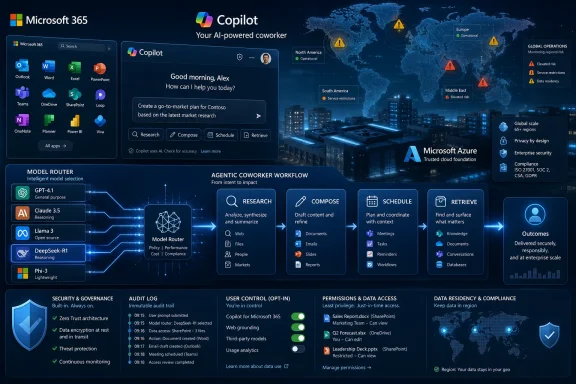
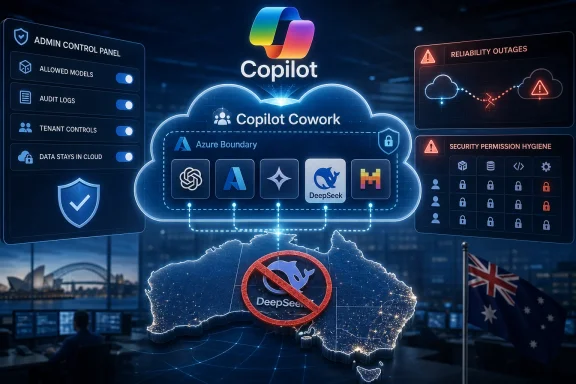
Microsoft is considering an Azure-hosted DeepSeek model as a cheaper option for its Copilot Cowork enterprise agent, a June 2026 move that collides with Australia’s government ban on DeepSeek and arrives after repeated Copilot reliability, security, and adoption concerns. The company’s pitch is that customer data would remain inside Microsoft’s cloud, with the model optional and wrapped in enterprise controls. The harder sell is that Microsoft now wants customers to trust yet another layer of AI abstraction at precisely the moment many IT departments are asking whether Copilot has become too large, too expensive, and too deeply embedded to govern cleanly. For Australian organizations, the issue is no longer whether AI belongs in the productivity stack; it is whether Microsoft’s model marketplace can be reconciled with national-security policy, procurement reality, and basic operational discipline.
Microsoft has spent the last three years trying to make Copilot feel inevitable. It is in Windows, it is in Microsoft 365, it is in Teams, it is in Edge, it is in Azure, and it is increasingly treated not as an optional assistant but as the new skin over Microsoft’s entire software estate. That is a bold platform strategy, but it also creates a new kind of dependency: when Copilot breaks, irritates users, or raises security questions, the blast radius is not confined to a chatbot tab.
That is why the DeepSeek report matters. On paper, Microsoft can argue that a hosted Chinese model inside Azure is not the same thing as employees pasting corporate secrets into a public DeepSeek app. In practice, the distinction will be harder to explain to boards, regulators, and security teams that have already been told DeepSeek is too risky for government systems.
Microsoft is not merely adding a model. It is testing whether the enterprise cloud can launder geopolitical risk into an acceptable procurement line item. The answer may vary by country, sector, and regulator, but in Australia the timing could hardly be worse.
The company’s broader problem is that Copilot’s value proposition has not matured as fast as its distribution. The more Microsoft embeds AI into the operating system and productivity suite, the more it inherits the standards customers apply to identity, email, documents, compliance, and endpoint management. A flaky chatbot is an annoyance. A flaky AI layer attached to the office workflow is an operational risk.
The result is a gap between Microsoft’s AI narrative and enterprise reality. Many organizations are still trying to determine which employees should have Copilot licenses, which data sources should be exposed to it, and whether their permission hygiene is good enough for an assistant that can summarize what users technically have access to but may never have manually discovered. That is not a philosophical objection to AI. It is a practical objection to deploying AI across messy document estates.
Australian businesses are not unique in this respect, but they are unusually exposed to the compliance angle. Privacy obligations, critical-infrastructure rules, and public-sector procurement restrictions make “optional” features less optional when they appear inside platforms that already dominate corporate life. Once a capability is present in Microsoft 365 or Azure, security teams must prove it is controlled, blocked, logged, or contractually addressed.
That is the quiet cost of Microsoft’s bundling strategy. It may increase availability, but it also turns product adoption into a governance chore. Even customers that do not want a feature must spend time understanding whether it is enabled, where it appears, how it is billed, and which policies suppress it.
Microsoft has a long history of running globally resilient cloud infrastructure, and no serious buyer expects zero incidents. But AI assistants introduce a different expectation problem. They are marketed as always-available colleagues, task runners, and agents that can act across applications. When those agents go dark, the failure feels less like a missing feature and more like an unreliable dependency.
This is where Copilot’s ambition becomes a liability. The more Microsoft describes Copilot as an agentic operating layer, the less convincing it is to treat outages as ordinary app downtime. If the assistant is supposed to mediate search, meetings, documents, workflows, and developer tasks, then its availability belongs in the same conversation as identity, email, and collaboration uptime.
Administrators have noticed. They are not just asking whether Copilot is useful; they are asking whether Microsoft provides the operational transparency, controls, and service guarantees that match the role it wants Copilot to play. AI features that live at the edge of a product can be forgiven for occasional instability. AI features that sit in the middle of the workday cannot.
Usage-based pricing for Copilot Cowork reflects that reality. If enterprise agents are going to run long tasks, Microsoft must either absorb unpredictable infrastructure costs or pass more of that volatility to customers. Cheaper model options are therefore not a side issue; they are central to making the economics of workplace agents tolerable.
DeepSeek is attractive for exactly that reason. Chinese AI labs have put enormous pressure on the economics of frontier AI by claiming strong performance at lower cost. Even if some benchmark claims remain disputed or context-dependent, the competitive signal is obvious: Western AI providers can no longer assume customers will pay premium prices indefinitely for every workload.
But the cheapest model is not necessarily the deployable model. In Australia, DeepSeek is already politically and administratively radioactive because federal authorities banned it from government systems and devices over security concerns. That does not automatically prohibit every private-sector use of a Microsoft-hosted variant, but it changes the burden of proof.
Microsoft’s argument will be that Azure hosting changes the risk profile. Data would not flow to the public DeepSeek service, enterprise controls would apply, and customers could choose whether to enable the model. That may be technically meaningful. It may also be insufficient for organizations whose policies do not distinguish neatly between a Chinese model accessed directly and a Chinese model mediated by a US cloud provider.
That is the dilemma for Australian CIOs. If Microsoft offers DeepSeek as a selectable model inside Azure or Copilot Cowork, a blocklist aimed at consumer apps will not be enough. Administrators will need policy controls that identify which model served which task, where the data was processed, how prompts were retained, whether outputs were logged, and how to prove that prohibited models were never invoked.
The distinction between “available” and “enabled” will become critical. Microsoft can say DeepSeek is optional, but enterprise security teams will ask whether optional means disabled by default, excluded from regulated tenants, visible in audit logs, and controllable through existing administrative policy. If the answer requires manual review of new AI settings across multiple portals, Microsoft will have repeated an old mistake: shipping first and leaving governance to catch up.
The public sector will be especially cautious. Agencies cannot afford a procurement argument that sounds clever in Redmond but fails in Canberra. If a model family is banned on national-security grounds, using it through an Azure wrapper may look less like compliance and more like semantic evasion.
Private companies face their own version of the same problem. Banks, telcos, retailers, and critical-infrastructure operators do not need a formal government prohibition to conclude that the reputational risk is too high. For them, the question is not only “Is this secure?” It is “Can we defend this decision after an incident?”
In theory, that is sensible. In practice, many enterprise tenants are full of stale groups, overbroad SharePoint permissions, legacy file shares, abandoned Teams, and documents that were never classified properly. Copilot does not need to break access controls to create a problem. It can make existing access sprawl more visible, searchable, and consequential.
Recent reporting on Copilot exploit chains has made that concern sharper. Researchers have described ways attackers could manipulate Copilot-assisted search and retrieval flows to expose sensitive information or push users toward exfiltration paths. Microsoft can patch specific vulnerabilities, but the larger issue is structural: generative AI turns search, summarization, and action into a single workflow, and that workflow is only as safe as the identity and data controls underneath it.
This is why Microsoft’s “enterprise boundary” language can sound both reassuring and incomplete. Boundaries matter. So do logs, data residency, encryption, and compliance commitments. But the most common enterprise failure modes are not exotic espionage plots; they are misconfigured permissions, rushed deployments, unclear ownership, and executives assuming a product is safe because it came bundled with the suite.
The DeepSeek proposal lands on top of that unresolved foundation. If organizations are already uneasy about Copilot summarizing internal data through Western models, adding a Chinese-origin model to the menu will not calm them down. It will force a deeper conversation about which models are allowed to reason over which categories of corporate information.
That matters for Microsoft because Copilot Cowork and similar agentic systems are not just applications. They are orchestration layers that may depend on multiple model providers. If one model is removed, restricted, repriced, or regionally limited, the customer may experience that geopolitical decision as a product degradation.
Microsoft’s multi-model strategy is meant to reduce that risk. If OpenAI is too expensive for a task, use another model. If Anthropic is unavailable, route elsewhere. If a smaller model is good enough, save money. Architecturally, that is rational.
Politically, it is combustible. The replacement model is not neutral if it comes from a country already named in security policies. For Australian customers, the irony is obvious: US controls can restrict access to American frontier models, while Australian controls can restrict Chinese models, leaving Microsoft to promise that its cloud abstraction can reconcile both.
That promise may work for low-risk workloads. It is far less convincing for legal documents, regulated customer data, source code, incident response, board materials, or government-adjacent operations. The more sensitive the workflow, the less room there is for model-routing ambiguity.
For years, Microsoft benefited from being the safe default. Nobody got fired for buying Microsoft because Microsoft software was already everywhere, already supported, and already legible to auditors. Copilot complicates that inheritance. It asks customers to accept a fast-moving AI layer whose behavior, dependencies, and economics are less predictable than the products underneath it.
That does not mean Copilot will fail. Microsoft has distribution, cash, cloud capacity, developer tooling, and contractual reach that few companies can match. It can improve the product, harden the controls, and make model selection more transparent. It can also succeed simply because the Microsoft 365 estate is where work already happens.
But default status is not the same as trust. Trust is earned through boring things: stable service, clear admin controls, conservative defaults, honest incident reporting, predictable billing, and documentation that does not require a licensing archaeologist. Microsoft’s AI pitch has too often emphasized inevitability when customers wanted governability.
DeepSeek puts that tension in plain view. If Microsoft wants to offer cheaper models, it must also offer customers a clean way to say no. Not a hidden toggle. Not a roadmap promise. A hard administrative boundary that survives product updates, regional changes, and licensing experiments.
Copilot risks the same fate. Microsoft can make a strong case that AI assistance belongs in productivity software. It weakens that case every time users feel coerced, confused, or unable to remove features they do not want. The difference is that browser annoyance is mostly a user-experience problem, while AI coercion can become a security and compliance problem.
The Xbox angle, the Windows integration, the Office renaming, the Copilot key, the recurring prompts — all of it contributes to the impression that Microsoft is not offering AI so much as rearranging the Microsoft ecosystem around it. Enthusiasts may experiment. Consumers may ignore it. Enterprises have to govern it.
That distinction matters for WindowsForum readers because Windows has always been both a personal platform and a managed platform. Microsoft’s consumer instincts and enterprise obligations now collide in the same interface. What looks like helpful AI nudging at home can look like unauthorized workflow mutation in a regulated business.
Microsoft should know this. Its best enterprise products have succeeded because administrators could make them boring. Copilot is not boring yet.
The company’s best argument is technical. A model hosted in Azure is not the same operational risk as a standalone foreign app. Microsoft can isolate infrastructure, apply enterprise contractual terms, enforce data residency, and prevent customer prompts from being sent to DeepSeek’s public service. Those controls are meaningful and should not be dismissed.
The counterargument is institutional. Regulators and boards do not evaluate risk only by packet flow. They evaluate ownership, influence, legal compulsion, supply-chain exposure, model provenance, training practices, auditability, and public confidence. A Chinese model may remain a Chinese model even when the inference endpoint sits behind an Azure invoice.
That is where Microsoft’s messaging must be unusually precise. “Optional” is not enough. “Secure” is not enough. “Hosted in Azure” is not enough. Customers need to know whether DeepSeek can be disabled tenant-wide, whether administrators can enforce approved-model lists, whether audit logs expose model use clearly, and whether Microsoft will contractually indemnify or support customers facing regulatory scrutiny.
Without those answers, the DeepSeek option looks less like flexibility and more like risk-shifting. Microsoft gets lower compute costs and a broader model catalog. Customers get another policy exception to justify.
Usage-based billing is an admission that the old software subscription model does not map cleanly onto AI labor. A Word license does not become dramatically more expensive because an employee writes a longer paragraph. An agent that spends 40 minutes planning, searching, drafting, revising, and invoking tools has a real marginal cost.
That cost pressure explains why cheaper models are attractive. It also explains why Microsoft’s model-diversity strategy is not just about capability. It is about margin. The company needs a way to match workload sensitivity and complexity to the least expensive model that can do the job.
There is nothing inherently wrong with that. Enterprises already tier storage, compute, databases, and support contracts. The problem is that AI model choice carries legal, ethical, and geopolitical meaning in a way that choosing a cheaper VM size does not.
A low-cost model for drafting a lunch menu is one thing. A low-cost model summarizing merger documents or triaging security incidents is another. Microsoft’s challenge is to make those distinctions enforceable rather than aspirational.
The key issue is control. Administrators need to know not only whether Copilot is enabled, but which Copilot, backed by which model, operating under which data commitments, and available to which users. They need defaults that respect regulated environments rather than assuming every tenant wants the newest feature the moment it ships.
Microsoft’s historical pattern is to move aggressively, absorb criticism, and then add controls once enterprise resistance becomes loud enough. That may not be sufficient for AI. The risk velocity is higher, the politics are more volatile, and the public tolerance for opaque data handling is lower than it was during earlier cloud transitions.
If Microsoft wants Copilot to be infrastructure, it must behave like infrastructure. That means predictable lifecycle management, transparent incident communication, strong regional controls, and model governance that does not depend on customers reading every roadmap post and message-center update like a legal notice.
 Microsoft’s AI Strategy Has Reached the Trust-Me Phase
Microsoft has spent the last three years trying to make Copilot feel inevitable. It is in Windows, it is in Microsoft 365, it is in Teams, it is in Edge, it is in Azure, and it is increasingly treated not as an optional assistant but as the new skin over Microsoft’s entire software estate. That is a bold platform strategy, but it also creates a new kind of dependency: when Copilot breaks, irritates users, or raises security questions, the blast radius is not confined to a chatbot tab.That is why the DeepSeek report matters. On paper, Microsoft can argue that a hosted Chinese model inside Azure is not the same thing as employees pasting corporate secrets into a public DeepSeek app. In practice, the distinction will be harder to explain to boards, regulators, and security teams that have already been told DeepSeek is too risky for government systems.
Microsoft is not merely adding a model. It is testing whether the enterprise cloud can launder geopolitical risk into an acceptable procurement line item. The answer may vary by country, sector, and regulator, but in Australia the timing could hardly be worse.
The company’s broader problem is that Copilot’s value proposition has not matured as fast as its distribution. The more Microsoft embeds AI into the operating system and productivity suite, the more it inherits the standards customers apply to identity, email, documents, compliance, and endpoint management. A flaky chatbot is an annoyance. A flaky AI layer attached to the office workflow is an operational risk.
Copilot’s Forced March Has Outrun User Patience
Microsoft’s Copilot push has always had two faces. One is the public demo: polished, agentic, conversational, and apparently capable of turning a messy workday into a neat queue of delegated tasks. The other is the lived experience of users and administrators dealing with feature churn, licensing confusion, inconsistent behavior, and yet another Microsoft surface asking to be trusted with sensitive context.The result is a gap between Microsoft’s AI narrative and enterprise reality. Many organizations are still trying to determine which employees should have Copilot licenses, which data sources should be exposed to it, and whether their permission hygiene is good enough for an assistant that can summarize what users technically have access to but may never have manually discovered. That is not a philosophical objection to AI. It is a practical objection to deploying AI across messy document estates.
Australian businesses are not unique in this respect, but they are unusually exposed to the compliance angle. Privacy obligations, critical-infrastructure rules, and public-sector procurement restrictions make “optional” features less optional when they appear inside platforms that already dominate corporate life. Once a capability is present in Microsoft 365 or Azure, security teams must prove it is controlled, blocked, logged, or contractually addressed.
That is the quiet cost of Microsoft’s bundling strategy. It may increase availability, but it also turns product adoption into a governance chore. Even customers that do not want a feature must spend time understanding whether it is enabled, where it appears, how it is billed, and which policies suppress it.
The Outages Turned AI Ambition Into an Availability Problem
Copilot’s reliability troubles have sharpened that governance debate. June 2026 brought fresh reports of Microsoft Copilot and Microsoft 365 service disruptions, including incidents affecting Copilot Chat and access to Microsoft cloud services. For users, the details matter less than the pattern: a tool sold as a productivity accelerant can quickly become a productivity sink when it is entangled with the same portals and workflows people use to get work done.Microsoft has a long history of running globally resilient cloud infrastructure, and no serious buyer expects zero incidents. But AI assistants introduce a different expectation problem. They are marketed as always-available colleagues, task runners, and agents that can act across applications. When those agents go dark, the failure feels less like a missing feature and more like an unreliable dependency.
This is where Copilot’s ambition becomes a liability. The more Microsoft describes Copilot as an agentic operating layer, the less convincing it is to treat outages as ordinary app downtime. If the assistant is supposed to mediate search, meetings, documents, workflows, and developer tasks, then its availability belongs in the same conversation as identity, email, and collaboration uptime.
Administrators have noticed. They are not just asking whether Copilot is useful; they are asking whether Microsoft provides the operational transparency, controls, and service guarantees that match the role it wants Copilot to play. AI features that live at the edge of a product can be forgiven for occasional instability. AI features that sit in the middle of the workday cannot.
DeepSeek Solves a Cost Problem by Creating a Policy Problem
The reported DeepSeek option appears to be driven by a real economic pressure. Agentic systems are expensive because they do not simply answer one prompt and stop. They plan, call tools, inspect files, revise outputs, and loop through tasks. Every extra step burns tokens, compute, and money.Usage-based pricing for Copilot Cowork reflects that reality. If enterprise agents are going to run long tasks, Microsoft must either absorb unpredictable infrastructure costs or pass more of that volatility to customers. Cheaper model options are therefore not a side issue; they are central to making the economics of workplace agents tolerable.
DeepSeek is attractive for exactly that reason. Chinese AI labs have put enormous pressure on the economics of frontier AI by claiming strong performance at lower cost. Even if some benchmark claims remain disputed or context-dependent, the competitive signal is obvious: Western AI providers can no longer assume customers will pay premium prices indefinitely for every workload.
But the cheapest model is not necessarily the deployable model. In Australia, DeepSeek is already politically and administratively radioactive because federal authorities banned it from government systems and devices over security concerns. That does not automatically prohibit every private-sector use of a Microsoft-hosted variant, but it changes the burden of proof.
Microsoft’s argument will be that Azure hosting changes the risk profile. Data would not flow to the public DeepSeek service, enterprise controls would apply, and customers could choose whether to enable the model. That may be technically meaningful. It may also be insufficient for organizations whose policies do not distinguish neatly between a Chinese model accessed directly and a Chinese model mediated by a US cloud provider.
Canberra’s DeepSeek Ban Was Not Written for Microsoft’s Model Bazaar
Australia’s DeepSeek ban was designed for a simpler world: block the application, remove it from government devices, and prevent public servants from using a product deemed to pose unacceptable risk. Microsoft’s evolving AI stack complicates that model because AI capability is no longer a discrete app. It is becoming a routing decision inside a cloud platform.That is the dilemma for Australian CIOs. If Microsoft offers DeepSeek as a selectable model inside Azure or Copilot Cowork, a blocklist aimed at consumer apps will not be enough. Administrators will need policy controls that identify which model served which task, where the data was processed, how prompts were retained, whether outputs were logged, and how to prove that prohibited models were never invoked.
The distinction between “available” and “enabled” will become critical. Microsoft can say DeepSeek is optional, but enterprise security teams will ask whether optional means disabled by default, excluded from regulated tenants, visible in audit logs, and controllable through existing administrative policy. If the answer requires manual review of new AI settings across multiple portals, Microsoft will have repeated an old mistake: shipping first and leaving governance to catch up.
The public sector will be especially cautious. Agencies cannot afford a procurement argument that sounds clever in Redmond but fails in Canberra. If a model family is banned on national-security grounds, using it through an Azure wrapper may look less like compliance and more like semantic evasion.
Private companies face their own version of the same problem. Banks, telcos, retailers, and critical-infrastructure operators do not need a formal government prohibition to conclude that the reputational risk is too high. For them, the question is not only “Is this secure?” It is “Can we defend this decision after an incident?”
Copilot’s Security Model Still Depends on Boring Permission Hygiene
The security anxiety around Copilot is not only about China. It is also about Microsoft 365 itself. Copilot inherits user permissions, which means it can surface information from email, SharePoint, OneDrive, Teams, and other connected data stores according to what the user is already allowed to access.In theory, that is sensible. In practice, many enterprise tenants are full of stale groups, overbroad SharePoint permissions, legacy file shares, abandoned Teams, and documents that were never classified properly. Copilot does not need to break access controls to create a problem. It can make existing access sprawl more visible, searchable, and consequential.
Recent reporting on Copilot exploit chains has made that concern sharper. Researchers have described ways attackers could manipulate Copilot-assisted search and retrieval flows to expose sensitive information or push users toward exfiltration paths. Microsoft can patch specific vulnerabilities, but the larger issue is structural: generative AI turns search, summarization, and action into a single workflow, and that workflow is only as safe as the identity and data controls underneath it.
This is why Microsoft’s “enterprise boundary” language can sound both reassuring and incomplete. Boundaries matter. So do logs, data residency, encryption, and compliance commitments. But the most common enterprise failure modes are not exotic espionage plots; they are misconfigured permissions, rushed deployments, unclear ownership, and executives assuming a product is safe because it came bundled with the suite.
The DeepSeek proposal lands on top of that unresolved foundation. If organizations are already uneasy about Copilot summarizing internal data through Western models, adding a Chinese-origin model to the menu will not calm them down. It will force a deeper conversation about which models are allowed to reason over which categories of corporate information.
Washington Has Made AI Access a Geopolitical Control Surface
The Australian angle cannot be separated from US policy. The reported suspension of Anthropic’s most advanced Fable 5 and Mythos 5 models after a US export-control directive showed how quickly national-security decisions can interrupt commercial AI access. Whether one agrees with the order or not, the lesson for enterprise buyers is brutal: a model endpoint can disappear because a government decides the capability is too sensitive.That matters for Microsoft because Copilot Cowork and similar agentic systems are not just applications. They are orchestration layers that may depend on multiple model providers. If one model is removed, restricted, repriced, or regionally limited, the customer may experience that geopolitical decision as a product degradation.
Microsoft’s multi-model strategy is meant to reduce that risk. If OpenAI is too expensive for a task, use another model. If Anthropic is unavailable, route elsewhere. If a smaller model is good enough, save money. Architecturally, that is rational.
Politically, it is combustible. The replacement model is not neutral if it comes from a country already named in security policies. For Australian customers, the irony is obvious: US controls can restrict access to American frontier models, while Australian controls can restrict Chinese models, leaving Microsoft to promise that its cloud abstraction can reconcile both.
That promise may work for low-risk workloads. It is far less convincing for legal documents, regulated customer data, source code, incident response, board materials, or government-adjacent operations. The more sensitive the workflow, the less room there is for model-routing ambiguity.
Microsoft’s Real Competitor Is No Longer Google or OpenAI
The DeepSeek controversy makes it tempting to frame this as a vendor contest: Microsoft versus Google, OpenAI versus Anthropic, American AI versus Chinese AI. That misses the deeper shift. Microsoft’s real competitor is enterprise caution.For years, Microsoft benefited from being the safe default. Nobody got fired for buying Microsoft because Microsoft software was already everywhere, already supported, and already legible to auditors. Copilot complicates that inheritance. It asks customers to accept a fast-moving AI layer whose behavior, dependencies, and economics are less predictable than the products underneath it.
That does not mean Copilot will fail. Microsoft has distribution, cash, cloud capacity, developer tooling, and contractual reach that few companies can match. It can improve the product, harden the controls, and make model selection more transparent. It can also succeed simply because the Microsoft 365 estate is where work already happens.
But default status is not the same as trust. Trust is earned through boring things: stable service, clear admin controls, conservative defaults, honest incident reporting, predictable billing, and documentation that does not require a licensing archaeologist. Microsoft’s AI pitch has too often emphasized inevitability when customers wanted governability.
DeepSeek puts that tension in plain view. If Microsoft wants to offer cheaper models, it must also offer customers a clean way to say no. Not a hidden toggle. Not a roadmap promise. A hard administrative boundary that survives product updates, regional changes, and licensing experiments.
The Edge Playbook Is a Warning, Not a Model
The comparison with Microsoft Edge is uncomfortable but useful. Edge is a competent browser, yet Microsoft’s most aggressive tactics around prompts, defaults, and Windows integration have often made users resent it. The product’s technical merits became entangled with the company’s habit of pushing too hard.Copilot risks the same fate. Microsoft can make a strong case that AI assistance belongs in productivity software. It weakens that case every time users feel coerced, confused, or unable to remove features they do not want. The difference is that browser annoyance is mostly a user-experience problem, while AI coercion can become a security and compliance problem.
The Xbox angle, the Windows integration, the Office renaming, the Copilot key, the recurring prompts — all of it contributes to the impression that Microsoft is not offering AI so much as rearranging the Microsoft ecosystem around it. Enthusiasts may experiment. Consumers may ignore it. Enterprises have to govern it.
That distinction matters for WindowsForum readers because Windows has always been both a personal platform and a managed platform. Microsoft’s consumer instincts and enterprise obligations now collide in the same interface. What looks like helpful AI nudging at home can look like unauthorized workflow mutation in a regulated business.
Microsoft should know this. Its best enterprise products have succeeded because administrators could make them boring. Copilot is not boring yet.
Australia Is the Stress Test for Microsoft’s AI Cloud
Australia is not the largest Microsoft market, but it is a revealing one. It is a close US ally, a sophisticated cloud market, a country with serious cyber concerns, and a jurisdiction willing to draw hard lines around foreign technology when national-security agencies ask for them. If Microsoft cannot explain its DeepSeek posture there, it will struggle in other countries with similar anxieties.The company’s best argument is technical. A model hosted in Azure is not the same operational risk as a standalone foreign app. Microsoft can isolate infrastructure, apply enterprise contractual terms, enforce data residency, and prevent customer prompts from being sent to DeepSeek’s public service. Those controls are meaningful and should not be dismissed.
The counterargument is institutional. Regulators and boards do not evaluate risk only by packet flow. They evaluate ownership, influence, legal compulsion, supply-chain exposure, model provenance, training practices, auditability, and public confidence. A Chinese model may remain a Chinese model even when the inference endpoint sits behind an Azure invoice.
That is where Microsoft’s messaging must be unusually precise. “Optional” is not enough. “Secure” is not enough. “Hosted in Azure” is not enough. Customers need to know whether DeepSeek can be disabled tenant-wide, whether administrators can enforce approved-model lists, whether audit logs expose model use clearly, and whether Microsoft will contractually indemnify or support customers facing regulatory scrutiny.
Without those answers, the DeepSeek option looks less like flexibility and more like risk-shifting. Microsoft gets lower compute costs and a broader model catalog. Customers get another policy exception to justify.
The AI Bill Has Come Due
There is an economic bluntness beneath all of this. Frontier AI is expensive, and the market is discovering that productivity gains are easier to demo than to monetize at scale. If every agentic task triggers long chains of model calls, then someone must pay: Microsoft, the customer, or both.Usage-based billing is an admission that the old software subscription model does not map cleanly onto AI labor. A Word license does not become dramatically more expensive because an employee writes a longer paragraph. An agent that spends 40 minutes planning, searching, drafting, revising, and invoking tools has a real marginal cost.
That cost pressure explains why cheaper models are attractive. It also explains why Microsoft’s model-diversity strategy is not just about capability. It is about margin. The company needs a way to match workload sensitivity and complexity to the least expensive model that can do the job.
There is nothing inherently wrong with that. Enterprises already tier storage, compute, databases, and support contracts. The problem is that AI model choice carries legal, ethical, and geopolitical meaning in a way that choosing a cheaper VM size does not.
A low-cost model for drafting a lunch menu is one thing. A low-cost model summarizing merger documents or triaging security incidents is another. Microsoft’s challenge is to make those distinctions enforceable rather than aspirational.
The Copilot Era Now Belongs to the Administrators
For all the grand talk about agentic operating systems, the next phase of Copilot will be decided in admin centers, procurement reviews, and risk committees. That is where the romance of AI meets the spreadsheet of obligations. It is also where Microsoft will learn whether customers believe the company has earned the right to automate more of their work.The key issue is control. Administrators need to know not only whether Copilot is enabled, but which Copilot, backed by which model, operating under which data commitments, and available to which users. They need defaults that respect regulated environments rather than assuming every tenant wants the newest feature the moment it ships.
Microsoft’s historical pattern is to move aggressively, absorb criticism, and then add controls once enterprise resistance becomes loud enough. That may not be sufficient for AI. The risk velocity is higher, the politics are more volatile, and the public tolerance for opaque data handling is lower than it was during earlier cloud transitions.
If Microsoft wants Copilot to be infrastructure, it must behave like infrastructure. That means predictable lifecycle management, transparent incident communication, strong regional controls, and model governance that does not depend on customers reading every roadmap post and message-center update like a legal notice.
Redmond’s Australian Problem in One Page
Microsoft can still turn the DeepSeek story into a demonstration of mature AI governance, but only if it treats the controversy as more than a communications problem. The company needs to prove that model diversity does not mean model ambiguity, and that cheaper inference will not be smuggled into sensitive workflows under the banner of innovation.- Microsoft is reportedly considering Azure-hosted DeepSeek as a lower-cost model option for Copilot Cowork, not as a mandatory replacement for all Copilot workloads.
- Australia’s federal ban on DeepSeek makes even an Azure-hosted version politically and operationally difficult for government and regulated customers.
- Copilot’s recent reliability issues have made IT departments less willing to accept vague assurances about AI as a core productivity layer.
- The security concern is broader than DeepSeek because Copilot’s usefulness depends heavily on the quality of Microsoft 365 permissions, data classification, and tenant governance.
- US export controls on frontier AI models show that model availability can be disrupted by geopolitical decisions outside the customer’s control.
- Microsoft’s path forward depends on giving administrators hard controls over which models are allowed, where they run, and what data they can touch.
References
- Primary source: channelnews.com.au
Published: 2026-06-21T22:06:07.665451
- Related coverage: techradar.com
Microsoft makes Copilot Cowork open to everyone, and wants to help you tackle even the trickiest work tasks | TechRadar
Copilot Cowork gets an upgrade as it opens to all userswww.techradar.com - Related coverage: windowscentral.com
Microsoft’s AI strategy feels like a beta test — at the expense of Windows and Office | Windows Central
The future of Windows and Office potentially hangs in the balance as Microsoft pivots to AI.www.windowscentral.com - Related coverage: axios.com
Microsoft explores DeepSeek for Copilot Cowork
Microsoft will also shift to usage-based pricing for the enterprise agent.www.axios.com
- Related coverage: techtimes.com
Microsoft Copilot Fails Twice in June: Enterprise IT Has No SLA Protection for AI Downtime
Microsoft Copilot outage on June 11 was the second major disruption in 11 days, exposing a critical enterprise reliability gap: Copilot carries no financially backed SLA comparable to Exchangewww.techtimes.com - Related coverage: vaasblock.com
Build 2026's Agentic Copilot Pitch Followed a 14,000-User Outage
At Build 2026 Nadella called Copilot 'the first truly agentic OS.' Seventy-two hours earlier, 14,000 users reported it was down. The pattern is the problem, not the outage.www.vaasblock.com
- Related coverage: outage.report

Microsoft Copilot down? Outage map, service status, incidents history
See if Microsoft Copilot is down or it's just you. Check current status and outage map. Post yours and see other's reports and complaints
outage.report
- Related coverage: itstatus.clarku.edu

Microsoft Copilot Outage, Microsoft 365 Access Issues | Clark University - ITS Status Page
Microsoft Copilot is experiencing an outage. Because Microsoft 365's landing page is now Copilot, users may also...
itstatus.clarku.edu
- Related coverage: statusgator.com
- Related coverage: digitalpolicyalert.org
Australia: Department of Home Affairs adopted order blocking use of DeepSeek on government systems and mobile devices (PSPF Direction 001-2025) - Digital Policy Alert
On 4 February 2025, the Department of Home Affairs adopted an order blocking the use of DeepSeek products and applications on government systems and mobile devices. The order directs Australian Government entities to prevent the use, installation, o…digitalpolicyalert.org - Official source: learn.microsoft.com
Copilot returning error "something went wrong" - Microsoft Q&A
issue with co-pilot plug in on edge , as well as the application itself on my machine. When using co-pilot to summarize a massive email, I get a response started to be generated and once it seems to be close to being done, it disappears and says…learn.microsoft.com - Related coverage: crn.com
Microsoft Copilot Outage Disrupts Users, Company Investigates
Users report Microsoft Copilot outage as the company works to identify root cause and restore service.www.crn.com - Related coverage: isdown.app
Is Microsoft Copilot Down? Check current status and user reports | IsDown
Check if Microsoft Copilot is down right now. Live Microsoft Copilot status, real-time outage detection, and instant alerts when Microsoft Copilot has issues. Free 14-day trial. isdown.app
- Official source: blogs.microsoft.com
Introducing the First Frontier Suite built on Intelligence + Trust - The Official Microsoft Blog
Today Microsoft is announcing: Wave 3 of Microsoft 365 Copilot Expanded model diversity with Claude and next-gen OpenAI models available today General availability of Agent 365 on May 1 for $15 per user General availability of the new Microsoft 365 E7: The Frontier Suite on May 1 for $99 per...blogs.microsoft.com - Related coverage: abc.net.au
Chinese AI chatbot DeepSeek banned from government devices over security fears - ABC News
The decision follows advice from national security and intelligence agencies that determined the platform posed "an unacceptable risk" to government technology. www.abc.net.au
- Related coverage: pingoru.io
Is Microsoft Down? Outages, Status & Downtime — June 2026 · Pingoru
Microsoft had 9 major outages in the last 30 days, totaling 2d 3h of downtime. Track Microsoft status, get email + webhook alerts the moment Microsoft reports an incident, outage, or maintenance window. Free for 5 monitors. pingoru.io
- Related coverage: tomshardware.com
Microsoft unveils Project Solara AI, a chip-to-cloud platform built to power a new generation of 'agent-first' enterprise devices — hardware designed to run AI agents instead of traditional apps | Tom's Hardware
Microsoft ditches Windows to build OS on Androidwww.tomshardware.com - Related coverage: tomsguide.com
Biggest Microsoft Build 2026 announcements — agentic AI, RTX Spark Dev Box, GitHub Copilot app, new MAI models, and more | Tom's Guide
All the big news from Microsoft's AI-focused eventwww.tomsguide.com - Related coverage: lgitsa.com.au
- Related coverage: arturmarkus.com
Microsoft 365 Copilot Rolls Out 27 New Features in January 2026, Adds GPT-5.2 Model Selector with 3 Reasoning Modes
PDF documentwww.arturmarkus.com
- Related coverage: itpro.com
Anthropic suspends Fable and Mythos systems "for all users" after US government claims jailbreak risk | IT Pro
Despite complying with the government, Anthropic suggests it's only a "potential narrow, non-universal jailbreak"www.itpro.com