

Microsoft is reportedly evaluating a fine-tuned DeepSeek model or another open-source alternative for parts of Copilot Cowork, even as the U.S. government restricts access to Anthropic’s Fable 5 and Mythos 5 models over national-security concerns tied to China and advanced cyber capabilities. The contradiction is not a footnote to the AI boom; it is the business model cracking through the geopolitics. Washington wants tighter control over frontier models, while enterprise software vendors need cheaper inference, broader model choice, and predictable margins. Microsoft is now standing at the uncomfortable intersection of all three.
The first phase of generative AI was sold as magic: a chat box that could draft, summarize, code, search, reason, and eventually act. The second phase is less glamorous. It is about who pays the compute bill when millions of office workers start asking those systems to do real work all day.
That is the context behind Microsoft’s reported interest in DeepSeek. Copilot Cowork is not a consumer toy or a demo prompt box; it is meant to sit inside the enterprise workflow, planning tasks, producing drafts, reviewing outputs, and coordinating across the Microsoft 365 estate. If users run hundreds of tasks a week, the product is succeeding from an adoption standpoint while simultaneously becoming more expensive to operate.
This is the central tension in enterprise AI. Vendors want users to treat AI agents like digital staff, but the underlying economics still look more like renting a supercomputer by the minute. The more useful the assistant becomes, the more it costs to run.
Microsoft has spent the last several years trying to convince corporate customers that Copilot is not merely a feature but a new productivity layer. That promise depends on scale. It also depends on Microsoft finding a way to make high-volume AI usage fit inside the familiar economics of enterprise software subscriptions.
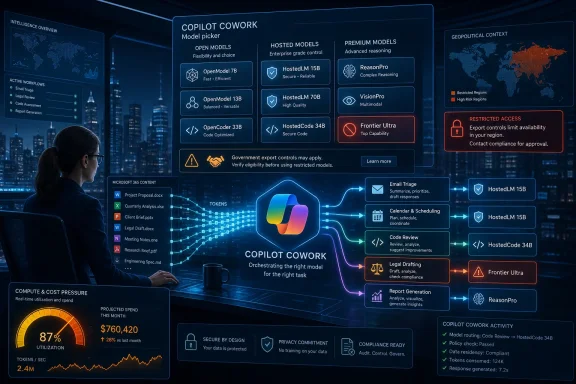
Microsoft’s current Copilot model strategy already reflects that shift. Copilot Cowork documentation describes a model picker with Anthropic Claude models, OpenAI-compatible frontier options, and the possibility of other Microsoft-hosted models. That is not an accident. It is an architectural declaration: the product should be a routing layer, not a monument to one model family.
For Microsoft, this is classic platform behavior. Windows abstracted hardware differences. Azure abstracts infrastructure. Microsoft 365 abstracts an organization’s documents, identity, compliance, and communications. Copilot increasingly wants to abstract the model itself.
That abstraction matters because models are becoming volatile inputs. They change pricing. They change safety policies. They get rate-limited. They get regulated. They get leapfrogged. They get politically radioactive. A vendor that hardcodes its flagship enterprise assistant to one model provider is not building a platform; it is building a dependency.
That is a problem for enterprises because AI assistants are not isolated apps. They are being wired into code review, procurement, legal drafting, customer support, security operations, research, and executive workflows. When a model disappears, degrades, or becomes unavailable to part of a global workforce, the disruption is not theoretical.
The nationality-based nature of the reported restriction also exposes how awkward AI export controls become in cloud environments. Geography is relatively easy to enforce. Citizenship and residency status are not. A global company may have U.S. citizens in Europe, non-U.S. citizens in California, contractors in India, developers in Canada, and security staff in Singapore, all using the same tenant and the same enterprise AI tools.
That is where policy meets identity infrastructure. If governments insist on access rules based on nationality, AI vendors may need controls that resemble defense contracting systems more than SaaS admin consoles. That would be a profound change for products marketed as general-purpose productivity tools.
That argument is not trivial. In enterprise technology, where data goes often matters more than where code originated. Companies routinely run open-source software written by developers all over the world, including in countries with adversarial governments. The security model is not based on national purity; it is based on inspection, isolation, patching, provenance, access control, and contractual accountability.
But AI models complicate that logic. A model is not just code. It is a compressed artifact of training data, optimization choices, alignment policies, and behavioral tendencies that are often difficult to audit. Even if customer prompts stay in Azure, customers may still ask what latent assumptions, censorship patterns, refusal behaviors, or security weaknesses came along for the ride.
Microsoft can mitigate those concerns, but it cannot wave them away. A Chinese-origin model running in Azure is still going to trigger procurement questions in regulated industries, government-adjacent sectors, and companies already under pressure to document AI supply chains. The phrase “hosted by Microsoft” will reassure some buyers. For others, it will be the beginning of the questionnaire, not the end.
If a smaller or open model can handle routine office tasks at a fraction of the cost, it becomes irresponsible not to evaluate it. Not every Copilot task requires the most powerful model on the market. Summarizing meeting notes, drafting internal updates, extracting action items, rewriting documents, and classifying content are valuable but not always frontier-level reasoning problems.
This is where enterprise AI will likely settle: model routing by task, sensitivity, cost, and required reasoning depth. A premium model may handle complex legal analysis or multi-document strategic synthesis. A cheaper model may handle routine drafting. A locally hosted or tenant-bound model may handle sensitive data. The user sees “Copilot,” but the system underneath becomes a market of interchangeable engines.
That future is uncomfortable for model labs that want to charge premium rates for every token. It is also uncomfortable for regulators who prefer neat categories. A Copilot workflow may touch a U.S. model, a European model, a Microsoft-hosted open model, and a specialized safety classifier in the same session. The old question, “Which AI do you use?” will become less useful than “Which model handled which task under which policy?”
If Chinese open models are good enough and cheap enough, American companies will be tempted to use them—not because they want to empower a rival state, but because their own products need sustainable unit economics. That is the contradiction now surfacing around Microsoft. The same strategic rivalry that makes Chinese AI politically suspect also makes low-cost Chinese AI economically attractive.
This is not new in technology. Global supply chains have always created awkward dependencies. American software runs on devices assembled in Asia, chips fabricated in Taiwan, components sourced across borders, and open-source libraries maintained by strangers. AI simply makes the dependency more visible because the model itself appears to “think,” answer, refuse, summarize, and recommend.
The national-security concern is not imaginary. Models can assist with vulnerability discovery, influence operations, data analysis, and automation at scale. But the cost pressure is also not imaginary. If enterprise AI remains too expensive, adoption will slow, margins will compress, or vendors will quietly substitute cheaper systems behind the scenes.
Admins will want to know which model processed which prompt, where the data was stored, whether logs were retained, whether outputs were filtered, and whether a given model is available in their region or cloud. They will also want policy controls that map to real organizational risk: disable a model for legal work, allow it for marketing drafts, block it in regulated departments, or restrict it to non-confidential content.
Microsoft’s existing Copilot controls already point in that direction, with model availability shaped by region, admin settings, subprocessors, preview status, and data-retention terms. But the more models Microsoft adds, the more Copilot becomes a governance surface rather than a single product switch. That is good if the controls are precise. It is dangerous if the complexity is hidden behind friendly branding.
The worst outcome would be model sprawl disguised as simplicity. “Copilot did it” is not an acceptable audit trail when different models carry different data commitments, safety profiles, and regulatory risks. If Microsoft wants to be the enterprise broker for AI models, it must also be the enterprise broker for AI accountability.
That distinction matters. Microsoft’s OpenAI partnership remains one of the most consequential alliances in modern tech, but even a close alliance can become a strategic constraint. If Copilot’s economics, roadmap, and reliability depend too heavily on one lab, Microsoft loses leverage.
Anthropic’s presence in Microsoft 365 Copilot already showed that Microsoft was moving toward a multi-model future. A DeepSeek-derived option would push that shift further, from “choice among Western frontier labs” to “choice among model families, licensing approaches, cost structures, and national origins.”
This is a more mature strategy, but also a messier one. Microsoft gets leverage and flexibility. Customers get choice. Regulators get nervous. Model providers get commoditized. The AI assistant becomes less like a branded intelligence and more like a managed marketplace of reasoning services.
A poorly governed U.S. model can leak sensitive data, generate insecure code, or hallucinate compliance advice. A well-contained open model can be useful for low-risk workflows. Conversely, a foreign-origin model with opaque training, questionable refusal behavior, or hidden supply-chain concerns may be inappropriate for sensitive enterprise use even if it is cheap.
The real security posture is layered. Enterprises should evaluate model provenance, hosting location, data handling, retention, admin controls, red-team results, output monitoring, and incident response. National origin is part of that analysis, not a substitute for it.
This is also where Windows and Microsoft 365 administrators have a role to play. AI governance will increasingly resemble endpoint governance: inventory first, policy second, monitoring always. You cannot secure what you cannot see, and you cannot explain what your vendor refuses to expose.
A cheaper model that handles 70 percent of routine work reliably may be more valuable than a premium model used indiscriminately. A powerful model that cannot be accessed by half a multinational team may be less useful than a slightly weaker model with predictable availability. A model with impressive benchmarks but unclear data handling may be unsuitable for regulated workloads.
This is the enterprise reality now arriving after the demo era. AI is becoming infrastructure, and infrastructure is judged by boring criteria: uptime, cost, control, compliance, and support. The vendors that win will not merely have the smartest models. They will have the best answers when a customer asks, “What happened to my data, and why did this output appear?”
Microsoft is well positioned because it already owns the admin plane for many organizations. But that advantage comes with expectations. Customers will not accept consumer-grade opacity inside enterprise-grade contracts forever.
If Microsoft adds a DeepSeek-derived model, the choice will not merely be “fast versus smart” or “cheap versus premium.” It will also be a choice about supply-chain tolerance. Some organizations will enable it immediately for low-risk tasks. Others will block it by default. Some will demand contractual assurances. Government and defense-adjacent customers may never touch it.
This is why Microsoft’s framing matters. If the company presents the model as simply another low-cost engine, it will invite backlash. If it presents it as an optional, Microsoft-hosted, admin-governed, task-appropriate model with clear boundaries, it has a better chance of making the controversy manageable.
The difference is not cosmetic. Enterprise trust is built on defaults and disclosures. Microsoft can make model choice feel like control, or it can make it feel like a shell game.
But the company cannot fully automate away political trust. If U.S. policy continues to treat advanced AI as a strategic asset comparable to chips or cryptography, then model selection will become a boardroom issue. If Chinese open models continue improving while undercutting Western pricing, then ignoring them will become a cost issue. If governments can suddenly restrict models by nationality, then relying on any one provider becomes an availability issue.
That triangle has no clean solution. Microsoft can route around it, but not eliminate it. The future of Copilot will be shaped as much by export controls and procurement committees as by benchmark scores.
 Microsoft’s AI Strategy Has Become a Cost-Control Story
The first phase of generative AI was sold as magic: a chat box that could draft, summarize, code, search, reason, and eventually act. The second phase is less glamorous. It is about who pays the compute bill when millions of office workers start asking those systems to do real work all day.That is the context behind Microsoft’s reported interest in DeepSeek. Copilot Cowork is not a consumer toy or a demo prompt box; it is meant to sit inside the enterprise workflow, planning tasks, producing drafts, reviewing outputs, and coordinating across the Microsoft 365 estate. If users run hundreds of tasks a week, the product is succeeding from an adoption standpoint while simultaneously becoming more expensive to operate.
This is the central tension in enterprise AI. Vendors want users to treat AI agents like digital staff, but the underlying economics still look more like renting a supercomputer by the minute. The more useful the assistant becomes, the more it costs to run.
Microsoft has spent the last several years trying to convince corporate customers that Copilot is not merely a feature but a new productivity layer. That promise depends on scale. It also depends on Microsoft finding a way to make high-volume AI usage fit inside the familiar economics of enterprise software subscriptions.
DeepSeek Is Not the Point; Optionality Is
DeepSeek’s role in this story is symbolically powerful because it is Chinese, open, and associated with lower-cost model operation. But the deeper story is not that Microsoft has suddenly discovered Beijing as an AI partner. It is that Microsoft does not want any single frontier-model provider to become the tollbooth for its productivity empire.Microsoft’s current Copilot model strategy already reflects that shift. Copilot Cowork documentation describes a model picker with Anthropic Claude models, OpenAI-compatible frontier options, and the possibility of other Microsoft-hosted models. That is not an accident. It is an architectural declaration: the product should be a routing layer, not a monument to one model family.
For Microsoft, this is classic platform behavior. Windows abstracted hardware differences. Azure abstracts infrastructure. Microsoft 365 abstracts an organization’s documents, identity, compliance, and communications. Copilot increasingly wants to abstract the model itself.
That abstraction matters because models are becoming volatile inputs. They change pricing. They change safety policies. They get rate-limited. They get regulated. They get leapfrogged. They get politically radioactive. A vendor that hardcodes its flagship enterprise assistant to one model provider is not building a platform; it is building a dependency.
The Anthropic Restriction Shows How Fragile the Stack Has Become
The U.S. action involving Fable 5 and Mythos 5 is a warning shot for every CIO who assumed cloud AI was just another managed service. Anthropic’s newest models were reportedly restricted for foreign nationals after U.S. officials raised concerns about cybersecurity capabilities and a possible jailbreak. Whether that action was proportionate is now part of a broader policy fight, but its operational lesson is brutally simple: access to a model can change overnight.That is a problem for enterprises because AI assistants are not isolated apps. They are being wired into code review, procurement, legal drafting, customer support, security operations, research, and executive workflows. When a model disappears, degrades, or becomes unavailable to part of a global workforce, the disruption is not theoretical.
The nationality-based nature of the reported restriction also exposes how awkward AI export controls become in cloud environments. Geography is relatively easy to enforce. Citizenship and residency status are not. A global company may have U.S. citizens in Europe, non-U.S. citizens in California, contractors in India, developers in Canada, and security staff in Singapore, all using the same tenant and the same enterprise AI tools.
That is where policy meets identity infrastructure. If governments insist on access rules based on nationality, AI vendors may need controls that resemble defense contracting systems more than SaaS admin consoles. That would be a profound change for products marketed as general-purpose productivity tools.
Microsoft Wants the Cloud Boundary to Do Political Work
Microsoft’s likely defense, if it adopts a DeepSeek-derived model, is straightforward: the model would run inside Azure, under Microsoft’s contractual, compliance, and data-governance framework. Customer data would not be sent to a Chinese cloud. The model would be fine-tuned, moderated, evaluated, and wrapped in Microsoft’s safety systems. Admins would presumably be able to choose whether to enable it.That argument is not trivial. In enterprise technology, where data goes often matters more than where code originated. Companies routinely run open-source software written by developers all over the world, including in countries with adversarial governments. The security model is not based on national purity; it is based on inspection, isolation, patching, provenance, access control, and contractual accountability.
But AI models complicate that logic. A model is not just code. It is a compressed artifact of training data, optimization choices, alignment policies, and behavioral tendencies that are often difficult to audit. Even if customer prompts stay in Azure, customers may still ask what latent assumptions, censorship patterns, refusal behaviors, or security weaknesses came along for the ride.
Microsoft can mitigate those concerns, but it cannot wave them away. A Chinese-origin model running in Azure is still going to trigger procurement questions in regulated industries, government-adjacent sectors, and companies already under pressure to document AI supply chains. The phrase “hosted by Microsoft” will reassure some buyers. For others, it will be the beginning of the questionnaire, not the end.
The Open-Source AI Argument Has Finally Reached the Enterprise Buyer
For years, open-source AI advocates argued that cheaper, inspectable, self-hostable models would put pressure on closed frontier labs. That argument was often framed as philosophical: openness versus control, community versus corporate gatekeeping. Microsoft’s reported DeepSeek evaluation turns it into a procurement argument.If a smaller or open model can handle routine office tasks at a fraction of the cost, it becomes irresponsible not to evaluate it. Not every Copilot task requires the most powerful model on the market. Summarizing meeting notes, drafting internal updates, extracting action items, rewriting documents, and classifying content are valuable but not always frontier-level reasoning problems.
This is where enterprise AI will likely settle: model routing by task, sensitivity, cost, and required reasoning depth. A premium model may handle complex legal analysis or multi-document strategic synthesis. A cheaper model may handle routine drafting. A locally hosted or tenant-bound model may handle sensitive data. The user sees “Copilot,” but the system underneath becomes a market of interchangeable engines.
That future is uncomfortable for model labs that want to charge premium rates for every token. It is also uncomfortable for regulators who prefer neat categories. A Copilot workflow may touch a U.S. model, a European model, a Microsoft-hosted open model, and a specialized safety classifier in the same session. The old question, “Which AI do you use?” will become less useful than “Which model handled which task under which policy?”
Washington’s China Policy Is Colliding With Silicon Valley’s Margin Problem
The U.S. government has spent years trying to slow China’s access to advanced semiconductors, frontier AI capabilities, and sensitive cyber tooling. That strategy assumes that cutting off access to the most powerful systems preserves an American advantage. But the software industry’s economic incentives are now pushing in the opposite direction.If Chinese open models are good enough and cheap enough, American companies will be tempted to use them—not because they want to empower a rival state, but because their own products need sustainable unit economics. That is the contradiction now surfacing around Microsoft. The same strategic rivalry that makes Chinese AI politically suspect also makes low-cost Chinese AI economically attractive.
This is not new in technology. Global supply chains have always created awkward dependencies. American software runs on devices assembled in Asia, chips fabricated in Taiwan, components sourced across borders, and open-source libraries maintained by strangers. AI simply makes the dependency more visible because the model itself appears to “think,” answer, refuse, summarize, and recommend.
The national-security concern is not imaginary. Models can assist with vulnerability discovery, influence operations, data analysis, and automation at scale. But the cost pressure is also not imaginary. If enterprise AI remains too expensive, adoption will slow, margins will compress, or vendors will quietly substitute cheaper systems behind the scenes.
Copilot Customers Will Care Less About Geopolitics Than Control
For WindowsForum readers running tenants, devices, policies, and security baselines, the practical question is not whether DeepSeek is symbolically ironic. It is whether Microsoft gives administrators meaningful control. Enterprise buyers can tolerate complexity when it is visible. They are less forgiving when a vendor changes the underlying engine without clear governance.Admins will want to know which model processed which prompt, where the data was stored, whether logs were retained, whether outputs were filtered, and whether a given model is available in their region or cloud. They will also want policy controls that map to real organizational risk: disable a model for legal work, allow it for marketing drafts, block it in regulated departments, or restrict it to non-confidential content.
Microsoft’s existing Copilot controls already point in that direction, with model availability shaped by region, admin settings, subprocessors, preview status, and data-retention terms. But the more models Microsoft adds, the more Copilot becomes a governance surface rather than a single product switch. That is good if the controls are precise. It is dangerous if the complexity is hidden behind friendly branding.
The worst outcome would be model sprawl disguised as simplicity. “Copilot did it” is not an acceptable audit trail when different models carry different data commitments, safety profiles, and regulatory risks. If Microsoft wants to be the enterprise broker for AI models, it must also be the enterprise broker for AI accountability.
The OpenAI Relationship Is Changing, Not Vanishing
One claim in the wider discussion deserves caution: Microsoft has not simply “ended” its relationship with OpenAI in the clean, dramatic sense that phrase implies. The better reading is that Microsoft has been reducing its dependence on OpenAI by integrating other model providers and by building more flexibility into Copilot and Azure AI services.That distinction matters. Microsoft’s OpenAI partnership remains one of the most consequential alliances in modern tech, but even a close alliance can become a strategic constraint. If Copilot’s economics, roadmap, and reliability depend too heavily on one lab, Microsoft loses leverage.
Anthropic’s presence in Microsoft 365 Copilot already showed that Microsoft was moving toward a multi-model future. A DeepSeek-derived option would push that shift further, from “choice among Western frontier labs” to “choice among model families, licensing approaches, cost structures, and national origins.”
This is a more mature strategy, but also a messier one. Microsoft gets leverage and flexibility. Customers get choice. Regulators get nervous. Model providers get commoditized. The AI assistant becomes less like a branded intelligence and more like a managed marketplace of reasoning services.
The Security Debate Cannot Stop at Model Nationality
There will be a temptation to reduce this debate to a simple rule: American models good, Chinese models bad. That may be politically convenient, but it is technically inadequate. A model’s risk depends on how it was trained, how it behaves, where it runs, what data it sees, what tools it can call, what logs are retained, and what controls surround it.A poorly governed U.S. model can leak sensitive data, generate insecure code, or hallucinate compliance advice. A well-contained open model can be useful for low-risk workflows. Conversely, a foreign-origin model with opaque training, questionable refusal behavior, or hidden supply-chain concerns may be inappropriate for sensitive enterprise use even if it is cheap.
The real security posture is layered. Enterprises should evaluate model provenance, hosting location, data handling, retention, admin controls, red-team results, output monitoring, and incident response. National origin is part of that analysis, not a substitute for it.
This is also where Windows and Microsoft 365 administrators have a role to play. AI governance will increasingly resemble endpoint governance: inventory first, policy second, monitoring always. You cannot secure what you cannot see, and you cannot explain what your vendor refuses to expose.
The New AI Procurement Test Is Boring—and That Is the Point
The hype cycle encourages executives to ask whether a model is “the best.” Procurement should ask whether it is fit for purpose. That means accuracy, latency, price, availability, data commitments, regional support, auditability, and failure modes all belong in the same conversation.A cheaper model that handles 70 percent of routine work reliably may be more valuable than a premium model used indiscriminately. A powerful model that cannot be accessed by half a multinational team may be less useful than a slightly weaker model with predictable availability. A model with impressive benchmarks but unclear data handling may be unsuitable for regulated workloads.
This is the enterprise reality now arriving after the demo era. AI is becoming infrastructure, and infrastructure is judged by boring criteria: uptime, cost, control, compliance, and support. The vendors that win will not merely have the smartest models. They will have the best answers when a customer asks, “What happened to my data, and why did this output appear?”
Microsoft is well positioned because it already owns the admin plane for many organizations. But that advantage comes with expectations. Customers will not accept consumer-grade opacity inside enterprise-grade contracts forever.
The Copilot Model Picker Is Becoming a Policy Battleground
The model picker may look like a convenience feature, but it is becoming one of the most important interfaces in enterprise AI. It translates strategy into a drop-down menu. Behind each option sits a chain of cost, compliance, performance, politics, and trust.If Microsoft adds a DeepSeek-derived model, the choice will not merely be “fast versus smart” or “cheap versus premium.” It will also be a choice about supply-chain tolerance. Some organizations will enable it immediately for low-risk tasks. Others will block it by default. Some will demand contractual assurances. Government and defense-adjacent customers may never touch it.
This is why Microsoft’s framing matters. If the company presents the model as simply another low-cost engine, it will invite backlash. If it presents it as an optional, Microsoft-hosted, admin-governed, task-appropriate model with clear boundaries, it has a better chance of making the controversy manageable.
The difference is not cosmetic. Enterprise trust is built on defaults and disclosures. Microsoft can make model choice feel like control, or it can make it feel like a shell game.
The Part Microsoft Cannot Automate Away
Microsoft’s greatest strength in this fight is that it can absorb complexity on behalf of customers. It can fine-tune models, host them in Azure, wrap them in identity controls, connect them to Microsoft 365 data, expose admin policies, and present the result as Copilot. That is exactly what enterprise software vendors do.But the company cannot fully automate away political trust. If U.S. policy continues to treat advanced AI as a strategic asset comparable to chips or cryptography, then model selection will become a boardroom issue. If Chinese open models continue improving while undercutting Western pricing, then ignoring them will become a cost issue. If governments can suddenly restrict models by nationality, then relying on any one provider becomes an availability issue.
That triangle has no clean solution. Microsoft can route around it, but not eliminate it. The future of Copilot will be shaped as much by export controls and procurement committees as by benchmark scores.
The Enterprise Lesson Hidden Inside the DeepSeek Irony
The immediate story is Microsoft reportedly looking at DeepSeek while the U.S. restricts Anthropic’s Fable 5 and Mythos 5. The larger story is that AI has moved from wonder to dependency faster than its governance model has matured.- Microsoft’s reported evaluation of DeepSeek is best understood as a cost and optionality move, not a sudden ideological embrace of Chinese AI.
- The U.S. restriction on Anthropic’s newest models shows that AI access can be disrupted by national-security policy with little operational warning.
- Enterprise customers should demand model-level transparency inside Copilot, including data handling, retention, hosting, and administrative controls.
- Open-source and lower-cost models are likely to handle more routine enterprise AI tasks as vendors try to control inference costs.
- National origin matters in AI risk assessment, but it should not replace technical evaluation, hosting controls, auditability, and workload-specific policy.
- The most important Copilot feature may soon be not the chat box, but the governance layer deciding which model is allowed to answer.
References
- Primary source: The Indian Panorama
Published: 2026-06-19T13:30:12.062866
Microsoft eyes DeepSeek to lower AI costs while US restricts Mythos and Fable 5 over China fears — The Indian Panorama
Science & Technology | The artificial intelligence boom is creating strange alliances and even stranger contradictions. For years, American AI companies have accused Chinesewww.theindianpanorama.news - Related coverage: tomshardware.com
U.S. gov't orders Anthropic to disable its newest AI models worldwide due to security threats — ban on Claude Fable 5 and Mythos 5 bars access by any foreign national, even its own employees | Tom's Hardware
An alleged jailbreak triggered a national security directive that forced the model to be pulled.www.tomshardware.com - Related coverage: axios.com
Who's in charge of Anthropic's AI models?
The fight over Anthropic's Fable 5 is turning AI oversight from a theoretical debate into a real test of government power.www.axios.com
- Official source: learn.microsoft.com
Choose a model for Copilot Cowork | Microsoft Learn
Pick the right model for your task in Microsoft 365 Copilot Cowork.learn.microsoft.com - Related coverage: scmp.com
US blocks foreign access to Anthropic’s newest AI models over security risks | South China Morning Post
The commerce department’s mandate forces a shutdown of top-tier systems after officials reportedly found ways to bypass safeguards.www.scmp.com - Related coverage: semafor.com
US limits use of Anthropic AI models Fable 5 and Mythos | Semafor
A new White House directive forced Anthropic to shut down access to its most advanced AI models.www.semafor.com
- Related coverage: winbuzzer.com
U.S. Order Forces Anthropic to Suspend Fable 5, Mythos 5
Anthropic has disabled Fable 5 and Mythos 5 after a U.S. foreign-access order, disputing the underlying jailbreak risk as customers lose hosted-model access. winbuzzer.com
- Related coverage: europapress.es
Estados Unidos ordenó restringir Claude Fable 5 y Mythos 5 por temores a un acceso vinculado a China, según Semafor
La directiva emitida por el Gobierno de Estados Unidos para que Anthropic suspendiera el...www.europapress.es
- Related coverage: techtimes.com
Anthropic Fable 5 Shutdown: US Export Order Forces a Global Customer Cutoff
Anthropic disabled Fable 5 and Mythos 5 for every customer after a US export control directive barred access by foreign nationals inside and outside the country. The company disputes the government’swww.techtimes.com - Related coverage: windowscentral.com
This is Microsoft's new "Copilot Cowork": An experiment with Anthropic's Claude AI models that plans and delegates your work | Windows Central
Microsoft ships Copilot Cowork to its Frontier program.www.windowscentral.com
