

Microsoft’s Deputy CISO for Government and Trust lays out a clear, urgent argument: defending government data today requires a fundamentally different posture — one that moves from reactive patching to proactive, collaborative, and engineering-led defense — and that Microsoft intends to bring product design, organizational governance, and cross-sector partnerships to bear on that challenge. s://www.microsoft.com/investor/reports/ar24/index.html)
The recent Deputy CISO blog post from Microsoft, authored by Tim Langan, reframes how vendors and public-sector defenders should think about protecting government mission spaces. The post emphasizes three converging realities: nation-state and state-sponsored groups increasingly target government clouds and local agencies; adversaries operate with persistence and sophistication; and defending at scale requires marrying product-level security, engineering governance, and cng with customers and partners.
This perspective is not isolated inside Microsoft. The company’s multi-year Secure Future Initiative (SFI) — an engineering-heavy program to bake security into development, reduce attack surface through secure defaults, and make fixes durable — is the internal vehicle Microsoft uses to operationalize that approach. Microsoft has publicly described SFI as a program to “start green, get green, stay green, and validate green,” that ties security outcomes to engineering processes and leadership oversight.
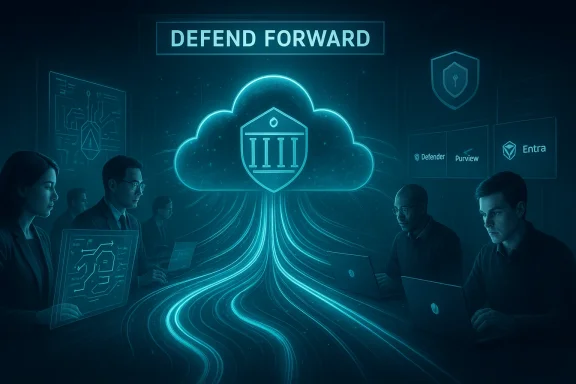
Meanwhile, the broader security community and national cyber organizations have been embracing the proactive posture often described as “defend forward” or “persistent engagement,” where defenders seek to identify and disrupt adversary capabilities before they can be used against targets. This operational concept, originating and evolving through U.S. government cyber strategy documents and exercises, has become a touchstone for how public- and private-sector actors think about pre-attack disruption.
Two implications follow immediately. First, assume breach as the baseline: detection and recovery must be built into operations. Second, intelligence and response must be continuous and i across products, teams, or organizations. Microsoft’s Deputy CISO argues that every detection and alert is a learning opportunity that should be operationalized across engineering and customer support to harden the whole ecosystem.
This threat reality reflects wider policy discussion. U.S. cyber policy documents have framed the problem similarly: “defend forward” seeks to disrupt malicious activity at or near its source, and capacity-building and partner engagement are core to that doctrine. Commercial cloud providers and government operators now share requirements for earlier, richer threat signals and coordinated responses.
This mirrors the defend-forward doctrine at the national level: a faster, outward-looking stance that privileges persistent engagement, information sharing, and partner-focused actions to reduce adversary effectiveness. For governments, that requires legal, policy, and operational trust between vendors and public agencies.
Key concepts Microsoft pushes are:
That said, the approach requires cautious implementation. Governments must avoid wholesale vendor consolidation without safeguards, insist on independent verification of claims, and require legal frameworks that allow timely cooperation while protecting civil liberties and sovereignty. The defend-forward mindset improves defensive posture, but it must be operationalized through clear oversight and shared authorities when it involves pre-emptive or cross-border activity.
Ultimately, the most defensible path for governmental data is one that pairs vendor-driven engineering scale with rigorous, independent governance. If agencies adopt Microsoft’s technical pillars while preserving interoperability, auditability, and policy clarity, they will materially raise their chances of staying ahead of persistent, capable nation-state adversaries.
Acknowledgment: This article synthesizes Microsoft’s Deputy CISO perspective and public company commitments with independent policy and defense analysis to provide a practical, critical guide for government CISOs and IT leaders.
Source: Microsoft Security strategies for safeguarding governmental data | Microsoft Security Blog
 Background
The recent Deputy CISO blog post from Microsoft, authored by Tim Langan, reframes how vendors and public-sector defenders should think about protecting government mission spaces. The post emphasizes three converging realities: nation-state and state-sponsored groups increasingly target government clouds and local agencies; adversaries operate with persistence and sophistication; and defending at scale requires marrying product-level security, engineering governance, and cng with customers and partners.This perspective is not isolated inside Microsoft. The company’s multi-year Secure Future Initiative (SFI) — an engineering-heavy program to bake security into development, reduce attack surface through secure defaults, and make fixes durable — is the internal vehicle Microsoft uses to operationalize that approach. Microsoft has publicly described SFI as a program to “start green, get green, stay green, and validate green,” that ties security outcomes to engineering processes and leadership oversight.
Meanwhile, the broader security community and national cyber organizations have been embracing the proactive posture often described as “defend forward” or “persistent engagement,” where defenders seek to identify and disrupt adversary capabilities before they can be used against targets. This operational concept, originating and evolving through U.S. government cyber strategy documents and exercises, has become a touchstone for how public- and private-sector actors think about pre-attack disruption.
The threat picture government defenders must hold in mind
The Microsoft post opens with a blunt thesis: government entities — national, state, and local — are high-value targets for well-resourced state-sponsored actors, and the success rate for att is rising. This is a different risk calculus than the typical small‑business compromise: adversaries are patient, capable of multi-year campaigns, and willing to exploit supply chains, identity weaknesses, and cloud misconfigurations for strategic gain.Two implications follow immediately. First, assume breach as the baseline: detection and recovery must be built into operations. Second, intelligence and response must be continuous and i across products, teams, or organizations. Microsoft’s Deputy CISO argues that every detection and alert is a learning opportunity that should be operationalized across engineering and customer support to harden the whole ecosystem.
This threat reality reflects wider policy discussion. U.S. cyber policy documents have framed the problem similarly: “defend forward” seeks to disrupt malicious activity at or near its source, and capacity-building and partner engagement are core to that doctrine. Commercial cloud providers and government operators now share requirements for earlier, richer threat signals and coordinated responses.
Microsoft’s strategic response: three pillars
Microsoft’s approach — as described by the Deputy CISO — rests on three interlocking pillars: proactive defense (including defend-forward thinking), engineering-first security (Secure Future Initiative), and deep customer partnership and transparency. Each pillar has both product and organizational mechanisms that Microsoft highlights as central to protecting governmental data.1) Proactive and collaborative threat operations
Microsoft describes a posture that goes beyond reacting to alerts: network and cloud defenders should continually hunt, share indicators, and mitigate thretical impacts. Microsoft’s Cybersecurity Governance Council is presented as an internal mechanism to rapidly feed operational learnings into engineering priorities and product changes, closing the loop between detection and durable remediation. The goal is to make defensive telemetry and playbooks reusable across customers.This mirrors the defend-forward doctrine at the national level: a faster, outward-looking stance that privileges persistent engagement, information sharing, and partner-focused actions to reduce adversary effectiveness. For governments, that requires legal, policy, and operational trust between vendors and public agencies.
2) Engineering-first security: Secure by design and durable fixes
The Secure Future Initiative places security earlier in the life cycle: “secure by design,” automated enforcement (paved paths), and programmatic ownership for long-term fixes. The idea is simple but operationally demanding: security and compliance should be built into developers’ standard workflows so that secure choices become the default and durable remediations replace one-off patches. Microsoft has publicly documented progress and engineering practices tied to SFI.Key concepts Microsoft pushes are:
- Paved paths — curated, secure development pipelines that make the right choices the easiest choices.
- Durability — remediation that prevents regressions, enforced by automation and ownership.
- Secure-by-default configurations for cloud services used by government customers.
3) Deep customer engagement, transparency, and limits on human access
Tim Langan emphasizes active listening with government customers, faster threat-information sharing, and processes that limit and log human access to customer data — for example, Customer Lockbox and hardened support workflows. That combination is meant to build trust while enabling Microsoft to act quickly when it detects risks that cross tenancy boundaries. Microsoft also couches these technical controls inside contractual and compliance commitments — an important reassurance for governments with legal and sovereignty obligations.How Microsoft’s product stack maps to government protections
Microsoft’s blog and related Microsoft security content highlight concrete controls and products that map to Zero Trust and data protection for government tenants. Below is the high‑level mapping Microsoft emphasizes.- Identity and access control
- Microsoft Entra (identity, B2B controls, Private Access for ZTNA). Conditional Access, passwordless options, and continuous risk evaluation form the identity gatekeeper.
- Data governance and protection
- Microsoft Purview for classification, labeling, DLP, retention, and policy enforcement across cloud and endpoints. Purview enables automated discovery and policy application to reduce accidental exposure.
- Threat detection and response
- Microsoft Defender suite, Microsoft Sentinel for SIEM + SOAR, and integration between product telemetry and engineering playbooks to enable cross-tenant detections and automated response.
- Operational controls
- Customer Lockbox, hardened admin workstations, and just‑in‑time access controls to limit support or engineering access to customer data, with full audit trails.
- Development and supply-chain
- Secure CI/CD pipelines (paved paths), GitHub Advanced Security for code scanning, and artifact controls as part of SFI-driven durability programs.
What’s strong about this approach
Microsoft’s combined operational and engineering view has several concrete strengths for government defenders.- Engineering scale and integration: SFI codifies an industry-scale attempt to make secure defaults, durable remediations, and global telemetry part of product lifecycles. This reduces time-to-fix for cross-tenant problems and helps scale protective controls across millions of services.
- Operational learning loop: The Cybersecurity Governance Council and the Deputy CISO role are structural commitments to route threat intelligence into product priorities and support operations, which can shorten the window between discovery and systemic mitigation.
- Product primitives matching Zero Trust and data governance: Identity-first controls, automated classification, and logged, constrained human access address core attack vectors used against government systems: account compromise, data exfiltration, and supply-chain abuse.
- Public posture and transparency: Public commitments (Annual Report language, SFI progress reporting) and documented technical controls provide governments with auditable, contractual assurances that can be referenced in procurement and compliance processes.
Risks, limits, and open questions
No single-vendor strategy eliminates all risk. Microsoft’s model brings benefits — but also exposes policy and operational tradeoffs that agencies must consider.- Vendor consolidation and potential lock-in. Deep integration with Microsoft Entra, Purview, Defender, and Azure tooling can lock agencies into a single vendor’s operational model. That reduces integration complexity but raises long-term strategic dependency and procurement risk. Agencies must weigh the benefit of integrated telemetry against the need for multi-vendor resilience.
- Transparency vs. operational secrecy. Proactive measures and threat hunting sometimes require sensitive operational details. Governments will need explicit legal and procedural frameworks to permit timely threat-sharing while preserving classified information and civil‑liberties safeguards. The legal architecture for cross-border telemetry and investigatory actions must remain explicit.
- Assumed capabilities vs. public accountability. “Defend forward” style actions or pre-emptive measures, when executed by private companies in concert with government customers, raise important questions about authority, oversight, and attribution. While Microsoft focuses on defensive mitigation and information sharing, any action that pushes beyond detection into active disruption invites scrutiny and requires clear governance.
- Durability is hard at scale. Embedding fixes into pipelines (“paved paths”) is effective but organizationally heavy. Smaller agencies or contractors may struggle to adopt SFI-style patterns without additional funding, skills, or migration paths. Durable fixes also require continuous monitoring to prevent regressions.
- Data residency, sovereignty, and compliance complexity. Contractual promises and product features may not fully resolve local legal constraints, intelligence‑sharing requests, or emerging national cloud regulations. Agencies must continue to demand explicit contractual terms, technical controls that enforce residency, and auditability suited to their legal regimes.
Practical roadmap for government CISOs and IT leaders
If your agency is evaluating how to take advantage of Microsoft’s suggested model — or more generally how to modernize government cyber defenses — here’s a prioritized, pragmatic plan distilled from Microsoft’s recommendations and broader policy guidance.- Rapidly inventory and prioritize (30–60 days)
- Conduct a focused asset inventory: critical services, identities with high privilege, and data repositories.
- Tier assets by mission impact and exposure, then map current MFA, conditional access, and logging posture.
- Harden identity and reduce blast radius (60–120 days)
- Enforce phishing-resistant MFA for all high‑privilege and remote access accounts.
- Apply conditional access policies keyed to device posture, network context, and session risk.
- Deploy basic data governance and DLP (90–180 days)
- Roll out automated classification for sensitive datasets; apply labels and retention to prevent inappropriate sharing.
- Integrate DLP policies with secure collaboration tools and cloud storage.
- Establish continuous detection and response (120–270 days)
- Centralize telemetry in a SIEM/analytics platform; onboard critical logs and threat indicators.
- Build runbooks that operationalize threat intel and automate containment tasks where safe and reversible.
- Institutionalize secure-by-default DevOps (6–12 months and ongoing)
- Adopt paved paths or curated pipelines for mission-critical teams; embed static analysis, SBOM, and artifact verification.
- Measure durability KPIs and tie remediation ownership to engineering owners.
- Formalize partnerships and legal frameworks (concurrent)
- Negotiate data residency, audit rights, and incident response SLAs with vendors.
- Establish information-sharing agreements and clear escalation paths for nation‑level threats consistent with legal authorities.
Governance aments should insist on
Technical controls alone are insufficient. Governments should require clear, auditable commitments in procurement and operating contracts.- Audit and verification. Independent attestation of security posture (third-party audits, SOC‑type reports tailored to government needs) should be required for high-sensitivity contracts.
- Data residency and legal protections. Contracts must include explicit language on data residency, access requests, and notification requirements for law enforcement or intelligence demands.
- Interoperability requirements. Avoid proprietary lock-in by mandating open telemetry and standardized interfaces for incident response and data export.
- Incident playbook and joint exercises. Regular, scheduled crisis exercises with vendors, including tabletop and live drills, build trust and reveal operational friction points.
Conclusion — a practical, cautious optimism
Microsoft’s Deputy CISO message is a useful, realistic roadmap for how a major cloud provider intends to address government-scale threats: combine proactive threat operations, engineering-first security (the Secure Future Initiative), and sustained customer transparency. For defenders, the takeaway is straightforward: adopt identity-first Zero Trust, demand durable fixes and automated enforcement, and institutionalize explicit partnerships and legal guardrails for threat-sharing and rapid response.That said, the approach requires cautious implementation. Governments must avoid wholesale vendor consolidation without safeguards, insist on independent verification of claims, and require legal frameworks that allow timely cooperation while protecting civil liberties and sovereignty. The defend-forward mindset improves defensive posture, but it must be operationalized through clear oversight and shared authorities when it involves pre-emptive or cross-border activity.
Ultimately, the most defensible path for governmental data is one that pairs vendor-driven engineering scale with rigorous, independent governance. If agencies adopt Microsoft’s technical pillars while preserving interoperability, auditability, and policy clarity, they will materially raise their chances of staying ahead of persistent, capable nation-state adversaries.
Acknowledgment: This article synthesizes Microsoft’s Deputy CISO perspective and public company commitments with independent policy and defense analysis to provide a practical, critical guide for government CISOs and IT leaders.
Source: Microsoft Security strategies for safeguarding governmental data | Microsoft Security Blog
