

Organizations across Mexico and the United States are increasingly recognizing that true cyber resilience is not a product you can buy off a shelf but an engineered outcome achieved through an integrated, multi-layer defense-in-depth architecture that combines native cloud protections, data-centric encryption, and immutable recovery systems.
The migration to hyperscale cloud platforms radically changed the attack surface and the distribution of security responsibilities. As cloud providers harden their physical and platform layers, the burden of protecting data, identities, applications, and recovery capabilities has shifted squarely onto organizational teams and their partners. This reality underscores the shared responsibility model: cloud vendors secure the cloud’s infrastructure while customers and their integrators secure what runs inside it.
Industry voices in Mexico are stressing collaboration across vendors, channel partners, and security teams. In condensed form: fragmented defenses create blind spots that attackers can exploit; coordination accelerates detection, containment, and recovery. That premise sits at the heart of a practical defense-in-depth strategy designed to preserve confidentiality, integrity, and availability across the data lifecycle.
This article examines the technical architecture and operational practices needed to build that multi-layer defense—what components matter, how they should be integrated, the trade-offs involved, and the subtle implementation risks that too often undermine otherwise well-meaning programs.
Key operational practices at this layer:
Core principles:
Essential characteristics for an effective recovery layer:
Key integration patterns:
When choosing a partner or integrating third-party solutions, prioritize:
Ensure that:
The ecosystem will also continue to fragment with specialized vendors adding niche protections (e.g., data-centric tokenization, immutable object storage plugins, orchestration platforms). The integration challenge is not to collect tools but to orchestrate them so they operate as a cohesive whole.
The stakes are high: failing to coordinate defenses or to invest in recoverability invites operational fragility and potential reputational damage. By prioritizing centralized posture management, rigorous key governance, and immutable backups—and by operationalizing those controls with repeatable tests and automation—organizations can dramatically improve their ability to withstand, respond to, and recover from modern cyberattacks.
Source: Mexico Business News Building Cyber Resilience Through Integrated Multi-Layer Defenses
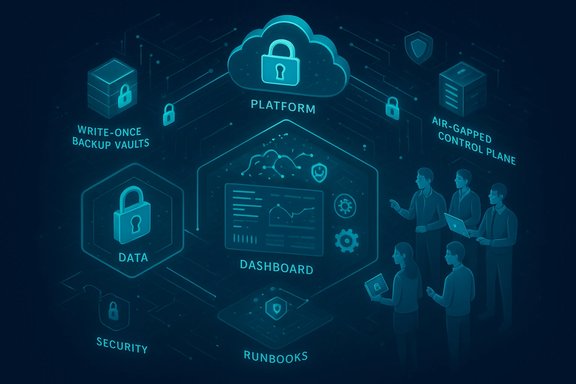 Background / Overview
The migration to hyperscale cloud platforms radically changed the attack surface and the distribution of security responsibilities. As cloud providers harden their physical and platform layers, the burden of protecting data, identities, applications, and recovery capabilities has shifted squarely onto organizational teams and their partners. This reality underscores the shared responsibility model: cloud vendors secure the cloud’s infrastructure while customers and their integrators secure what runs inside it.Industry voices in Mexico are stressing collaboration across vendors, channel partners, and security teams. In condensed form: fragmented defenses create blind spots that attackers can exploit; coordination accelerates detection, containment, and recovery. That premise sits at the heart of a practical defense-in-depth strategy designed to preserve confidentiality, integrity, and availability across the data lifecycle.
This article examines the technical architecture and operational practices needed to build that multi-layer defense—what components matter, how they should be integrated, the trade-offs involved, and the subtle implementation risks that too often undermine otherwise well-meaning programs.
Why defense-in-depth matters now
Perimeter-era thinking—network walls, VPN tunnels, and perimeter firewalls—no longer matches the way organizations operate. Cloud workloads, distributed identities, remote users, and API-driven automation create a dynamic environment where attackers can pivot quickly. In this context, defense-in-depth means deliberately stacking independent security controls so that a failure in one layer does not lead to catastrophic loss.- Attackers increasingly target backups and recovery systems as a deliberate tactic to force ransom payments or prevent recovery.
- Zero Trust principles reduce reliance on implicit trust inside an environment by verifying every access request and enforcing least privilege.
- Immutable backups are becoming an operational requirement rather than a luxury—when backups are tamper-proof, the organization preserves a decisive path to recovery.
The three essential layers of modern resilience
1. Intrinsically secure infrastructure (the platform layer)
The infrastructure layer is where applications, identities, and data reside. Hyperscale cloud providers operate at a scale and have security investments that are difficult for many organizations to replicate. Key platform characteristics that matter here:- Centralized posture management that monitors configuration drift and recommends corrective action.
- Robust identity services that centralize authentication and conditional access.
- Native platform capabilities to segment networks and enforce microsegmentation and workload isolation.
Key operational practices at this layer:
- Inventory cloud resources and align them to an agreed security benchmark.
- Apply role-based access control and just-in-time privileges for administrative operations.
- Harden management planes and restrict privileged operations via multi-user authorization and separation of duties.
2. Data-centric security and Zero Trust (the asset layer)
If the platform is breached, the next line of defense must render the stolen artifacts useless. That is the objective of a data-centric strategy built on encryption, key management, and Zero Trust access controls.Core principles:
- Encrypt data at rest and in transit using strong, industry-standard algorithms.
- Centralize cryptographic key management in a hardened vault that is logically separated from storage, limiting the blast radius of a compromise.
- Enforce least-privilege access to data with contextual authorization (who, what, where, when, and why).
- Use a managed key vault service to hold keys and secrets, ideally with HSM-backed protection for high-assurance scenarios.
- Implement data classification and label sensitive assets so that access policies can be applied automatically and consistently.
- Combine encryption with tokenization or format-preserving techniques where needed for operational systems.
3. Immutable recovery and rapid restore (the final line)
When all else fails, recoverability saves the business. Modern ransomware actors target backups as a high-priority objective; therefore, defenses must include immutable, air-gapped, and regularly tested backups that cannot be modified or deleted within a defined retention window.Essential characteristics for an effective recovery layer:
- Immutability: backup copies are write-once, read-many (WORM) for a defined retention period.
- Logical or virtual air gap: backup control planes and credentials are isolated from production environments.
- Regular restore testing: recovery plans are exercised frequently and validated against recovery time and point objectives.
Integrating the layers: architecture and orchestration
Integration is the differentiator between a checklist and a resilient architecture. The three layers must be orchestrated so that platform telemetry, key lifecycle events, and backup integrity signals feed a unified incident response and automation pipeline.Key integration patterns:
- Centralized security posture dashboard: aggregate misconfigurations, identity anomalies, and backup health into a single operational view to simplify triage and remediation.
- Automated response playbooks: define automated actions such as isolating compromised workloads, rotating keys, or initiating pre-tested restore sequences to reduce mean time to recover.
- Distinct credentialing for backup operations: use separate service accounts and multi-factor protections for systems that manage backups and vaults.
Tools, partners, and the role of the ecosystem
No single vendor can cover every technical requirement or every industry nuance. The evolving reality is cooperative: cloud platform vendors provide the broad infrastructure protections and identity primitives; specialized vendors add targeted encryption, advanced detection, and immutable storage solutions; partners offer systems integration and local regulatory knowledge.When choosing a partner or integrating third-party solutions, prioritize:
- Open orchestration and API-driven integrations that avoid black-box coupling.
- Auditable access controls and key management practices.
- Proven experience in backup hardening, disaster recovery testing, and incident response orchestration.
Operationalizing resilience: policies, tests, and governance
A resilient architecture without disciplined operations is brittle. Operational practices turn controls into outcomes.- Policy and governance
- Define data classification, retention, and encryption policies that map directly to technical enforcement.
- Create an authorization matrix for backup operations and key lifecycle management.
- Integrate third-party SLAs and partner responsibilities into vendor contracts and runbooks.
- Backup and restore testing
- Schedule regular, full-scale restore tests that mimic business-critical recovery scenarios.
- Validate recovery time objective (RTO) and recovery point objective (RPO) under real restoration conditions.
- Maintain “golden images” and IaC templates to rebuild systems quickly if hardware recovery is required.
- Incident response and tabletop exercises
- Run tabletop exercises simulating backup compromise and ransomware to test coordination among security, IT, legal, and communications teams.
- Ensure playbooks include steps to reconstitute credentials, isolate malicious persistence, and restore from immutable copies.
- Continuous improvement
- Feed post-incident lessons learned into configuration management and posture policies.
- Use security scorecards and measurable KPIs to track posture improvements and remediation velocity.
The benefits: what a correct implementation delivers
When the three layers are implemented and integrated, organizations achieve several tangible benefits:- Reduced likelihood of paying ransoms because immutable backups provide a path to recovery.
- Faster incident detection and containment thanks to centralized posture management and automation.
- Better regulatory compliance through auditable key management and documented recovery procedures.
- Resilience to supply-chain or downstream compromises when backups and keys are segregated from production environments.
Risks, trade-offs, and implementation pitfalls
No architecture is risk-free. The very measures that protect you can also create operational and strategic challenges if not implemented carefully.- Vendor and operational lock-in: relying exclusively on a single cloud provider’s integrated features can simplify operations—but it can also make cross-cloud recovery and migration more complex. Design for portability where practicable.
- Misconfigured immutability: locking an immutable vault irreversibly without adequate testing can impede legitimate operational needs. Implement immutability after validating restore procedures and retention policies.
- Key management centralization: while centralizing keys improves control, it also concentrates risk. Protect the key management plane with strict access controls, multi-user authorization, and robust auditing.
- Complexity and human error: orchestration across many systems increases cognitive load. Invest in automation, runbooks, and training to reduce the chance of operator mistakes during high-stress incidents.
- Cost and ROI: hardened architectures and immutable storage impose costs. Build an objective business case comparing the cost of resilience against the potential impact of outage, ransom, and reputational loss.
Technology recommendations and a practical roadmap
Below is an actionable roadmap to move from fragmented security to an integrated defense-in-depth posture.- Assess and prioritize
- Inventory data, classify by criticality, and map to recovery priorities.
- Conduct a gap analysis against a recognized security benchmark.
- Harden the platform
- Apply cloud security posture management and enforce the baseline.
- Harden identities using conditional access and MFA for all administrative roles.
- Centralize key and secret management
- Deploy an HSM-backed vault for high-value keys and rotate keys on a policy cadence.
- Separate operational credentials for backup systems and control planes.
- Implement immutable backups
- Configure write-once retention policies and logically isolate backup accounts.
- Use multi-user authorization for destructive operations in the backup vault.
- Automate detection and response
- Integrate posture telemetry with SOAR playbooks to orchestrate containment and restore actions.
- Use prioritized AI-assisted recommendations to reduce remediation toil.
- Test and validate
- Run scheduled recovery drills; include worst-case scenarios (e.g., simultaneous production and backup compromise).
- Maintain a tracked scoreboard for RTO and RPO compliance.
- Institutionalize partnerships and intelligence sharing
- Formalize relationships with platform partners and integrators to ensure rapid, pre-authorized support during incidents.
- Participate in sector information-sharing groups to benefit from up-to-date threat intelligence.
Governance and legal considerations
Resilience plans must align to regulatory and contractual obligations. Immutable backups and WORM retention can intersect with data retention laws and e-discovery requirements; configurations should balance legal holds and recovery needs. Additionally, cross-border storage and key escrow policies may have jurisdictional implications that require legal review.Ensure that:
- Retention and immutability policies are mapped to legal holds and deletion authorizations.
- Vendor contracts include clarity on responsibilities during incident response and recovery.
- Insurance and post-incident reporting obligations are reflected in recovery playbooks.
The human factor: training, process, and culture
Technology alone will not deliver resilience. A culture that values coordinated incident response, rehearsed procedures, and cross-team collaboration is decisive.- Security, IT, application owners, and executives must agree on what constitutes “acceptable downtime” and the communication flows during incidents.
- Regular cross-functional exercises build muscle memory and sharpen decision-making under pressure.
- Investment in runbook automation and run-playbooks for common failure modes reduces reliance on brittle tribal knowledge.
Looking ahead: automation, AI, and the evolving threat landscape
Volume and velocity of alerts will continue to grow. AI and automated remediation will become central to maintaining a competitive security posture. That said, automation introduces its own risks—misapplied rules or poorly tested playbooks can cause disruptive side effects. Balance is key: automated containment of known-danger activities, human-in-the-loop for high-impact decisions.The ecosystem will also continue to fragment with specialized vendors adding niche protections (e.g., data-centric tokenization, immutable object storage plugins, orchestration platforms). The integration challenge is not to collect tools but to orchestrate them so they operate as a cohesive whole.
Conclusion
Building cyber resilience in the cloud era is an exercise in systems design, not a procurement checklist. Effective defense-in-depth brings together three interdependent layers: a hardened platform; data-centric encryption and Zero Trust controls; and immutable, testable recovery capabilities. Integration, automation, and a partner ecosystem translate technical capabilities into business outcomes.The stakes are high: failing to coordinate defenses or to invest in recoverability invites operational fragility and potential reputational damage. By prioritizing centralized posture management, rigorous key governance, and immutable backups—and by operationalizing those controls with repeatable tests and automation—organizations can dramatically improve their ability to withstand, respond to, and recover from modern cyberattacks.
Source: Mexico Business News Building Cyber Resilience Through Integrated Multi-Layer Defenses
