

The UK’s Department for Environment, Food & Rural Affairs (Defra) quietly closed a multi‑year IT modernisation chapter worth roughly £312 million — only for a significant portion of that investment to land squarely on an operating system that Microsoft officially stopped supporting on 14 October 2025.
Defra’s recent account to Parliament frames the £312 million spending as a targeted push to remove long‑standing technical debt across a sprawling estate. The department reported removing 31,500 Windows 7 devices, remediating more than 49,000 critical vulnerabilities, migrating 137 legacy applications to modern platforms, and closing at least one ageing datacentre as part of the work completed during the 2022–23 to 2024–25 spending review window. Those activities — device replacement, vulnerability fixing, application rationalisation and datacentre consolidation — are precisely the sort of outcomes cybersecurity auditors and operational resilience teams want to see. They materially reduce acute risk vectors, improve maintainability and provide immediate operational benefit for services such as flood monitoring, border biosecurity and agricultural payments. That part of the story is a genuine public‑sector engineering win.
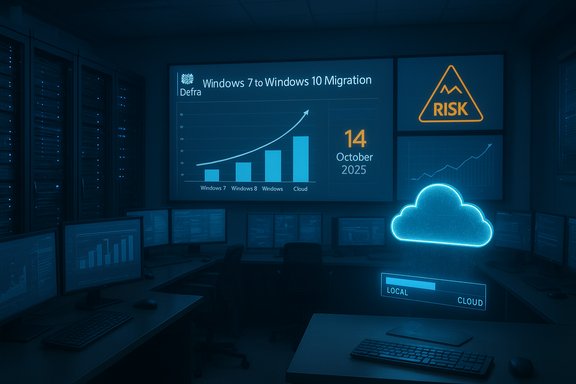
But there’s a strategic snag: the bulk of the refreshed laptops were standardised onto Windows 10, an OS Microsoft declared to have reached the end of support on 14 October 2025. After that date Microsoft stopped shipping routine security updates and technical fixes for mainstream Windows 10 editions — unless customers adopt Microsoft’s Extended Security Updates (ESU) program or migrate workloads to alternative supported platforms. This timing turns a headline success into a policy problem: the department has bought a more secure baseline today, but many of those gains risk evaporating unless a funded migration path to Windows 11, cloud desktops, or a paid ESU bridge is implemented quickly. Independent reporting and Defra’s own delayed reply to the Public Accounts Committee have crystallised this mismatch and raised hard questions about procurement timing, lifecycle alignment and future budget exposure.
From a governance perspective, the case is instructive: lifecycle events published by vendors are immovable calendar facts that should anchor procurement and budgeting cycles. If a department signs contracts and standardises on an OS within months of a vendor EOL date, ministers and accounting officers must be prepared to explain the rationale and the funding contingency for the next steps.
This is not an argument against modernisation; it is a guide for doing it end‑to‑end. Vendor lifecycles are hard dates. Procurement, budgets and migration roadmaps must be tightly aligned to those dates to prevent the practical and political cost of buying yesterday’s solution twice. Defra’s case is a cautionary study in lifecycle management that every public IT leader should read and learn from.
Source: GB News The UK Government spent £312 million upgrading to Windows 10 before its retirement this past October
 Background: what happened and why it matters
Defra’s recent account to Parliament frames the £312 million spending as a targeted push to remove long‑standing technical debt across a sprawling estate. The department reported removing 31,500 Windows 7 devices, remediating more than 49,000 critical vulnerabilities, migrating 137 legacy applications to modern platforms, and closing at least one ageing datacentre as part of the work completed during the 2022–23 to 2024–25 spending review window. Those activities — device replacement, vulnerability fixing, application rationalisation and datacentre consolidation — are precisely the sort of outcomes cybersecurity auditors and operational resilience teams want to see. They materially reduce acute risk vectors, improve maintainability and provide immediate operational benefit for services such as flood monitoring, border biosecurity and agricultural payments. That part of the story is a genuine public‑sector engineering win.But there’s a strategic snag: the bulk of the refreshed laptops were standardised onto Windows 10, an OS Microsoft declared to have reached the end of support on 14 October 2025. After that date Microsoft stopped shipping routine security updates and technical fixes for mainstream Windows 10 editions — unless customers adopt Microsoft’s Extended Security Updates (ESU) program or migrate workloads to alternative supported platforms. This timing turns a headline success into a policy problem: the department has bought a more secure baseline today, but many of those gains risk evaporating unless a funded migration path to Windows 11, cloud desktops, or a paid ESU bridge is implemented quickly. Independent reporting and Defra’s own delayed reply to the Public Accounts Committee have crystallised this mismatch and raised hard questions about procurement timing, lifecycle alignment and future budget exposure.
Overview of the technical facts (verified)
- Microsoft’s official lifecycle notice confirms that Windows 10 reached end of support on 14 October 2025 and that routine security and feature updates ceased on that date for mainstream editions. Microsoft advises migration to Windows 11 or enrollment in ESU where appropriate.
- Defra’s statement to Parliament lists £312 million spent in the 2022–23 to 2024–25 review period on legacy‑mitigation activities, including the removal of 31,500 Windows 7 laptops and an upgrade to Windows 10, remediation of ~49,000 critical vulnerabilities, and migration of 137 legacy applications. These figures have been reported across multiple outlets and appear in the department’s correspondence with oversight bodies.
- Microsoft’s consumer ESU route offers a one‑year extension through 13 October 2026 with low‑cost consumer enrollment options (including a $30 one‑time purchase or redeeming Microsoft Rewards), while commercial ESU for organisations is available via volume licensing and is priced per device — commonly reported as ~$61 per device in Year 1, with list prices designed to double each subsequent year (Year 2 ≈ $122, Year 3 ≈ $244). That structure intentionally nudges organisations toward migration rather than indefinite paid maintenance.
The wins: what the £312m actually delivered
Defra’s programme was not a cosmetic refresh. The reported deliverables have immediate operational and security value:- Removal of high‑risk legacy endpoints: Replacing 31,500 Windows 7 devices eliminated a large population of machines that had long been unsupported and exposed to unpatched vulnerabilities. That action alone reduces an easily exploitable attack surface.
- Vulnerability remediation: Addressing roughly 49,000 critical vulnerabilities is a measurable improvement in cyber posture. It directly cuts down known exposure points and improves compliance posture for regulated services.
- Application migration and datacentre consolidation: Moving 137 legacy applications away from obsolete infrastructure and closing at least one datacentre are foundational steps toward a leaner, cloud‑friendly architecture that supports modern disaster recovery and observability.
- Targeted temporary mitigations: The department applied security patches to ageing servers and deployed “hyper care” to buy time for full replacements — a pragmatic approach for mission‑critical services that can’t be swapped overnight.
The problem: bought obsolescence and timing mismatch
Despite the tangible wins, the programme’s OS choice created a shortened support runway. By standardising much of the new fleet on Windows 10 during 2024–25, Defra created a calendar mismatch: Microsoft’s lifecycle end date for Windows 10 meant that many of those updated endpoints would be left without free security updates just weeks or months after deployment. That turns a one‑off capital programme into a recurring policy decision with material budget implications. Key practical consequences:- Short bridge vs long migration: ESU is available as a time‑boxed bridge but is deliberately priced to compel migration. Relying on ESU across tens of thousands of devices will become increasingly expensive because of the year‑on‑year price escalation. For 31,500 devices, Year‑One ESU at ~$61/device would be roughly $1.92 million — modest relative to £312m but the costs escalate quickly if extended.
- Hardware compatibility limitations: Many of Defra’s remaining 24,000 devices and a wide slice of the estate may not meet Windows 11’s minimum hardware baseline (TPM 2.0, UEFI Secure Boot, supported CPU families, minimum RAM/storage). That means an in‑place OS upgrade may be impossible for a meaningful cohort, forcing full hardware replacement rather than a simple software migration. That drives new capital cycles.
- Operational complexity for domain‑specific apps: Some legacy applications — especially those tied to field systems, specialised instrumentation or tightly coupled workflows (like border controls or animal‑health systems) — require supplier revalidation and retesting for Windows 11. Migration timelines for those applications are longer and carry service continuity risk.
Financial and procurement risks
The episode highlights predictable but avoidable fiscal exposures:- ESU as a recurring cost trap: While a single year of ESU may be affordable, the doubling price model is cumulative. If an organisation uses ESU as a stopgap for multiple cohorts, the aggregate bill compounds fast and competes with funds for genuine transformation projects. Industry reporting and Microsoft partner guidance are consistent on this point.
- Procurement cadence vs vendor lifecycles: Public‑sector funding windows and supplier lead times don’t easily compress, yet vendor lifecycles (like Microsoft’s EOL calendar) are immovable. Misalignment here risks buying yesterday’s solution at scale and then funding the necessary fixes again. Parliamentary oversight noted Defra’s delayed response to the PAC request — the department’s letter arrived more than a year after a requested deadline — which reduced transparency about funding choices and ESU purchases.
- Hidden total cost of ownership (TCO): Beyond hardware purchase lies imaging, testing, user support, training, recycling and contract renegotiation. Large OS transitions understate the day‑two operational costs, which are the drivers of the next budget cycle.
Security implications and citizen impact
From a security lens, the timing matters because unsupported systems are high‑value targets for threat actors. The immediate mitigation — replacing Windows 7 devices — was justified and urgent. However:- Without a firm migration plan to supported platforms or a clear ESU procurement strategy, the residual estate faces elevated long‑term exposure once ESU windows close or are not purchased.
- Critical public services (flood monitoring, biosecurity, payments) rely on continuity and integrity. If ESU isn’t bought or migrations slip, the department will have to rely on compensating controls — network isolation, microsegmentation, and enhanced monitoring — which are costly and operationally brittle compared with supported endpoints.
- The citizen‑facing risk is not hypothetical — outages, data breaches, or degraded performance in services that underpin safety and commerce carry direct social and economic costs.
Practical options and trade‑offs for Defra (and similar organisations)
- Publish a clear, time‑boxed 36‑month roadmap:
- Identify device cohorts: eligible for in‑place upgrade to Windows 11, upgradeable with firmware/BIOS changes, non‑upgradeable (replacement required), and mission‑critical exceptions that need special handling.
- Commit to quarterly public reporting against KPIs (vulnerability counts, device replacement rates, critical app migrations).
- Use ESU strategically, not universally:
- Buy ESU only for the smallest set of devices that cannot be migrated within the next 12 months and which are business‑critical.
- Where possible, prioritise cloud‑hosted alternatives (Windows 365/Cloud PCs, Azure Virtual Desktop) because cloud entitlements can receive ESU updates without a per‑device commercial ESU fee in certain scenarios.
- Accelerate application modernisation for the highest‑impact services:
- Migrate externally exposed and border‑facing applications first.
- Use containerisation, refactoring, or cloud rehosting for stateful services where it reduces hardware dependency.
- Adopt circular procurement and sustainability practices:
- Implement trade‑in, refurbishment and certified recycling to lower net capital outlay and e‑waste. Large public programmes can reduce unit costs by recycling qualifying assets and using certified refurbishers.
- Strengthen governance and centralised inventory:
- Create an authoritative asset register tied to licensing entitlements and a single procurement pipeline to avoid duplicate purchases and last‑minute premium spending. Parliamentary scrutiny in this case found reporting delays that exacerbated the timing problem.
Accountability, optics and lessons from past programmes
Public scrutiny will rightly focus on whether the department’s programme was well‑planned end‑to‑end or a sequence of justified but disconnected interventions. Historical precedents in the UK show how major IT modernisation programmes can overshoot both budgets and deadlines; these cautionary tales give auditors and stakeholders reason to ask hard questions about long‑term value for money. Defra’s reported outcomes deserve credit, but taxpayers are entitled to clarity on how the department intends to avoid repeating a cycle of “buy today, fix again tomorrow.”From a governance perspective, the case is instructive: lifecycle events published by vendors are immovable calendar facts that should anchor procurement and budgeting cycles. If a department signs contracts and standardises on an OS within months of a vendor EOL date, ministers and accounting officers must be prepared to explain the rationale and the funding contingency for the next steps.
Strengths, weaknesses and the balanced verdict
Strengths- The programme removed a clearly identifiable risky population (Windows 7 devices) and materially reduced a backlog of critical vulnerabilities.
- Application migration and datacentre consolidation are durable investments that lower operational fragility and support future cloud transformation.
- Deployment of temporary protections for ageing servers shows pragmatic, risk‑based thinking where immediate replacement was infeasible.
- Choosing Windows 10 as the standardised target late in its lifecycle created a short support runway and exposed the department to renewed spending pressure within months.
- Public reporting delays and lack of explicit confirmation on whether ESU had been procured left parliamentary oversight and the public in the dark about near‑term funding exposure.
- Significant device backlogs and hardware compatibility gaps mean the next phase of modernisation will be capital‑intensive and operationally complex.
- The capital programme delivered real, measurable security and operational improvements. That matters.
- However, the strategic misalignment with Microsoft’s published lifecycle means many benefits are temporary unless Defra rapidly executes a funded migration, selectively uses ESU as a bridge, or moves eligible workloads into cloud entitlements that include extended updates.
What to watch next (short list)
- Publication of a time‑boxed migration roadmap with clear funding lines and named milestones.
- Parliamentary follow‑up that confirms whether and how ESU was purchased, and for which cohorts.
- Evidence of accelerated hardware refresh budgets or concrete cloud‑migration contracts covering the most critical services.
- Measurable quarterly impact: reductions in outstanding Windows 10 endpoints, decreases in critical vulnerability counts, and completed migrations of the highest‑risk legacy applications.
Conclusion
Defra’s £312 million modernisation programme addressed a real and present set of technical liabilities: the removal of tens of thousands of Windows 7 devices and the remediation of tens of thousands of critical vulnerabilities are measurable wins that reduced immediate risk to services that matter to citizens. But the decision to standardise on Windows 10 as Microsoft’s lifecycle clock ran down has created a new clock for taxpayers and officials: either pay for a time‑boxed vendor bridge, accelerate the move to Windows 11 and cloud desktops, or accept a growing exposure once ESU windows close.This is not an argument against modernisation; it is a guide for doing it end‑to‑end. Vendor lifecycles are hard dates. Procurement, budgets and migration roadmaps must be tightly aligned to those dates to prevent the practical and political cost of buying yesterday’s solution twice. Defra’s case is a cautionary study in lifecycle management that every public IT leader should read and learn from.
Source: GB News The UK Government spent £312 million upgrading to Windows 10 before its retirement this past October
