

Defra’s recent two‑day hackathon showed, in stark and practical terms, how focused cross‑disciplinary effort can pull a messy, policy‑bound problem into the light — and produce working, demonstrable solutions in days rather than months. What began as a compact experiment in automation for environmental reporting became a microcosm of modern public‑sector digital transformation: user research alongside technical prototyping, low‑code for rapid ingestion, cloud tools for heavy‑lifting transformations, and a candid appraisal of what worked — and what didn’t — when policy people and coders share a room.
Defra faces a perennial data problem: environmental reporting requires large volumes of heterogeneous datasets from many sources, submitted in different formats and with variable quality. These are core inputs to policies on air quality, emissions, peatland restoration, and regulatory compliance — areas where timeliness and traceability matter. Manual ingestion, ad‑hoc emails, and bespoke spreadsheets have long created bottlenecks that slow analysis and decision‑making.
The department’s broader digital and data transformation agenda has signalled a clear intent to modernise how it handles data: to consolidate tooling, adopt cloud platforms where appropriate, and embed user‑centred design in technical change. The hackathon, run by the Defra digital, data and technology team, was an experiment to test whether structured, short‑duration collaboration could produce practical automation that directly addresses everyday analyst pain points.
At the event, two mixed teams focused on complementary parts of the pipeline: Team A attacked the data intake problem using Microsoft Power Automate to replace manual email‑and‑file workflows with structured ingestion; Team B tackled the data transformation burden using an Azure‑centric approach to automate repetitive, time‑consuming ETL tasks. A parallel user research strand interviewed analysts and policy teams to keep development grounded in real‑world needs. The team reported they produced a working proof‑of‑concept within 48 hours — a rapid turnaround that emphasised showing over telling.
Azure was used for heavier transformation tasks where scale, complex joins, geospatial processing or machine learning could be required. Within Azure’s ecosystem, services like Data Factory, Databricks, Functions, and Blob Storage allow automated pipelines to be orchestrated, audited, and scaled — a necessary capacity when raw reporting files must be normalised, validated and aggregated for policy analysis.
The hackathon’s approach — low‑code for the intake layer, cloud compute for transformation — mirrors proven patterns used across UK public bodies that are modernising: low‑code to rapidly remove the most painful human processes and cloud to take on compute‑heavy transformations.
At the same time, government sustainability frameworks emphasise that digital transformation must not increase overall environmental harm. Office footprints, datacentre energy usage, and lifecycle impacts of devices are all part of the calculus. Any expansion of cloud‑based data processing should therefore include a carbon‑cost analysis and, where possible, utilisation of low‑carbon regions or offsetting strategies consistent with government guidance.
However, prototypes are not products. The event’s immediate success must now be followed by rigorous engineering, governance, procurement discipline, and cultural change work to achieve production‑grade systems. Particular attention should be paid to security, data protection, commercial commitments, and environmental impact as solutions are scaled.
If Defra and other public bodies use this format as a repeatable discovery loop — building prototypes, validating user demand, and then investing the time to harden the most promising ideas — the payback could be significant: faster reporting cycles, more reliable evidence for policy, and better use of analyst time to focus on outcomes. The key is to treat the hackathon as the beginning of an accountable delivery pathway, not its end.
Defra’s experiment demonstrates an important truth for public‑sector digital transformation: speed and structure are complementary. Well‑designed hackathons can compress discovery, prove concepts, and bring disparate teams into productive dialogue. But to turn that momentum into sustained change requires the same discipline and investment that any high‑value government service demands. The hackathon offered a practical glimpse of what’s possible — the work now is to institutionalise the pathways that lead from prototype to secure, sustainable, and policy‑useful production systems.
Source: UKAuthority Defra holds hackathon for environmental reporting data challenges | UKAuthority
 Background: why Defra ran the hackathon
Defra faces a perennial data problem: environmental reporting requires large volumes of heterogeneous datasets from many sources, submitted in different formats and with variable quality. These are core inputs to policies on air quality, emissions, peatland restoration, and regulatory compliance — areas where timeliness and traceability matter. Manual ingestion, ad‑hoc emails, and bespoke spreadsheets have long created bottlenecks that slow analysis and decision‑making.The department’s broader digital and data transformation agenda has signalled a clear intent to modernise how it handles data: to consolidate tooling, adopt cloud platforms where appropriate, and embed user‑centred design in technical change. The hackathon, run by the Defra digital, data and technology team, was an experiment to test whether structured, short‑duration collaboration could produce practical automation that directly addresses everyday analyst pain points.
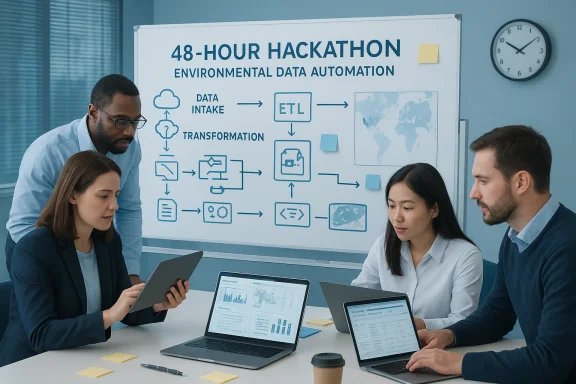
At the event, two mixed teams focused on complementary parts of the pipeline: Team A attacked the data intake problem using Microsoft Power Automate to replace manual email‑and‑file workflows with structured ingestion; Team B tackled the data transformation burden using an Azure‑centric approach to automate repetitive, time‑consuming ETL tasks. A parallel user research strand interviewed analysts and policy teams to keep development grounded in real‑world needs. The team reported they produced a working proof‑of‑concept within 48 hours — a rapid turnaround that emphasised showing over telling.
What happened in the room: structure, tools, and outcomes
A disciplined, dual‑track format
Defra’s approach followed a clear pattern:- User research ran in parallel with technical work, feeding immediate insight into developer choices.
- Two problem domains were targeted: intake (the front door) and transformation (the backstage work).
- Mixed teams included policy leads, analysts, digital specialists, and vendor partners, aiming to blend domain knowledge with engineering capability.
- The event ended with working demonstrations rather than slide decks — a tactical decision designed to build confidence in the approaches and show practical value quickly.
Why Power Automate and Azure?
Power Automate is a natural fit for rapid, low‑code workflows that reduce human touchpoints in data ingestion: automated email parsing, file extraction, and moving data into a canonical storage location. For many government teams, Power Platform reduces time‑to‑value because citizen‑facing analysts and subject matter experts can participate without waiting for a full engineering project.Azure was used for heavier transformation tasks where scale, complex joins, geospatial processing or machine learning could be required. Within Azure’s ecosystem, services like Data Factory, Databricks, Functions, and Blob Storage allow automated pipelines to be orchestrated, audited, and scaled — a necessary capacity when raw reporting files must be normalised, validated and aggregated for policy analysis.
The hackathon’s approach — low‑code for the intake layer, cloud compute for transformation — mirrors proven patterns used across UK public bodies that are modernising: low‑code to rapidly remove the most painful human processes and cloud to take on compute‑heavy transformations.
Why the outcomes matter: practical benefits for environmental reporting
The hackathon produced several concrete gains that are directly relevant to analysts and policy teams:- Faster time to insight. Automating ingestion and routine transformations shrinks the lag from file receipt to analyst‑ready data.
- Reduced manual error. Removing repeated cut‑and‑paste and manual normalisation lowers the risk of transcription errors that contaminate datasets.
- Increased reproducibility. Declarative workflows and scripted transforms produce auditable pipelines, improving traceability for regulatory and transparency purposes.
- Better use of skills. Automation returns analyst time from routine plumbing to interpretation and policy analysis — where domain expertise matters most.
- Cross‑team empathy. Shared workspaces and direct dialogue between policy and technical teams produce common mental models; the hackathon format expanded that benefit in a compressed timeframe.
Critical analysis: strengths of the approach
1) Rapid validation with low upfront cost
Running a two‑day, bounded event concentrates effort and minimises sunk cost risk. Rather than commissioning a months‑long vendor engagement, Defra created a space to test viability. This fail fast, learn fast pattern is particularly suitable for targeted automation problems with clear success criteria.2) User‑centred design prevented techno‑solutionism
Explicitly embedding interviews and research avoided the common pitfall of building “clever” tools that don’t fit workflows. The event demonstrated that technical feasibility without user fit is worthless, and prioritising analyst interviews delivered practical constraints for the prototypes.3) Demonstrations beat slides
The hackathon confirmed an intuitive but important lesson: working prototypes build trust. Where PowerPoint promises fail, a live ingestion pipeline and a demo transform are persuasive both to analysts and procurement stakeholders.4) Reuse of existing foundations
Teams intentionally focused on adding automation on top of existing systems rather than rebuilding everything. This incrementalism is not just pragmatic; it reduces risk, shortens delivery cycles, and improves the chance of eventual adoption.Risks, limits, and practical concerns
No hackathon is a silver bullet. The event identified operational and governance risks that need careful mitigation before prototypes can be industrialised.1) Perceived sidelining of policy and operational colleagues
Once technical prototyping began, some policy and operational people felt marginalised. That’s a predictable dynamic: the “build” phase often becomes a developer‑centric exercise. The team mitigated this by introducing parallel non‑technical activities (North Star visioning, MVP drafting), but the lesson is clear: design the event so every participant has meaningful continuous tasks across all phases.2) Technical debt and production readiness
Proofs of concept often harden into fragile production systems if not re‑engineered. Rapid prototypes may lack robust error handling, monitoring, cost controls, security hardening, or data governance. Turning a 48‑hour prototype into a resilient production pipeline requires disciplined rework, architecture reviews, and a clear acceptance of re‑engineering cost.3) Vendor and platform lock‑in
The hackathon used Microsoft Power Automate and Azure. That is defensible — many UK public bodies already use Microsoft cloud and Power Platform — but it raises questions around long‑term vendor dependency, licensing costs, and the ability to interoperate with non‑Microsoft tooling. A short event should not dictate platform choice for all future work without a formal decision framework.4) Data protection and legal compliance
Environmental reporting often includes sensitive or personally identifiable information (PII) depending on the data source. Rapid prototyping must not sidestep data protection obligations, including lawful bases under data protection regulation, retention policies, and secure handling. Prototype demos should always use anonymised or synthetic data — a point the Defra team observed by securing dummy datasets prior to the event.5) Cloud sustainability trade‑offs
Moving heavier processing to cloud providers reduces on‑premise footprint but is not automatically greener. Organisations must consider regional datacentre energy mixes, the carbon cost of compute, and lifecycle emissions of data storage. A sustainability assessment should be part of the decision to scale any cloud‑based transformation.Technical considerations: from prototype to production
If Defra (or any public body) wishes to take these POCs forward, the route to production has a clear engineering and governance checklist:- Harden the pipelines
- Convert proof‑of‑concept scripts and flows into tested, versioned code or managed artifacts.
- Add retry logic, error handling, schema validation, and idempotency guarantees.
- Implement observability
- Deploy logging, metrics, and alerts. Ensure analysts and SRE teams can trace data lineage end‑to‑end.
- Perform security and privacy reviews
- Conduct threat modelling, penetration testing for exposed interfaces, and a DPIA where PII could be processed.
- Formalise governance and data catalogue
- Register datasets in a central catalogue with ownership, SLAs, and retention rules.
- Cost management
- Introduce cloud cost monitoring and enforce limits for test and production environments.
- Accessibility and inclusivity
- Ensure any analyst UIs meet accessibility standards and can be used by different teams and stakeholders.
- Re‑architecture where required
- For long‑running jobs, consider more economical compute (scheduled batch on Databricks, Azure Batch or containerised jobs) rather than always‑on services.
Governance, procurement and commercial considerations
The hackathon model is appealing to vendors and partners because it accelerates engagement and clarifies scope early. But the public‑sector context places special emphasis on procurement transparency, value for money and long‑term maintenance contracts.- Procurement teams should use the hackathon outputs to author clear scope for subsequent work: what is the minimum viable product (MVP), who will operate it, what are support SLAs, and how will upgrades be funded?
- Commercial agreements must balance rapid vendor involvement with public procurement rules and the government's responsibilities to avoid hidden long‑term costs.
- Open standards and APIs reduce lock‑in risk. Wherever possible, ensure that ingestion formats and transformed datasets are accessible via commonly‑used APIs or data formats, not locked to a single vendor’s proprietary outputs.
Policy and organisational change: the human side
Automation changes workflows. Analysts will routinely gain more time for insight work, but that requires organisational readiness:- Retraining and re‑skilling. Analysts and policy leads should be trained on how the new pipelines work and how to interpret data lineage and quality flags.
- Role redefinition. Teams may move from data wrangling to data stewardship, requiring new job descriptions and performance measures.
- Decision rights. Establish who owns the “single source of truth” for a dataset and who can approve changes to ingestion rules or transforms.
- Change management. Embed user research and feedback loops post‑deployment to ensure tools evolve with policy needs.
Recommendations: how Defra and similar public bodies should scale this model
Based on what worked in the hackathon and what public‑sector practice shows, here is a practical roadmap for scaling prototypes into resilient services:- Treat the hackathon as formal discovery, not delivery. Use it to shape an MVP backlog with clear acceptance criteria and success metrics.
- Insist on synthetic or anonymised data during events. Only move to live datasets after DPIA and security approval.
- Plan the production pathway beforehand. Allocate budget and governance time for re‑engineering, not just a single procurement sprint.
- Adopt platform‑neutral design where possible. Use open data formats and layered architectures so components can be replaced if vendor strategy changes.
- Build a data catalogue and pipeline registry at the outset. This improves discoverability and prevents “shadow pipelines” from multiplying.
- Prioritise observability and testability. Pipelines without monitoring and automated tests are brittle and costly to operate.
- Bake sustainability into platform choices. Consider compute hours, regional energy factors, and data retention policies when designing solutions.
Wider context: how this fits into the UK government’s digital and sustainability strategies
Defra’s experiment sits within broader government trends: departments are embracing cloud platforms where they can deliver scale and efficiency, while also adopting low‑code platforms to empower non‑engineers to automate routine tasks. This is reflected in multiple public‑sector digital programmes that prioritise both modernisation and sustainability of digital services.At the same time, government sustainability frameworks emphasise that digital transformation must not increase overall environmental harm. Office footprints, datacentre energy usage, and lifecycle impacts of devices are all part of the calculus. Any expansion of cloud‑based data processing should therefore include a carbon‑cost analysis and, where possible, utilisation of low‑carbon regions or offsetting strategies consistent with government guidance.
Final assessment: what the hackathon proved — and what remains to be done
Defra’s hackathon was a pragmatic and well‑executed demonstration that short, focused collaboration can surface viable automation approaches for entrenched data problems. The combination of Power Automate for ingestion and Azure for transformation is a sensible pattern that leverages low‑code speed with cloud scale.However, prototypes are not products. The event’s immediate success must now be followed by rigorous engineering, governance, procurement discipline, and cultural change work to achieve production‑grade systems. Particular attention should be paid to security, data protection, commercial commitments, and environmental impact as solutions are scaled.
If Defra and other public bodies use this format as a repeatable discovery loop — building prototypes, validating user demand, and then investing the time to harden the most promising ideas — the payback could be significant: faster reporting cycles, more reliable evidence for policy, and better use of analyst time to focus on outcomes. The key is to treat the hackathon as the beginning of an accountable delivery pathway, not its end.
Practical checklist for other departments considering a similar event
- Define clear success metrics before the event (e.g., reduce manual ingestion time by X%, or automate Y% of routine transforms).
- Secure ethical and legal sign‑off for the use of any live data; default to synthetic datasets in the hackathon.
- Recruit mixed teams: policy leads, analysts, user researchers, platform engineers and procurement representatives.
- Build an explicit MVP and North Star during the hackathon to maintain relevance for non‑technical participants.
- Schedule a post‑event transition window for re‑engineering prototypes into compliant services, with assigned budget and owners.
- Publish an outcomes report that includes technical architecture, cost estimates for production, and a plan for monitoring and governance.
Defra’s experiment demonstrates an important truth for public‑sector digital transformation: speed and structure are complementary. Well‑designed hackathons can compress discovery, prove concepts, and bring disparate teams into productive dialogue. But to turn that momentum into sustained change requires the same discipline and investment that any high‑value government service demands. The hackathon offered a practical glimpse of what’s possible — the work now is to institutionalise the pathways that lead from prototype to secure, sustainable, and policy‑useful production systems.
Source: UKAuthority Defra holds hackathon for environmental reporting data challenges | UKAuthority
