

Dell’s 2024 forecast that “AI PCs” would trigger a broad laptop refresh has proven partly prophetic — but not in the tidy, single-cause way the company pitched. The industry did see a meaningful replacement wave through 2025, driven first by a hard calendar deadline (Windows 10 end-of-support) and second by OEMs’ push to position Copilot+ / AI PCs as the natural upgrade choice for organizations and power users. The result: shipment volumes ticked up, enterprise procurement patterns changed, and OEMs such as Dell reorganized product lines to make AI-capable devices easier to buy and manage — but the refresh was less a stampede to buy AI hardware than a multi-factor market reaction where security, procurement simplicity, and poster‑child AI features all played parts.
The PC market entered 2025 under two overlapping forces. First, Microsoft set a hard lifecycle boundary: Windows 10 reached end-of-support on October 14, 2025, which meant enterprises and many public institutions faced security and compliance drivers to refresh or enroll in Extended Security Updates. That deadline created a concrete procurement window for risk-averse buyers. Second, Microsoft and major OEMs reframed the upgrade conversation around a new hardware tier — Copilot+ PCs (aka AI PCs) — which pair Windows 11’s Copilot functionality with on-device neural processing (NPUs) and a baseline hardware footprint (practical minima such as 16 GB RAM, 256 GB storage and NPUs capable of tens of TOPS). OEM marketing and analyst forecasts amplified this message: vendors argued that on-device AI improves latency, privacy and productivity for many everyday workloads, so buyers should pick AI-capable machines when replacing end-of-life equipment. The combined effect — a hard software EoS deadline plus a marketed AI-premium — produced a quarter where global PC shipments climbed substantially year-on-year in Q3 2025, with IDC reporting roughly 75.8–75.9 million units (+9.4% YoY) and marking Dell, Lenovo and HP among the largest vendors by shipments. IDC’s tracking put Dell’s market share near 13.3% in that quarter. Independent aggregator snapshots show slight methodological differences but the same overall direction: a refresh wave anchored to Windows 10 EoS with AI-capable devices prominent in vendor portfolios.
That public repositioning included two visible tactics:
The Dell-predicted “great refresh” arrived — but it was a composite event, not a single-cause revolution. Windows 10’s end-of-support created the buying window; Dell’s simpler product taxonomy and Copilot+ positioning helped it capture and shape demand inside that window; and on‑device AI has become a meaningful differentiator where the business case is clear. For IT leaders, the lesson is pragmatic: treat AI-capable devices as targeted strategic investments, not an automatic replacement rationale for every endpoint. Evidence, pilots, governance and lifecycle commitments should guide the refresh — while vendor messaging and analyst forecasts help prioritize where real ROI is likely to appear.
Source: htxt.co.za Have AI PCs resulted in the great refresh Dell predicted? - Hypertext
 Background / Overview
The PC market entered 2025 under two overlapping forces. First, Microsoft set a hard lifecycle boundary: Windows 10 reached end-of-support on October 14, 2025, which meant enterprises and many public institutions faced security and compliance drivers to refresh or enroll in Extended Security Updates. That deadline created a concrete procurement window for risk-averse buyers. Second, Microsoft and major OEMs reframed the upgrade conversation around a new hardware tier — Copilot+ PCs (aka AI PCs) — which pair Windows 11’s Copilot functionality with on-device neural processing (NPUs) and a baseline hardware footprint (practical minima such as 16 GB RAM, 256 GB storage and NPUs capable of tens of TOPS). OEM marketing and analyst forecasts amplified this message: vendors argued that on-device AI improves latency, privacy and productivity for many everyday workloads, so buyers should pick AI-capable machines when replacing end-of-life equipment. The combined effect — a hard software EoS deadline plus a marketed AI-premium — produced a quarter where global PC shipments climbed substantially year-on-year in Q3 2025, with IDC reporting roughly 75.8–75.9 million units (+9.4% YoY) and marking Dell, Lenovo and HP among the largest vendors by shipments. IDC’s tracking put Dell’s market share near 13.3% in that quarter. Independent aggregator snapshots show slight methodological differences but the same overall direction: a refresh wave anchored to Windows 10 EoS with AI-capable devices prominent in vendor portfolios. What Dell predicted — and what it changed in practice
Dell’s big bet: AI PCs as the refresh engine
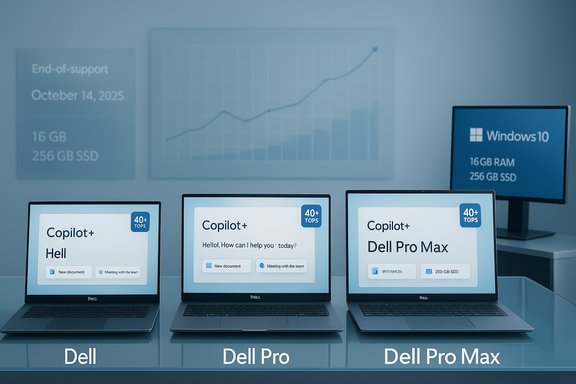
At public events and in regional briefings, Dell framed 2024–2025 as a window where endpoint hardware would be redefined around on-device AI capabilities. The company repositioned its laptop lineup into simplified tiers (Dell, Dell Pro, Dell Pro Max) designed to make it easier for procurement teams to match device personas to roles, and highlighted Copilot+ integrations as a key differentiator for the new devices. The messaging was explicit: smart, Copilot‑enabled endpoints plus deskside Pro Max workstations for heavier development workloads would nudge procurement decisions toward AI-capable hardware.That public repositioning included two visible tactics:
- A major naming and segmentation overhaul to convert legacy model names into a simpler three‑tier taxonomy (Dell / Dell Pro / Dell Pro Max), intended to reduce procurement confusion and speed specification decisions.
- Heavy promotion of Copilot+ PC capabilities — physical Copilot keys, NPUs with specified TOPS targets, and messaging around “on‑device AI” workflows — as a reason to prefer new systems when replacing Windows 10 endpoints.
Reality check: the refresh drivers were layered, not singular
Dell’s forecast proved directionally accurate — AI capability is one of the main differentiators in current OEM messaging and product roadmaps — but the immediate refresh that showed up in shipment figures was primarily a response to Windows 10’s end-of-support. Many organizations treated Windows 11 compatibility and the security imperative as the initial driver, and then selected AI-capable SKUs where budgets and role needs aligned. In short: the EoS date created the buying window; AI features influenced which SKUs vendors and IT teams picked during that window. Multiple trackers and analyst commentary support this reading: IDC and Gartner tallies for Q3 2025 show increased shipments (IDC ~75.8M, Gartner a slightly lower number), and their accompanying analysis points to Windows 10 EOS + regional education and public-sector refresh programs as the immediate cause — with AI PC positioning helping to lift average selling prices and to steer procurement choices for prioritized user groups.The Dell lineup change: simpler names, real impacts
From Latitude, XPS and Inspiron to Dell / Dell Pro / Dell Pro Max
Dell’s renaming was a bold move with operational and communications intent: reduce SKU confusion, standardize procurement personas, and make it easier to match device tiers to organizational roles. That change created short-term friction — long‑standing model names like XPS, Latitude, Inspiron and Precision had familiarity and institutional memory — but Dell’s messaging argued the simplified taxonomy would speed decision-making and reduce the risk of mis‑specifying endpoints. Early feedback from channel partners suggests the simplification helped procurement teams identify the intended device class more quickly once they adjusted to the new names.Practical benefits observed in enterprise procurement
- More stakeholders in organizations participated in procurement decisions, in part because the new naming and persona framing made trade-offs clearer.
- Procurement cycles became slightly more unified; organizations reported fewer one-off purchases for individual employees and more standardized device baselines across business units.
- Where organizations prioritized security and Copilot features (e.g., knowledge-worker segmentation, creative teams, compliance-heavy groups), they selected Dell Pro and Dell Pro Max SKUs that matched their Copilot+ requirements.
Did AI capabilities actually drive the replacement decisions?
Short answer: sometimes. Contextual answer: the degree to which AI features drove replacement varied by buyer type and by role.Where AI won the argument
- Creative professionals and knowledge workers who benefit from local inference (real-time transcription, meeting recall, on-device image enhancement and content generation) were most likely to justify Copilot+ SKUs. For these roles, NPUs reduced latency and preserved privacy relative to cloud-only processing.
- Regulated industries (healthcare, finance, government) that wanted on‑premise inference for sensitive data favored deskside Pro Max appliances or Copilot+ devices with strong governance and encryption features.
- Early adopter IT teams with a mandate to modernize workflows used pilot programs to prove productivity gains and then selected AI-capable devices for high-value personas.
Where AI mattered less
- Price-sensitive consumer segments and budget-constrained deployments often prioritized cost and battery life over NPU specs. Many such buyers deferred replacement unless a machine failed or a sale made the price compelling.
- Some enterprise channels treated AI capability as a nice-to-have rather than a must-have when the primary procurement driver was merely “replace Windows 10” for compliance reasons. In those cases, procurement selected the lowest-cost Windows 11‑capable device that met security standards.
The numbers: what trackers actually show
- IDC’s preliminary Q3 2025 read placed worldwide PC shipments at roughly 75.8–75.9 million units, a 9.4% year‑on‑year increase. The firm attributed much of the uplift to Windows 10 EoS-led refresh demand and large public-sector purchases in APAC (notably Japan). Dell’s share by IDC was reported around 13.3% for Q3 2025.
- Gartner’s published snapshots produced a slightly different unit total (methodology differences between firms are common), but Gartner likewise highlighted Windows 10 EoS as the key near‑term driver and forecasted that AI PCs could account for a sizeable share of device shipments through 2025 and beyond — a trend that supports Dell’s positioning even if the timing of adoption varies.
Technical reality: what “AI PC” means in 2025
Copilot+ certification and NPUs
Microsoft’s Copilot+ push formalized a hardware tier with practical minimums:- A dedicated NPU capable of roughly 40+ TOPS (Trillions of Operations Per Second) is the commonly cited baseline for unlocking many on‑device Copilot features.
- Practical Copilot+ SKUs target 16 GB RAM, 256 GB SSD and silicon families that include Intel Core Ultra (with Intel AI Boost), AMD Ryzen AI 300 series, or Qualcomm Snapdragon X variants. These thresholds signal the vendor‑certified on‑device capability set that supports features like Recall, cocreation tools, and rich Windows Studio Effects.
On-device versus cloud: practical trade-offs
- On‑device inference reduces latency and some privacy exposure, but it typically increases device cost and can raise power/thermal trade-offs, especially in thin‑and‑light form factors.
- Cloud processing remains valuable where models are large, stateful, or frequently updated. Many Copilot features operate on a hybrid model: local acceleration where possible, cloud fallback where needed. Enterprises should design governance around both ends of this spectrum.
Strengths and opportunities of Dell’s strategy
- Simplified procurement: Rebranded tiers (Dell / Dell Pro / Dell Pro Max) help non-technical stakeholders choose appropriate devices for job functions faster, lowering procurement friction.
- Product breadth: Dell offers both Copilot+ laptops for everyday productivity and Pro Max deskside systems (GB10) for local model development — a complementary portfolio for enterprise AI journeys.
- Services integration: Dell couples hardware with managed services (APEX, accelerator services) that help organizations deploy, govern and backup AI‑enabled endpoints and the data they produce. This services layer is crucial to converting pilots into scale deployments.
- Market timing: Pairing a migration narrative (Windows 10 EoS) with product launches gave Dell a near-term instrument to capture replacement budgets. It was a pragmatic alignment of technical capability and sales timing.
Risks, limits and open questions
- Software / driver maturity: On-device AI depends on stable runtimes, OS integrations and vendor drivers. Early NPUs often face tooling gaps that delay real productivity benefits. Enterprises should demand evidence of end-to-end software maturity before wide rollouts.
- Measurable ROI: For many roles, AI features remain incremental. Without well-defined KPIs and pilot results, broad purchases risk delivering little productivity uplift relative to their cost. Pilot-based procurement is still the prudent course.
- Battery, thermals, and user experience: NPUs add power and thermal demands. Thin laptops marketed as AI PCs may throttle sustained workloads; for heavy, sustained inference, desktops or deskside appliances (e.g., Pro Max GB10) remain preferable.
- E‑waste and lifecycle concerns: A synchronized refresh tied to EoS creates a wave of retired devices. Responsible procurement must include trade-in, refurbishment and secure data sanitization programs to avoid environmental and security downsides.
- Vendor lock-in and governance: On-device models, recall features and local stores raise governance, compliance and discovery questions. Running AI locally does not reduce the need for centralized logging, access controls, model provenance and audit trails. Vendors’ managed services help, but customers still own the governance design.
Practical guidance for IT teams and buyers
- Map your estate: identify endpoints that cannot upgrade to Windows 11, those that need AI features, and those that can wait.
- Pilot before scale: run role-based pilots (e.g., contact centers, creative teams, compliance groups) and measure KPIs such as time saved, error reduction, or model latency.
- Validate software stacks: insist on proof that your target workloads run on the vendor’s NPU runtime, not just on paper TOPS numbers.
- Negotiate lifecycle terms: require trade-in, certified refurbishment, secure wiping, and a clear driver/firmware update commitment.
- Use ESU as bridge: Extended Security Updates can buy time for measured migration rather than forcing a rushed, expensive wholesale replacement.
Verdict: did Dell’s prediction come true?
Dell’s strategic bet — that AI-capable PCs would reshape procurement and prompt a refresh — was directionally correct. The market did refresh in 2025, and AI PC messaging materially influenced which SKUs were chosen for prioritized user groups. But the phenomenon was not solely an “AI PC” stampede. A hard lifecycle deadline (Windows 10 end-of-support) was the primary accelerant, and Dell’s rebranding and Copilot+ positioning helped the company capture a significant portion of the upgrade budgets that followed. Analysts’ multiple readings of Q3 2025 (IDC vs. Gartner) agree on the trend lines: an elevated refresh anchored to EoS, with AI PCs forming an important — but not exclusive — axis of differentiation.Where we go from here
- Watch the next IDC / Gartner quarterly reports to see whether AI PC share continues to grow beyond EoS-driven momentum. If AI-capable devices drop into mainstream procurement driven by measurable ROI, Dell’s strategy will have delivered sustained value. If AI remains a premium feature adopted only by a subset of users, vendor messaging may shift to services and hybrid cloud solutions instead.
- Track software updates and developer tooling: real on-device value depends on mature runtimes and broad app integration. The NPU TOPS race matters less than the ecosystem’s ability to utilize that compute.
- Monitor regulatory and governance responses: features like Recall and local activity indexing will attract scrutiny. Enterprises must construct policies proactively to avoid privacy and compliance risk.
The Dell-predicted “great refresh” arrived — but it was a composite event, not a single-cause revolution. Windows 10’s end-of-support created the buying window; Dell’s simpler product taxonomy and Copilot+ positioning helped it capture and shape demand inside that window; and on‑device AI has become a meaningful differentiator where the business case is clear. For IT leaders, the lesson is pragmatic: treat AI-capable devices as targeted strategic investments, not an automatic replacement rationale for every endpoint. Evidence, pilots, governance and lifecycle commitments should guide the refresh — while vendor messaging and analyst forecasts help prioritize where real ROI is likely to appear.
Source: htxt.co.za Have AI PCs resulted in the great refresh Dell predicted? - Hypertext
