

Dell and Microsoft used the Microsoft Ignite stage to push a single, business‑critical message: cyber resilience must move from a checkbox to an operational practice, and the fastest route there is tighter product integration, automated recovery workflows, and cloud‑native protection that treats recovery readiness as a first‑class feature.
Microsoft Ignite 2025 served as the backdrop for a series of coordinated announcements that expand how Dell’s storage and data‑protection portfolio integrates with Microsoft Azure and Azure Local. The briefings focused on three intertwined themes: extending enterprise file and unstructured data services into Azure, delivering backup‑as‑a‑service and cyber recovery capabilities built on Azure infrastructure, and packaging those capabilities with advisory and managed services to accelerate customer adoption.
This is not a simple product refresh. The announcements signal a deeper strategic posture: a joint effort to marry Dell’s long‑standing strengths in on‑premises storage, backup appliances and cyber‑recovery tooling with Microsoft’s cloud scale, platform services, and operational tooling. The result is a portfolio that pitches resilience — not just prevention — as the measurable outcome for enterprise customers wrestling with ransomware, supply‑chain risks and increasingly complex hybrid environments.
Yet technology is only one pillar. These product moves will deliver real business value for organizations that:
Ultimately, the shift from prevention to resilience is not optional — it reflects how the threat landscape has matured. Vendors are packaging useful tools and managed services to reduce operational friction; the deciding factor for organizations will be whether these capabilities are adopted with discipline and verified through regular, realistic testing.
Source: SiliconANGLE Dell Microsoft collaboration emphasizes cyber resilience - SiliconANGLE
 Background
Microsoft Ignite 2025 served as the backdrop for a series of coordinated announcements that expand how Dell’s storage and data‑protection portfolio integrates with Microsoft Azure and Azure Local. The briefings focused on three intertwined themes: extending enterprise file and unstructured data services into Azure, delivering backup‑as‑a‑service and cyber recovery capabilities built on Azure infrastructure, and packaging those capabilities with advisory and managed services to accelerate customer adoption.This is not a simple product refresh. The announcements signal a deeper strategic posture: a joint effort to marry Dell’s long‑standing strengths in on‑premises storage, backup appliances and cyber‑recovery tooling with Microsoft’s cloud scale, platform services, and operational tooling. The result is a portfolio that pitches resilience — not just prevention — as the measurable outcome for enterprise customers wrestling with ransomware, supply‑chain risks and increasingly complex hybrid environments.
Overview of the announcements
What was introduced (high level)
- Dell PowerScale for Azure — a fully managed, enterprise file storage option integrated as a native service within the Azure ecosystem, designed to handle high‑performance, unstructured workloads and bridge on‑premises and cloud operations.
- PowerProtect Backup Services on Azure — enhancements to Dell’s backup‑as‑a‑service offering that run on Azure infrastructure, promising unified protection for hybrid workloads and automated recovery workflows for faster incident response.
- Expanded Azure Local support for Dell Private Cloud and PowerStore — enabling tighter hybrid deployments where Azure Local can be consumed with Dell private cloud infrastructure.
- Product updates across the PowerProtect portfolio — improvements to the cyber recovery suite, Data Domain enhancements (including larger virtual capacity on Azure), and new add‑ons for government/cloud‑facing workloads.
- Advisory and managed services — bundled services to accelerate adoption, including managed detection and response that combines Dell expertise with platform tooling, and advisory programs aimed at regulatory frameworks and resilience maturity.
The tone and messaging
The messaging shifted away from pure capability arms‑racing and toward a recovery‑centric posture. Executives framed the problem as a “confidence versus capability” gap within enterprises: leadership often believes controls are resilient, yet organizations discover gaps only during an incident. As a corrective, the announcements focused on ensuring customers can prove recoverability — through immutable copies, isolated recovery vaults, integrated detection, and automated workflows that reduce human error during crisis recovery.Why this matters: the practical value for enterprise IT
Closing the “confidence vs capability” gap
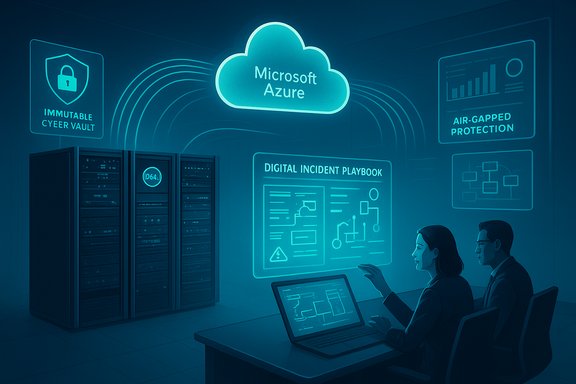
Organizations routinely overestimate their preparedness. The announcements address this by operationalizing recoverability:- Immutable backups and air‑gapped cyber vaults aim to ensure that a “clean copy” exists off the attack surface.
- Automated recovery playbooks and orchestration reduce the manual toil that slows recovery and increases risk.
- Integrations with cloud identity and platform security help align backup controls with the rest of the security stack.
Simplified hybrid operations
The push to deliver PowerScale as a managed, native Azure service and to expand Azure Local support for Dell Private Cloud shows an explicit effort to reduce the friction of hybrid architectures:- Centralized, cloud‑native management lowers operational overhead and reduces the need for bespoke automation.
- Dell taking responsibility for deployment, lifecycle updates, and operations can help teams focus on application outcomes rather than low‑level storage tuning.
- Native Azure packaging lowers the barrier for cloud teams to consume enterprise file services without complex lift‑and‑shift projects.
Better ransomware posture, in principle
Key product moves were explicitly aimed at ransomware resilience:- Data immutability layers, multi‑factor controls, and role‑based access control were highlighted as prerequisites.
- Cyber recovery vaults and the application of automated forensic scanning and anomaly detection to backups were presented as tools to speed safe restores and stop reinfection cycles.
- The focus on automated recovery workflows aims to cut Mean Time To Restore (MTTR), a metric that correlates directly with business impact and cost.
Technical specifics and verification
PowerScale for Azure and PowerProtect changes
- PowerScale for Azure is positioned as a managed, enterprise file storage service that integrates with Azure tooling and manages unstructured data across on‑premises and cloud environments. Dell’s briefings and product pages confirm the managed service approach, the goal of simplifying unstructured data operations, and the delegation of deployment and lifecycle management to Dell’s operations team.
- PowerProtect Backup Services enhancements include agentless protection for Azure workloads, support for Azure Blob storage as a target, and expanded virtual capacity for Data Domain in Azure (reported increases in virtual edition capacity). Product notes highlight integration with cyber vault tooling and the availability of new add‑ons for government/GovCloud deployments.
- Data Domain virtual appliance capacity and platform performance improvements were called out as part of the data‑protection portfolio refresh. Specific hardware models and claimed performance gains were published by the vendor as part of a product launch.
Service availability and timelines
The managed PowerScale and APEX‑branded protection services were described as being in public preview or rolling out in controlled availability windows, with some services slated for general availability in phased timelines. The vendor called out preview windows and first‑half-of‑year availability for certain managed options. Customers should plan for staggered availability and request explicit SLA, region, and compliance details during procurement conversations.Numbers and “exabyte” claims — exercise caution
Public statements by vendors about the scale of data under protection often vary across presentations and transcripts. Company briefings included large‑scale numbers — exabytes of data protected — but those figures have shifted in different public statements over time and are sometimes cited in broader investor or marketing documents. Because these numbers are company self‑reported and an aggregation across multiple services and partner environments, they require cautious handling:- Treat multi‑exabyte figures as vendor‑reported scale metrics, useful for gauging market presence but not as independently audited performance or coverage guarantees.
- Request audited, region‑specific capacity and operational guarantees during procurement, rather than relying on headline exabyte numbers.
Strengths of the Dell–Microsoft approach
1. Integrated stack reduces complexity
Providing native, managed file services in Azure and bundling backup services on Azure infrastructure reduces friction and operational inconsistency. For organizations wrestling with hybrid stacks, this can materially lower the TCO and reduce the number of moving parts during incident response.2. Emphasis on recoverability and automation
Automation of recovery playbooks and orchestration of vaulting and forensic scanning shift resilience from a best‑effort practice to something measurable and testable. This is especially valuable for organizations with limited incident response manpower.3. Platform scale and choices
Combining a major hyperscaler’s global footprint with Dell’s engineered appliances and field services gives large enterprises the option to meet stringent regulatory and performance needs while still leveraging cloud agility.4. Advisory and managed services reduce time to maturity
Including advisory programs for maturity models and assigning managed detection/responder capability reduces the expertise gap and can accelerate customers up the maturity curve faster than technology purchases alone.Risks, gaps, and potential pitfalls
1. Vendor lock‑in and platform entanglement
Tighter integrations inevitably raise questions about lock‑in. Moving primary recovery mechanisms and operational responsibilities to a vendor‑managed service within a single cloud provider makes exit more complex. Exit strategies and cross‑platform portability of backups should be part of any procurement RFP.2. Operational assumptions vs. reality
Managed services often assume the customer wants to hand off daily operations. Many enterprises have partial outsourcing models or strict security policies that complicate vendor access to backups and recovery tooling. Clear contractual definitions of roles, access control, auditability and incident governance are required.3. Shared responsibility and opaque dependencies
When recovery tooling is delivered by one vendor and cloud infrastructure by another, responsibility boundaries blur. During an incident, coordinated incident response across multiple vendors and internal teams is still hard. The announcements simplify deployment, but not the human coordination needed in a multi‑party crisis.4. Security by integration is not security by default
Integrated tooling can improve detection and reduce friction, but if integrations are misconfigured, they can create systemic vulnerabilities. Examples include misapplied identity permissions between backup services and production systems, or incomplete immutability configurations that don’t cover all retention windows.5. Regulatory and sovereignty concerns
Expanding backup and recovery capabilities into Azure and Azure Local raises data residency and compliance questions. For regulated industries, integration into cloud platforms must be validated against local laws, breach notification requirements, and audit expectations. “Azure Local” helps with edge and sovereign deployments, but customers must validate the exact topology and custody model.Procurement and implementation checklist
To turn these product promises into operational resilience, IT leaders should take a pragmatic approach. Use the following checklist during evaluation and rollout:- Map critical workloads and define recovery objectives (RPO/RTO) for each.
- Demand explicit SLAs for backup, vaulting, and restore times from vendors, including regional limitations.
- Request architecture diagrams that show custody, encryption keys, and access controls for any cloud‑hosted vault.
- Validate immutability features in a proof‑of‑concept restore test that simulates an active ransomware event.
- Confirm the audit trail, forensic logging, and third‑party access policies for managed services.
- Design an exercise schedule (monthly or quarterly) that includes failover/failback and cross‑team incident playbooks.
- Review exit and portability plans, including how to export backups and orchestrations if needed.
- Ensure legal/compliance review of cross‑border backup replication and Azure Local deployments.
How to measure success: KPIs and operational metrics
Evaluating cyber resilience requires more than uptime dashboards. Recommended KPIs include:- Recovery Time Objective (RTO) for critical services — measure actual time to bring systems back in drills and real incidents.
- Recovery Point Objective (RPO) validation — confirm the maximum acceptable data loss aligns with business tolerance.
- Time to Detect and Time to Isolate — the quicker the detection, the less likely backups are contaminated.
- Restore success rate — percentage of restores that recover clean, verified data.
- Number of tested recoveries in the last 90 days — cadence matters; monthly tests are better than annual checkups.
- Mean Time To Restore (MTTR) during incidents — track improvements after automation or new tooling is introduced.
Strategic implications for the market
The announcements underscore a broader industry trend: backup and cyber recovery are migrating from niche IT functions into central, board‑level resilience planning. As hyperscalers and systems vendors co‑engineer offerings, the competitive battleground will shift to operational guarantees, cross‑vendor orchestration capabilities, and the quality of post‑breach playbooks.- Expect competitors to respond with similar hybrid, managed offerings and deeper integrations across other major clouds.
- The differentiators will likely be the maturity of automation, the speed and fidelity of forensic scanning, and the clarity of multi‑party incident governance.
- Security and compliance auditing services will become a de‑facto companion offering as customers demand provable, repeatable recovery.
Final analysis and guidance
The Dell–Microsoft push toward integrated cyber resilience is a welcome evolution from vendors that previously focused on prevention or isolated backup capabilities. By emphasizing managed file services, cloud‑native backup, immutable vaulting and recovery automation, the announcements tackle the practical problems that lengthen recovery after an incident.Yet technology is only one pillar. These product moves will deliver real business value for organizations that:
- Treat recoverability as a measurable outcome, codified into SLAs and tested regularly.
- Preserve separation of duties and clear governance even when operations are outsourced.
- Plan for portability and exit scenarios to avoid being locked into a single operational model.
Ultimately, the shift from prevention to resilience is not optional — it reflects how the threat landscape has matured. Vendors are packaging useful tools and managed services to reduce operational friction; the deciding factor for organizations will be whether these capabilities are adopted with discipline and verified through regular, realistic testing.
Source: SiliconANGLE Dell Microsoft collaboration emphasizes cyber resilience - SiliconANGLE
