

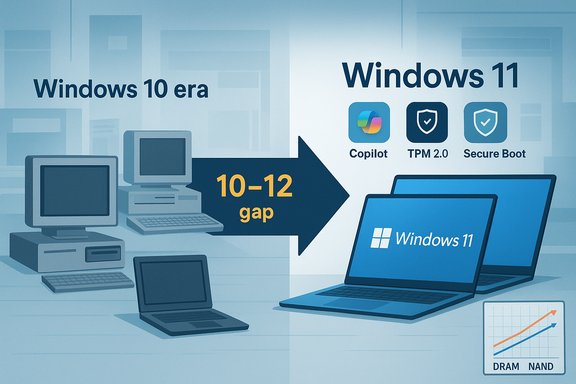
Dell's blunt assessment during its latest earnings call — that the Windows 11 transition is trailing the Windows 10 migration by roughly 10–12 percentage points — crystallizes a quiet but consequential reality for the PC market: the upgrade cycle that once reliably boosted OEM sales now looks fractured, slower, and shaped by forces far beyond simple software preference.
Dell’s Chief Operating Officer, Jeffrey Clarke, told investors that the company “has not completed the Windows 11 transition,” and quantified the gap: compared to the previous Windows migration at a similar point after an OS end-of-support milestone, Dell is about 10–12 points behind with Windows 11. Clarke also gave an installed-base estimate — roughly 1.5 billion PCs in the field — and broke that down into two groups: about 500 million devices that are capable of running Windows 11 but haven’t upgraded, and an additional ~500 million that are effectively too old to support Windows 11 without hardware changes. Those remarks came in the context of Dell forecasting flat PC sales for 2026, and pointing to rising component costs — especially memory (DRAM) and NAND flash — as a headwind that limits margin and pricing flexibility.
Those numbers and the commentary are Dell’s; they were repeated broadly by press outlets and discussed by market analysts. At the same time, independent operating-system usage trackers recorded Windows 11 crossing a major threshold in mid-2025, when it overtook Windows 10 to become the most-used desktop Windows version globally. That apparent milestone sits next to Dell’s view of a slower migration curve in response to the end-of-support deadline for Windows 10, creating a nuanced — and at times apparently contradictory — picture of adoption versus migration momentum.
Enterprises often stagger upgrades into hardware refresh projects that line up with broader IT cycles. The added friction of strict Windows 11 requirements — and the availability of ESU options — has extended that timeline.
Additionally, the promise of AI PCs — devices designed with on-device ML accelerators and Copilot+ features — has created a phenomenon of “wait and see.” Buyers who think the next wave of AI-optimized laptops will appear in the next buying window may defer purchases now to secure a future-proof model.
The core takeaway for readers is pragmatic: treat ESU and the extra time it provides as a planning window, not a permanent escape hatch. If security and compatibility matter, plan refreshes and procurement with an eye on component-price volatility and real feature differentiation rather than panic-driven deadlines. If budgets are tight and the current hardware suffices, judicious delay can be a valid strategy — but only if that delay is managed, with an upgrade or migration plan ready before temporary protections expire.
Dell’s numbers are a vendor’s lens on the market; they are influential but not definitive. The broader landscape shows Windows 11 has gained substantial foothold in overall market share. The tension between those two truths — growing cumulative adoption and slower migration velocity near an EOL milestone — will shape PC demand, product strategies, and upgrade decisions throughout the next 12–18 months. The coming year will show whether this diffusion of urgency is a temporary lull ahead of a sustained refresh cycle, or a structural change in how the world upgrades its PCs.
Source: TechRadar https://www.techradar.com/computing...s-after-support-ended-compared-to-windows-10/
 Background
Dell’s Chief Operating Officer, Jeffrey Clarke, told investors that the company “has not completed the Windows 11 transition,” and quantified the gap: compared to the previous Windows migration at a similar point after an OS end-of-support milestone, Dell is about 10–12 points behind with Windows 11. Clarke also gave an installed-base estimate — roughly 1.5 billion PCs in the field — and broke that down into two groups: about 500 million devices that are capable of running Windows 11 but haven’t upgraded, and an additional ~500 million that are effectively too old to support Windows 11 without hardware changes. Those remarks came in the context of Dell forecasting flat PC sales for 2026, and pointing to rising component costs — especially memory (DRAM) and NAND flash — as a headwind that limits margin and pricing flexibility.Those numbers and the commentary are Dell’s; they were repeated broadly by press outlets and discussed by market analysts. At the same time, independent operating-system usage trackers recorded Windows 11 crossing a major threshold in mid-2025, when it overtook Windows 10 to become the most-used desktop Windows version globally. That apparent milestone sits next to Dell’s view of a slower migration curve in response to the end-of-support deadline for Windows 10, creating a nuanced — and at times apparently contradictory — picture of adoption versus migration momentum.
Overview: what Dell actually said and what it implies
The headline figures
- Dell says the Windows 11 migration is about 10–12 percentage points behind where the Windows 10 migration was at the comparable post-support point.
- Dell estimates an installed base of roughly 1.5 billion PCs, of which:
- ~500 million can run Windows 11 but remain on Windows 10,
- ~500 million are four or more years old and cannot run Windows 11 without hardware changes.
- Dell expects PC sales roughly flat year-over-year in 2026, after mid-to-high single-digit growth during the prior year; this conservatism is linked to component price inflation (memory, SSDs, GPUs) and the slow refresh.
Why those statements matter
Dell is a leading OEM and channel partner with a direct line of sight into enterprise and consumer purchasing. Its guidance to investors is calibrated to what it sees in sales pipelines and end-customer behavior. When Dell flags a migration lag, it signals:- A reduced near-term tailwind for new-PC demand tied to an OS-imposed refresh.
- The potential for extended hardware lifecycles (consumers and businesses delaying or avoiding new purchases).
- A need for OEMs and channel partners to rethink how they stimulate upgrades — beyond the classic “end of support” leverage.
Why Windows 11 migration is slower: technical, economic, and behavioral causes
1) Hardware requirements and upgrade friction
Windows 11 introduced stricter baseline requirements versus Windows 10: TPM 2.0, Secure Boot enforcement, and certain CPU-family compatibility constraints. Those requirements are real upgrade blockers for many machines.- Many laptops and compact OEM desktops cannot accept new CPUs or TPM modules; for those units, upgrade means replacing the entire system.
- Even for upgrade-capable desktops, the cost and complexity of an OS-centric upgrade are often unattractive compared with buying a new machine — especially with rising memory and storage costs.
2) Microsoft’s extended support choices changed the calculus
When Microsoft announced extended security updates (ESU) and a consumer path to get an extra year of security patches through October 13, 2026, it fundamentally altered the urgency for many users.- Microsoft’s consumer ESU program includes a free enrollment path for many users if they enable cloud backup or redeem Microsoft Rewards, and a paid $30 option for others under certain conditions.
- The ESU window gives users extra time to decide whether to upgrade hardware, enroll in ESU, or migrate away from Windows entirely.
3) Enterprise migration cycles are conservative by design
Enterprises standardize on OS versions slowly because of application compatibility, device fleets, and testing cycles. The Windows 7-to-10 shift saw dramatic activity, but that migration was also driven by an earlier landscape: fewer hardware-imposed compatibility issues and different cloud and security dynamics.Enterprises often stagger upgrades into hardware refresh projects that line up with broader IT cycles. The added friction of strict Windows 11 requirements — and the availability of ESU options — has extended that timeline.
4) Consumer sentiment and product reception
Windows 11's reception has been mixed. For some users, the UI changes and default behaviors represent an improvement; for others, they’re a source of irritation. Controversies around forced Microsoft account sign-ins in some processes, perceived feature regressions, and prominent UI shifts have kept some users from embracing Windows 11 quickly.Additionally, the promise of AI PCs — devices designed with on-device ML accelerators and Copilot+ features — has created a phenomenon of “wait and see.” Buyers who think the next wave of AI-optimized laptops will appear in the next buying window may defer purchases now to secure a future-proof model.
5) Component price inflation and supply constraints
OEMs are wrestling with a serious memory and NAND supply situation driven by AI data-center demand. Major memory vendors signaled price increases in 2025, and retail/contract pricing for DRAM and NAND has surged. These market dynamics drive:- Higher BOM costs for laptops and desktops,
- OEM reluctance to cut prices and sacrifice margin,
- A reduced incentive for price-sensitive consumers to refresh.
Cross-checking the record: adoption vs. migration pace
There’s an important distinction between cumulative adoption numbers and migration velocity at a post-EOL inflection point.- Independent OS market trackers reported that Windows 11 surpassed Windows 10 in overall usage share during mid-2025, marking a milestone in cumulative adoption.
- Dell’s comment, however, is not about cumulative market share. It’s a comparative statement about the pace of migration at an equivalent post-support interval versus previous generations.
What this means for the PC ecosystem
For OEMs and retailers
- Short-term demand driven purely by an OS deadline is likely to be weaker than in past cycles. That reduces the tailwind OEMs historically relied on to offset other market softness.
- Pricing discipline will be crucial. With component costs rising, OEMs must either accept eroded margins or pass costs to consumers — the latter risks further depressing refresh demand.
- AI PC messaging will be an increasingly important differentiator: units that can credibly demonstrate on-device AI benefits, extended battery life with new SoCs, or tangible productivity lifts will command a premium.
For IT managers and businesses
- Upgrade planning must be pragmatic. ESU and other transitional tools provide breathing room, but they are temporary patches, not permanent solutions.
- For companies with regulated environments, mission-critical apps, or strict security needs, the calculus still favors planning hardware refreshes over prolonged dependence on ESU.
- The fragmentation between devices that can be upgraded and those that can’t will complicate patch and endpoint management for longer than some teams expect.
For consumers
- If a Windows 10 device meets your needs, ESU gives you a legitimate option to defer spending for up to a year — but that choice carries the trade-off of eventual forced upgrade or migration once ESU expires.
- For users considering buying new hardware soon, two conflicting pressures exist: buy now to lock-in lower prices before memory-driven price increases hit, or wait for AI-optimized systems and next-gen features that may appear in the first half of the coming year.
Risks and fragilities
- Security fragmentation: Extended support programs reduce immediate urgency but extend the period during which devices are vulnerable if users fail to enroll properly. A more fragmented installed base raises the attack surface for both consumers and enterprises.
- Vendor-tied enrollment friction: Enrollment paths that require Microsoft account sign-ins or cloud backup to get free ESU may push privacy-sensitive users away — and in some regions regulatory pushback has already forced Microsoft to tweak enrollment mechanics.
- Purchase timing hazards: The memory and NAND price spikes reported across the industry mean that Black Friday and holiday-season bargains might be the last chance for certain price points before OEMs lift prices. Conversely, waiting for AI PCs risks paying premium early on for “first generation” devices that may be eclipsed quickly.
- Market concentration effects: If the PC upgrade market cools, OEMs that stockpiled memory or have favorable supplier deals will be advantaged, while smaller players or niche builders may suffer.
Practical guidance for readers (consumers, IT pros, and enthusiasts)
For consumers deciding whether to upgrade now
- Confirm compatibility: Use Microsoft’s compatibility tools or vendor hardware checkers to see whether your device can run Windows 11 without major upgrades.
- Evaluate needs vs. features: If your current device meets performance and security needs and you can enroll in ESU, deferring a purchase may make sense; if you want on-device AI features, consider an AI-optimized Copilot+ laptop.
- Watch component price cycles: If memory and SSD prices remain elevated, buying during a promotional window could save significant money.
For IT decision-makers
- Map your device estate by compatibility, lifecycle, and business-critical workloads.
- Use ESU only as a stopgap: plan hardware refresh windows within the ESU timeframe rather than treating ESU as a long-term fix.
- Factor component pricing into procurement timelines: negotiating with vendors and planning volume buys may reduce per-device cost in a volatile market.
For power users and enthusiasts
- If you’re comfortable with tinkering, older systems can sometimes be provisioned to run Windows 11 through hardware upgrades — but this isn’t feasible for most laptops and it’s not a long-term strategy.
- Consider Linux or a dual-boot strategy for devices that are unsupported and still useful; modern Linux distributions are more user-friendly and offer longevity for older hardware.
The upside: a slower migration can also be strategic
A slower migration isn’t universally bad. It creates windows for:- OEMs to design clearly differentiated AI PCs and justify upgrades on features rather than fear.
- Enterprises to perform controlled, lower-risk rollouts that prioritize compatibility and user experience.
- Consumers to make considered decisions instead of being rushed by a deadline.
What to watch next
- Will Windows 11 continue to accumulate share globally while still lagging in migration velocity tied to EOL events? The difference between adoption totals and migration momentum will be a key metric to follow.
- How quickly will OEMs pass memory and NAND cost increases to end buyers? The timing and scale of any price rises will materially affect refresh demand.
- Will Microsoft change ESU enrollment mechanics further in response to regional regulatory pressure or consumer backlash? Any modification to account requirements or free paths will shift consumer behavior.
- How compelling will the first wave of AI-PCs be in real-world productivity gains? If the promise of on-device AI delivers noticeable benefits, it could become the dominant driver of upgrades—not deadlines.
Conclusion
Dell’s blunt assessment is a useful temperature check: the PC upgrade cycle tied to Microsoft’s OS deadlines is no longer a simple, one-dimensional lever that reliably sends customers to the stores. Strict Windows 11 hardware requirements, more forgiving extended-update options, enterprise caution, consumer ambivalence, and a volatile component market have combined to slow the migration pace. That slowdown matters for OEMs, channel partners, IT planners, and consumers alike.The core takeaway for readers is pragmatic: treat ESU and the extra time it provides as a planning window, not a permanent escape hatch. If security and compatibility matter, plan refreshes and procurement with an eye on component-price volatility and real feature differentiation rather than panic-driven deadlines. If budgets are tight and the current hardware suffices, judicious delay can be a valid strategy — but only if that delay is managed, with an upgrade or migration plan ready before temporary protections expire.
Dell’s numbers are a vendor’s lens on the market; they are influential but not definitive. The broader landscape shows Windows 11 has gained substantial foothold in overall market share. The tension between those two truths — growing cumulative adoption and slower migration velocity near an EOL milestone — will shape PC demand, product strategies, and upgrade decisions throughout the next 12–18 months. The coming year will show whether this diffusion of urgency is a temporary lull ahead of a sustained refresh cycle, or a structural change in how the world upgrades its PCs.
Source: TechRadar https://www.techradar.com/computing...s-after-support-ended-compared-to-windows-10/
