
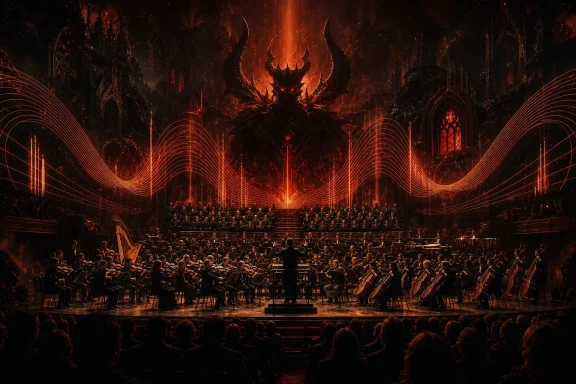
On June 6, 2026, Blizzard Entertainment’s Diablo franchise marked its 30th anniversary with The Infernal Symphony at London’s Royal Festival Hall, a Game Music Festival concert built around three decades of music from Sanctuary. The date was too neat to ignore, but the real story was not the numerology. It was the way Diablo’s sound has become one of Blizzard’s most durable pieces of worldbuilding. In an industry obsessed with engines, seasons, and monetization, Diablo’s music remains the thing that tells players where they are before the UI does.
Diablo’s identity is usually described in visual language: gothic cathedrals, corpse-strewn dungeons, candlelit villages, horned demons, and the red-black glow of Hell. But the franchise’s deeper memory lives in sound. The first time many players felt Diablo become Diablo was not when a skeleton shattered under a mace, but when that lonely guitar line in Tristram made safety feel temporary.
That is why a symphonic concert for Diablo is more than a nostalgia exercise. It tests whether game music designed for long sessions, repeated loops, and interactive tension can survive when removed from the mouse clicks and loot drops. At Royal Festival Hall, the answer was not simply yes; it was that Diablo’s score may be better understood when the player is forced to sit still and listen.
The concert drew from across the franchise, including the foundational sounds of the original games and the newer orchestral language of Diablo 4. The event was presented as an official 30th anniversary celebration in partnership with Blizzard, with the London Mozart Players, Hertfordshire Chorus, conductor Marek Wroniszewski, and arrangements by Ignacy Wojciechowski. It was not a playlist with better speakers. It was Blizzard asking whether one of gaming’s most famous atmospheres could stand beside traditional concert programming without apologizing for being born in a dungeon crawler.
That matters because Diablo has always relied on restraint more than spectacle. Its best music does not behave like a victory lap. It creeps, mutters, groans, and sometimes leaves space where another game would put a brass fanfare.
At the London performance, that melody became the emotional hinge of the evening. The reported reaction in the hall — the collective intake of breath, the recognition before analysis — says something important about how game music enters memory. Players do not merely remember where they heard it; they remember what kind of attention the game demanded from them at the time.
For Diablo, that attention was paranoid. You were in town, but not safe in any permanent sense. You were managing inventory, listening to villagers, repairing gear, preparing to go back below. The Tristram theme became the sound of respite with a countdown running behind it.
That is why its return in later Diablo music is not just fan service. When Derek Duke says Blizzard is “always conscious of the past and keeping that legacy,” he is describing a practical design problem as much as an aesthetic one. A franchise cannot simply paste an old theme over a new engine and expect continuity to emerge. The old motif has to work in the grammar of the new game.
Diablo 4’s soundtrack often does this by letting memory surface in fragments. It does not need to replay Diablo 2 at full volume because the audience can recognize a small harmonic gesture, a particular string color, or a guitar texture. That is the difference between nostalgia as decoration and nostalgia as structure.
That shift is audible in places like Kyovashad, where the music feels less like a town theme and more like a frozen sermon. The strings do not merely accompany the scene; they press down on it. The atmosphere suggests a world where survival has become ritualized because hope has failed too often to be trusted.
In the concert hall, those newer cues reportedly sat well beside older material because Diablo 4’s soundtrack understands inheritance without being swallowed by it. It uses a broader orchestral vocabulary, more elaborate choral writing, and a denser sense of space, but it still obeys the franchise’s central rule: beauty should feel contaminated.
That rule is easy to break. Too much grandeur and Diablo becomes generic dark fantasy. Too much abstraction and it becomes ambient wallpaper. The sweet spot is the place where the music is listenable enough to haunt you and hostile enough to deny comfort.
The live choir made that balance especially clear. Human voices in Diablo are rarely just voices. They are bodies, rituals, cults, lamentations, and warnings. In a concert setting, a choir can turn the franchise’s gothic horror into something almost ecclesiastical, which is exactly the point: Diablo has always treated Hell not as a destination but as an institution.
That does not make the work less artistic. If anything, it makes the achievement more impressive. A Diablo cue has to serve mood, pacing, repetition, player agency, and brand identity at once. It must survive being heard for minutes, hours, and years.
Pyle’s path into Blizzard from film production is telling. Game audio has borrowed from cinema for decades, but it now requires a production culture that film alone does not fully explain. Interactive music has to anticipate behavior rather than merely score a fixed sequence. It has to be modular without feeling mechanical.
Duke’s long tenure at Blizzard represents the other side of the equation: institutional memory. A franchise that turns 30 needs people who remember not just the official lore, but the taste and texture of earlier creative decisions. That memory is what stops a new installment from becoming a reboot in disguise.
The discussion around Neyrelle’s theme shows how this works in practice. A character used across cinematics needs a musical idea that can travel. It must signal identity without boxing the story into a single emotional register. In a game like Diablo 4, where characters are often defined by trauma, temptation, and consequence, a theme has to hold ambiguity.
Duke’s point that technology has allowed Blizzard to work faster and collaborate more efficiently is easy to underestimate. Remote recording can sound like a logistical convenience, but it changes the available palette. A team can reach for an electric violinist in Canada, percussion in Los Angeles, or vocalists elsewhere in the world without forcing every contribution through the same building.
The danger is that such a process can become frictionless in the wrong way. Too many modern scores sound expensive but placeless, as though every instrument has been polished into the same cinematic sheen. Diablo avoids that when it remembers that texture is not an afterthought. The scrape, breath, pluck, and resonance are part of the horror.
A live concert reverses the production process. Instead of assembling distant performances into a playable atmosphere, it gathers bodies into one room and makes the audience confront the physicality of the sound. No respawns, no second takes, no sliders, no mix options buried in settings. Just air moving.
That physicality matters for a franchise whose soundtracks often function as environmental pressure. In-game, Diablo’s music seeps into the player’s decisions. On stage, the same material becomes architectural. The hall itself becomes the dungeon.
Diablo is a strong test case because its most famous music is not primarily melodic in the blockbuster sense. It is atmospheric, textural, and psychological. It does not always announce itself with themes that an audience can hum on the way home. Sometimes it is a drone, a tremor, a suggestion that the floor under the player is not stable.
That kind of music can be harder to program for a general audience, but it can be more rewarding when handled seriously. The concert format asks listeners to notice the craft that gameplay can obscure. Players may spend hundreds of hours with a soundtrack and still rarely hear it as a composition because they are busy surviving, optimizing, looting, or comparing affixes.
The Game Music Festival framing helps here. This was not a one-off corporate activation bolted onto a marketing beat. It sat within a broader London festival devoted to video game music, a context that treats the medium as a serious cultural source rather than a novelty import from fandom.
That distinction matters for WindowsForum readers because PC gaming culture has always been both technical and aesthetic. We talk about frame pacing, patches, launchers, GPUs, and anti-cheat systems because they shape the experience. But so does sound, and sound is often the first thing compressed, muted, or taken for granted in how people discuss games.
That is part of why the Tristram theme is such a durable design. It does not rely on pristine playback to communicate. Its emotional signal survives weak speakers and imperfect rooms. The same is true of Diablo’s broader use of low drones, choral mass, and percussive threat. The music is engineered not just for beauty, but for recognition under compromised conditions.
Modern Diablo, of course, has far more technical room to breathe. Diablo 4 players may experience the game through spatial headphones, home theater systems, or high-quality desktop audio chains. The soundtrack can carry subtler details because the expected playback environment is less primitive than it was in the 1990s.
But the challenge has not disappeared. Live-service games are often played while Discord is open, YouTube is running on a second monitor, and players are half-listening for loot cues or party chatter. The music must compete with the multitasking culture of the modern PC desktop.
That makes Diablo’s commitment to atmosphere more impressive and more precarious. The score is asking for attention in an ecosystem designed to fracture it. A concert like The Infernal Symphony temporarily restores the old bargain: listen closely, and the world gets deeper.
That tension was present even if the concert itself focused on music rather than corporate narrative. Diablo is one of the rare Blizzard properties that can still summon several generations of players into the same emotional register. Some came through the original game and Diablo 2. Others found the series through Diablo 3’s console-friendly action or Diablo 4’s shared-world structure.
The music is one of the few elements that can bridge those audiences without requiring them to agree on itemization, endgame loops, seasonal design, or monetization. A player who dislikes a balance patch can still be moved by a theme. A lapsed fan can hear Tristram and remember why the series mattered before they remember why they left.
That does not mean music solves the franchise’s problems. It means music reveals what the franchise cannot afford to lose. Diablo can iterate on systems, classes, expansions, and seasonal mechanics, but if it loses its dread, it becomes merely efficient.
The anniversary concert therefore functioned as a kind of audit. It asked what remains when the loot treadmill is turned off. The answer, at least for one night in London, was atmosphere, memory, and a sound world strong enough to survive translation.
The old guitar theme works because it is not over-explained. It is not a logo sting. It is a place. When the franchise invokes it, the music is not merely saying “remember Diablo 2”; it is reactivating the emotional conditions under which Diablo first trained players to listen.
That is why restraint is the real skill. A less disciplined anniversary concert could have leaned into bombast, giving every cue the same orchestral inflation. But Diablo’s core sound is not about scale alone. It is about unease, negative space, and the suspicion that the next note may not resolve kindly.
The same principle applies to Diablo 4. The game’s soundtrack can go bigger because the world is bigger, but it cannot become too clean. The darkness has to remain tactile. Sanctuary should sound like wood, bone, iron, breath, stone, and old faith curdling into violence.
This is where Blizzard’s veterans matter. Institutional knowledge is not just knowing which melody to quote. It is knowing when not to quote it, when to bury it, when to fracture it, and when to let silence do the work.
A concert reverses that hierarchy. The music becomes the object rather than the environment. The audience can no longer treat the score as a support system for action. It has to confront the fact that much of Diablo’s identity was composed, arranged, performed, mixed, and iterated into being by people whose work often disappears precisely because it functions well.
That disappearance is the paradox of great game audio. If it is too noticeable at the wrong moment, it can distract. If it is too invisible, it risks being undervalued. Diablo’s music has spent 30 years walking that line, and the Royal Festival Hall performance pulled it into the light without bleaching out the darkness.
The presence of vocalists such as Uyanga Bold and Asja Kadric, associated with Diablo 4’s sonic world, underlined how much the newer games rely on human timbre to create scale without losing intimacy. A choir can represent the heavens, the hells, the church, the mob, or the dead. A solo voice can make cosmic horror feel personal.
That range is essential to Diablo’s modern storytelling. The series is no longer just a descent beneath a town. It is a sprawling mythos of angels, demons, cults, wanderers, broken families, and compromised choices. The music has had to expand accordingly while still sounding like it belongs to the same cursed bloodline.
Diablo proves the opposite. Atmosphere is not garnish; it is a retention mechanic of the soul. Players come back to action-RPGs for builds and loot, but they remember them because a world made them feel a certain way. In Diablo’s case, that feeling is dread braided with compulsion.
The music is central to that loop. It slows the player’s imagination even when the combat is fast. It implies histories the quest text may never spell out. It makes dungeons feel older than the player, towns less safe than their vendors suggest, and villains more present than their screen time.
That is also why Diablo’s sound has remained influential. Many dark fantasy games can imitate the iconography of Hell, but fewer understand the emotional pacing of it. Horror does not come from volume alone. It comes from timing, distance, and the sense that something has been waiting longer than you have been alive.
A symphony hall is an unusual place to rediscover that lesson, but perhaps a fitting one. The concert stripped away the loot and left the dread exposed.
 Blizzard’s Darkest Franchise Has Always Been Heard Before It Is Seen
Diablo’s identity is usually described in visual language: gothic cathedrals, corpse-strewn dungeons, candlelit villages, horned demons, and the red-black glow of Hell. But the franchise’s deeper memory lives in sound. The first time many players felt Diablo become Diablo was not when a skeleton shattered under a mace, but when that lonely guitar line in Tristram made safety feel temporary.That is why a symphonic concert for Diablo is more than a nostalgia exercise. It tests whether game music designed for long sessions, repeated loops, and interactive tension can survive when removed from the mouse clicks and loot drops. At Royal Festival Hall, the answer was not simply yes; it was that Diablo’s score may be better understood when the player is forced to sit still and listen.
The concert drew from across the franchise, including the foundational sounds of the original games and the newer orchestral language of Diablo 4. The event was presented as an official 30th anniversary celebration in partnership with Blizzard, with the London Mozart Players, Hertfordshire Chorus, conductor Marek Wroniszewski, and arrangements by Ignacy Wojciechowski. It was not a playlist with better speakers. It was Blizzard asking whether one of gaming’s most famous atmospheres could stand beside traditional concert programming without apologizing for being born in a dungeon crawler.
That matters because Diablo has always relied on restraint more than spectacle. Its best music does not behave like a victory lap. It creeps, mutters, groans, and sometimes leaves space where another game would put a brass fanfare.
The Tristram Theme Is Not Nostalgia Bait, It Is Load-Bearing Architecture
Every long-running game series has a sound fans recognize on contact. Mario has his bounce, Halo has its monk-like chant, The Legend of Zelda has its heroic intervals, and Diablo has that 12-string guitar. The Tristram theme is almost absurdly fragile for something that has carried so much cultural weight: a few plucked notes, a sense of distance, and the feeling that home is already half-lost.At the London performance, that melody became the emotional hinge of the evening. The reported reaction in the hall — the collective intake of breath, the recognition before analysis — says something important about how game music enters memory. Players do not merely remember where they heard it; they remember what kind of attention the game demanded from them at the time.
For Diablo, that attention was paranoid. You were in town, but not safe in any permanent sense. You were managing inventory, listening to villagers, repairing gear, preparing to go back below. The Tristram theme became the sound of respite with a countdown running behind it.
That is why its return in later Diablo music is not just fan service. When Derek Duke says Blizzard is “always conscious of the past and keeping that legacy,” he is describing a practical design problem as much as an aesthetic one. A franchise cannot simply paste an old theme over a new engine and expect continuity to emerge. The old motif has to work in the grammar of the new game.
Diablo 4’s soundtrack often does this by letting memory surface in fragments. It does not need to replay Diablo 2 at full volume because the audience can recognize a small harmonic gesture, a particular string color, or a guitar texture. That is the difference between nostalgia as decoration and nostalgia as structure.
Diablo 4 Sounds Bigger Because Sanctuary Got Heavier
Diablo 4 arrived in 2023 with the burden of restoring a tone many players felt had drifted over the years. Diablo 3 eventually became an excellent action-RPG, but its brighter palette and more arcade-like momentum changed how the series felt. Diablo 4’s visual and sonic identity was a deliberate turn back toward weight, grime, and religious dread.That shift is audible in places like Kyovashad, where the music feels less like a town theme and more like a frozen sermon. The strings do not merely accompany the scene; they press down on it. The atmosphere suggests a world where survival has become ritualized because hope has failed too often to be trusted.
In the concert hall, those newer cues reportedly sat well beside older material because Diablo 4’s soundtrack understands inheritance without being swallowed by it. It uses a broader orchestral vocabulary, more elaborate choral writing, and a denser sense of space, but it still obeys the franchise’s central rule: beauty should feel contaminated.
That rule is easy to break. Too much grandeur and Diablo becomes generic dark fantasy. Too much abstraction and it becomes ambient wallpaper. The sweet spot is the place where the music is listenable enough to haunt you and hostile enough to deny comfort.
The live choir made that balance especially clear. Human voices in Diablo are rarely just voices. They are bodies, rituals, cults, lamentations, and warnings. In a concert setting, a choir can turn the franchise’s gothic horror into something almost ecclesiastical, which is exactly the point: Diablo has always treated Hell not as a destination but as an institution.
The Blizzard Music Machine Is Less Romantic Than Fans Imagine
Fans often imagine game composers as solitary figures receiving visions from the lore gods. The reality, as Charlotte Pyle and Derek Duke described it, is more collaborative and more industrial. Blizzard’s music pipeline is embedded in game development, which means themes emerge from concept art, narrative planning, cinematics, level design, and the practical needs of implementation.That does not make the work less artistic. If anything, it makes the achievement more impressive. A Diablo cue has to serve mood, pacing, repetition, player agency, and brand identity at once. It must survive being heard for minutes, hours, and years.
Pyle’s path into Blizzard from film production is telling. Game audio has borrowed from cinema for decades, but it now requires a production culture that film alone does not fully explain. Interactive music has to anticipate behavior rather than merely score a fixed sequence. It has to be modular without feeling mechanical.
Duke’s long tenure at Blizzard represents the other side of the equation: institutional memory. A franchise that turns 30 needs people who remember not just the official lore, but the taste and texture of earlier creative decisions. That memory is what stops a new installment from becoming a reboot in disguise.
The discussion around Neyrelle’s theme shows how this works in practice. A character used across cinematics needs a musical idea that can travel. It must signal identity without boxing the story into a single emotional register. In a game like Diablo 4, where characters are often defined by trauma, temptation, and consequence, a theme has to hold ambiguity.
Technology Made the Orchestra Global Before It Made It Live
One of the quieter ironies of The Infernal Symphony is that some of the musicians whose sounds helped shape Diablo 4 reportedly had not all performed together in the same room before the concert. That is the modern game soundtrack in miniature: global, remote, layered, and assembled through production systems that would have seemed exotic when the original Diablo shipped in 1996.Duke’s point that technology has allowed Blizzard to work faster and collaborate more efficiently is easy to underestimate. Remote recording can sound like a logistical convenience, but it changes the available palette. A team can reach for an electric violinist in Canada, percussion in Los Angeles, or vocalists elsewhere in the world without forcing every contribution through the same building.
The danger is that such a process can become frictionless in the wrong way. Too many modern scores sound expensive but placeless, as though every instrument has been polished into the same cinematic sheen. Diablo avoids that when it remembers that texture is not an afterthought. The scrape, breath, pluck, and resonance are part of the horror.
A live concert reverses the production process. Instead of assembling distant performances into a playable atmosphere, it gathers bodies into one room and makes the audience confront the physicality of the sound. No respawns, no second takes, no sliders, no mix options buried in settings. Just air moving.
That physicality matters for a franchise whose soundtracks often function as environmental pressure. In-game, Diablo’s music seeps into the player’s decisions. On stage, the same material becomes architectural. The hall itself becomes the dungeon.
Game Music Has Outgrown the Novelty Circuit
There was a time when orchestral game concerts were treated as charming proof that games had “real” music. That argument is now stale. The more interesting question is not whether game music belongs in concert halls, but what changes when music built for interactivity is presented as a fixed work.Diablo is a strong test case because its most famous music is not primarily melodic in the blockbuster sense. It is atmospheric, textural, and psychological. It does not always announce itself with themes that an audience can hum on the way home. Sometimes it is a drone, a tremor, a suggestion that the floor under the player is not stable.
That kind of music can be harder to program for a general audience, but it can be more rewarding when handled seriously. The concert format asks listeners to notice the craft that gameplay can obscure. Players may spend hundreds of hours with a soundtrack and still rarely hear it as a composition because they are busy surviving, optimizing, looting, or comparing affixes.
The Game Music Festival framing helps here. This was not a one-off corporate activation bolted onto a marketing beat. It sat within a broader London festival devoted to video game music, a context that treats the medium as a serious cultural source rather than a novelty import from fandom.
That distinction matters for WindowsForum readers because PC gaming culture has always been both technical and aesthetic. We talk about frame pacing, patches, launchers, GPUs, and anti-cheat systems because they shape the experience. But so does sound, and sound is often the first thing compressed, muted, or taken for granted in how people discuss games.
Diablo’s Audio Legacy Is a Platform Problem Too
For PC players, Diablo’s music has never existed in a vacuum. It has been mediated by beige speakers, Sound Blaster cards, headphones, surround setups, compressed streams, laptop drivers, Windows audio stacks, and whatever bargain headset survived the last upgrade cycle. The franchise’s sonic identity had to persist through all of that.That is part of why the Tristram theme is such a durable design. It does not rely on pristine playback to communicate. Its emotional signal survives weak speakers and imperfect rooms. The same is true of Diablo’s broader use of low drones, choral mass, and percussive threat. The music is engineered not just for beauty, but for recognition under compromised conditions.
Modern Diablo, of course, has far more technical room to breathe. Diablo 4 players may experience the game through spatial headphones, home theater systems, or high-quality desktop audio chains. The soundtrack can carry subtler details because the expected playback environment is less primitive than it was in the 1990s.
But the challenge has not disappeared. Live-service games are often played while Discord is open, YouTube is running on a second monitor, and players are half-listening for loot cues or party chatter. The music must compete with the multitasking culture of the modern PC desktop.
That makes Diablo’s commitment to atmosphere more impressive and more precarious. The score is asking for attention in an ecosystem designed to fracture it. A concert like The Infernal Symphony temporarily restores the old bargain: listen closely, and the world gets deeper.
The Franchise Turns 30 With Its Past Still Unsettled
Diablo’s 30th anniversary arrives at a complicated time for Blizzard. The company’s legacy remains enormous, but its modern reputation has been shaped by corporate upheaval, live-service economics, shifting player expectations, and the long shadow of Microsoft’s acquisition of Activision Blizzard. Any celebration of Blizzard history now carries more weight than a simple birthday party.That tension was present even if the concert itself focused on music rather than corporate narrative. Diablo is one of the rare Blizzard properties that can still summon several generations of players into the same emotional register. Some came through the original game and Diablo 2. Others found the series through Diablo 3’s console-friendly action or Diablo 4’s shared-world structure.
The music is one of the few elements that can bridge those audiences without requiring them to agree on itemization, endgame loops, seasonal design, or monetization. A player who dislikes a balance patch can still be moved by a theme. A lapsed fan can hear Tristram and remember why the series mattered before they remember why they left.
That does not mean music solves the franchise’s problems. It means music reveals what the franchise cannot afford to lose. Diablo can iterate on systems, classes, expansions, and seasonal mechanics, but if it loses its dread, it becomes merely efficient.
The anniversary concert therefore functioned as a kind of audit. It asked what remains when the loot treadmill is turned off. The answer, at least for one night in London, was atmosphere, memory, and a sound world strong enough to survive translation.
The Best Fan Service Is Discipline
The phrase “keeping that legacy” can sound safe, even managerial. In entertainment, legacy often becomes a trap: bring back the old thing, cue applause, repeat until the reference loses charge. Diablo’s musical legacy is too delicate for that approach.The old guitar theme works because it is not over-explained. It is not a logo sting. It is a place. When the franchise invokes it, the music is not merely saying “remember Diablo 2”; it is reactivating the emotional conditions under which Diablo first trained players to listen.
That is why restraint is the real skill. A less disciplined anniversary concert could have leaned into bombast, giving every cue the same orchestral inflation. But Diablo’s core sound is not about scale alone. It is about unease, negative space, and the suspicion that the next note may not resolve kindly.
The same principle applies to Diablo 4. The game’s soundtrack can go bigger because the world is bigger, but it cannot become too clean. The darkness has to remain tactile. Sanctuary should sound like wood, bone, iron, breath, stone, and old faith curdling into violence.
This is where Blizzard’s veterans matter. Institutional knowledge is not just knowing which melody to quote. It is knowing when not to quote it, when to bury it, when to fracture it, and when to let silence do the work.
The Concert Hall Revealed What the Dungeon Hides
A player’s relationship with Diablo music is usually utilitarian. It helps establish mood, signals danger, fills travel time, and deepens the fantasy of place. The player is grateful, perhaps, but rarely still.A concert reverses that hierarchy. The music becomes the object rather than the environment. The audience can no longer treat the score as a support system for action. It has to confront the fact that much of Diablo’s identity was composed, arranged, performed, mixed, and iterated into being by people whose work often disappears precisely because it functions well.
That disappearance is the paradox of great game audio. If it is too noticeable at the wrong moment, it can distract. If it is too invisible, it risks being undervalued. Diablo’s music has spent 30 years walking that line, and the Royal Festival Hall performance pulled it into the light without bleaching out the darkness.
The presence of vocalists such as Uyanga Bold and Asja Kadric, associated with Diablo 4’s sonic world, underlined how much the newer games rely on human timbre to create scale without losing intimacy. A choir can represent the heavens, the hells, the church, the mob, or the dead. A solo voice can make cosmic horror feel personal.
That range is essential to Diablo’s modern storytelling. The series is no longer just a descent beneath a town. It is a sprawling mythos of angels, demons, cults, wanderers, broken families, and compromised choices. The music has had to expand accordingly while still sounding like it belongs to the same cursed bloodline.
The Anniversary Is a Reminder That Atmosphere Is a Feature
The games industry often treats atmosphere as secondary to measurable systems. Balance changes can be charted. Player counts can be graphed. Monetization can be modeled. Atmosphere is harder to quantify, which makes it easier to undervalue until it is gone.Diablo proves the opposite. Atmosphere is not garnish; it is a retention mechanic of the soul. Players come back to action-RPGs for builds and loot, but they remember them because a world made them feel a certain way. In Diablo’s case, that feeling is dread braided with compulsion.
The music is central to that loop. It slows the player’s imagination even when the combat is fast. It implies histories the quest text may never spell out. It makes dungeons feel older than the player, towns less safe than their vendors suggest, and villains more present than their screen time.
That is also why Diablo’s sound has remained influential. Many dark fantasy games can imitate the iconography of Hell, but fewer understand the emotional pacing of it. Horror does not come from volume alone. It comes from timing, distance, and the sense that something has been waiting longer than you have been alive.
A symphony hall is an unusual place to rediscover that lesson, but perhaps a fitting one. The concert stripped away the loot and left the dread exposed.
Sanctuary’s Music Carries the Anniversary Better Than Any Trailer Could
The concrete lessons from The Infernal Symphony are less about nostalgia than continuity. Blizzard’s challenge is not to preserve Diablo in amber, but to keep its sound legible as the franchise grows, mutates, and serves different kinds of players.- Diablo’s 30th anniversary concert took place on June 6, 2026, at London’s Royal Festival Hall as an official Game Music Festival event produced in partnership with Blizzard Entertainment.
- The performance drew from across the franchise and placed older motifs, especially the Tristram theme’s 12-string guitar identity, beside the broader orchestral language of Diablo 4.
- Blizzard’s audio team treats legacy as an active design constraint, not a museum piece, which is why familiar musical ideas can return without reducing newer scores to imitation.
- The modern Diablo sound is built through global collaboration, remote performance, embedded production, and early coordination with narrative and cinematic teams.
- The concert format showed that Diablo’s music can stand apart from gameplay because its atmosphere was never merely background; it has always been one of the franchise’s central systems.
- For PC players and IT-minded fans, the event is a reminder that sound design survives through hardware, platforms, compression, and changing play habits only when the underlying musical identity is strong.
References
- Primary source: Windows Central
Published: 2026-06-21T22:52:08.521043
"We’re always conscious of the past and keeping that legacy," — I went to the Diablo Infernal Symphony and talked to the team behind 30 years of music | Windows Central
The Diablo 30th Anniversary Infernal Symphony celebrated the music behind my favorite franchisewww.windowscentral.com - Related coverage: ad.dlh.net
Diablo® Turns 30: Official Anniversary Concert Announced At The Royal Festival HallNews | DLH.NET The Gaming People
We give away millions of Steam Keys to our registered Users. Know more, visit our site:- www.dlh.net Register now and grab your free Steam Keysad.dlh.net
- Related coverage: news.blizzard.com
Catch Up on the Diablo 30th Anniversary Spotlight — Diablo IV — Blizzard News
Catch up on the Diablo Spotlight, showcasing our newest class: the Warlock, new skill tree updates, and more.news.blizzard.com - Related coverage: gamemusic.net
The Infernal Symphony – Diablo 30th anniversary concert - Game Music Festival 2026
On 06.06.26, the Royal Festival Hall in London will host a musical ritual, invoking the iconic sounds of Diablo games arranged into a monumental symphonic opus. gamemusic.net
- Related coverage: icy-veins.com
- Related coverage: shortlist.com
Diablo is getting a 30th anniversary concert at the Royal Festival Hall | Shortlist
Hellish tuneswww.shortlist.com
- Related coverage: gamereactor.se
Blizzard firar 30 år av Diablo med The Infernal Symphony-konsert i London
Endagsföreställningen äger rum i början av juni.www.gamereactor.se
- Related coverage: ents24.com
Game Music Festival: The Infernal Symphony London tickets at Royal Festival Hall, London on 6 June 2026 | Ents24
Official tickets and information for Game Music Festival: The Infernal Symphony at Royal Festival Hall from Ents24 - rated Excellent on Trustpilot.www.ents24.com
- Related coverage: halibuts.com
How To Design Your Perfect Music Night in London Using halibuts.com | Halibuts
Using halibuts.com To Find The Perfect London Concert, Gig Or Musical For You.halibuts.com - Related coverage: londontheatre.co.uk
Game Music Festival: The Infernal Symphony tickets | London Theatre
showsMetaDescriptionwww.londontheatre.co.uk - Related coverage: gamereactor.no
Blizzard markerer 30 år med Diablo med konserten The Infernal Symphony i London
Konserten, som kun varer én dag, vil finne sted i begynnelsen av juni.www.gamereactor.no
- Related coverage: bynder.southbankcentre.co.uk
- Related coverage: music.duke.edu
