

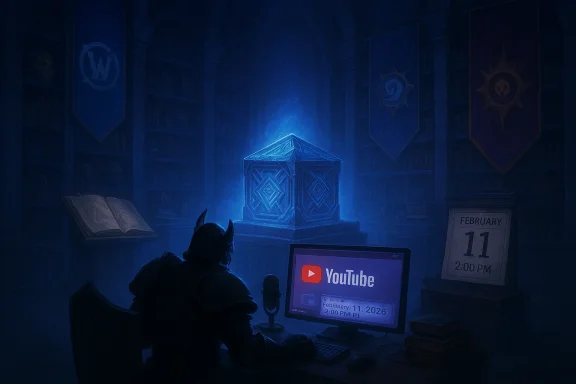
Blizzard has confirmed a new, multi-part showcase series that kicks off at the end of January and runs into February — and crucially for Diablo fans, the company has scheduled a dedicated Diablo 30th Anniversary Spotlight for February 11, 2026 at 2:00 p.m. Pacific. The announcement comes via Blizzard’s own “Blizzard: The Next Chapter” viewers’ guide and accompanying video, and it’s explicitly positioned as the opening salvo of a year of reveals that will build toward the long‑awaited return of BlizzCon in September.
Blizzard’s new slate of developer‑led presentations is framed as both a celebration of the company’s 35‑year history and a forward look at each franchise’s roadmap. The short, archival montage titled Blizzard: The Next Chapter highlights roughly 400 physical artifacts from Blizzard’s archives and sets a nostalgic tone while the studio promises new content and “big announcements” across its major IPs. The showcase schedule lists four titled presentations: World of Warcraft’s State of Azeroth (January 29), Overwatch Spotlight (February 4), Hearthstone Spotlight (February 9), and the Diablo 30th Anniversary Spotlight (February 11). All streams are planned for Blizzard’s official YouTube and Twitch channels.
The company’s public messaging — including a short statement from Blizzard president Johanna Faries — frames this sequence as “only the beginning” of a year of reveals and developer updates, an explicit signal that Blizzard intends to maintain cadence across 2026 rather than front‑loading everything into a single conference. That line and the schedule appeared in Blizzard’s official viewers’ guide and have been corroborated by multiple outlets.
Multiple outlets covering the announcement framed the February 11 presentation as the most likely venue for Diablo‑specific reveals — a conclusion Blizzard’s calendar makes unavoidable. Whether the segment will include a full expansion reveal, new class details, release windows, or more modest anniversary content is not confirmed; Blizzard’s “only the beginning” rhetoric makes it reasonable to expect at least one substantive reveal.
Community reaction to paywalled early access (Paladin via pre‑purchase) has already been mixed. Some players welcome the chance to test new builds early and to generate content for streams and guides; others see a “pay for time” dynamic that confers seasonally meaningful advantages. That friction is not hypothetical — forum coverage and community threads have been vocal on both sides, and analysts warn about the reputational tradeoffs of gated play advantages in a live‑service environment. When large systems (crafting, endgame loot, leaderboards) intersect with early‑access windows, perceived inequality can widen quickly.
Merch cross‑promotions also introduce complexity: Blizzard’s Gear Store listings indicated some physical purchases include in‑game codes, and some cross‑IP items require ownership or subscription to other Blizzard titles (for example, WoW decor requiring a WoW subscription to use). That kind of entanglement can frustrate buyers who assume direct parity between purchase and in‑game usability. Consumers should verify the precise in‑game benefit of any physical item before purchase; Blizzard’s product pages often label items as “in‑game content” but don’t always define whether codes are cosmetic or gameplay‑affecting.
If Blizzard uses the Diablo spotlight to transparently show the how — detailed systems demonstrations, PTR schedules, and developer rationales for design choices — it could rebuild trust among players who have been wary of monetization and live‑service design. Conversely, a shallow anniversary segment heavy on nostalgia and light on actionable technical detail risks fueling frustration, especially given the scale of the Lord of Hatred changes already announced. The company’s challenge is not merely to excite, but to explain and deliver a coherent plan for testing and balance.
From a commercial standpoint, Blizzard’s multi‑prong approach — timed pre‑purchase incentives, physical merchandise tied to in‑game codes, and developer showcases — is financially sensible. It monetizes different fan segments and keeps engagement steady. But the payoff depends on execution: ill‑considered gating of competitive features or unclear in‑game benefit descriptions can damage goodwill quickly. Players and observers should judge the February showcase not only on new reveals but on the clarity of Blizzard’s rollout plan.
Source: Windows Central Blizzard confirms February Diablo reveal With new showcase event
 Background / Overview
Blizzard’s new slate of developer‑led presentations is framed as both a celebration of the company’s 35‑year history and a forward look at each franchise’s roadmap. The short, archival montage titled Blizzard: The Next Chapter highlights roughly 400 physical artifacts from Blizzard’s archives and sets a nostalgic tone while the studio promises new content and “big announcements” across its major IPs. The showcase schedule lists four titled presentations: World of Warcraft’s State of Azeroth (January 29), Overwatch Spotlight (February 4), Hearthstone Spotlight (February 9), and the Diablo 30th Anniversary Spotlight (February 11). All streams are planned for Blizzard’s official YouTube and Twitch channels. The company’s public messaging — including a short statement from Blizzard president Johanna Faries — frames this sequence as “only the beginning” of a year of reveals and developer updates, an explicit signal that Blizzard intends to maintain cadence across 2026 rather than front‑loading everything into a single conference. That line and the schedule appeared in Blizzard’s official viewers’ guide and have been corroborated by multiple outlets.
The showcase schedule: dates, times and where to watch
Blizzard’s viewers’ guide gives clear showtimes in Pacific Time, with corresponding Eastern and UK times listed. For North American readers, the immediate takeaways are:- World of Warcraft — State of Azeroth: January 29, 9:00 a.m. PT / 12:00 p.m. ET.
- Overwatch — Spotlight: February 4, 10:00 a.m. PT / 1:00 p.m. ET.
- Hearthstone — Spotlight: February 9, 9:30 a.m. PT / 12:30 p.m. ET.
- Diablo — 30th Anniversary Spotlight: February 11, 2:00 p.m. PT / 5:00 p.m. ET.
Why February 11 matters to Diablo fans
The Diablo spotlight date is notable for two reasons. First, Blizzard has been teasing Diablo‑adjacent announcements for February; the February 11 slot is the formal confirmation that something Diablo‑centric will be revealed that day. Second, the timing and title — Diablo 30th Anniversary Spotlight — suggests a blend of nostalgia and forward motion: anniversary retrospectives are paired with forward‑looking product updates. Taken together, players should expect a mix of historical reflection, community celebration, and concrete new details about Diablo’s roadmap. These expectations are grounded in Blizzard’s wording and the explicit anniversary framing in its video and viewers’ guide.Multiple outlets covering the announcement framed the February 11 presentation as the most likely venue for Diablo‑specific reveals — a conclusion Blizzard’s calendar makes unavoidable. Whether the segment will include a full expansion reveal, new class details, release windows, or more modest anniversary content is not confirmed; Blizzard’s “only the beginning” rhetoric makes it reasonable to expect at least one substantive reveal.
What Blizzard has already committed to for Diablo (verified)
To put the near‑term spotlight in context, Blizzard’s broader Diablo roadmap already contains firm commitments that influence what may appear on February 11:- Blizzard has announced the next Diablo IV expansion, Lord of Hatred, and published an official release date of April 28, 2026 on Diablo’s product pages and storefronts. That expansion bundles multiple systems changes (skill‑tree reworks, higher level caps, a return of the Horadric Cube concept, new endgame systems like War Plans and Echoing Hatred) and includes two new classes — the Paladin (already playable via pre‑purchase) and a second unnamed class. These details are listed on Blizzard’s official pages and in major outlet coverage.
- Blizzard’s store and pre‑purchase messaging confirm that pre‑ordering Lord of Hatred grants immediate access to the Paladin class and bundled digital bonuses (extra stash tabs, character slots, and certain cross‑IP decor items), with the expansion itself releasing in late April. This early‑access model has already been implemented and forms part of community discussion about fairness and game economy impacts.
What to expect from the Diablo 30th Anniversary Spotlight
Predicting exact reveals is always speculative, but we can map reasonable expectations based on recent Blizzard behavior, the structure of the Lord of Hatred announcements, and the anniversary framing.- Likely: deeper detail on Lord of Hatred systems. Given the expansion’s announced systems overhaul (skill trees, Loot Filter, Horadric Cube transmutation concept, War Plans, Echoing Hatred), Blizzard will likely showcase concrete gameplay footage or developer commentary that clarifies how those systems work in practice. The company has signaled systemic changes that benefit from developer‑led explanation.
- Possible: the reveal or mechanical tease of the second new class. The Paladin is already in players’ hands via pre‑purchase; Blizzard may hold the second class back for a higher‑impact reveal at the anniversary. That would fit a cadence of staggered reveals. However, no official confirmation ties the second class reveal specifically to the February spotlight, so treat this as plausible, not guaranteed.
- Plausible: anniversary packages, community events, and limited‑time cosmetics. A 30th anniversary spotlight is a natural place for special cosmetic drops, retrospective montages, and community programming (streams, developer Q&As, community spotlights). Expect multi‑platform messaging and archive material — Blizzard’s own video already leans heavily into archive artifacts.
- Less likely but possible: a surprise bigger‑ticket reveal or cross‑IP initiative. Blizzard’s messaging hints that these showcases are the opening act of a year that culminates in BlizzCon 2026. Major unveils could be reserved for BlizzCon, so don’t count on an all‑in blockbuster at the February slot; conversely, Blizzard could use the spotlight to drop a significant surprise to generate momentum. Past Blizzard behavior shows both conservative, staged reveals and occasional surprise drops.
Monetization, merchandise and community trust — why the context matters
Blizzard’s 2025–2026 Diablo cycle has already shown that the studio plans to combine digital pre‑purchase incentives with physical merchandise that includes in‑game codes. The Lord of Hatred marketing and Gear Store activity (premium statues, apparel, in‑game weapon codes tied to purchases) are real, monetized levers Blizzard is using to fuel the campaign. Those items were prominently part of the expansion rollout around The Game Awards and the expansion disclosure, and they remain present in the public storefronts. This combination of premium physical goods and early‑access digital unlocks matters because it shapes perception of fairness and access for players.Community reaction to paywalled early access (Paladin via pre‑purchase) has already been mixed. Some players welcome the chance to test new builds early and to generate content for streams and guides; others see a “pay for time” dynamic that confers seasonally meaningful advantages. That friction is not hypothetical — forum coverage and community threads have been vocal on both sides, and analysts warn about the reputational tradeoffs of gated play advantages in a live‑service environment. When large systems (crafting, endgame loot, leaderboards) intersect with early‑access windows, perceived inequality can widen quickly.
Merch cross‑promotions also introduce complexity: Blizzard’s Gear Store listings indicated some physical purchases include in‑game codes, and some cross‑IP items require ownership or subscription to other Blizzard titles (for example, WoW decor requiring a WoW subscription to use). That kind of entanglement can frustrate buyers who assume direct parity between purchase and in‑game usability. Consumers should verify the precise in‑game benefit of any physical item before purchase; Blizzard’s product pages often label items as “in‑game content” but don’t always define whether codes are cosmetic or gameplay‑affecting.
The risks Blizzard must manage (and what players should watch for)
- Balance shock and player investment disruption. Overhauling core systems (full skill trees, crafting, loot) across all classes risks invalidating months of player investment. Blizzard will need robust respec paths, conversion tools, or generous rollback options to maintain goodwill. Forum analysis and developer commentary have repeatedly emphasized this as a high‑risk area.
- Economy destabilization from deterministic crafting. Reintroducing a Horadric Cube‑style transmutation system elevates crafting power; without careful sinks and gating, deterministic upgrades can compress item rarity and inflate in‑game economies. Historically, deterministic crafting systems require limited reagents, hard sinks, or recipe rarity to remain balanced. Monitor Blizzard’s PTR notes closely for recipe costs and material scarcity.
- Pay‑for‑time optics. Early Paladin access via pre‑purchase is already in place; if early access meaningfully alters seasonal progression (leaderboards, early access to materials, time‑limited rewards), community backlash may intensify. Blizzard will need to ensure early access is balanced in a way that doesn’t lock core competitive or meta advantages behind a payment wall.
- Choice overload and system overlap. War Plans, talismans, the Cube, expanded skill variants and other layered systems could create confusing overlaps. Blizzard should clearly define how systems interact and provide guidance and examples to reduce choice paralysis at launch. This is a design challenge rather than a showstopper, but it affects player retention and first‑week impressions.
- PR sequencing. Blizzard must sequence reveals and PTRs such that players understand the scope and testing windows. Short PTRs or opaque tuning cycles will magnify launch problems; longer PTR windows offer better telemetry and community feedback but can also extend the timeline for fixes. The company’s “only the beginning” phrasing indicates a staged year, which can be an advantage if Blizzard commits to transparent PTR cycles.
How to watch, prepare, and what to do afterward
- Mark your calendar for the specific stream times listed in Blizzard’s viewers’ guide (see schedule above). Use the franchise’s official channels for the best reliability.
- If you’re a content creator or community leader, prepare capture rigs and moderation teams — developer‑led streams produce fast moving information that benefits from rapid summaries and clipable content.
- For players concerned about early access fairness: review Blizzard’s pre‑purchase terms now and decide whether early access confers advantages you care about. Many buyers evaluated the Paladin early‑access tradeoff as part of their pre‑purchase decision last winter; that context remains relevant.
- After the stream: look for follow‑up dev posts, patch notes and PTR announcements. Blizzard’s showcases are developer‑led; the post‑show technical notes and PTR windows are where the crucial tuning details will appear.
Critical read: what this means for Blizzard and the Diablo franchise
Blizzard’s decision to stage a multi‑week showcase across its major franchises is a pragmatic pivot from the monolithic festival model: it spreads attention across weeks, lets developers go deeper on systems, and builds momentum into BlizzCon 2026. For Diablo specifically, the February 11 slot is an opportunity to clarify the mechanics that will define the game’s competitive and long‑term PvE meta for months ahead.If Blizzard uses the Diablo spotlight to transparently show the how — detailed systems demonstrations, PTR schedules, and developer rationales for design choices — it could rebuild trust among players who have been wary of monetization and live‑service design. Conversely, a shallow anniversary segment heavy on nostalgia and light on actionable technical detail risks fueling frustration, especially given the scale of the Lord of Hatred changes already announced. The company’s challenge is not merely to excite, but to explain and deliver a coherent plan for testing and balance.
From a commercial standpoint, Blizzard’s multi‑prong approach — timed pre‑purchase incentives, physical merchandise tied to in‑game codes, and developer showcases — is financially sensible. It monetizes different fan segments and keeps engagement steady. But the payoff depends on execution: ill‑considered gating of competitive features or unclear in‑game benefit descriptions can damage goodwill quickly. Players and observers should judge the February showcase not only on new reveals but on the clarity of Blizzard’s rollout plan.
Final takeaways and what to watch for on February 11
- The Diablo 30th Anniversary Spotlight on February 11 at 2:00 p.m. PT / 5:00 p.m. ET is real and will stream on Blizzard’s official Diablo channels. Expect archival celebration plus at least some forward‑facing product news.
- Lord of Hatred is already scheduled for April 28, 2026, and pre‑purchase grants immediate Paladin access. That release date and the pre‑purchase mechanics are verified on Blizzard’s official pages and storefronts. Use those pages to confirm edition contents before purchasing.
- The community should watch for: concrete system demonstrations (how the Horadric Cube, War Plans and Loot Filter will actually function), any announcement about the second new class, PTR timing, and explicit design notes addressing player investment, balance reconciliation, and economy management.
- Finally, treat rumor and speculation about BlizzCon surprises or unannounced projects as unverified until Blizzard provides developer comment or official follow‑ups. Several outlets have discussed possible BlizzCon teasers, but those points remain speculative until presented on Blizzard channels.
Source: Windows Central Blizzard confirms February Diablo reveal With new showcase event
