

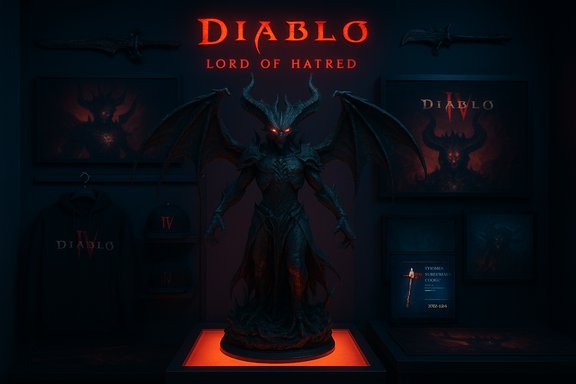
Blizzard has quietly turned one of its biggest upcoming game moments into a full merchandising play: alongside the Diablo IV: Lord of Hatred expansion reveal at The Game Awards, the company launched a dedicated line of tie‑in apparel, accessories, and premium collectibles — anchored by a towering 26‑inch Mephisto statue — and linked physical purchases to in‑game rewards such as the Diablo Death’s Head Cudgel weapon code.
Diablo IV: Lord of Hatred is the second major expansion for Diablo IV and promises to conclude the Age of Hatred saga by pitting players against Mephisto in the newly revealed Skovos region. The expansion is scheduled to release on April 28, 2026, and Blizzard is already offering pre‑purchase bundles that grant immediate access to the long‑awaited Paladin class, include the Vessel of Hatred expansion, and provide a range of in‑game and cross‑product cosmetics. At the same time Blizzard opened sales on a themed Gear Store collection that includes everyday apparel (tees, hoodies, hats), desk mats and posters, and higher‑end statuettes and replicas. The most conspicuous item is the Diablo IV: Lord of Hatred Mephisto 26" Statue, priced at $700 and listed as a pre‑order slated to ship in early 2026. Purchases across specified Diablo gear collections are also tied to limited‑time in‑game codes — notably the Diablo Death’s Head Cudgel — creating a direct bridge between real‑world merchandise and virtual content.
For fans who are comfortable buying into the Blizzard ecosystem — and who want both the physical keepsake and the digital perks — the new Lord of Hatred collection is attractive. For more cautious players, the prudent path is to verify the weapon code’s in‑game effect, confirm eligibility dates regionally, and treat expensive pre‑orders with the usual consumer caution until shipping and refund policies are fully understood.
The merchandising rollout for Diablo IV: Lord of Hatred crystallizes how major publishers now unify live‑service content, seasonal engagement, and physical goods into coherent campaigns. It’s a lucrative model when handled transparently; it risks backlash when mechanics and timelines are murky. Blizzard has the brand power to move merchandise quickly, but the company will need to keep the community informed on the precise nature of in‑game rewards if it wants this campaign to be celebrated rather than litigated in forum threads.
Source: Windows Central https://www.windowscentral.com/gaming/blizzard/blizzard-announces-new-diablo-iv-merch/
 Background
Diablo IV: Lord of Hatred is the second major expansion for Diablo IV and promises to conclude the Age of Hatred saga by pitting players against Mephisto in the newly revealed Skovos region. The expansion is scheduled to release on April 28, 2026, and Blizzard is already offering pre‑purchase bundles that grant immediate access to the long‑awaited Paladin class, include the Vessel of Hatred expansion, and provide a range of in‑game and cross‑product cosmetics. At the same time Blizzard opened sales on a themed Gear Store collection that includes everyday apparel (tees, hoodies, hats), desk mats and posters, and higher‑end statuettes and replicas. The most conspicuous item is the Diablo IV: Lord of Hatred Mephisto 26" Statue, priced at $700 and listed as a pre‑order slated to ship in early 2026. Purchases across specified Diablo gear collections are also tied to limited‑time in‑game codes — notably the Diablo Death’s Head Cudgel — creating a direct bridge between real‑world merchandise and virtual content. What Blizzard is selling — the merch breakdown
The new Blizzard Gear Store Diablo IV: Lord of Hatred collection is broad, spanning both affordable items for everyday fans and premium pieces aimed squarely at collectors. Key items called out by Blizzard and media outlets include:- Mephisto 26" Statue — $700, high‑quality resin, dark paint finishes; scheduled to ship February 2026 (pre‑order).
- Logo Black Zip‑Up Hoodie — $65, 80% cotton / 20% polyester, unisex.
- Logo Black T‑Shirt — $32–$35 depending on SKU; unisex regular fit.
- Snapback Hat — $35, adjustable.
- Mephisto Deskmat — $35, 32×14" surface artwork featuring Mephisto.
Editions and digital bundles
Physical merch sits alongside the standard digital expansion editions:- Standard Edition — price around $39.99 on official storefronts; includes the Lord of Hatred expansion itself (requires base Diablo IV), Vessel of Hatred, an extra stash tab, and two extra character slots.
- Deluxe Edition — roughly $59.99; adds cosmetic bundles, a mini pet, a mount bundle, and a premium battle pass bundle.
- Ultimate Edition — roughly $89.99; bundles even more cosmetics, 3,000 Platinum, and other premium items.
How the merchandise ties into in‑game content
Blizzard’s approach is explicitly cross‑promotional: physical purchases can unlock codes or drops useful in the game, while pre‑purchasing the expansion unlocks in‑game content immediately. Two separate mechanisms are at play:- Pre‑purchase digital bonuses — Early access to the Paladin and immediate access to the Vessel of Hatred expansion when you pre‑purchase any Lord of Hatred edition. This is an immediate digital reward delivered via Battle.net or Steam.
- In‑game codes tied to physical items — The Gear Store advertises that select purchases (and specific collections) include a code for the Diablo Death’s Head Cudgel. The Gear Store has been explicit about limited‑time windows during which the Death’s Head promotion is active; individual product pages also show the “In‑Game Content with Purchase” label with date ranges attached.
Why this matters: a strategic read on Blizzard’s push
Blizzard’s simultaneous expansion pre‑order and Gear Store launch is a textbook example of cross‑platform monetization that leverages scarcity, exclusivity, and fan identity. There are four clear strategic motives:- Revenue diversification. High‑margin physical collectibles (the $700 Mephisto statue is a case in point) offer Blizzard a revenue stream independent of the in‑game microtransaction economy and can be highly profitable relative to digital goods.
- Retention and acquisition. Early‑access Paladin unlocks are a retention tool: players who buy now are invested in the Season 11 cycle and more likely to stick for the expansion’s April 28, 2026 launch. The timing of Season 11 — which began Dec. 11, 2025, at 8:30 p.m. PT — and the shadow drop surrounding The Game Awards suggests deliberate scheduling to generate buzz and immediate engagement.
- Brand‑loyalty marketing. Apparel and home goods turn players into visible brand advocates. Fans wearing a Paladin hoodie or displaying a Mephisto deskmat multiply marketing reach at live events, streams, and conferences.
- Cross‑sell and platform synergy. Including World of Warcraft housing decor items with expansion purchases nudges players toward Blizzard’s broader ecosystem and monetization vehicles (and in the case of WoW, requires an active subscription to fully use the decor items).
The collector economy and pricing realities
The Mephisto statue is positioned as the flagship collectible: large, detailed, and expensive. At $700 it sits in the established premium tier of gaming collectibles where factors like limited production runs, build quality, and licensing legitimacy justify the price to collectors. Blizzard explicitly lists February 2026 as the shipping window for the statue, putting it in fans’ hands well ahead of the expansion launch. For mass‑market fans, the hoodies, tees, and desk mats carry price points typical of corporate licensed apparel ($30–$65). These items are designed to be accessible impulse buys while still carrying the official Blizzard branding.- Benefits for Blizzard:
- High margin on premium collectibles.
- Predictable direct‑to‑consumer sales via Blizzard Gear Store.
- Marketing lift from high‑visibility products used in streaming setups and social media.
- Benefits for consumers:
- Official, licensed collectibles vetted for design fidelity.
- Tangible goods for community status and display.
- In‑game tie‑ins for additional perceived value.
Risks, controversies, and consumer concerns
While the strategy is sound commercially, it raises several notable concerns that are worth calling out:- Perception of pay‑to‑win or pay‑for‑advantage. Any time physical purchases come with a weapon code the community parses whether the reward affects gameplay balance. The Diablo Death’s Head Cudgel promotion is presented through the Gear Store as in‑game content, but product pages and promotional blurbs do not always clarify whether the item is purely cosmetic or grants combat advantage. That ambiguity can fuel backlash if players perceive an unfair advantage tied to cash purchases. Blizzard’s product pages and the Gear Store label the Death’s Head Cudgel as a weapon code available via select product purchases, but they stop short of detailed gameplay descriptions — a gap that should be addressed to avoid community distrust. This is an area where the available public information is not explicit, and purchasers should treat the weapon code’s functional impact as uncertain until Blizzard publishes specifics.
- Limited windows and fine print. The Death’s Head Cudgel code promotion has clearly defined windows for eligible purchases; these windows vary by product and region on the Gear Store and sometimes end in early to mid‑December 2025 for specific collections. Consumers should be alert to date‑specific eligibility and the potential for regional exclusions. The Gear Store posts terms and date ranges on product pages indicating the promotion’s time limits.
- Pricing and accessibility. A $700 statue is outside the budget of most players and will be subject to scalping/secondary market markups if units are limited — a predictable outcome for high‑end collectible drops. Blizzard can mitigate this with transparent production numbers or staggered restocks, but no explicit limited‑run disclosures were visible on the listing at the time of publication.
- Cross‑product gating for WoW content. Including World of Warcraft housing decor items with Diablo expansions is smart cross‑promotion, but using these items fully requires a World of Warcraft subscription and, in some regions, the latest WoW expansion ownership. That creates layered prerequisites that may frustrate players who buy the Diablo expansion solely for Diablo content. Blizzard’s own terms clarify that WoW decor items require active WoW access.
- Logistics and shipping timing. Premium pre‑orders with ship dates months ahead create expectations; missed deadlines or supply chain delays can erode goodwill. Blizzard lists shipping windows (the Mephisto statue ships around February 2026), which gives buyers a clear timeframe, but physical fulfillment remains a risk in an era of complex global logistics.
Consumer due diligence: what to verify before you buy
If you’re considering buying Blizzard’s Lord of Hatred merchandise, follow a short checklist to avoid surprises:- Confirm the exact in‑game benefit of any code (cosmetic vs. gameplay‑affecting). Blizzard product pages often say “in‑game content” but do not always define the mechanics. Treat the functional impact as unverified unless explicitly documented by Blizzard.
- Check the promotion window and regional availability for the Death’s Head Cudgel and similar codes; some offers expired or differ by SKU.
- For high‑value pre‑orders (the Mephisto statue), review shipping dates, return policy, and collector guarantees; pre‑orders may be non‑refundable or subject to limited stock.
- Remember cross‑product requirements: WoW decor items need an active WoW subscription and may require certain expansions to be usable.
The timing and marketing play: why Dec. 2025 matters
Blizzard synchronized the Season 11 launch (Season of Divine Intervention) with The Game Awards window — Season 11 began Dec. 11, 2025 at 8:30 p.m. PT — and immediately followed with the Lord of Hatred expansion reveal. The co‑ordinated timing is no accident: late‑night unveilings and immediate season rollovers maximize viewership, press traction, and the likelihood of a quick pre‑purchase conversion while excitement is peak. Pre‑purchase incentives like early Paladin access capitalize on that momentum: players who don’t want to miss early build time and leaderboard positioning are nudged to buy now. That creates a virtuous loop for Blizzard: strong pre‑order numbers, engaged playerbases for the new season, and built‑in marketing via player streams and social feeds.Broader implications for game merchandising and industry trends
Blizzard’s approach reflects larger trends in AAA game monetization:- The blurring of physical and digital merchandise: in‑game codes bundled with physical items are becoming commonplace as studios chase new revenue streams and engagement levers.
- Premium physical collectibles as direct revenue: well‑produced statues and replicas offer more profit per buyer than many digital items and carry prestige for the brand.
- Cross‑ecosystem bundling: using a single IP to drive activity across multiple live services (Diablo + WoW) is efficient for platform engagement — but it also risks alienating players who don’t participate in every Blizzard franchise.
What remains uncertain and where to watch next
Several important details still require clarification from Blizzard or further documentation in official patch notes and store terms:- The functional nature of the Death’s Head Cudgel: is it purely cosmetic, or does it confer a stat benefit? Public product pages label it “in‑game content” but do not define the effect. This is material to community reception and gameplay balance. Treat the weapon’s impact as unverified until Blizzard publishes specific item stats or clarifies its nature.
- Production quantity and restock policy for high‑ticket collectibles: the Mephisto statue listing shows a ship date but does not disclose whether quantities are limited or how Blizzard will handle restocks. That affects long‑term collector value and secondary market dynamics.
- Precise eligibility details for promotional codes across regions and storefronts: the Gear Store has differing date ranges noted per product; ensuring consistent messaging across storefronts and regional sites will be important to avoid customer confusion.
- Any potential in‑game exclusivity tied to physical purchases that could influence competitive leaderboards or speed‑run viability. Blizzard’s track record has emphasized cosmetic or vanity bonuses in store promotions for fairness, but the lack of explicit detail warrants attention.
Final analysis: a profitable, if delicate, cross‑platform campaign
Blizzard’s early push of Diablo IV: Lord of Hatred merch is a smart commercial move timed to capitalize on The Game Awards and the Season 11 rollout. The strategy combines:- Immediate digital engagement (Paladin early access and Season 11),
- Long‑term brand monetization (premium collectibles and apparel),
- Cross‑product synergies (in‑game WoW decor and weapon code promotions).
For fans who are comfortable buying into the Blizzard ecosystem — and who want both the physical keepsake and the digital perks — the new Lord of Hatred collection is attractive. For more cautious players, the prudent path is to verify the weapon code’s in‑game effect, confirm eligibility dates regionally, and treat expensive pre‑orders with the usual consumer caution until shipping and refund policies are fully understood.
Quick reference: verified facts (for easy scanning)
- Diablo IV: Lord of Hatred release date: April 28, 2026.
- Pre‑purchase bonus: early access to the Paladin class and immediate access to Vessel of Hatred.
- Season 11 (Season of Divine Intervention) start: December 11, 2025, 8:30 p.m. PT.
- Gear Store headline item: Mephisto 26" Statue — $700, shipping estimated February 2026.
- Gear Store promotion: select purchases include the Diablo Death’s Head Cudgel weapon code for a limited time; dates and eligible SKUs vary by product.
The merchandising rollout for Diablo IV: Lord of Hatred crystallizes how major publishers now unify live‑service content, seasonal engagement, and physical goods into coherent campaigns. It’s a lucrative model when handled transparently; it risks backlash when mechanics and timelines are murky. Blizzard has the brand power to move merchandise quickly, but the company will need to keep the community informed on the precise nature of in‑game rewards if it wants this campaign to be celebrated rather than litigated in forum threads.
Source: Windows Central https://www.windowscentral.com/gaming/blizzard/blizzard-announces-new-diablo-iv-merch/
