

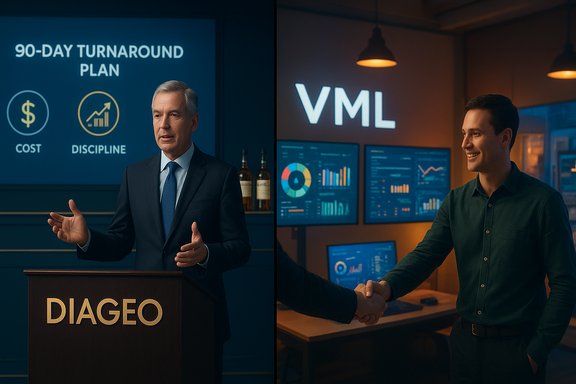
Diageo’s board has moved decisively to install former Tesco chief executive Sir Dave Lewis to lead the drinks giant’s turnaround, while in the advertising world VML confirmed that long‑time executive Mel Edwards will step away in spring 2026 — two leadership moves that signal corporate recalibration across consumer goods and creative services at a time of slowing demand, intense cost pressure, and consolidation of strategy and talent.
The announcements arrived within days of one another in November 2025, each framed as a strategic handover after periods of volatility or integration. Diageo’s board named Sir Dave Lewis as Chief Executive Officer, with his appointment effective 1 January 2026; the drinks group has cited the need for stronger operational discipline and brand revitalization amid falling top‑line momentum. Storyboard18 had earlier aggregated this round of CXO moves as part of its executive‑change bulletin, flagging consumer‑goods leadership resets as a broader pattern.
At VML, Mel Edwards — a respected industry figure who helped steward the post‑merger creation of VML from Wunderman Thompson and VMLY&R — announced she will retire in late spring 2026 after a multi‑decade career in advertising. Her planned exit follows a period of network integration and growth in digital, commerce, and technology‑driven services that positioned VML as a WPP flagship for creative‑plus‑technology deliverables. The firm’s public statement and subsequent trade coverage framed Edwards’s departure as a planned transition rather than an abrupt exit. These moves are symptomatic of two related corporate realities in late‑cycle markets: boards are replacing or reinforcing operating leadership to address execution shortfalls, and agency networks are formalizing succession plans as merged entities mature. Storyboard18’s roundup captured the same trend-line across multiple brands, underscoring that these are not isolated personnel items but part of broader strategic resets across consumer goods, technology and advertising ecosystems.
Both organizations now face the same operational imperative: convert leadership momentum into measurable outcomes without sacrificing long‑term capability. That requires published milestones, named transition owners, and transparent vendor and client communications — practical steps that reduce risk and create the conditions for a successful handover.
Source: Storyboard18 Diageo appoints former Tesco CEO Dave Lewis as Chief Executive Officer
Source: Storyboard18 VML's Global President Mel Edwards announces retirement
 Background
The announcements arrived within days of one another in November 2025, each framed as a strategic handover after periods of volatility or integration. Diageo’s board named Sir Dave Lewis as Chief Executive Officer, with his appointment effective 1 January 2026; the drinks group has cited the need for stronger operational discipline and brand revitalization amid falling top‑line momentum. Storyboard18 had earlier aggregated this round of CXO moves as part of its executive‑change bulletin, flagging consumer‑goods leadership resets as a broader pattern.At VML, Mel Edwards — a respected industry figure who helped steward the post‑merger creation of VML from Wunderman Thompson and VMLY&R — announced she will retire in late spring 2026 after a multi‑decade career in advertising. Her planned exit follows a period of network integration and growth in digital, commerce, and technology‑driven services that positioned VML as a WPP flagship for creative‑plus‑technology deliverables. The firm’s public statement and subsequent trade coverage framed Edwards’s departure as a planned transition rather than an abrupt exit. These moves are symptomatic of two related corporate realities in late‑cycle markets: boards are replacing or reinforcing operating leadership to address execution shortfalls, and agency networks are formalizing succession plans as merged entities mature. Storyboard18’s roundup captured the same trend-line across multiple brands, underscoring that these are not isolated personnel items but part of broader strategic resets across consumer goods, technology and advertising ecosystems.
Why these moves matter: Strategic context
Diageo — the stakes of a turnaround appointment
Diageo is the world’s largest spirits company and owns globally recognized brands, but it has been under pressure from slowing sales growth, rising costs, and competitive shifts in major markets. The board’s appointment of Sir Dave Lewis — a leader known for operational transformation at Tesco and senior roles at Unilever — is a clear signal that investors and directors want an operator who can both tighten execution and reaccelerate brand performance. The appointment matters for several reasons:- Immediate investor signal: Diageo’s shares rallied sharply on the announcement, reflecting market confidence in Lewis’s turnaround credentials.
- Operational focus: Lewis brings a reputation for cost discipline and restructuring, which boards commonly seek when companies need quicker margin rehabilitation rather than incremental brand repositioning.
- Cross‑sector experience: His Unilever background provides consumer‑goods marketing and brand building expertise that the board likely values for global portfolio management.
VML — planned succession at the intersection of creativity and technology
VML’s environment is different but no less consequential. The agency emerged from a high‑profile consolidation and now competes on the promise of blending creative excellence with commerce and martech capabilities. Mel Edwards’s retirement represents the natural maturation of an agency network that must move from hand‑to‑hand integration to institutionalized operating rhythms and leadership benches. Key considerations:- Cultural continuity: Edwards has been both a creative and integration steward; her planned departure gives the network time to codify culture and governance so that creative standards and technology investments remain stable through the switch.
- Client‑facing reassurance: For major clients (pharma, auto, CPG, tech), planned succession with a clear transition timeline reduces uncertainty and preserves long‑term partnerships. VML’s messaging emphasized a staged handover and the retention of a unified leadership team.
- Industry optics: The advertising trade — which closely watches the mechanics of network leadership — treated the announcement as a professional exit rather than a crisis signal, reinforcing that this is an evolution rather than an upheaval.
Profiles of the incoming and outgoing leaders
Sir Dave Lewis — what he brings and the open questions
Sir Dave Lewis’s career profile is straightforward: decades at Unilever across marketing and commercial leadership, followed by a high‑visibility stint as Group CEO of Tesco where he led a major recovery after the retailer’s accounting scandal and refocused operations and customer propositions. Those credentials are precisely why Diageo’s board selected him. His known strengths include:- Operational turnaround experience and P&L management.
- Large‑scale marketing and brand experience from Unilever.
- A track record of decisive cost and structure interventions.
- Category expertise: Spirits and beverage markets have distribution, regulation and consumer‑taste dynamics distinct from grocery retail and FMCG. Lewis will need rapid domain learning. This is solvable but not automatic.
- Transition signals: Boards typically back turnaround CEOs with levers: explicit cost programs, capital allocation shifts, and potential C‑suite changes. Stakeholders should watch for a published 90‑ and 180‑day plan with named milestones. Absent those details, investor optimism can fade.
- Conflicts and departures: Lewis will step down from other roles (for example, his chairmanship at Haleon) to avoid governance conflicts; the timeline and successor arrangements for those roles will matter for market perception.
Mel Edwards — legacy and the opportunity for disciplined succession
Mel Edwards’s tenure is notable for navigating multiple network integrations and for championing inclusion programs and creative excellence. Her public communications emphasize a planned phase‑out and a desire to hand the network to a next‑generation leadership team in a predictable way. Strengths attributed to Edwards include:- Integration leadership: She helped shape VML’s post‑merger identity and service architecture.
- Championing diversity and inclusion: Edwards has been publicly recognized for advancing inclusion programs across WPP networks.
- Client trust: Her long tenure and client relationships reduce the risk of client flight during the transition.
Practical implications for buyers, partners and IT leaders
Both announcements matter beyond corporate PR because they affect procurement, technology roadmaps, and vendor relationships.- For enterprise and retail partners that rely on Diageo’s brands and supply operations, a Lewis‑led Diageo likely means stronger emphasis on:
- Cost optimization across supply chain and logistics;
- Prioritization of core, high‑margin brands and SKU rationalization;
- Increased rigor in vendor performance metrics and tighter commercial terms.
Stakeholders should expect requests for shorter payment terms, consolidated service-level agreements, and pilot-based investments that tie vendor fees to measurable retail outcomes. Market reporting suggests Diageo has already signaled cost programs and a downgrading of near‑term guidance, so vendors should prepare for more disciplined procurement cycles. - For marketing technology vendors and creative agencies working with VML, the retirement timeline offers a runway to lock in roadmaps and renewals under known leadership. But it also underscores the value of:
- Formalizing knowledge transfer, IP ownership and documentation for co‑developed platforms;
- Negotiating clear continuity clauses in multi‑year contracts that specify transition teams and retention bonuses for key personnel;
- Preparing for possible strategic changes in client priorities once the new leadership fully settles. VML’s public note emphasized continuity and a staged handover, but buyers should still request named points of contact and transition SLAs.
- For IT and systems teams inside these organizations, leadership changes often trigger:
- Reprioritization of roadmaps (some capital projects may be deferred).
- Reexamination of vendor and cloud‑service expense lines.
- Renewed emphasis on reporting and KPI transparency to reassure new leaders.
Expect an immediate push for clean, auditable performance dashboards and cost‑to‑benefit business cases in both commercial and technology domains.
Critical analysis — strengths, execution risks, and what to monitor
Strengths of these leadership moves
- Decisive governance: Diageo’s board acted quickly to install a seasoned operator, which reduces ambiguity and restores investor confidence in the short term.
- Planned succession at VML: Edwards’s retirement appears staged with public messaging that minimizes disruption and gives the network time to institutionalize her contributions.
- Signal of focus: Both moves signal a shift from headline strategy to operational execution — a trend many boards favor when growth has stalled. Storyboard18’s CXO coverage framed this pattern as organizations aligning leadership to strategic bets and operational realities.
Execution risks and red flags
- Mismatch of domain expertise: Operational success at Tesco and Unilever does not guarantee category fluency in spirits distribution and on‑trade/off‑trade dynamics. The board must pair Lewis with seasoned spirits operators and fast learning loops. Without that, early decisions risk being misaligned with category economics.
- Overreliance on cost cuts: A turnaround narrative often privileges short‑term cost savings over brand investment. If Diageo pursues purely defensive cuts, the company risks eroding long‑term brand equity in premium segments. Stakeholders should watch for the mix of cost containment versus targeted growth spending in the first two quarters of 2026.
- Succession complacency: Agencies sometimes mistake symbolic continuity for real operational transfer. VML must demonstrate that Edwards’s networks, client knowledge, and cultural norms are mapped into governance documents, mentoring programs, and measurable KPIs; otherwise the agency faces attrition risk among senior creatives and technologists. Storyboard18 recommends named transition leads and staged handover documents exactly for this reason.
- Communication gaps: Both changes require consistent, transparent updates for customers, employees, and vendors. Absence of such communications — or inconsistent messaging between local markets and global headquarters — can amplify uncertainty.
What to watch next (90‑day checklist)
- Diageo publishes a public 90‑day roadmap with named operational priorities and KPIs.
- Announcements of deputized spirits/market leaders who will work closely with Lewis (to cover domain experience gaps).
- VML releases a formal succession plan, including interim client teams and retention measures for key personnel.
- Evidence of contractual protections from vendors (transition SLAs, knowledge-transfer obligations).
- Any material changes in capital allocation or workforce strategy that indicate a hard pivot in either company.
Cross‑verification, transparency and caveats
The above reporting synthesizes the Storyboard18 briefing with independent trade and wire coverage. The Storyboard18 briefs provided an early aggregation of exec moves and flagged structural implications; that reporting helped surface the items for further verification. Major independent confirmations are present in Reuters, The Guardian and company press materials for Diageo’s appointment, and in VML’s own news release plus trade coverage for Edwards’s retirement. These independent sources corroborate the timing and the high‑level framing of each decision. Caveats and unverifiable claims:- Public announcements often omit detailed financial KPIs, headcount targets, or precise commercial term changes. Those items remain private until disclosed in filings or direct communications; treat headline cost‑cutting targets and timeline targets as management goals rather than audited facts.
- Some reporting on legacy roles and the internal dynamics of boards is interpretive; where direct quotes or internal memos are not published, inferences about motive or internal conflict should be treated cautiously and flagged as such. When such claims are made without corroborating internal documents, they are explicitly noted as unverified interpretations in this analysis.
Practical recommendations for stakeholders
- Boards and executives should document and publish clear 90‑ and 180‑day execution plans whenever leadership changes. This reduces market speculation and gives procurement and partner teams the signals they need to plan. Many of the risks described above can be mitigated by transparent milestone reporting.
- Procurement teams working with Diageo should prepare scenario plans for tightened cash conversion cycles: update contract renegotiation templates to include step‑down clauses, accelerated discounting for early payments, and defined SLAs for inventory and logistics continuity.
- Clients and partners of VML should seek named continuity leaders and secure contractual assurances for ongoing campaigns and martech roadmaps; request transition playbooks and knowledge‑transfer milestones to be incorporated into SOWs.
- IT leaders should lock down documentation and systems knowledge that could be mission‑critical during leadership transitions: release plans, runbooks, change logs, and ownership matrices are practical low‑cost investments that pay off during leadership churn.
Conclusion
These two high‑profile transitions — Sir Dave Lewis’s appointment at Diageo and Mel Edwards’s planned retirement at VML — are emblematic of a market that is increasingly unforgiving of strategy without execution. Boards are choosing operators who can deliver cash, tighten execution, and rationalize portfolios; agencies are managing succession to preserve client trust and institutional knowledge. The immediate market reactions (share gains for Diageo; trade acceptance of VML’s plan) reflect confidence in the choices, but the real test will be in the next 90 to 180 days: the clarity of execution plans, the speed of domain assimilation, and the robustness of transitional governance.Both organizations now face the same operational imperative: convert leadership momentum into measurable outcomes without sacrificing long‑term capability. That requires published milestones, named transition owners, and transparent vendor and client communications — practical steps that reduce risk and create the conditions for a successful handover.
Source: Storyboard18 Diageo appoints former Tesco CEO Dave Lewis as Chief Executive Officer
Source: Storyboard18 VML's Global President Mel Edwards announces retirement