

Digital identity has quietly moved from an abstract security concept to the plumbing of everyday life — and with that elevation has come a stark trade‑off: convenience versus control. The technology that lets services remember us, let agents act for us, and let machines prove a human exists is now being stitched into browsers, clouds, national ID programmes and even autonomous AI commerce. The result is an identity landscape that is simultaneously empowering and perilous — one that demands careful design, clear rules, and skeptical stewardship.
Digital identity began as little more than a username and password. Over five decades, that modest model has been layered with federated logins, single sign‑on (SSO), verifiable credentials, decentralized identifiers (DIDs) and now agent identities for non‑human actors. The core problem hasn’t changed: who — or what — gets to claim an identity, who verifies that claim, and who holds the keys to manage or revoke it.
The last 25 years show a familiar arc: large technology firms establish convenience‑first systems (Microsoft Passport in 1999, later social logins via Google and Facebook); standards bodies and open projects (OpenID, OAuth, OpenID Connect) wrestle complexity into working protocols; startups and incumbents commercialize identity as a service (Auth0, Okta, Microsoft Entra); and every now and then a disruptive alternative appears in the form of blockchain‑based self‑sovereign identity (SSI) and verifiable credentials. The ForkLog feature supplied to this piece captures that arc and the tensions it creates, from centralized convenience to decentralized promise.
The ForkLog reporting lays out this tension clearly: centralized systems deliver convenience but also create a single choke point for mass surveillance, data harvesting, and large‑scale breaches.
But capability without governance is a recipe for concentrated risk. Centralized identity vendors offer frictionless convenience while creating single points of failure; decentralized projects offer privacy but demand rigorous recovery and governance; and agent identities invite economic automation with systemic consequences.
The responsible path forward is not a single architecture but a set of pragmatic rules: minimize retained evidence, adopt phishing‑resistant authenticators, treat agents as privileged actors, demand independent audits, and ensure legal frameworks keep pace with technology. For Windows administrators, developers and hobbyists alike, the immediate priorities are practical — deploy passkeys and hardware MFA, harden agent flows, and insist on contractual safeguards from identity vendors.
Digital identity is an infrastructure decision with long tails. The choices made today — by standards groups, enterprises, and regulators — will determine whether identity becomes a foundation for individual sovereignty or a mechanism for mass surveillance. The technical community must steer it toward the former, because convenience alone is a poor substitute for trust.
Source: ForkLog An identity of sorts | ForkLog
 Background / Overview
Digital identity began as little more than a username and password. Over five decades, that modest model has been layered with federated logins, single sign‑on (SSO), verifiable credentials, decentralized identifiers (DIDs) and now agent identities for non‑human actors. The core problem hasn’t changed: who — or what — gets to claim an identity, who verifies that claim, and who holds the keys to manage or revoke it.The last 25 years show a familiar arc: large technology firms establish convenience‑first systems (Microsoft Passport in 1999, later social logins via Google and Facebook); standards bodies and open projects (OpenID, OAuth, OpenID Connect) wrestle complexity into working protocols; startups and incumbents commercialize identity as a service (Auth0, Okta, Microsoft Entra); and every now and then a disruptive alternative appears in the form of blockchain‑based self‑sovereign identity (SSI) and verifiable credentials. The ForkLog feature supplied to this piece captures that arc and the tensions it creates, from centralized convenience to decentralized promise.
How we got here: key milestones
From accounts to federated identity
- The earliest login models were local accounts: usernames and passwords stored per application.
- In 1999 Microsoft’s Passport introduced consumer‑grade cross‑site accounts; this concept evolved into modern SSO and identity federation.
- OpenID (2005) and OAuth (2007) created an open Web model for delegated authentication and authorization; OpenID Connect later unified identity with OAuth tokens and underpins the sign‑in experiences users now see (Sign in with Google/Apple/Facebook).
Identity-as-a-Service and the corporate stack
Identity management is now big business. Developers ship authentication using APIs rather than building bespoke systems. Okta’s acquisition of Auth0 in March 2021 for roughly $6.5 billion exemplified this consolidation of developer identity tooling and enterprise SSO. Market research firms place the global Identity & Access Management (IAM) market in the tens of billions: a MarketsandMarkets report estimated the market at about USD 22.9 billion in 2024 with a projected rise to USD 34.3 billion by 2029 — a sign that enterprises are still investing heavily in identity as the primary control plane.Standardization and trust frameworks
Standards bodies and consortiums — W3C (DID & Verifiable Credentials), the Decentralized Identity Foundation, the OpenID Foundation — have worked to define interoperable formats and privacy‑preserving flows. In mid‑2025, the OpenID Foundation formed a community group focused on AI identity management, signaling that identity standards must now handle both humans and autonomous agents.The present: centralized power, decentralized alternatives
The “lords of the internet” and concentration risk
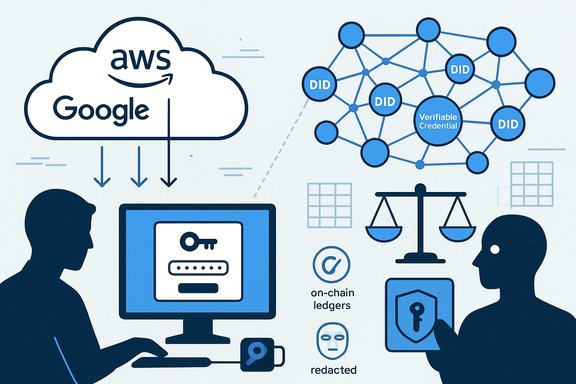
Major cloud providers — Amazon Web Services, Google Cloud, Microsoft Azure — power much of the modern identity infrastructure. Enterprises rely on their identity products (Azure AD/Entra, Google Workspace, Okta) for workforce and customer authentication, and those platforms’ integrations have become default choices in contracts and alliances. This concentration is efficient but fragile: a misconfiguration, breach or policy change at a dominant vendor can cascade across millions of users.The ForkLog reporting lays out this tension clearly: centralized systems deliver convenience but also create a single choke point for mass surveillance, data harvesting, and large‑scale breaches.
Blockchain, SSI and the promise of DIDs and VCs
Blockchain projects reframed the identity problem: what if identifiers and attestations could be anchored immutably while sensitive attributes remained private, under user control? This is the Self‑Sovereign Identity (SSI) model, powered by two key W3C standards:- Decentralized Identifiers (DIDs) — cryptographic identifiers not issued by a central authority.
- Verifiable Credentials (VCs) — digitally signed attestations (a diploma, a driving licence) that can be verified cryptographically without calling a central database.
- ENS (Ethereum Name Service) simplified blockchain addresses into human‑readable names when it launched in May 2017, making ownership and identity on Ethereum more accessible.
- Microsoft’s ION (Identity Overlay Network) is a Sidetree implementation on Bitcoin that anchors DIDs in a scalable, token‑free layer‑2 model. Microsoft and collaborators positioned ION as a way to deploy DIDs at scale without introducing new tokens.
- Polygon ID launched in early March 2023 as a ZK‑proof based identity toolkit enabling issuers, verifiers and holders to work with zero‑knowledge proofs for privacy‑preserving attestations. The product emphasized on‑chain verification without exposing raw personal data.
The new frontier: identities for AI agents
The rapid integration of AI into workflows has produced a new category of identities: agent identities for non‑human actors. These identities let autonomous software act, pay, and be audited.- Coinbase’s x402 protocol (announced May 2025) revives the HTTP 402 mechanism to enable HTTP‑native stablecoin payments, designed to let web clients — including AI agents — pay for API calls and services in a standardized way. Coinbase followed with Payments MCP: a developer toolkit and wallet layer that lets AI models like Claude and Gemini access an onchain wallet to pay for services autonomously. These moves effectively give agents the same financial primitives as humans, enabling automated commerce.
- Industry efforts such as AGNTCY and agent identity frameworks are attempting to standardize agent‑to‑agent interactions and assign each agent an identity that can hold credentials and keys. The result: agents that can be issued permissions, be audited for actions, and — crucially — be held accountable in ways closer to human actors.
What works well today
- Interoperability through standards: W3C DIDs and Verifiable Credentials give a practical, interoperable baseline for SSI. When implemented properly they reduce the need for central repeatable checks and limit data collection.
- Phishing‑resistant authentication: FIDO2/passkeys and hardware-backed authenticators reduce credential theft risk and are increasingly supported across ecosystems.
- Selective disclosure and ZK proofs: Systems like Polygon ID demonstrate how zero‑knowledge proofs let users prove an attribute (e.g., "over 18") without revealing the underlying data.
- Enterprise IAM maturity: Large vendors offer mature, auditable IAM suites that integrate conditional access, device posture and lifecycle governance — essential for complex Windows/Active Directory estates.
The big risks — and why they matter
- Centralization of power and data
When a handful of providers control identity flows, they control recovery, auditing, telemetry and potential access to billions of attestations. That enables surveillance, coercion and catastrophic exposures if breached. - Supply‑chain and vendor aggregation
Outsourcing identity checks (age verification, KYC) concentrates sensitive biometric and document images with specialist vendors. When those vendors are breached, user IDs and biometric data can leak at scale — a problem highlighted repeatedly in incident post‑mortems and community threads. - Key loss and irrecoverability
Self‑sovereign systems are only as usable as their recovery models. Losing a private key can permanently orphan access to identity-enabled services unless robust, privacy‑respecting recovery flows are in place. - Biometric overreach
Projects like Worldcoin that use iris scanning and similar biometrics spark ethical, legal and privacy concerns. Centralized biometric registries are highly sensitive and have triggered regulatory pushback in multiple jurisdictions. - Agentic attack surface
Giving AI agents wallets and permissions reduces human latency — but it also means a compromised agent can cause automated financial loss or automated policy violations. Agent identities must therefore be governed like privileged credentials, with spend limits, just‑in‑time grants, and human‑in‑the‑loop controls where appropriate. Evidence from recent developer platform launches underscores this urgency. - Unclear regulation and cross‑border mismatch
National ID programmes and transnational initiatives (the EU EUDI Wallet) create a patchwork of rules. The EU has mandated EUDI Wallet availability by 2026 under eIDAS 2, but technical, legal and operational gaps remain that providers and relying parties must address.
Practical guidance for WindowsForum readers: secure identity choices today
- Prefer phishing‑resistant authenticators. Enroll hardware tokens (YubiKey/FIDO2) or platform passkeys for privileged accounts. This reduces exposure to credential‑harvesting attacks that have become the primary intrusion vector.
- Treat agent identities like service accounts. Apply:
- Least privilege (narrow scopes).
- Spend and action limits for agents that hold wallets.
- Lifecycle governance: provisioning, review, deprovisioning.
- Use conditional access and device attestation (Microsoft Entra/Azure AD features) for high‑risk operations. Bind sensitive resources to device posture and context.
- Demand contractual security hygiene from identity vendors: minimal retention, redaction of uploaded ID images, and mandatory breach notification. Outsourced verification must not become a permanent datastore of raw biometric evidence. Community guidance in our repository stresses these operational mitigations as minimum requirements.
- Pilot decentralized identity only after exhaustive recovery planning. If exploring DIDs and VCs, plan fallback paths for lost keys (social recovery, multi‑party escrows) and ensure they align with privacy and legal constraints.
Policy and governance: what regulators and enterprises must do
- Enforce data minimization: require that identity vendors return attestations, not raw documents. Where evidence must be collected, demand ephemeral processing and cryptographic protections.
- Standardize agent accountability: introduce legal and technical frameworks that bind an agent’s actions to auditable ownership, entitlements and redress mechanisms.
- Clarify the role of biometric registries: deploy strict limits on where and how biometrics can be used, retained and shared, with independent audits and meaningful consent.
- Support cross‑border interoperability: regulators should converge on standards for VCs and DIDs (legal recognition, non‑repudiation, revocation semantics) to avoid fragmentation.
Where claims need caution
Several high‑profile projects and market figures are compelling, but some claims require careful scrutiny:- Market forecasts (IAM market size, growth rates) depend on vendor definitions and report methodology; treat absolute figures as a directional indicator rather than immutable truth. The MarketsandMarkets numbers are widely cited but reflect their specific market taxonomy.
- Decentralization is not automatic. Many “decentralized” implementations still rely on vendor‑managed nodes or cloud operators; verify governance and node diversity before assuming resistance to censorship or single‑party failure.
- Biometric identity projects promise inclusivity but often create exclusionary outcomes in practice — people without documents or who cannot present biometrics may be locked out, and marginalized groups may bear outsized privacy risks.
The near future: plausible scenarios
- The EU will push the EUDI Wallet into production windows in 2026, forcing suppliers and platforms that operate in Europe to support EUDI attestation flows and selective disclosure. This will accelerate wallet adoption and create global interoperability pressure.
- Agentic commerce will scale quickly if HTTP‑native payment rails (x402) and agent wallets (Payments MCP) gain traction. That will create new markets for microservices priced at tiny increments, and also a new attack surface where automated fraud becomes highly profitable.
- Enterprise identity vendors will embed agent governance and richer entitlement models into IAM suites, making identity the operational center for hybrid human/agent workforces.
- Blockchain and ZK‑proof identity tooling will mature as practical options for selective disclosure, especially in Web3 and privacy‑sensitive enterprise contexts; however, the user experience and recovery models will remain key adoption bottlenecks. Polygon ID’s March 2023 release showed the practical benefits of ZK proofs, but adoption will be phased and context‑dependent.
Conclusion
Digital identity has moved from an engineering problem to a societal one. The technical building blocks — DIDs, VCs, zero‑knowledge proofs, passkeys, and HTTP‑native payments — are maturing rapidly. They offer stronger privacy and new capabilities, including agentic automation that can transact without human intervention.But capability without governance is a recipe for concentrated risk. Centralized identity vendors offer frictionless convenience while creating single points of failure; decentralized projects offer privacy but demand rigorous recovery and governance; and agent identities invite economic automation with systemic consequences.
The responsible path forward is not a single architecture but a set of pragmatic rules: minimize retained evidence, adopt phishing‑resistant authenticators, treat agents as privileged actors, demand independent audits, and ensure legal frameworks keep pace with technology. For Windows administrators, developers and hobbyists alike, the immediate priorities are practical — deploy passkeys and hardware MFA, harden agent flows, and insist on contractual safeguards from identity vendors.
Digital identity is an infrastructure decision with long tails. The choices made today — by standards groups, enterprises, and regulators — will determine whether identity becomes a foundation for individual sovereignty or a mechanism for mass surveillance. The technical community must steer it toward the former, because convenience alone is a poor substitute for trust.
Source: ForkLog An identity of sorts | ForkLog
