

ICESCO and Microsoft have quietly rolled out a targeted educational push in Sharjah: a three-part workshop series called Digital Mindsets designed to move students beyond tool use and toward a critical, ethical, and human-centered understanding of artificial intelligence. The in-person series—delivered in Arabic at ICESCO’s regional office in Sharjah and reported to include 60 university students—pairs a foundational primer on AI with hands-on training in Microsoft Copilot and a forward-looking session on Agent AI, framing technical skills inside broader conversations about responsibility, human roles, and labor market shifts.
ICESCO (the Islamic World Educational, Scientific and Cultural Organization) maintains a regional office in Sharjah that has been actively promoting education and digital initiatives across member states. Microsoft, meanwhile, has turned product lines such as Microsoft Copilot, Copilot Studio, and Azure AI Foundry into public-facing channels for both consumer productivity and enterprise agent development. Combining ICESCO’s regional reach and Microsoft’s tooling makes the program timely—and potentially influential for students entering an AI-shaped labor market.
A realistic curriculum, therefore, should prepare students for:
That said, the program’s impact will hinge on implementation details: ensuring equitable access, teaching security and governance as core competencies, and avoiding narrow vendor lock-in. Success requires more than a three-part workshop; it requires follow-on support, institutional commitments to equitable access, curriculum portability, and a rigorous focus on accountability.
For educators and policy designers, the model is promising—but only if the human-centered language at the program’s core is treated as more than rhetoric. True digital mindsets are measured not by familiarity with tools, but by the ability to interrogate them, govern them, and place human dignity and societal fairness at the center of the AI transition.
Source: sharjah24.ae ICESCO and Microsoft launch the “Digital Mindsets” series
 Background
Why this matters now
Artificial intelligence is no longer a distant technical specialty; it is a practical force reshaping jobs, classrooms, and civic life. Initiatives that treat AI as a socio-technical system—where models, platforms, governance, and human judgement interact—are increasingly important. The ICESCO–Microsoft collaboration positions itself explicitly at that intersection: not merely teaching students how to use AI, but teaching how to think about it.ICESCO (the Islamic World Educational, Scientific and Cultural Organization) maintains a regional office in Sharjah that has been actively promoting education and digital initiatives across member states. Microsoft, meanwhile, has turned product lines such as Microsoft Copilot, Copilot Studio, and Azure AI Foundry into public-facing channels for both consumer productivity and enterprise agent development. Combining ICESCO’s regional reach and Microsoft’s tooling makes the program timely—and potentially influential for students entering an AI-shaped labor market.
What the program contains
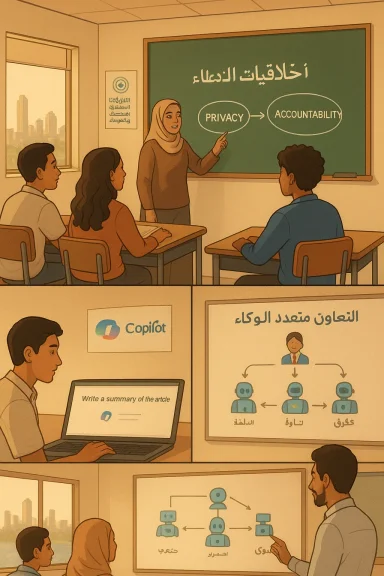
The series comprises three interconnected workshops:- Decoding Artificial Intelligence — a conceptual and ethical primer covering fundamental AI concepts, real-world applications, and frameworks for ethical evaluation.
- Microsoft Copilot workshop — practical skills to interact intelligently with Copilot-style assistants, focusing on prompt and command formulation to improve productivity and to avoid common failure modes.
- Agent AI — an exploration of multi-agent systems and the changing nature of work as intelligent systems take on more planning and execution responsibilities.
The initiative in context
ICESCO’s mission and regional presence
ICESCO’s mandate centers on education, science, and culture across member states, and its Sharjah regional office has become a hub for workshops and partnerships that align with the UAE’s digital and educational strategies. Recent activity from the Sharjah office underscores a pattern: convening youth-focused workshops, signing MoUs with regional universities, and hosting training events that link local students with global technology firms. In that light, a program that blends ethics with hands-on AI tooling fits squarely into ICESCO’s established remit.Microsoft’s evolving AI stack
Microsoft’s product and platform road map over the last three years has emphasized embedded AI assistants and an enterprise-ready stack for building agents:- Microsoft Copilot is now tightly integrated across Windows and Microsoft 365 products as an AI productivity assistant; the experience has evolved from a sidebar to a native-like app optimized for multitasking on Windows devices.
- Copilot Studio provides graphical and low-code tooling to design, test, and publish AI agents that can be deployed across Microsoft 365, Teams, and other channels. It’s marketed as an end-to-end platform for creating conversational and autonomous agents.
- Azure AI Foundry (sometimes referenced simply as Foundry) acts as Microsoft’s unifying AI platform for model choice, orchestration, retrieval, governance, and distribution of models and agents.
What the workshops aim to teach—and why that matters
Decoding Artificial Intelligence: building critical literacy
A foundational session on AI should do more than explain models and datasets. When executed well, it teaches students to:- Recognize how generative models are trained and where their errors and biases originate.
- Differentiate model outputs that are useful from those that are plausible but wrong (hallucinations).
- Apply ethical frameworks to evaluate deployment contexts—privacy, fairness, transparency, and accountability.
- Connect technical choices (data selection, model constraints) with societal outcomes.
Microsoft Copilot workshop: operational competence and prompt craft
The Copilot workshop reportedly focuses on the practical skill of prompt engineering and efficient interaction with AI assistants. Practical benefits for participants may include:- Faster information triage across documents, email, and browser tabs.
- Structuring prompts to reduce ambiguity and extract grounded answers.
- Integrating Copilot into everyday workflows—research, drafting, data summarization.
Agent AI: the future of work and human roles
Agent AI workshops explore orchestration of multi-step workflows and autonomous agent behaviors. Key learning objectives usually include:- Understanding the architecture of multi-agent systems and where human oversight is required.
- Designing safeguards, escalation mechanisms, and audit trails for agents that take actions on behalf of users or organizations.
- Mapping job roles to hybrid systems where humans and agents collaborate—rethinking tasks around judgment, ethics, and domain expertise.
Strengths and likely benefits
- Human-first framing. The initiative’s explicit focus on humanistic and ethical dimensions is a major strength. Students are less likely to adopt AI as a black-box productivity hack and more likely to develop critical thinking skills about its use.
- Practical, tool-based learning. Hands-on training with Copilot and agent tools reduces the gap between conceptual knowledge and employable skills—an advantage in job markets where platform familiarity matters.
- Language accessibility. Delivering workshops in Arabic removes a language barrier that can limit access to AI training in the region, increasing inclusivity for non-English-speaking students.
- Regional capacity-building. ICESCO’s institutional presence and Microsoft’s tooling together offer a model for sustainable upskilling that could be scaled across member states.
- Alignment with industry trends. Teaching agent design and orchestration anticipates workplace realities where multi-agent systems and Copilot integrations are increasingly common.
Risks, limitations, and unanswered questions
Equity and the device requirementt
Participants are expected to bring their own devices for practical sessions. This seemingly small logistical detail raises equity concerns:- Students with older hardware or limited connectivity may be unable to participate fully, producing a selection bias toward better-resourced learners.
- Copilot and agent toolchains often assume reliable broadband and modern browsers; offline or low-bandwidth modes remain limited.
Language and model limitations
While the workshops are offered in Arabic, many AI models and product features remain optimized for English. Limitations include:- Reduced accuracy or lower-quality responses when prompts or knowledge sources are Arabic-first.
- Gaps in training data for dialectical Arabic, affecting the performance of generative models when working in regional linguistic contexts.
Vendor lock-in and skills portability
Training students on Microsoft Copilot and Copilot Studio delivers immediate productivity gains, but it also creates dependencies on proprietary tooling. Important considerations:- Platform-specific skills may not transfer easily to non-Microsoft AI stacks.
- Organizations and individuals should be taught portability strategies—open standards, exportable prompts, and cross-platform architectural patterns—to avoid lock-in.
Data protection, privacy, and compliance
Cloud-hosted assistants and agent services raise clear privacy and compliance issues:- When Copilot interacts with organizational or personal documents, what data is logged, retained, and shared with model providers?
- Students must be taught best practices: anonymization, minimization, and how to use enterprise controls (conditional access, tenant-level governance) where available.
Misuse, social engineering, and security threats
Agent frameworks are powerful but open new attack surfaces. Recent security research has shown that social-engineering techniques can abuse agent interfaces to harvest OAuth permissions or trick users into conceding access. Students need threat literacy:- How to recognize malicious agent prompts or consent screens.
- How to request and require admin approval for third-party agents.
- Fundamental hygiene: MFA, limiting OAuth consents, and audit logging.
The accountability gap
Teaching students to use agents and Copilot must include governance skills:- How are decisions traced and audited when agents act autonomously?
- Whose liability attaches to an agent’s error—the developer, the deploying organization, or the user who approved the action?
- What policies should students expect from employers around human-in-the-loop thresholds?
How this fits into the wider educational and labor landscape
Jobs are changing—but so are required competencies
The labs reflect a broader shift in how work is structured. Mundane cognitive tasks—summarization, triage, basic analytics—are increasingly automatable. What remains valuable are skills where humans add clear causal or ethical judgement: domain expertise, policy interpretation, cross-cultural communication, and oversight.A realistic curriculum, therefore, should prepare students for:
- Hybrid workflows where agents handle routine steps and humans handle exceptions.
- Roles centered on governance, verification, and system design rather than purely production-focused tasks.
- Interdisciplinary collaboration with law, social sciences, and ethics to craft policy-compliant systems.
Local advantage if done right
For students in the Gulf and wider Islamic world, Arabic-language, ethically-grounded AI education can produce unique regional advantages. Fluent human-AI operators who understand local contexts, laws, and languages will be valuable for regional governments, healthcare systems, media, and education.Practical recommendations for educators and program designers
- Build explicit equity mechanisms: device lending, stipends for connectivity, and offline-friendly curricula.
- Include robust security modules that teach OAuth hygiene, admin consent patterns, and token management when studying Copilot Studio and agent frameworks.
- Teach verification workflows: how to corroborate AI outputs with source documents, provenance tracking, and secondary verification.
- Offer modularity: emphasize cross-platform concepts and portability so students learn transferable skills beyond Microsoft tooling.
- Embed governance labs: have students design escalation flows, audit trails, and human-in-the-loop thresholds for agents.
- Localize model evaluation: assess AI outputs in Arabic, different dialects, and domain-specific datasets; don’t rely solely on English benchmarks.
- Provide follow-on pathways: internships, apprenticeships with supervised agent deployments, and mentorship with cross-functional teams.
What to watch for next
- Scaling and replication: whether ICESCO and Microsoft extend the program to other regional offices or translate the curriculum into scalable online modules.
- Accessibility of Copilot Studio: companies and governments will be watching for features that enable safer, audit-capable agent deployments suitable for public-sector use.
- Security mitigations from platform vendors: as agent frameworks proliferate, attention to consent UX, token safety, and platform-level guardrails will be essential.
- Measurable learning outcomes: the initiative’s long-term value will depend on whether graduates can demonstrate improved critical reasoning, safer tool use, and employable agency-skills.
Final assessment
The ICESCO–Microsoft Digital Mindsets series represents a sound, pragmatic attempt to bridge ethical literacy and practical skills in AI—an approach badly needed in technical education today. Teaching students to decode AI, use productivity assistants responsibly, and design agent-aware workflows addresses both immediate employability and longer-term civic responsibilities.That said, the program’s impact will hinge on implementation details: ensuring equitable access, teaching security and governance as core competencies, and avoiding narrow vendor lock-in. Success requires more than a three-part workshop; it requires follow-on support, institutional commitments to equitable access, curriculum portability, and a rigorous focus on accountability.
For educators and policy designers, the model is promising—but only if the human-centered language at the program’s core is treated as more than rhetoric. True digital mindsets are measured not by familiarity with tools, but by the ability to interrogate them, govern them, and place human dignity and societal fairness at the center of the AI transition.
Source: sharjah24.ae ICESCO and Microsoft launch the “Digital Mindsets” series
