

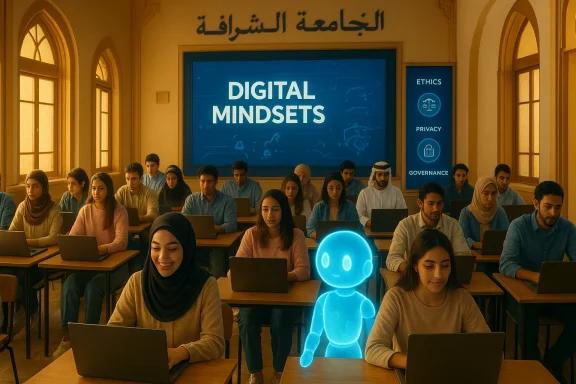
The Sharjah regional office of the Islamic World Educational, Scientific and Cultural Organization (ICESCO), in collaboration with Microsoft, has launched a three-part knowledge series called Digital Mindsets, a focused short-run training cycle designed to teach not just how to use AI tools but how to think about them—technically, ethically, and professionally—targeting 60 university students at ICESCO’s Sharjah headquarters.
Artificial intelligence is reshaping education, government services, and the workplace at a speed that makes plain-language, practice-focused, and ethically grounded education essential. The Digital Mindsets series aims to respond to that need by pairing conceptual grounding with hands-on sessions using Microsoft tools, deliberately coupling ethics and human-centered discussion with practical Copilot and agent-oriented training. The program is delivered iin Arabic, requires participants to bring their own devices, and is reported to be limited to 60 students on a first‑come, first‑served basis.
ICESCO framed the initiative as an investment in cognitive and ethical readiness as much as in technical literacy: Salem Omar Salem, Director of the ICESCO Regional Office in Sharjah, is quoted as saying the program “reflects ICESCO’s commitment to preparing a generation that is aware of and capable of understanding the profound transformations brought about by artificial intelligence, not only from a technical perspective but also from a cognitive, humanistic, and ethical standpoint.”
This story matters for regional education policy, for students deciding how to prioritize skills in the AI era, and for institutions that must balance access to vendor tools with public-interest safeguards. An analysis prepared for a technical audience within the community further underscores that the collaboration intentionally situates tool training (Copilot, agent workflows) inside larger conversations about accoion, and labor-market change.
Practical considerations:
At the same time, the program’s limited scale, BYOD constraints, and the inherent risks of vendor-centered labs mean organizers should prioritize open, shareable materials, robust sandboxing, explicit governance instruction, and follow-up pathways to convert awareness into sustained capability. Verified product documentation and independent reporting confirm the technical relevance of Copilot Studio and Foundry as the enterprise scaffolding behind the agent concepts students will encounter; this validation strengthens the program’s practical utility but also raises the bar for governance education and privacy practice.
If the initiative is to have lasting regional impact, ICESCO and Microsoft should treat the first cohort as a pilot: publish bilingual (Arabic + English) learning artifacts, create an online self-study pathway, and set measurable outcomes for cognitive and operational competency that can be audited and iterated. The stakes are high and the opportunity real: empowering students to think through AI, not just use it, will be one of the most consequential educational investments of the next decade.
Source: malaysiasun.com https://www.malaysiasun.com/news/278828340/icesco-microsoft-launch-digital-mindsets-series/
 Background / Overview
Artificial intelligence is reshaping education, government services, and the workplace at a speed that makes plain-language, practice-focused, and ethically grounded education essential. The Digital Mindsets series aims to respond to that need by pairing conceptual grounding with hands-on sessions using Microsoft tools, deliberately coupling ethics and human-centered discussion with practical Copilot and agent-oriented training. The program is delivered iin Arabic, requires participants to bring their own devices, and is reported to be limited to 60 students on a first‑come, first‑served basis. ICESCO framed the initiative as an investment in cognitive and ethical readiness as much as in technical literacy: Salem Omar Salem, Director of the ICESCO Regional Office in Sharjah, is quoted as saying the program “reflects ICESCO’s commitment to preparing a generation that is aware of and capable of understanding the profound transformations brought about by artificial intelligence, not only from a technical perspective but also from a cognitive, humanistic, and ethical standpoint.”
This story matters for regional education policy, for students deciding how to prioritize skills in the AI era, and for institutions that must balance access to vendor tools with public-interest safeguards. An analysis prepared for a technical audience within the community further underscores that the collaboration intentionally situates tool training (Copilot, agent workflows) inside larger conversations about accoion, and labor-market change.
What the Digital Mindsets series actually includes
The series comprises three interconnected workshops that progress from foundations to tool practice to future-facing scenarios:- Decoding Artificial Intelligence — A conceptual and ethical primer introducing core AI concepts, typical applications, failure modes (e.g., hallucinations), and framework deployments. The agenda emphasizes critical literacy over rote use.
- Microsoft Copilot workshop — Hands-on training in interacting with Copilot-style assistants: structured prompt design, practical workflows for documentation, and safe data-handling practices when working with cloud-based assistants. Participants are coached on techniques to reduce ambiguity in prompts and to verify outputs before acting on them.
- Agent AI — Explorations of multi-agent orchestration, autonomous workflows, and the evolving nature of work when systems can plan and execute multi-step processes. This session includes discussion of audit trails, escalation paths, and the human roles that will persist or emerge as agents automate routine tasks.
Why Microsoft tooling matters here — and what it actually is
Microsoft’s Copilot and its agent tooling are at the center of the practical modules. For readers who want technical clarity:- Microsoft Copilot (for Microsoft 365 and Windows) is the company’s embedded productivity assistant that draws on the Microsoft Graph and connected data sources to summarize, draft, and help users create content inside familiar applications. It’s designed to operate within the user’s permission scope, and Microsoft has emphasized enterprise-grade data protections for Copilot integrations.
- Copilot Studio is Microsoft’s low-code/no-code environment for designing, customizing, and deploying AI agents (custom copilots) that can be connected to business data sources, templates, and channels used by organizations. Copilot Studio supports building conversational flows and autonomous capabilities and is explicitly marketed as a platform to design agents for enterprise workflows.
- Microsoft Foundry (Azure AI Foundry) is the broader Azure AI platform canopy that provides model selection, routing, governance, and orchestration for AI apps and agents at scale—what Microsoft describes as an “AI app and agent factory.” Foundry offers model selection across thousands of models, fine-tuning, real-time model routing to optimize quality and cost, and a control plane for governance. These are the underlying capabilities enterprises use to build robust, auditable agent systems.
Who this helps — and who might be left out
The stated target is university students from various disciplines—an intentionally broad cohort. This is sensible: digital literacy is cross-disciplinary, and students in humanities, social sciences, and STEM all need frameworks to reason about AI and work with AI tools responsibly.Practical considerations:
- The program size (reported at 60 students) suggests an intensive, cohort-style delivery rather than mass skilling—advantageous for depth but limited in scale.
- Delivery in Arabic is a crucial accessibility choice for the region and signals attention to localization rather than transplanting.
- The bring-your-own-device (BYOD) requirement lowers logistical costs but implicitly favors students who can supply laptops or tablets, which can introduce equity considerations for less privileged learners.
Strengths: why this initiative has real potential
- Human-first framing: By pairing ethics and critical thinking with tool training, the program avoids the common pitfall of turning AI literacy into purely product-driven instruction. This builds resilient skills—how to check outputs, how to reason about bias, and how to design oversight processes.
- **Local language n Arabic increases comprehension and widens participation among students who may struggle with English-first technical content.
- Hands-on tool practice: Real exposure to Copilot and agent concepts gives students a practical sense of how productivity and automation workflows are built and governed—valuable for employability in a market where employers expect AI fluency.
- Institutional partnership model: ICESCO’s regional remit and Microsoft’s platform capabilities make for a complementary partnership: one brings access and cultural framing; the other brings tools, curriculum content, and industry-contextual examples. The model aligns with other regional Microsoft skilling programs that combine product access with localized pedagogies.
Risks and gaps — what the program must manage
No single short-run program can solve all problems. Below are the most consequential risks and recommendations to address them.- Vendor dependence and platform literacy
Risk: Training that revolves around a single vendor’s products can leave learners with narrow, product-specific habits rather than transferable conceptual skills.
Mitigation: Keep the Decoding AI session vendor-neutral, emphasizing concepts (e.g., model training, retrieval-augmented generation, hallucination modes), and treat Copilot labs as illustrative cases rather than universal standards. Cite differences between model behavior, data access, and governance across vendors when possible. - Data privacy and inadvertent leakage
Risk: Cloud-based copilots and agents often require connecting data sources; students might accidentally upload sensitive information or rely on default settings that expose content.
Mitigation: Include clear, demonstrable operational practices—sandboxed accounts, rules for sanitizing inputs, staged publishing, and strong emphasis on opt-in connectors. Tie hands-on labs to concrete privacy checklists and enterprise-grade governance features. Microsoft’s documentation stresses Copilot operates within permission boundaries and highlights data protection features; these should be taught and tested during sessions. - Overconfidence in outputs (hallucination and factuality issues)
Risk: A Copilot-generated summary or answer can look authoritative while being incorrect. Students must learn verification workflows and the limits of generative systems.
Mitigation: Teach verification as a required step—use source logging, retrieval provenance, and manual cross-checks as standard operating procedure. Exercises that intentionally present flawed model outputs are pedagogically useful. - Equity and scale
Risk: With only 60 seats, the program cannot alone produce broad regional change. The BYOD requirement further limits access for economically disadvantaged students.
Mitigation: ICESCO and Microsoft should publish open materials, recorded sessions, and structured self-study modules in Arabic to scale access. Consider a follow-up digital track with device loans or campus-hosted labs for students without personal devices. - Skill mismatch for the future of work
Risk: Teaching only prompt-tuning and basic agent concepts might short-change the skills employers need, such as agent governance, dataset curation, evaluation metrics, and regulatory compliance knowledge.
Mitigation: Add modules or follow-up bootcamps focused on agent auditing, model evaluation metrics, privacy impact assessment, and human-in-the-loop design. Emphasize interdisciplinary skills: ethics, domain expertise, and project management for AI-enabled workflows.
Technical verification: matching claims to authoritative sources
Several claims about Microsoft tooling and the nature of agents are verifiable through official product documentation and reputable technology reporting:- Microsoft’s description of Copilot Studio as a low-code environment for building and managing agents, including templates and the ability to connect to business data, is confirmed by Microsoft’s product pages. Copilot Studio supports building conversational agents and adding autonomous capabilities for business processes.
- The broader Foundry (Azure AI Foundry) product is explicitly positioned as an integrated platform for building, optimizing, and governing AI apps and agents—supporting thousands of models, model routing, and governance features on Azure. These capabilities align with the kinds of agent workflows discussed in the Digital Mindsets Agent AI session.
- Independent reporting has documented agent-level features such as Copilot Studio’s expansion into “computer use” (allowing agents to interact with web pages and desktop apps), which elevates agent capabilities from passive assistance to action-taking automation—an important technical shift that heightens the need for guardrails and auditability.
Practical curriculum checklist for educators running similar programs
Institutions designing comparable short-courses should consider the following checklist to maximize learning outcomes while minimizing risk:- Begin with clarifying outcomes
- Decide whether the program’s priority is awareness, operational competence, or job-readiness. Each goal requires different depth and follow-up resources.
- Vendor-neutral foundations
- Teach model architectures, common failure modes, and ethical frameworks before introducing vendor tools.
- Sandboxes and safe data practices
- Use anonymized datasets in labs; provide sandboxed enterprise-demo accounts; enforce a privacy checklist for any exercise that touches external APIs.
- Verification routines
- Require participants to show how they checked an output (sources, cross-references, or simple tests).
- Governance and audit trails
- Walk through designing an audit trail for agent actions; practice building escalation and rollback mechanisms.
- Assessment and artefacts
- Have each participant produce a short portfolio item: an annotated prompt, a critical review of an agent interaction, and a one-page governance plan.
- Open materials and scaling
- Publish Arabic-language resources, recorded demos, and self-study guides for wider accessibility.
- Follow-up support
- Offer office hours, online forums, or mentoring to convert initial exposure into retained skills.
Critical analysis: what success will look like—and what to watch for
Success for Digital Mindsets should be judged on several axes beyond attendance numbers:- Cognitive shift: Students should leave able to articulate the limits of generative systems and to design a simple verification pipeline for any Copilot-generated artifact.
- Operational readiness: Graduates should be able to compose structured prompts, integrate Copilot into at least two realistic workflows (e.g., document summarization and data triage), and describe the steps to prevent accidental data exposure.
- Governance thinking: Participants should be able to draft a one-page governance checklist for an agent that acts on behalf of a user—listing permissions, audit logging, and escalation points.
- Multiplier effect: The program should produce shareable materials (in Arabic) or a “train-the-trainer” pipeline so that its impact scales beyond the initial cohort.
- Training that focuses on shortcuts and hacks rather than verification and governance will create false confidence.
- If labs use real, private datasets without strong sandboxing, the program risks creating data-leakage incidents that undermine trust.
- An absent follow-up pathway means skills will atrophy; short in‑person sessions need structured follow-up to become durable competencies.
Regional and policy implications
This ICESCO–Microsoft collaboration is a microcosm of how international tech firms and regional educational bodies can partner. The benefits are clear: access to current tools, contextualized delivery, and localized language support. But there are policy questions that merit attention from educators and regulators:- Standards for teaching commercial tools: Should ministries or regional authorities endorse curricula that include vendor tools? If so, what minimum safeguards (sandboxing, privacy, audit demonstrations) should be mandated?
- Digital equity: Programs that rely on BYOD risk leaving some groups behind. Policy-level support for device access (loan programs, campuidered.
- Credential and recognition: Short workshops are valuable, but employers and universities may prefer formal microcredentials or assessment. Aligning workshops to recognized competency frameworks would increase employability outcomes.
Conclusion
ICESCO’s Digital Mindsets series, executed with Microsoft, is a timely and well-structured attempt to bridge ethical AI literacy with hands-on productivity and agent training for a cohort of university students in Sharjah. The decision to teach in Arabic, focus on humanistic and ethical framing, and pair conceptual modules with Copilot and agent practice represents best-practice thinking for short-form AI education in a region undergoing rapid digital transformation.At the same time, the program’s limited scale, BYOD constraints, and the inherent risks of vendor-centered labs mean organizers should prioritize open, shareable materials, robust sandboxing, explicit governance instruction, and follow-up pathways to convert awareness into sustained capability. Verified product documentation and independent reporting confirm the technical relevance of Copilot Studio and Foundry as the enterprise scaffolding behind the agent concepts students will encounter; this validation strengthens the program’s practical utility but also raises the bar for governance education and privacy practice.
If the initiative is to have lasting regional impact, ICESCO and Microsoft should treat the first cohort as a pilot: publish bilingual (Arabic + English) learning artifacts, create an online self-study pathway, and set measurable outcomes for cognitive and operational competency that can be audited and iterated. The stakes are high and the opportunity real: empowering students to think through AI, not just use it, will be one of the most consequential educational investments of the next decade.
Source: malaysiasun.com https://www.malaysiasun.com/news/278828340/icesco-microsoft-launch-digital-mindsets-series/
