

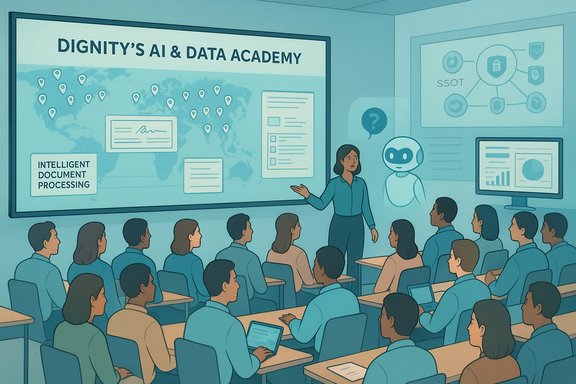
Dignity has opened an in-house AI & Data Academy for 55 employees in a targeted push to convert decades of manual administration into data-driven, AI-augmented operations across more than 570 branches, aiming to cut repetitive work such as the processing of roughly 100,000 paper cheques every year and to bring consistent, real-time visibility to everyday operational decisions.
Background
Dignity operates a network of funeral homes and end‑of‑life care services that has historically relied heavily on manual administration: spreadsheets for lease and site tracking, branch-level forecasting completed by hand, and large volumes of paper-based financial transactions. These processes are typical of mature, geographically dispersed service businesses where operational practices evolved locally over many years. The new academy is an organizational response intended to standardize skills, introduce digital tools, and reduce the operational drag caused by fragmented, manual workflows.The training is being delivered in partnership with an established upskilling provider and includes multi‑level curricula designed for technical and non‑technical roles alike. Programs focus on practical adoption of AI into daily work, leadership-level understanding of AI strategy, and the development of data-literate teams able to build and use tools responsibly.
Why this matters: scale, waste, and the opportunity cost
Even in an era of rapid digitization, organizations with large physical footprints often harbor pockets of heavy manual work. The figures highlighted by Dignity—hundreds of branches and six-figure annual cheque volumes—are not just accounting curiosities: they represent recurring operational cost, process risk, and lost time for frontline staff who must prioritize administration over customer-facing care.- Manual cheque processing, paper workflows, and spreadsheet-based site records are costly and fragile.
- Inconsistent forecasting at branch level increases inventory and resourcing inefficiencies.
- Data silos across branches make enterprise-level decision-making slow and uncertain.
The Academy model: levels, audience and practical aims
The academy is structured into distinct levels to match roles and outcomes:- Level 3 — AI-Powered Productivity: Practical courses focused on using generative AI and productivity tools in everyday tasks. This track is intended for users who need to integrate tools like Copilot-style assistants, prompt-based automation, and local knowledge-base querying into their daily workflows.
- Level 4 — AI for Business Value: A business-focused curriculum to build literacy across teams, enabling non-expert staff to identify use cases, assess business impact, and adopt AI responsibly.
- Level 5 — AI and Strategy Leadership: Aimed at senior leaders, this level emphasizes governance, strategic planning for AI investments, risk management, and leading organizational change.
Key practical aims of the programme include:
- Replacing repetitive manual tasks with AI-augmented workflows.
- Increasing data visibility across branches to support consistent KPIs and reporting.
- Reducing reliance on paper and local spreadsheets.
- Embedding a continuous learning culture so staff can evolve skills as tools change.
Training partner and delivery approach
Dignity’s training partner provides workplace-centred learning designed to combine classroom content with practical, on-the-job application. The model focuses on:- Role-specific, applied learning rather than abstract theory.
- Coaching and project-based assessments that produce tangible outputs (dashboards, automation scripts, policy drafts).
- Leadership modules that connect AI strategy to operational realities and compliance requirements.
Where AI can make an immediate impact
The academy specifically targets several high-impact operational pain points:- Cheque and paper-processing: Intelligent document processing (IDP) with OCR and ML models can convert cheque, invoice, and form data into structured records far faster than manual entry. Paired with workflow automation, this reduces processing time, error rates, and archiving costs.
- Branch forecasting: Machine learning models trained on historical branch data, seasonality, and external indicators can offer consistent, auditable forecasts and identify anomalies. This reduces time spent on manual number-crunching and improves accuracy.
- Lease and site management: A centralized asset register and a single source of truth (SSOT) replace spreadsheets, enabling automated alerts for renewals, standardized contract metadata, and consolidated reporting.
- Knowledge capture and retrieval: Generative retrieval-augmented systems and enterprise search enable staff to find guidance, templates, and local precedent quickly—helpful for sensitive, compliance-heavy customer interactions.
- Standardized reporting and dashboards: Company-wide KPIs presented through self-serve analytics tools let branch managers make decisions from a consistent data foundation.
Recommended technology patterns for rapid wins
For organizations starting the transition, the following technology patterns typically deliver high ROI when combined with staff upskilling:- Intelligent Document Processing (IDP): Combine OCR with ML-based classification and named entity extraction to ingest cheques, invoices, and forms automatically.
- Robotic Process Automation (RPA) augmented by AI: Use RPA for deterministic, rule-based automation, and layer generative or ML components for unstructured decisions.
- Data mesh or centralized data platform: Depending on scale, create a governed data platform or federated data mesh so branch-level data is discoverable, usable, and auditable.
- Self-service analytics (Power BI / Tableau / Looker): Train teams to build governed reports linked to trusted datasets.
- Generative AI assistants integrated with M365/Google Workspace: These tools boost productivity for drafting, summarising, and researching—if properly governed.
- Access management and encryption: Centralize authentication and ensure data-at-rest and in-transit are encrypted; use role-based access to limit exposure.
Governance, ethics and regulatory considerations
Training staff to use AI is necessary but not sufficient. A robust governance framework must be in place before operational AI is scaled.Key governance elements:
- Data governance and lineage: Know where data originates, how it is transformed, and who can access it. Lineage is essential for audit, retrospective model correction, and compliance.
- Model governance: Test models for bias, performance drift, and appropriateness. Keep test datasets and validation rules documented.
- Human-in-the-loop controls: For sensitive decisions—financial approvals, bereavement communications—maintain human oversight and clear escalation paths.
- Privacy and data minimization: Where staff process personal data, ensure compliance with privacy laws and retention limits. Anonymize or pseudonymize data where possible.
- Vendor risk management: When using third-party AI (cloud models, managed services), assess data residency, reuse policies, and contractual protections against model misuse or data leakage.
- Explainability and record-keeping: Keep concise, accessible documentation about where and why automation is applied.
People, change management and culture
Training alone rarely moves the needle without parallel change management. Successful upskilling programmes embed four practices:- Clear, measurable objectives: Define outcomes (hours saved, processing time reduced, forecast error decreased) linked to each training cohort.
- Champions and local coaches: Identify early adopters in each branch to provide peer-to-peer support.
- Process re-engineering, not just automation: Use training to re-evaluate the end-to-end process before automating steps. Automation of a bad process only cements inefficiency.
- Ongoing learning pathways: Technology changes fast; offer follow-up modules, microlearning, and access to sandbox environments for practice.
Risks and potential downsides
The academy approach addresses capability gaps but also surfaces risks that must be managed explicitly:- Automation that reduces empathy: Over-automation of front-line scripts can harm customer experience. Sensitive conversations need human warmth and professional judgment.
- Over‑reliance on out‑of‑the‑box generative models: These tools can hallucinate or provide incorrect facts; staff need training in verification and the limits of AI outputs.
- Data quality debt: Poor-quality source data leads to low-quality models and dashboards—invest in cleansing and standardization first.
- Security exposures: Increased tooling and model access expand the organization’s threat surface; strong identity, secrets management, and monitoring are required.
- Workforce resistance or skills mismatch: Not every employee will adapt at the same pace; provisioning time and support for practical learning is essential.
- Regulatory and reputational risk: Mistakes in financial processing or personal data handling can create outsized consequences for a funeral services provider.
Measuring success: KPIs that matter
To evaluate the academy’s impact, track a concise set of measurable KPIs tied to operational value and skill adoption:- Time to process cheques and other paper transactions (target reduction in minutes/hours).
- Percentage of cheque volume digitized and automated.
- Branch forecasting accuracy and time spent on forecast preparation.
- Number of automated workflows deployed and business hours saved.
- Data availability: percentage of branches using the SSOT, time to access key operational metrics.
- Learner outcomes: completion rates, applied projects delivered, on-the-job adoption metrics.
- Service quality: customer satisfaction and complaint rates tied to operational improvements.
Roadmap: pilot, prove, scale
A pragmatic rollout typically follows three phases:- Pilot (3–6 months): Select a few branches and a bounded set of use cases (cheque processing, one forecasting route, lease register). Pair learning with hands-on projects that deliver measurable assets.
- Proof of value (6–12 months): Measure gains, refine governance, and build templates and toolkits for replication. Establish a Centre of Excellence (CoE) responsible for standards, reusable components, and change management.
- Scale (12–24 months): Roll out to wider operations, combine with broader process re-engineering, and move from project-based automation to productized capabilities.
Practical recommendations for Dignity (and similar organizations)
- Begin with intelligent document processing for the highest-volume paper workflows to demonstrate quick ROI.
- Implement a simple data catalog and master data management program for core operational entities (sites, leases, branch KPIs).
- Build a lightweight CoE to manage model deployment, reuse templates, and own vendor integrations.
- Adopt role-based training tracks that lead to micro-credentials and internal recognition for learners.
- Use human-in-the-loop checkpoints for all automated decisions that affect finances or customer-facing outcomes.
- Measure the impact of each cohort in business terms (hours reclaimed, forecast error reduction, cost saved).
- Secure contractual protections about data usage and retention with any AI vendor, and require model documentation from suppliers.
- Invest in cyber hygiene: secure endpoints, centralised identity, and activity logging for AI tools that access company data.
Long-term strategic implications
If implemented thoughtfully, the academy can be the seed of a broader organizational shift: from a collection of local processes to a digitally capable network. Benefits beyond efficiency include:- Faster, evidence-based decision-making at regional and corporate levels.
- Improved employee engagement as repetitive tasks are reduced.
- Stronger resilience and auditability in finance and compliance processes.
- The ability to innovate—using the same skill base to explore advanced analytics, predictive maintenance for facilities, or personalised service offerings.
Critical analysis: strengths and blind spots
Strengths- Targeted workforce investment: Training 55 staff directly addresses the skills gap that commonly derails automation projects.
- Pragmatic curriculum mix: Combining productivity-level upskilling with leadership-level governance training encourages both adoption and oversight.
- Partnering for delivery: Using an experienced workplace learning provider accelerates rollout and brings proven pedagogy.
- Execution risk on scale: Training 55 people is a strong start but represents a fraction of total staff. Scaling the culture change will require sustained investment and clear incentives.
- Data readiness: The success of AI initiatives depends on clean, consistently structured data. The program will need parallel investments in data engineering and integration.
- Vendor dependence: Heavy reliance on cloud models or third-party platforms exposes the company to changing vendor terms and data reuse policies unless contracts are tightly managed.
- Measuring causality: Attribution of operational improvements to training versus other interventions must be explicit; otherwise, leadership may prematurely conclude success or failure.
- Human factors: In a sector where empathy and human judgment are central, automation must not erode the dignity of customer interactions. Guardrails must be designed with domain experts.
Closing assessment
Dignity’s AI & Data Academy is a sensible, modern response to a familiar enterprise problem: converting entrenched manual processes into consistent, auditable, and efficient digital operations. Its multi‑level design recognizes that real transformation requires both practical tool competence at the frontline and strategic governance at the top.The initiative is likely to produce measurable operational improvements if it pairs training with investments in data quality, targeted automation pilots, and a strong governance framework. The most important predictors of success will be disciplined metrics, human-centric design for sensitive workflows, and a sustained plan to scale learning and embed reuse across branches.
This programme is not a silver bullet but, properly executed, it can be the engine that turns paper-heavy, inconsistent operations into a modern, data-literate organization—reducing costs, improving employee experience, and delivering more consistent service to those the company serves.
Source: IT Brief UK https://itbrief.co.uk/story/dignity-launches-ai-data-academy-to-streamline-daily-operations/
