
Discord’s decision to make most accounts “teen by default” and roll out mandatory age verification has done something unusual: it exposed how dependent millions of communities are on one product, and how thin the options are when you need voice, screen-sharing, moderation, and community features that scale.
Discord announced a global shift in its safety model earlier in February, saying accounts that aren’t clearly proven to be adult will be placed into a restricted “teen” experience and that some users will have to verify their age to access age-restricted channels and features. The company subsequently paused and rearranged parts of the plan after a fierce backlash; Discord’s public blog and staff acknowledgments make clear the rollout will be delayed while more verification options and vendor transparency are added.
This controversy arrived on the heels of a high-profile third‑party incident: in late 2025 Discord disclosed that government ID photos submitted by users during previous age‑verification or appeal processes may have been exposed after a compromise involving a vendor. The incident — which Discord said affected roughly 70,000 government‑ID images — is still frequently cited in discussions about whether handing biometric or identity documents to vendors is worth the risk.
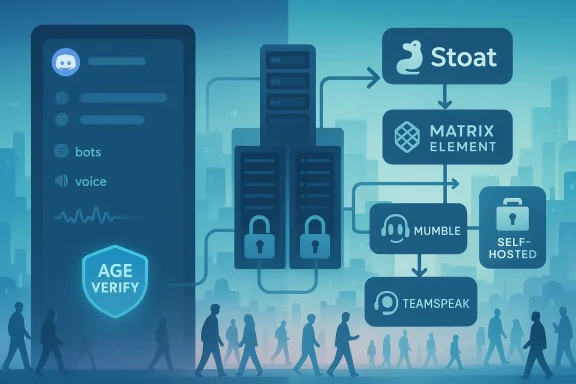
Almost immediately, search traffic and chatter spiked for “Discord alternatives” — Google Trends and multiple outlets reported search volume jumping by orders of magnitude, and smaller apps like Stoat (formerly Revolt), Matrix/Element, Root, Mumble, TeamSpeak and a raft of niche or self-hosted projects saw renewed interest. That rush of attention has a double edge: it shows the market demand, but also highlights that few alternatives match Discord’s combination of features and usability.
What Stoat offers:
Strengths:
But these projects share the same hard limits:
Where they fall short for a Discord-style migration:
The Persona/Founders Fund story crystallizes the political dimension of vendor choice: a vendor with investors tied to controversial surveillance-adjacent firms draws scrutiny, even if there’s no evidence the investor influences day-to-day product behavior. Discord’s short-lived tie to Persona and subsequent distancing underlines how reputational risk can domino quickly.
Expect three likely outcomes over the next 6–18 months:
Practical moves for community leaders are straightforward: assess your risk tolerance, test alternatives with a subset of active members, and never assume migration will be painless. In practice, the winners over the next year won’t be the loudest or the most ideological projects — they’ll be the ones that combine reliability, clear privacy guarantees, and low friction for moderators and users alike. The space is suddenly fertile with options, but replacing Discord’s decades‑long network effects is a marathon, not a sprint.
Source: Windows Central Done with Discord? Finding the right alternative is harder than I expected.
 Background
Discord announced a global shift in its safety model earlier in February, saying accounts that aren’t clearly proven to be adult will be placed into a restricted “teen” experience and that some users will have to verify their age to access age-restricted channels and features. The company subsequently paused and rearranged parts of the plan after a fierce backlash; Discord’s public blog and staff acknowledgments make clear the rollout will be delayed while more verification options and vendor transparency are added.This controversy arrived on the heels of a high-profile third‑party incident: in late 2025 Discord disclosed that government ID photos submitted by users during previous age‑verification or appeal processes may have been exposed after a compromise involving a vendor. The incident — which Discord said affected roughly 70,000 government‑ID images — is still frequently cited in discussions about whether handing biometric or identity documents to vendors is worth the risk.
Almost immediately, search traffic and chatter spiked for “Discord alternatives” — Google Trends and multiple outlets reported search volume jumping by orders of magnitude, and smaller apps like Stoat (formerly Revolt), Matrix/Element, Root, Mumble, TeamSpeak and a raft of niche or self-hosted projects saw renewed interest. That rush of attention has a double edge: it shows the market demand, but also highlights that few alternatives match Discord’s combination of features and usability.
Why Discord is hard to replace
Product momentum matters — and Discord has it in spades
There’s a reason Discord feels almost impossible to step away from: years of incremental feature builds, integrations, bot ecosystems, and platform familiarity. Public metrics and third‑party stats show Discord’s userbase runs in the hundreds of millions (registrations are well into the hundreds of millions), and the product’s UX is optimized for communities — friends, guilds, stream audiences, and hobbyist groups. When a platform becomes a community’s default, friction to migration is not technological alone; it’s social and economic.- Community ownership: Many server owners and moderators have invested months or years building roles, permissions, bots, and server economies.
- Integrations: Streaming overlays, bot ecosystems, and game integrations are often built specifically for Discord’s API.
- Network effects: People stay where their friends, teams, and audiences already are — the simplest, least painful decision is almost always to remain.
Feature parity is shallow — voice, moderation, and media are hard
If you strip Discord down into capabilities, the hardest features to replace at scale are:- Low-latency, reliable multi-user voice (with push-to-talk, bitrate controls, positional audio in some setups).
- Screen sharing and low-latency streaming for small groups.
- Granular permission and moderation systems that scale to large communities.
- An extensible bot ecosystem and stable API surface for developers.
The alternatives people are chasing (and their real trade-offs)
Below I break down the most-discussed options and what they actually deliver today — the goal is to show the practical trade-offs, not an ideological ranking.Stoat (formerly Revolt) — the familiar open‑source clone
Stoat is the project formerly known as Revolt: an open‑source, Discord-like chat platform that intentionally copies many of Discord’s UX patterns to shorten the learning curve for migrating communities. Stoat’s recent rebrand and heavy search traffic show it’s a beneficiary of the Discord backlash.What Stoat offers:
- A UI and server/channel model that looks and feels like Discord.
- Open‑source code with community servers and the option to self‑host.
- Rapid, community-driven development and a privacy-centered pitch.
- Maturity: Stoat still lacks the polish and reliability of Discord in many areas (bots, moderation tooling, large-server scaling).
- Hosting: To get the privacy/safety guarantees users want, groups typically self‑host. That adds technical burden and cost.
- Ecosystem: The bot and integration ecosystems are orders of magnitude smaller.
Matrix + Element — federation and privacy
Matrix is a federated, open‑standard protocol for real‑time messaging; Element is the most popular client built on Matrix. This combination is a serious contender for people prioritizing privacy, federation, and interoperability. Element is actively developed, open source, and usable as a hosted service or self‑hosted instance.Strengths:
- End-to-end encryption options and true federation (you can run your own server or use a trusted homeserver).
- Mature client and protocol, with bridges to other networks.
- Control: federated architecture reduces single-vendor lock-in.
- Feature gaps: Matrix/Element historically focused on chat and secure messaging; some convenience features (screen-sharing parity, voice scalability, polished moderation UIs) have lagged behind Discord’s product craft.
- Complexity for admins: self-hosting homeservers and managing federation adds administrative overhead.
- Migration friction: While bridges exist (bots that relay messages between platforms), moving a live community with roles, bots, and media histories is non-trivial.
Root and Fluxer and other “Discord clones”
A small group of newer apps (Root, Fluxer, Spacebar-style web apps) emphasize a slick, Discord-like UX with a desktop client. They aim for quick familiarity: import tools, server templates, and simple onboarding.But these projects share the same hard limits:
- Younger codebases mean more bugs under heavy load.
- Smaller user bases mean fewer bots and less tooling.
- Many are still freemium or early beta, which complicates community plans for long-term reliability.
Mumble and TeamSpeak — audio champions
If your group is primarily about voice, Mumble and TeamSpeak are time-tested solutions. Mumble is open source, ultra low-latency, and designed for self-hosting; TeamSpeak has been evolving and repositioning itself with modern features like screen sharing in its newer releases. Both are excellent for audio-first communities.Where they fall short for a Discord-style migration:
- Minimal text/chat feature set compared to Discord.
- Older UX for community features (roles, channels, multipurpose content).
- Not built for ephemeral media sharing, rich embeds, or built-in streaming features.
Signal, WhatsApp, Telegram — can messaging apps fill the gap?
Signal, WhatsApp, and Telegram are great for private group chat and end-to-end encryption, but they don’t scale as “community platforms” in the way Discord does:- Limited server-like features: no channel hierarchies, weak moderation flows, and no robust bot ecosystems.
- Group size and discoverability limitations.
- Mobile-first design that can be awkward for multi-channel PC use cases.
Practical migration scenarios: a playbook for server owners
If you’re a community admin considering a move, here are pragmatic paths depending on your risk tolerance and technical resources.- Small, tight-knit group (≤100 members)
- Option: Move to Stoat, a Matrix room on a trusted homeserver, or a private Signal/Telegram group.
- Why: Low friction, you can rebuild channels and roles quickly, and member onboarding is fast.
- Mid-size community (100–2,000 members)
- Option: Consider Matrix with a hosted Element service or Stoat on a paid hosted plan (or self-host).
- Why: You need moderation tools and the ability to bridge to Discord while members migrate; self-hosting gives control but requires ops work.
- Large communities (2,000+ members)
- Option: Be conservative. Test a parallel instance for a subset of active mods and users, keep Discord as the primary hub until replacements can replicate moderation tooling, bot functionality, and archive needs.
- Why: The operational and social costs are high; unsuccessful migrations fracture communities and lose institutional knowledge.
- Inventory: Export server templates, channel structures, bot lists, and role permissions.
- Test bridge strategies: Temporary message relays let two platforms coexist.
- Communication: Give users a clear migration timeline, why you’re moving, and how to get help.
- Backup: Archive important logs and pinned messages before you cut over.
Risk analysis: what to worry about — and what to trust cautiously
Data and vendor risk
Discord’s own post-rollout reaction shows the company understands the optics and safety of vendor use: they paused the global rollout, required on-device processing requirements for facial estimation partners, and promised vendor transparency going forward. But the core lesson is simple: identity verification at scale is brittle because it centralizes sensitive data flows that attract threat actors and regulatory attention.The Persona/Founders Fund story crystallizes the political dimension of vendor choice: a vendor with investors tied to controversial surveillance-adjacent firms draws scrutiny, even if there’s no evidence the investor influences day-to-day product behavior. Discord’s short-lived tie to Persona and subsequent distancing underlines how reputational risk can domino quickly.
Operational risk
Migration introduces operational risk: broken bot flows, moderation gaps, and lost histories. Admins underestimate the human cost of retraining moderators and teaching users to use slightly different permissions models. For that reason, many communities choose gradual, opt‑in migrations with bridges behind the scenes.Security trade-offs with self-hosting
Self-hosting (Matrix homeservers, Stoat instances, Mumble servers) reduces exposure to a single vendor, but it increases your attack surface and operational burden. A poorly configured self-host can be worse than a trusted hosted service. If you self‑host, plan for:- Regular security patching.
- Backups and DDoS mitigation.
- Clear admin access controls and monitoring.
How Discord’s mistakes and the search surge will shape the market
The reaction to Discord’s age verification push offered a real-time experiment: how many users will leave when a large platform adds identity friction? The immediate signal — a massive spike in “Discord alternatives” searches — tells us people are interested in leaving. But long-term migration requires more than interest: it requires a set of products that can replace core features without forcing communities to accept outsized risk or operational cost.Expect three likely outcomes over the next 6–18 months:
- Short-term churn: A bump of users will create pressure on smaller projects and public hosting options; expect onboarding delays and outages as formerly small services absorb big spikes.
- Product consolidation: Projects that can deliver reliable voice, screen share, and moderation will attract serious investment or consolidation. TeamSpeak’s modernization efforts and Mumble’s active release cadence suggest legacy VoIP projects can modernize quickly.
- Hybrid reality: Most mainstream communities will hedge rather than fully migrate. They’ll keep Discord as the canonical place, while testing or maintaining a “privacy-first” presence elsewhere for sensitive conversations and smaller subgroups.
Readers’ practical checklist: should you jump ship now?
- If your community’s members are indifferent to age verification and the platform works: stay put and watch developments. Discord paused its rapid expansion timeline and promised more verification options and transparency; sudden exodus is disruptive and unnecessary if the group values continuity.
- If your community processes sensitive content (LGBTQ+ spaces, political organizers, minors) or you cannot tolerate vendor ID collection: plan a migration path now. Start with a pilot, collect feedback, and set expectations.
- If you’re curious and technically capable: spin up a self‑hosted Matrix server or Stoat instance and try a soft launch with moderators. That gives you real-world experience without risking your main server.
What vendors and projects need to do next
- Make verification optional and transparent: Offer multiple non-biometric paths (credit card checks, trusted community attestations) and publish vendor poing: Projects that make importing templates, roles, and bots from Discord frictionless will get traction.
- Scale test coverage: Small open‑source projects must prioritize reliability under sudden spikes; community trust collapses quickly with onboarding failures.
- Invest in moderation tooling: Any real Discord replacement needs robust audit logs, role hierarchies, and scalable moderation interfaces.
Conclusion
The current surge of interest in Discord alternatives is not an accident — it’s the market reacting to friction introduced when a dominant platform ties community access to identity verification. But search spikes do not equal migrations. Most communities will do what’s easiest: stay put unless an alternative can match Discord’s features, reliability, and social gravity.Practical moves for community leaders are straightforward: assess your risk tolerance, test alternatives with a subset of active members, and never assume migration will be painless. In practice, the winners over the next year won’t be the loudest or the most ideological projects — they’ll be the ones that combine reliability, clear privacy guarantees, and low friction for moderators and users alike. The space is suddenly fertile with options, but replacing Discord’s decades‑long network effects is a marathon, not a sprint.
Source: Windows Central Done with Discord? Finding the right alternative is harder than I expected.
