

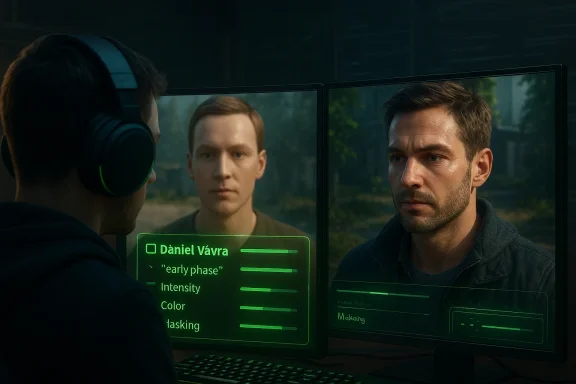
NVIDIA’s newest DLSS rollout has triggered the sort of debate that usually follows a major graphics breakthrough: equal parts excitement, suspicion, and outright backlash. The company says DLSS 5 is a real-time neural rendering system meant to add photoreal lighting and materials while preserving developer control, but its first public demos left many players focused on the uncanny faces and AI-smeared character details instead. Into that storm stepped Daniel Vávra, the director behind Kingdom Come: Deliverance 2, who argued that the technology is only in its rough early phase and could become far more useful once studios can shape it to fit specific art styles. NVIDIA, for its part, is already framing DLSS 5 as a platform shift and has named major publishers as supporters, suggesting the company expects the controversy to be temporary, not terminal. (nvidianews.nvidia.com)
The DLSS 5 conversation matters because it sits at the intersection of three huge forces in modern PC gaming: performance scaling, image reconstruction, and generative AI. NVIDIA has spent years moving DLSS from a simple upscaling trick to a broader graphics stack, with DLSS 4.5 and now DLSS 5 presented as part of a longer march toward AI-assisted rendering. The company says the new system is trained to understand semantics like hair, translucent skin, and lighting conditions, then reconstitutes the final image using color and motion vectors from the game engine. (nvidianews.nvidia.com)
That framing is important because it shows why some developers are receptive even when players recoil. For studios juggling budgets, frame budgets, and visual fidelity, any technology that promises more realism without brute-force ray tracing has obvious appeal. NVIDIA is explicitly pitching DLSS as the answer to the gap between real-time rendering and Hollywood-style VFX, arguing that brute force alone cannot close it. (nvidianews.nvidia.com)
At the same time, the reaction to the reveal highlights a hard truth: how a graphics feature is marketed often matters as much as the feature itself. NVIDIA’s demo language centered on photorealism and generative AI, but viewers zeroed in on faces that looked distorted or overprocessed. That kind of mismatch can do real damage, because gamers are not evaluating a benchmark slide deck; they are judging the emotional believability of characters they will spend dozens of hours staring at. (nvidianews.nvidia.com)
Vávra’s defense lands in the middle of that clash. He is not arguing that the current result is perfect; he is arguing that the technology’s trajectory is what matters. His point is essentially that an awkward first showing does not disqualify a tool if developers can later train and constrain it for their own visual goals. That is a familiar pattern in game tech, where early versions of motion blur, temporal upscaling, ray tracing, and frame generation all drew criticism before becoming normalized.
That matters because DLSS 5 is not appearing in a vacuum. It arrives after years of normalizing AI-driven rendering as a mainstream graphics strategy, and after a hardware cycle in which NVIDIA has repeatedly tied new GPU generations to neural rendering improvements. From the company’s perspective, DLSS 5 is the next step in a roadmap that already includes transformer-based Super Resolution, frame generation, and RTX-focused content creation tools. (nvidia.com)
The controversy also lands in a broader cultural fight over AI in game development. Studios have been criticized for using generative AI in concept art workflows, placeholder text, and internal ideation, even when they insist no final assets will ship in that form. Vávra himself has previously said he is not a fan of AI-generated art, but that it is here to stay and developers have to confront that reality rather than pretend otherwise.
Another reason is trust. NVIDIA’s messaging says DLSS 5 does not touch model geometry or textures, and that it gives developers controls for intensity, color grading, and masking. But when a demo feels overcooked, technical reassurance does not always soothe the audience, particularly when the company’s executive response is perceived as dismissive. (nvidianews.nvidia.com)
That distinction matters because it explains why NVIDIA believes DLSS 5 can go beyond the old “upscaling” argument. The company is effectively saying this is not just about recovering resolution, but about synthesizing missing detail in a way that respects artistic intent. It is also why the company emphasizes controls for intensity, color grading, and masking: the pitch is that developers can tune the result rather than accept a one-size-fits-all look. (nvidianews.nvidia.com)
There is also a difference between a controlled demo and a shipped game. NVIDIA’s reveal can showcase the best-case version of the model, but live games have messy animation states, varied camera angles, and artistic edge cases that are much harder to standardize. If the technology works best in one lighting regime and falls apart in another, adoption will likely be selective rather than universal. (nvidianews.nvidia.com)
His broader argument is that the current DLSS 5 footage is a starting point, not a final verdict. He compared the backlash to a “soap opera effect” style of complaint, implying that the tech’s flaw is not conceptual but implementation-driven. The core of his view is that no serious developer should assume the first version is the last version, especially when the industry has a long history of refining initially awkward visual techniques.
That does not mean every studio will embrace the same solution. But it does mean that once a leading vendor can show measurable value, the market tends to create a lane for it. The question is whether DLSS 5 becomes a universal layer, a niche premium option, or a controversial setting only used by studios comfortable with the visual trade-offs. (nvidia.com)
The environmental side of the technology is much easier to defend. In the comparisons referenced by the Windows Central piece, DLSS 5 reportedly added depth and punch to flatter scenes, especially in games like Starfield where lighting can appear subdued in interior or routine outdoor spaces. That is a meaningful use case because a lot of games need help making mid-tier environments feel more alive without resorting to more expensive rendering techniques.
That, in turn, may be the most realistic outcome in the near term. A technology does not need to solve every rendering problem to become commercially relevant. It only needs to solve enough of them well enough, often in the parts of games where players are least likely to scrutinize every pixel. (nvidianews.nvidia.com)
NVIDIA’s challenge is compounded by the way executives communicate in moments of backlash. When a company says critics are “completely wrong,” even if that claim is later softened, it can feel like dismissal rather than explanation. In a market where players already worry that AI will be used to cut corners, tone matters almost as much as technical precision. (nvidianews.nvidia.com)
That perception could become self-reinforcing. If gamers expect weird faces, they will look harder for weird faces, and every example will travel farther online than the many scenes that look fine. The first meme often becomes the lasting narrative in graphics debates. (nvidianews.nvidia.com)
For enterprise-scale game development, the strategic upside is even bigger. A tool that can improve lighting and materials in real time may reduce the dependence on more expensive path tracing in some scenarios, or at least delay the point at which hardware demands become prohibitive. That could be especially attractive for publishers that want high-end visuals across a broader hardware base. (nvidianews.nvidia.com)
That pressure will likely have two effects. First, it will intensify the race to make AI rendering less noticeable and more predictable. Second, it will force vendors to explain where their systems draw the line between enhancement and alteration, especially when visual authenticity becomes part of the sales pitch. The less visible the AI, the better the product story tends to be in graphics. (nvidianews.nvidia.com)
But the comparison is not perfect. DLSS 5 is not a simple display setting that the viewer can toggle on a TV. It sits inside a game’s rendering chain, which means it has to interact with art direction, animation timing, and scene composition. That makes the stakes higher and the control problem more complicated. (nvidianews.nvidia.com)
For developers, the practical test is simple: can the tool improve image quality without making characters feel artificial? If the answer is yes, many studios will eventually accept the trade-off, even if they never say so loudly. If the answer is no, DLSS 5 may remain a flashy but narrowly applied feature that lives mostly in demos and marketing slides. (nvidianews.nvidia.com)
Source: Windows Central Kingdom Come: Deliverance 2 director sticks up for NVIDIA's DLSS 5 AI tech
 Overview
The DLSS 5 conversation matters because it sits at the intersection of three huge forces in modern PC gaming: performance scaling, image reconstruction, and generative AI. NVIDIA has spent years moving DLSS from a simple upscaling trick to a broader graphics stack, with DLSS 4.5 and now DLSS 5 presented as part of a longer march toward AI-assisted rendering. The company says the new system is trained to understand semantics like hair, translucent skin, and lighting conditions, then reconstitutes the final image using color and motion vectors from the game engine. (nvidianews.nvidia.com)That framing is important because it shows why some developers are receptive even when players recoil. For studios juggling budgets, frame budgets, and visual fidelity, any technology that promises more realism without brute-force ray tracing has obvious appeal. NVIDIA is explicitly pitching DLSS as the answer to the gap between real-time rendering and Hollywood-style VFX, arguing that brute force alone cannot close it. (nvidianews.nvidia.com)
At the same time, the reaction to the reveal highlights a hard truth: how a graphics feature is marketed often matters as much as the feature itself. NVIDIA’s demo language centered on photorealism and generative AI, but viewers zeroed in on faces that looked distorted or overprocessed. That kind of mismatch can do real damage, because gamers are not evaluating a benchmark slide deck; they are judging the emotional believability of characters they will spend dozens of hours staring at. (nvidianews.nvidia.com)
Vávra’s defense lands in the middle of that clash. He is not arguing that the current result is perfect; he is arguing that the technology’s trajectory is what matters. His point is essentially that an awkward first showing does not disqualify a tool if developers can later train and constrain it for their own visual goals. That is a familiar pattern in game tech, where early versions of motion blur, temporal upscaling, ray tracing, and frame generation all drew criticism before becoming normalized.
Background
NVIDIA has spent years positioning DLSS as one of its defining advantages in PC gaming. The company says DLSS has been integrated into more than 750 games and that it began as a performance enhancer before evolving into broader image generation and frame generation techniques. In 2026, NVIDIA’s own announcements describe DLSS 4.5 as already being available in the NVIDIA app for Super Resolution, while dynamic multi-frame features roll out separately for RTX 50-series owners. (nvidianews.nvidia.com)That matters because DLSS 5 is not appearing in a vacuum. It arrives after years of normalizing AI-driven rendering as a mainstream graphics strategy, and after a hardware cycle in which NVIDIA has repeatedly tied new GPU generations to neural rendering improvements. From the company’s perspective, DLSS 5 is the next step in a roadmap that already includes transformer-based Super Resolution, frame generation, and RTX-focused content creation tools. (nvidia.com)
The controversy also lands in a broader cultural fight over AI in game development. Studios have been criticized for using generative AI in concept art workflows, placeholder text, and internal ideation, even when they insist no final assets will ship in that form. Vávra himself has previously said he is not a fan of AI-generated art, but that it is here to stay and developers have to confront that reality rather than pretend otherwise.
Why this debate escalated so quickly
A major reason the backlash became so loud is that graphics features are judged visually, instantly, and mercilessly. A rendering technology can have sensible technical merits and still fail socially if the first clips people see look artificial, especially around faces and skin. Once players associate a feature with uncanny valley character work, that label tends to stick. (nvidianews.nvidia.com)Another reason is trust. NVIDIA’s messaging says DLSS 5 does not touch model geometry or textures, and that it gives developers controls for intensity, color grading, and masking. But when a demo feels overcooked, technical reassurance does not always soothe the audience, particularly when the company’s executive response is perceived as dismissive. (nvidianews.nvidia.com)
- First impressions matter more than specifications.
- Character fidelity is more sensitive than environmental fidelity.
- Developer control is only persuasive if users can see it in practice.
- AI branding raises expectations and skepticism at the same time.
What NVIDIA is Actually Promising
NVIDIA’s own DLSS 5 materials frame the technology as a real-time neural rendering model that takes a game’s color and motion vectors as input and infuses the scene with lighting and materials anchored to the original 3D content. The company says the model is trained end to end to understand scene semantics such as characters, hair, fabric, and translucent skin, then uses that understanding to generate more visually precise images. In other words, it is not being sold as a generic filter but as a scene-aware reconstruction layer. (nvidianews.nvidia.com)That distinction matters because it explains why NVIDIA believes DLSS 5 can go beyond the old “upscaling” argument. The company is effectively saying this is not just about recovering resolution, but about synthesizing missing detail in a way that respects artistic intent. It is also why the company emphasizes controls for intensity, color grading, and masking: the pitch is that developers can tune the result rather than accept a one-size-fits-all look. (nvidianews.nvidia.com)
The control problem
The real question is whether those controls are sufficient in practice. Developers may be able to reduce the effect in sensitive areas, but that also means they must spend time learning how the system behaves across facial animation, lighting setups, and skin tones. That is a workflow cost, even if the tool ultimately saves more time elsewhere. (nvidianews.nvidia.com)There is also a difference between a controlled demo and a shipped game. NVIDIA’s reveal can showcase the best-case version of the model, but live games have messy animation states, varied camera angles, and artistic edge cases that are much harder to standardize. If the technology works best in one lighting regime and falls apart in another, adoption will likely be selective rather than universal. (nvidianews.nvidia.com)
- Scene grounding is the headline promise.
- Developer tuning is central to the sales pitch.
- The hardest test is consistency across an entire game, not a trailer.
Why Vávra’s Defense Matters
Vávra is not just another commentator tossing a hot take into the feed. As the lead figure behind Kingdom Come: Deliverance 2, he occupies a space where technology, historical authenticity, and art direction all matter deeply. When someone like that says a controversial graphics system may eventually be trainable for a game’s specific art style or even particular faces, the statement carries more weight than a generic pro-AI cheer.His broader argument is that the current DLSS 5 footage is a starting point, not a final verdict. He compared the backlash to a “soap opera effect” style of complaint, implying that the tech’s flaw is not conceptual but implementation-driven. The core of his view is that no serious developer should assume the first version is the last version, especially when the industry has a long history of refining initially awkward visual techniques.
Why developers listen
Studios tend to be less emotionally attached to visual purity than players are because they live inside production constraints. If a tool can make lighting, reflections, or materials look more convincing while reducing the need for expensive brute-force rendering, it becomes attractive fast. Vávra’s point is that production reality usually beats aesthetic purity over time. (nvidianews.nvidia.com)That does not mean every studio will embrace the same solution. But it does mean that once a leading vendor can show measurable value, the market tends to create a lane for it. The question is whether DLSS 5 becomes a universal layer, a niche premium option, or a controversial setting only used by studios comfortable with the visual trade-offs. (nvidia.com)
- Authority matters when the debate is about production workflows.
- The art-direction argument is stronger than the hype argument.
- A rough early version can still seed a future standard.
Character Faces Versus Environments
The criticism of DLSS 5 has focused heavily on character faces because faces are where players detect artificiality first. A slightly soft wall or a shimmering distant object can be forgiven, but a face that looks over-smoothed or oddly reconstructed immediately breaks immersion. That is why a technology can impress in landscapes and still fail in close-up storytelling. (nvidianews.nvidia.com)The environmental side of the technology is much easier to defend. In the comparisons referenced by the Windows Central piece, DLSS 5 reportedly added depth and punch to flatter scenes, especially in games like Starfield where lighting can appear subdued in interior or routine outdoor spaces. That is a meaningful use case because a lot of games need help making mid-tier environments feel more alive without resorting to more expensive rendering techniques.
The asymmetry problem
This creates an asymmetry in adoption. A developer may love what DLSS 5 does to surfaces, ambient light, and distant detail, but still reject it for character-heavy cutscenes. That tension could push studios toward selective deployment rather than full-scene replacement. (nvidianews.nvidia.com)That, in turn, may be the most realistic outcome in the near term. A technology does not need to solve every rendering problem to become commercially relevant. It only needs to solve enough of them well enough, often in the parts of games where players are least likely to scrutinize every pixel. (nvidianews.nvidia.com)
- Faces are the hardest sell.
- Environments are the easiest place to prove value.
- Selective deployment is more plausible than blanket replacement.
Consumer Reaction and the Trust Gap
Consumers react differently from developers because they are buying a finished emotional experience, not a workflow advantage. When they hear “generative AI,” they often think of slop, shortcuts, copyright anxiety, and diminished craftsmanship. That means NVIDIA has to overcome not only technical skepticism but also a broader trust deficit associated with AI branding. (nvidianews.nvidia.com)NVIDIA’s challenge is compounded by the way executives communicate in moments of backlash. When a company says critics are “completely wrong,” even if that claim is later softened, it can feel like dismissal rather than explanation. In a market where players already worry that AI will be used to cut corners, tone matters almost as much as technical precision. (nvidianews.nvidia.com)
Why “control” is not enough on its own
The company’s insistence that developers can fine-tune the effect is sensible, but consumers rarely see those dials. They see the final shipped image and decide whether it feels authentic. Unless the industry can demonstrate clear visual guardrails, users will continue to assume that AI enhancement means unpredictability. (nvidianews.nvidia.com)That perception could become self-reinforcing. If gamers expect weird faces, they will look harder for weird faces, and every example will travel farther online than the many scenes that look fine. The first meme often becomes the lasting narrative in graphics debates. (nvidianews.nvidia.com)
- Players judge emotional truth, not pipeline efficiency.
- Trust is fragile when AI enters the branding.
- Bad demos spread faster than good ones.
Enterprise and Studio Implications
For studios, the appeal of DLSS 5 is straightforward: better visual output without always paying the full cost of brute-force rendering. NVIDIA is explicitly positioning the technology as a creative tool with control surfaces for artists, which means the company wants game teams to see it as part of production, not a black box imposed from above. If that promise holds, it could be valuable for teams trying to hit deadlines without sacrificing visual ambition. (nvidianews.nvidia.com)For enterprise-scale game development, the strategic upside is even bigger. A tool that can improve lighting and materials in real time may reduce the dependence on more expensive path tracing in some scenarios, or at least delay the point at which hardware demands become prohibitive. That could be especially attractive for publishers that want high-end visuals across a broader hardware base. (nvidianews.nvidia.com)
The likely studio decision tree
Studios will probably evaluate DLSS 5 in layers rather than as an all-or-nothing proposition. One team may use it for environmental enhancement, another for selective post-processing, and another may ignore it entirely until the tooling matures. The companies most likely to adopt it quickly are those already invested in NVIDIA’s RTX ecosystem and comfortable with iterative visual tuning. (nvidia.com)- Big publishers may value controllable image gains more than ideological purity.
- Smaller teams may see it as a force multiplier if the tooling is mature enough.
- Adoption will likely vary by genre, camera distance, and art style.
Competitive Pressure on AMD, Intel, and the Broader Market
NVIDIA’s push puts pressure on rivals because it raises the bar for what “AI graphics” is supposed to mean. AMD and Intel have both competed on upscaling and frame generation, but NVIDIA is now trying to move the conversation from performance assistance into direct image synthesis. If DLSS 5 becomes associated with visibly better lighting or material fidelity, rivals will need a clearer answer than “we also do upscaling.” (nvidianews.nvidia.com)That pressure will likely have two effects. First, it will intensify the race to make AI rendering less noticeable and more predictable. Second, it will force vendors to explain where their systems draw the line between enhancement and alteration, especially when visual authenticity becomes part of the sales pitch. The less visible the AI, the better the product story tends to be in graphics. (nvidianews.nvidia.com)
Why the market may still fragment
Even if DLSS 5 succeeds technically, the broader market may not converge on a single standard. Hardware compatibility, studio values, and platform policies will continue to shape what gets used where. A PC-oriented premium feature can become influential without becoming universal, and that would still be enough for NVIDIA to win share of mind. (nvidia.com)- NVIDIA is shifting the debate from speed to visual authorship.
- Rivals will need clearer differentiation.
- Market fragmentation remains likely even if adoption grows.
Historical Parallels and Why This Is Familiar
The industry has seen this movie before, at least in outline. Motion smoothing on TVs, aggressive temporal anti-aliasing, early ray tracing, and frame generation all faced skepticism when they first reached consumers. Each time, the initial complaint was usually that the result looked “wrong,” “fake,” or too eager to chase technical novelty over artistic intent.But the comparison is not perfect. DLSS 5 is not a simple display setting that the viewer can toggle on a TV. It sits inside a game’s rendering chain, which means it has to interact with art direction, animation timing, and scene composition. That makes the stakes higher and the control problem more complicated. (nvidianews.nvidia.com)
The lesson from past graphics controversies
A graphics technology often wins when it becomes boring. Once players stop talking about the mechanic itself and start treating it as a normal part of how games look, adoption follows. That is why the best case for NVIDIA is not viral praise, but gradual acceptance. (nvidianews.nvidia.com)- New visuals are usually hated before they are normalized.
- The winning phase is often invisibility, not spectacle.
- Integration complexity makes DLSS 5 more than a simple toggle.
Strengths and Opportunities
The strongest argument for DLSS 5 is that it tries to solve a genuine rendering problem rather than inventing a fake one. If NVIDIA can keep the result stable and tunable, the technology could improve the look of environments, lighting, and materials in ways that feel substantial to players and valuable to developers. The opportunity is not just prettier screenshots; it is a broader shift toward AI-assisted real-time rendering that reduces the cost of chasing photorealism. (nvidianews.nvidia.com)- Better environmental depth without full brute-force cost
- Potential art-style tuning for specific projects
- Strong fit for studios already using RTX workflows
- Improved visual ambition for mid-range hardware targets
- A path toward more efficient production pipelines
- Long-term standardization if the tool matures
- Competitive differentiation for NVIDIA’s ecosystem
Risks and Concerns
The biggest risk is that DLSS 5 becomes remembered for its worst-looking faces rather than its best-looking scenes. Once players decide a feature is uncanny, it may be difficult to recover trust, especially if the company’s messaging sounds defensive. There is also the danger that studios will lean on the technology before it is ready, producing a wave of awkward implementations that reinforce the backlash. (nvidianews.nvidia.com)- Uncanny character rendering could define the brand
- Developer tuning may not be enough to prevent misuse
- Consumers may resist any AI-labeled visual enhancement
- Bad implementations could poison broader adoption
- Tone-deaf corporate messaging can magnify the backlash
- Selective use may become a fragmentation problem
- Artistic control concerns will remain front and center
Looking Ahead
The next few months will tell us whether DLSS 5 is a one-week controversy or the beginning of a broader graphics transition. NVIDIA is already pushing DLSS 4.5 through the app and driver stack while lining up new game integrations, which suggests the company intends to normalize AI-driven rendering quickly rather than let the debate linger. The critical question is whether upcoming demonstrations look more disciplined than the reveal that triggered the outrage. (nvidia.com)For developers, the practical test is simple: can the tool improve image quality without making characters feel artificial? If the answer is yes, many studios will eventually accept the trade-off, even if they never say so loudly. If the answer is no, DLSS 5 may remain a flashy but narrowly applied feature that lives mostly in demos and marketing slides. (nvidianews.nvidia.com)
Key things to watch
- Whether NVIDIA publishes more restrained, game-ready examples
- Whether studios announce selective or limited DLSS 5 usage
- Whether character fidelity improves in future updates
- Whether rival GPU makers respond with stronger AI rendering pitches
- Whether player sentiment cools once real games ship with the feature
Source: Windows Central Kingdom Come: Deliverance 2 director sticks up for NVIDIA's DLSS 5 AI tech
Last edited:
