

Dolby Vision 2 will begin rolling out later this year, promising what Dolby calls the most significant upgrade to its premium HDR image engine in more than a decade and setting the stage for a major rethink of how modern TVs handle brightness, colour, motion and ambient viewing conditions.
When Dolby first introduced Dolby Vision more than a decade ago it reset expectations for high dynamic range (HDR) on consumer displays: frame-by-frame metadata, deep colour, and dynamic tone mapping that preserved creative intent on consumer TVs. Over the years, screen manufacturers pushed peak brightness, panel contrast, and local-dimming complexity far beyond the capabilities assumed by many early HDR masters. That gap—between what content was graded for and what modern hardware can do in real living rooms—helped create familiar frustrations: dark HDR scenes that look unusably dim in bright rooms, clipped highlights, inconsistent colour across panel types, and motion judder or the “soap opera effect” when frame interpolation is applied too aggressively.
Dolby Vision 2 is Dolby’s response: a reworked image engine and a suite of Content Intelligence tools designed to adapt pictures in real time to both the content and the viewing environment. The company presented the technology publicly across late‑2025 and used CES 2026 to show working demos and to outline early roll‑out partners. Dolby positions this update as both evolutionary and structural—a platform upgrade that aims to be the foundation for premium TV picture quality going forward.
However, several vital details are still unconfirmed:
This approach has appeal—but it also raises questions:
For enthusiasts, Dolby Vision 2 Max promises an exciting new frontier in picture fidelity and motion handling. For ordinary buyers, Dolby Vision 2 represents an evolution that is worth watching closely—but not necessarily a reason to rush into a purchase unless you want a top‑end 2026 TV and access to early Dolby Vision 2 content. The next twelve months will be decisive: ecosystem adoption, the clarity of tiering between standard and Max, and real‑world content availability will determine whether Dolby Vision 2 becomes the new standard for premium TV viewing or another technically impressive but fragmented feature set.
Source: Tech Edition Dolby Vision 2 set to roll out later this year with major TV picture upgrades
 Background
When Dolby first introduced Dolby Vision more than a decade ago it reset expectations for high dynamic range (HDR) on consumer displays: frame-by-frame metadata, deep colour, and dynamic tone mapping that preserved creative intent on consumer TVs. Over the years, screen manufacturers pushed peak brightness, panel contrast, and local-dimming complexity far beyond the capabilities assumed by many early HDR masters. That gap—between what content was graded for and what modern hardware can do in real living rooms—helped create familiar frustrations: dark HDR scenes that look unusably dim in bright rooms, clipped highlights, inconsistent colour across panel types, and motion judder or the “soap opera effect” when frame interpolation is applied too aggressively.Dolby Vision 2 is Dolby’s response: a reworked image engine and a suite of Content Intelligence tools designed to adapt pictures in real time to both the content and the viewing environment. The company presented the technology publicly across late‑2025 and used CES 2026 to show working demos and to outline early roll‑out partners. Dolby positions this update as both evolutionary and structural—a platform upgrade that aims to be the foundation for premium TV picture quality going forward.
What Dolby Vision 2 actually is
At its core, Dolby Vision 2 is an intelligent image engine that sits between incoming Dolby Vision metadata and the TV’s display pipeline. It adds three intertwined capabilities:- Content Intelligence — AI-driven analysis that recognizes content type (movie, live sport, game, or broadcast) and applies viewing-mode optimizations on a shot‑by‑shot basis.
- Ambient-aware adjustments — the TV takes ambient light conditions into account via built-in sensors and reference lighting data embedded with the signal.
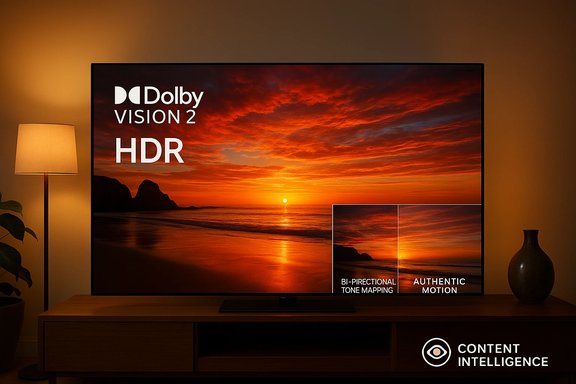
- Advanced tone mapping and motion control — new bi‑directional tone mapping and a motion handling system called Authentic Motion aim to preserve creative intent while using modern panel headroom safely.
Key billed features
- Precision Black — targets a long-standing complaint that HDR can appear “too dark” in real-world rooms. The system analyzes scene detail and smartly lifts shadow detail where appropriate while trying to preserve subject contrast.
- Light Sense — uses ambient-light sensing plus reference lighting data from the content source to adjust brightness, white point and contrast for daytime or brightly lit rooms.
- Bi-directional tone mapping — gives creators and devices more control to scale content both up (to take advantage of brighter, wider-gamut displays) and down (to preserve detail on less capable hardware).
- Authentic Motion — a creative-driven motion control tool that attempts shot-by-shot smoothing to reduce judder while avoiding the heavy-handed interpolation that causes the soap‑opera effect.
- Sports & Gaming Optimization — targeted adjustments (white point, motion control, responsiveness) for live sports broadcasts and interactive content.
Why the update matters technically
Modern televisions differ from the screens that most HDR content was mastered on. Panel peak brightness, color volume, and local‑dimming sophistication have increased, but content production workflows and the original mastering references have not kept pace uniformly. That mismatch can produce sub-optimal results on both ends:- Dark scenes graded for a dim reference room can look crushed in a bright living room.
- Content mastered for limited color or brightness headroom can fail to use modern displays’ potential.
- Traditional motion processing treats entire scenes uniformly, resulting in either jagged judder or over‑smoothed motion.
- Precision Black aims to extract usable shadow detail from HDR masters without flattening contrast. Instead of a single global curve, it applies local, content-aware adjustments so shadow lift is contextual.
- Light Sense is an explicit attempt to move beyond crude “bright room” picture modes. By blending in reference lighting metadata and real‑time ambient readings, the image engine can shift white point, brighten midtones, or temper highlights to preserve perceived contrast.
- Bi‑directional tone mapping is important for both ends of the product spectrum: it helps flagship TVs take fuller advantage of extreme peak brightness and color, and it also allows lower‑tier sets to present a faithful image without losing creative intent.
- Authentic Motion adopts a creative‑driven approach: motion is adjusted in a way that respects the filmmaker’s intent on a shot level, reducing unwanted judder but avoiding a universal interpolation setting that introduces unnatural smoothness.
Who will ship it first (and how)
Dolby used CES 2026 to name a handful of early manufacturing partners and to show live demos. Manufacturers confirmed plans to support Dolby Vision 2 across selected 2026 models and, in many cases, to roll support into additional sets through firmware updates where hardware allows.- Several TV makers said their 2026 flagship and high‑end MiniLED/OLED lines will include Dolby Vision 2 at launch or via firmware updates.
- Early confirmed brands include some manufacturers who plan to ship key 2026 models with out‑of‑the‑box support; others will add support later via OTA updates for models with sufficient processing horsepower and ambient‑light sensing.
- Dolby has specified that a TV needs adequate processing performance and an ambient light sensor to unlock the full Dolby Vision 2 experience—older models lacking those parts are unlikely to get full feature support.
Streaming and content: Peacock takes the lead, but questions remain
At CES, Dolby announced its first confirmed streaming partner for Dolby Vision 2. A major streaming platform committed to adopt Dolby Vision 2 and next‑generation Dolby audio—making it the first large service known to be preparing content delivery in the new format. That commitment is a critical first step: encoding, delivery pipelines, and QoS considerations for live sports and high‑bitrate on‑demand titles have to be worked into existing CDN and streaming stacks.However, several vital details are still unconfirmed:
- Dolby has not published a catalogue of early Dolby Vision 2–mastered titles, nor has it said whether existing Dolby Vision libraries will be automatically re‑processed into Dolby Vision 2.
- The timeline for when specific content categories (films, TV series, live sports) will start using the new metadata is unclear and will depend on both streamer adoption and studio remastering schedules.
- Support beyond streaming—such as UHD Blu‑ray, projectors, mobile devices, and gaming consoles—has not been broadly announced, and is likely to follow the TV roll‑out, if at all.
Two-tier strategy: mainstream vs Max — what it means for buyers
Dolby’s decision to split the rollout into Dolby Vision 2 and Dolby Vision 2 Max is a pragmatic one, but it introduces complexity for consumers and reviewers.- Dolby Vision 2 (core): the baseline upgrade bringing Content Intelligence, improved tone mapping and ambient adjustments to mainstream TVs. This tier targets sets that can run the updated image engine but may lack the CPU/GPU horsepower or sensor arrays to implement the full Max feature set.
- Dolby Vision 2 Max: enabled only on the highest performing TVs, Max adds premium features such as full Authentic Motion support, more aggressive bi‑directional tone mapping, and other enhancements that need extra silicon and sensor integration.
- Buyers must check not only whether a TV supports Dolby Vision 2, but which tier it supports.
- Brands may market “Dolby Vision 2 compatible” broadly, even though only a subset of models will support Max‑level features.
- Firmware updates could add standard tier features to more models later; Max features are less likely to be added after shipping if the hardware lacks required processing or sensors.
Competitive landscape and fragmentation risks
Dolby Vision 2 does not exist in a vacuum. Other HDR ecosystems are evolving in parallel, with newer proprietary and open formats seeking to address similar issues (tone mapping, motion, and ambient adaptation). The result:- Potential fragmentation: Consumers could face competing premium HDR ecosystems on new TVs. Manufacturers and streamers will need to decide whether to support multiple standards or pick favorites.
- Licensing and cost: Dolby Vision is a licensed technology; the added commercial cost of implementing Dolby Vision 2 and Max could be reflected in TV pricing or tiered feature sets.
- Ecosystem friction: If major studios or streamers choose other standards for certain content, consumers may encounter inconsistent HDR behavior between services or titles.
Motion handling: solving judder without alienating cinephiles
Motion remains one of the trickiest perception problems for TV designers and filmmakers. Traditional motion interpolation smooths motion by synthesizing frames, but that approach often removes the cinematic texture directors intend. Dolby’s Authentic Motion takes a different tack: creative‑driven, scene‑level motion control that aims to remove judder while preserving filmic motion cues.This approach has appeal—but it also raises questions:
- Will filmmakers embrace motion processing that alters playback beyond original frame timing, even if it reduces judder?
- Will AV purists accept any motion interpolation in movies?
- How transparent will implementations be to users (levels, auto/manual selection, metadata flags)?
Practical guidance for buyers and enthusiasts
If you are considering a TV purchase in 2026 and Dolby Vision 2 matters to you, here’s a practical checklist to navigate the early roll‑out:- Confirm the exact model number and read the manufacturer’s spec sheet for Dolby Vision 2 support, and whether it’s the standard tier or Max.
- Check for the presence of an ambient light sensor—this is a requirement for the Light Sense features to operate correctly.
- Ask about processor/chipset details and whether the TV vendor lists support for the new image‑engine requirements; some brands are using newer silicon that explicitly includes Dolby Vision 2 support.
- Verify the company’s firmware update policy—models announced without built‑in support may gain features later only if the hardware meets the minimum requirements.
- Confirm streaming app support for your primary services—initial content will be limited, and app updates will be needed to deliver Dolby Vision 2 streams.
Risks, caveats and unverified areas
While Dolby Vision 2 is compelling, several important points remain uncertain or require cautious interpretation:- Content availability at launch will be limited. Early streamer commitments are encouraging but not comprehensive. It is not yet confirmed which existing titles will be remastered for Dolby Vision 2 or whether catalogs will be upgraded automatically.
- Support outside TVs—such as UHD Blu‑ray players, projectors, smartphones, and consoles—has not been widely confirmed. That support may lag or never come for some device categories.
- Not all Dolby Vision 2 features will be available across all supporting TVs. Max features are hardware dependent, and vendors will choose which models qualify.
- Privacy and sensor use: ambient light sensors and metadata-driven adaptation require local sensing; buyers should review privacy and data‑handling policies from manufacturers if that is a concern.
- Implementation variability: as with prior HDR transitions, the experience depends heavily on each manufacturer’s image processing choices—two TVs with Dolby Vision 2 may not look identical.
How Dolby Vision 2 changes the upgrade calculus
For many consumers the question will be: is Dolby Vision 2 reason enough to upgrade now?- If you are buying a flagship 2026 TV and want the best possible HDR performance, Dolby Vision 2 Max (if available on your model) is a meaningful new capability that can materially improve shadow detail, highlight handling, and motion.
- If you have a midrange or last‑generation set, gains may be marginal unless your TV receives a firmware update that unlocks the standard tier. Even then, sensors and processing limits can cap improvements.
- Content matters more than format. Dolby Vision 2 needs both display support and Dolby Vision 2–encoded content to demonstrate its full benefits. Early adopters who also subscribe to the streaming platform(s) committed to the format will see the payoff first.
What to expect next (and when)
Dolby’s public roadmap and the CES 2026 demonstrations make several likely next steps:- Incremental manufacturer announcements across the year as TV lineups are revealed or refreshed. Expect details to arrive model‑by‑model, and pay special attention to the “Max” labeling.
- Wider streamer adoption over months as encoding pipelines and live event workflows are adjusted. Early sports coverage and marquee titles are the priority areas where consumers will notice the difference.
- Gradual firmware updates to add Dolby Vision 2 features to qualifying sets already in market—subject to hardware constraints.
- A slow expansion beyond TVs—projectors, set‑top boxes, and physical media will follow only if market demand and technical partnerships align.
Conclusion
Dolby Vision 2 is a bold, technically ambitious update to HDR on televisions. It directly tackles long‑standing pain points—dark HDR scenes, inconsistent tone mapping across displays, and motion judder—by blending AI, new metadata, ambient sensing and advanced tone mapping into a single image engine. Early manufacturer and streaming support is encouraging, but the rollout will be phased and uneven: two tiers, hardware prerequisites, and limited initial content mean the most visible benefits will be experienced first by owners of premium 2026 models and subscribers to the initial streaming partners.For enthusiasts, Dolby Vision 2 Max promises an exciting new frontier in picture fidelity and motion handling. For ordinary buyers, Dolby Vision 2 represents an evolution that is worth watching closely—but not necessarily a reason to rush into a purchase unless you want a top‑end 2026 TV and access to early Dolby Vision 2 content. The next twelve months will be decisive: ecosystem adoption, the clarity of tiering between standard and Max, and real‑world content availability will determine whether Dolby Vision 2 becomes the new standard for premium TV viewing or another technically impressive but fragmented feature set.
Source: Tech Edition Dolby Vision 2 set to roll out later this year with major TV picture upgrades
