

Microsoft published a May 14, 2026 customer story describing how Costa Rica’s Dos Pinos dairy cooperative has deployed roughly 80 AI agents across packaging review, legal drafting, risk work, IT service handling, sales reporting, and retail support using Microsoft 365 Copilot, Copilot Chat, and Copilot Studio. The headline example is an “AI inspector” that checks product labels against technical documents before packaging files leave the design team. Microsoft’s framing is unsurprising: AI agents are becoming coworkers, not side tools. But the more interesting story is less promotional and more operational — a mass-market food producer has found a credible early pattern for AI adoption by aiming agents at small, costly, repeatable failures rather than trying to automate the company in one dramatic leap.
The most revealing detail in Microsoft’s Dos Pinos story is not the number of agents. It is the target of the first memorable one: nutrition labels.
That sounds mundane until you remember what packaging means in a regulated food business. A label is not just marketing collateral. It is a legal claim, a compliance artifact, a manufacturing dependency, a customer-facing promise, and a potential recall trigger wrapped around a carton of milk or a cup of yogurt.
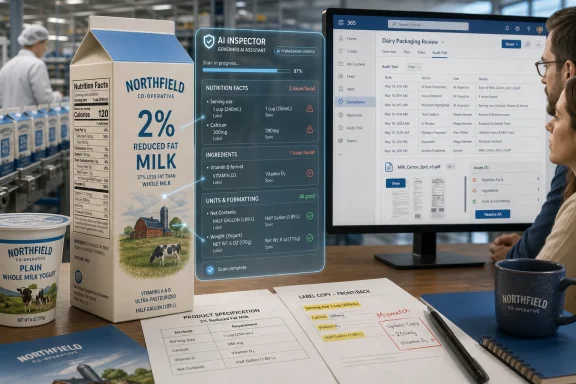
Jhojan Rodríguez, creative lead in the cooperative’s design department, built an agent in Microsoft Copilot Studio to compare final package labels against internal technical sheets. According to Microsoft’s account, the agent flags mismatches in nutritional and regulatory information before the design leaves the team. Dos Pinos says inconsistencies have fallen to nearly zero since the agent launched in late 2025.
That is exactly the kind of AI deployment enterprises say they want but often fail to prioritize. It does not require a science-fiction workplace. It does not ask employees to trust a model with a vague strategic mandate. It takes a high-friction workflow, finds the part humans are bad at doing repeatedly under deadline pressure, and inserts a machine check before the error becomes expensive.
For WindowsForum readers used to watching enterprise software arrive under grandiose banners, this is the practical version of the AI-agent pitch. The model is not “replace the designer.” The model is “give the designer a second set of eyes that never gets tired of checking decimal places.”
The cooperative’s scale matters here. Dos Pinos is based in Alajuela, Costa Rica, employs about 6,000 people, and receives milk from roughly 1,500 member farms. Microsoft says production is about 1.3 million liters per day. This is not a boutique pilot inside a white-collar software company. It is an agricultural, manufacturing, logistics, retail, and food-safety operation with thin margins and many opportunities for tiny errors to become very visible.
That setting makes the AI story more credible and more complicated. In consumer software, AI can be a feature. In a dairy cooperative, AI becomes part of a chain of responsibility. If a packaging agent misses a regulatory discrepancy, if a legal-drafting agent produces a clause that is wrong, or if a virtual veterinary assistant recommends the wrong product to a retailer, the consequences do not stay inside a demo environment.
This is where Microsoft’s agent strategy is most consequential. Copilot Studio is not merely a chatbot builder. It is part of Microsoft’s broader attempt to make agents governable inside the same enterprise stack that already handles identity, productivity, data, security, and compliance. That matters because the agent boom has a shadow problem: the easier it becomes for employees to build automations, the easier it becomes for organizations to lose track of what is acting on whose behalf.
Dos Pinos’ approach appears to thread that needle by keeping agents narrowly scoped. The packaging inspector compares labels to source documentation. Other agents support non-disclosure agreements, IT requests, risk documentation, and vendor recommendations for livestock products. These are not free-floating general intelligences. They are constrained assistants attached to named workflows.
That distinction is crucial. Enterprises do not need thousands of improvisational chatbots. They need a portfolio of accountable software actors, each with a job description, a data boundary, an owner, and an audit trail.
Human reviewers can absolutely do this work, but humans are least reliable precisely when the work is repetitive, visually dense, and time-sensitive. A designer scanning a label for the fifth time at the end of a product cycle is not the best possible control mechanism for a decimal-place error. A model that can compare two documents and highlight discrepancies is not magical, but it can be useful.
That usefulness depends on the workflow around the agent. The safest pattern is not to let the AI approve packaging. The safer pattern is to make it a pre-flight inspection tool that tells a human reviewer where to look. Microsoft’s story suggests that is how Dos Pinos is using it: the agent flags discrepancies before files leave the design team.
This is the core enterprise lesson. AI agents are more trustworthy when they reduce the search space for human judgment rather than substitute for it entirely. “Here are the three places where the label appears to diverge from the technical sheet” is much easier to operationalize than “the label is compliant.”
The difference may sound subtle, but it is the difference between augmentation and liability laundering. A company that treats AI as a reason to remove review creates a brittle process. A company that treats AI as a way to make review faster, more consistent, and more documented has a better chance of improving both productivity and quality.
For years, enterprise software has promised “citizen development,” usually meaning that business users can build small apps, workflows, or dashboards without waiting in line for central IT. The AI-agent era is extending that idea from forms and approvals into judgment-adjacent work. The person closest to the process can now describe the task, connect the relevant documents, and shape an assistant that mirrors part of the job.
That can be powerful. It can also be dangerous.
The upside is obvious. A central IT team may not know that the design department’s worst pain point is not creativity but nutritional-label verification. The people living inside the workflow understand where time is lost, where errors appear, and which checks are obvious to experts but easy to miss under pressure. Giving those people tools to build agents can surface dozens of useful automations that would never survive a traditional enterprise project intake process.
The risk is equally obvious. Once non-developers can build agents, the organization needs a way to prevent data sprawl, duplication, unsafe prompts, opaque logic, and accidental automation of bad processes. A bad spreadsheet is one thing. A bad AI agent connected to internal documents and business workflows can scale confusion faster than any macro-enabled workbook ever could.
Dos Pinos’ “AI ambassadors” program is therefore more than a training initiative. It is an attempt to create a social operating system for AI adoption. Ambassadors can translate between business teams and technical governance, normalize responsible experimentation, and keep agent-building from becoming a private hobby performed in the shadows.
That may prove as important as the technology itself. The companies that succeed with agents will not simply be the ones that buy Copilot licenses. They will be the ones that create a culture where employees can propose automations without bypassing security, and where IT can govern those automations without killing them.
In a conventional corporation, AI adoption is often framed through shareholder value, headcount efficiency, and margin expansion. Those pressures exist here too; Dos Pinos operates in a mass consumer market where costs, automation, service, process transformation, and quality all matter. But a cooperative has a broader constituency. Its long-term viability affects producers, workers, suppliers, retailers, and communities tied to the milk supply chain.
That does not make AI automatically benevolent. Cooperatives can automate badly, surveil employees, or make poor technology choices like any other organization. But it does mean the stakes are not limited to whether a software deployment produces a neat productivity chart.
If AI helps Dos Pinos reduce packaging errors, accelerate product launches, handle risk documentation, and improve service to vendors, the benefits could ripple outward. Faster internal processes can support competitiveness. Better quality controls can reduce waste. More consistent documentation can help a regulated food producer avoid costly setbacks. In a business where physical goods, perishability, logistics, and compliance intersect every day, operational competence is not abstract.
The cooperative context also complicates the common fear that AI agents are only a mechanism for labor reduction. Microsoft’s story emphasizes employees building agents for themselves and colleagues. That is the politically safer version of AI in the workplace: not a machine imposed from above, but a tool employees shape around their own bottlenecks.
Still, no serious reader should stop there. If 80 agents become 800, the question will not merely be whether employees like them. It will be how work is measured, how skills shift, how accountability is assigned, and whether efficiency gains are shared across the organization rather than extracted from it.
Dos Pinos’ examples map neatly onto that strategy. A sales analyst uses Copilot Chat as a coach to learn how to send reports through Outlook via Power BI Service. Legal work touches document generation. IT service requests fit into ticket-style workflows. Risk documentation lives in the knowledge-management layer. Packaging review connects internal technical documents to final output.
This is why Microsoft’s agent push may be more significant than yet another chatbot interface. The company is not only selling a conversational model. It is selling an enterprise substrate where agents can see files, respect permissions, trigger workflows, summarize documents, and act through familiar productivity tools.
For administrators, that is both the appeal and the nightmare. The appeal is centralized identity, policy, logging, and integration. The nightmare is that every department may soon want its own fleet of agents with access to sensitive operational data.
The old IT question was, “Who has access to this file?” The new question is, “Which human, agent, workflow, connector, and model can infer, transform, or act on this file’s contents?” That is a harder question, and most organizations are not yet mature enough to answer it cleanly.
Microsoft knows this. Its recent product direction has emphasized agent governance, orchestration, and control planes because uncontrolled AI adoption is a CIO’s recurring bad dream. The Dos Pinos case study works for Microsoft precisely because it suggests a path from experimentation to managed scale. Around 80 agents is enough to sound serious, but not so many that the story becomes chaos.
A non-disclosure agreement agent does not need to become a lawyer. It needs to help assemble or review documents within approved patterns and escalate uncertainty. An IT service agent does not need to reinvent support. It needs to gather context, route requests, and reduce repetitive triage. A risk documentation agent does not need to replace governance staff. It needs to help keep records complete and consistent.
The virtual veterinarian is the most eye-catching example because it moves closer to domain expertise. Microsoft says it recommends livestock products to vendors across retail locations. That is useful in a cooperative that also supplies agricultural and livestock inputs, but it is also the kind of use case that demands guardrails. Product recommendation in an agricultural context can affect animal health, producer economics, and customer trust.
The right way to read these examples is not as proof that AI can do everything. It is proof that companies are beginning to inventory their work at a more granular level. Instead of asking which jobs AI can replace, they are asking which recurring tasks can be delegated, checked, drafted, routed, or explained.
That task-level framing is healthier. Jobs are bundles of responsibilities, relationships, exceptions, and tacit knowledge. Tasks are often smaller, more observable, and easier to evaluate. Agents make more sense when deployed against tasks that have visible inputs and outputs.
The packaging inspector is therefore a model example. It has source documents, a target artifact, a comparison function, and a measurable error class. Enterprises should start there, not with vague requests to “make operations smarter.”
That means sysadmins and IT pros need to think beyond license assignment. The practical questions are about data access, permissions inheritance, document hygiene, prompt governance, retention, audit logs, and change control. AI agents are only as safe as the environment in which they operate.
If a SharePoint library is a mess, an agent grounded on that library can make the mess conversational. If document permissions are too broad, an agent may expose information in ways that feel new even if the underlying access problem is old. If business processes are undocumented, agents will encode assumptions that nobody has formally reviewed.
This is the unglamorous work that will determine whether agent adoption succeeds. Before every team builds an assistant, someone has to know where the authoritative technical sheets live. Someone has to know which contract templates are approved. Someone has to know whether the risk register is current. Someone has to decide what the agent is allowed to do when it is uncertain.
The irony is that AI adoption may punish organizations that treated knowledge management as clerical overhead. Agents need clean sources, clear ownership, and stable workflows. Without those, they become very fast interns wandering through a badly labeled filing cabinet.
For IT departments, the lesson is not to block experimentation reflexively. It is to insist that experimentation happens inside a managed frame. The organizations that forbid employees from using AI will drive the work into unmanaged tools. The organizations that permit everything will inherit a new layer of operational risk. The winners will build paved roads.
Dos Pinos says packaging inconsistencies have been reduced to nearly zero. That is a strong claim, and it fits the use case. But it does not tell us the full evaluation method, the number of packaging projects reviewed, the false-positive rate, the false-negative rate, the human review process, or how the agent behaves when source documents conflict. Those details matter if other companies want to replicate the result.
The same caution applies to the figure of roughly 80 AI agents. Quantity is not maturity. A company can have many agents and little governance, or fewer agents and strong controls. The meaningful metrics are not just how many agents exist, but how many are actively used, how many are monitored, how many have owners, how many have been retired, and how many have measurable business outcomes.
This is not a criticism of Dos Pinos so much as a warning about the next phase of enterprise AI marketing. The industry will be tempted to turn “number of agents deployed” into the new vanity metric. That would repeat the mistakes of earlier digital-transformation waves, where dashboards, apps, bots, and automation scripts multiplied faster than value.
The better metric is operational trust. Does the agent make the process more reliable? Does it reduce rework? Does it improve auditability? Does it help employees make better decisions? Does it fail safely? Does someone know when it changes?
By that standard, the packaging inspector is compelling because the value is concrete. It reduces a specific class of inconsistencies before they become business problems. The rest of the agent ecosystem should be judged just as concretely.
In practice, agents are becoming a new layer of middleware between people and systems. They read documents, summarize records, draft language, trigger workflows, and recommend actions. They sit above databases and below decision-makers. They turn business processes into conversations.
That is powerful because many enterprise workflows were already linguistic. Employees spend much of their day explaining, requesting, documenting, comparing, approving, and reminding. AI agents can compress that overhead. They can also blur the line between suggestion and action.
The danger is anthropomorphism. If employees think of agents as coworkers, they may overtrust them. If executives think of agents as labor units, they may overdeploy them. If IT thinks of agents as ordinary apps, it may underestimate their ability to recombine information across systems.
A healthier metaphor is an accountable assistant with a badge. The badge says who built it, what it can access, what it is allowed to do, where its outputs go, and who is responsible for its behavior. Without that badge, the “AI coworker” becomes a ghost employee.
Dos Pinos appears to have found those seams. Packaging review, NDA drafting, IT service requests, risk documentation, sales reporting, and product recommendations are all familiar enterprise frictions. None is glamorous. All consume attention.
This matters because AI strategy often fails when it begins at the executive abstraction layer. “We need to transform with AI” is not a workflow. “We need to compare the final package label against the technical sheet before handoff” is. The more specific the task, the easier it is to design, test, govern, and improve the agent.
There is a lesson here for Microsoft customers considering Copilot Studio. Do not start by asking which department should “get an AI agent.” Start by asking where employees already perform repetitive cognitive checks with known source material and visible consequences. Then build small, evaluate tightly, and expand only when the process improves.
That is less exciting than a sweeping AI roadmap, but it is more likely to work. Enterprise AI is not being won by the biggest promise. It is being won by the smallest useful delegation repeated hundreds of times.
Source: Microsoft Source A Costa Rican dairy cooperative turns AI agents into coworkers
 Dos Pinos Shows Why Boring AI Is the AI That Actually Ships
The most revealing detail in Microsoft’s Dos Pinos story is not the number of agents. It is the target of the first memorable one: nutrition labels.That sounds mundane until you remember what packaging means in a regulated food business. A label is not just marketing collateral. It is a legal claim, a compliance artifact, a manufacturing dependency, a customer-facing promise, and a potential recall trigger wrapped around a carton of milk or a cup of yogurt.
Jhojan Rodríguez, creative lead in the cooperative’s design department, built an agent in Microsoft Copilot Studio to compare final package labels against internal technical sheets. According to Microsoft’s account, the agent flags mismatches in nutritional and regulatory information before the design leaves the team. Dos Pinos says inconsistencies have fallen to nearly zero since the agent launched in late 2025.
That is exactly the kind of AI deployment enterprises say they want but often fail to prioritize. It does not require a science-fiction workplace. It does not ask employees to trust a model with a vague strategic mandate. It takes a high-friction workflow, finds the part humans are bad at doing repeatedly under deadline pressure, and inserts a machine check before the error becomes expensive.
For WindowsForum readers used to watching enterprise software arrive under grandiose banners, this is the practical version of the AI-agent pitch. The model is not “replace the designer.” The model is “give the designer a second set of eyes that never gets tired of checking decimal places.”
Microsoft’s Favorite Word Is “Frontier,” but the Real Word Is Governance
Microsoft has been pushing the idea of the frontier company — an organization that embeds AI deeply into everyday work, where human employees increasingly coordinate with digital agents. That phrase carries the usual vendor gloss, but Dos Pinos gives it a more grounded meaning. A frontier company is not necessarily one with a moonshot AI lab; it may be a cooperative where employees are allowed to build narrow agents for the tasks they know best.The cooperative’s scale matters here. Dos Pinos is based in Alajuela, Costa Rica, employs about 6,000 people, and receives milk from roughly 1,500 member farms. Microsoft says production is about 1.3 million liters per day. This is not a boutique pilot inside a white-collar software company. It is an agricultural, manufacturing, logistics, retail, and food-safety operation with thin margins and many opportunities for tiny errors to become very visible.
That setting makes the AI story more credible and more complicated. In consumer software, AI can be a feature. In a dairy cooperative, AI becomes part of a chain of responsibility. If a packaging agent misses a regulatory discrepancy, if a legal-drafting agent produces a clause that is wrong, or if a virtual veterinary assistant recommends the wrong product to a retailer, the consequences do not stay inside a demo environment.
This is where Microsoft’s agent strategy is most consequential. Copilot Studio is not merely a chatbot builder. It is part of Microsoft’s broader attempt to make agents governable inside the same enterprise stack that already handles identity, productivity, data, security, and compliance. That matters because the agent boom has a shadow problem: the easier it becomes for employees to build automations, the easier it becomes for organizations to lose track of what is acting on whose behalf.
Dos Pinos’ approach appears to thread that needle by keeping agents narrowly scoped. The packaging inspector compares labels to source documentation. Other agents support non-disclosure agreements, IT requests, risk documentation, and vendor recommendations for livestock products. These are not free-floating general intelligences. They are constrained assistants attached to named workflows.
That distinction is crucial. Enterprises do not need thousands of improvisational chatbots. They need a portfolio of accountable software actors, each with a job description, a data boundary, an owner, and an audit trail.
The Packaging Agent Is a Better AI Case Study Than a Chatbot Demo
The packaging inspector works because it attacks a class of error that is both frequent enough to matter and structured enough to verify. Nutritional tables, regulatory fields, ingredient declarations, and technical sheets are not poetry. They are documents with values, units, thresholds, formatting conventions, and compliance expectations.Human reviewers can absolutely do this work, but humans are least reliable precisely when the work is repetitive, visually dense, and time-sensitive. A designer scanning a label for the fifth time at the end of a product cycle is not the best possible control mechanism for a decimal-place error. A model that can compare two documents and highlight discrepancies is not magical, but it can be useful.
That usefulness depends on the workflow around the agent. The safest pattern is not to let the AI approve packaging. The safer pattern is to make it a pre-flight inspection tool that tells a human reviewer where to look. Microsoft’s story suggests that is how Dos Pinos is using it: the agent flags discrepancies before files leave the design team.
This is the core enterprise lesson. AI agents are more trustworthy when they reduce the search space for human judgment rather than substitute for it entirely. “Here are the three places where the label appears to diverge from the technical sheet” is much easier to operationalize than “the label is compliant.”
The difference may sound subtle, but it is the difference between augmentation and liability laundering. A company that treats AI as a reason to remove review creates a brittle process. A company that treats AI as a way to make review faster, more consistent, and more documented has a better chance of improving both productivity and quality.
The Employee-Built Agent Is the Real Organizational Experiment
Rodríguez built the packaging inspector himself. That detail deserves more attention than the usual discussion of model performance.For years, enterprise software has promised “citizen development,” usually meaning that business users can build small apps, workflows, or dashboards without waiting in line for central IT. The AI-agent era is extending that idea from forms and approvals into judgment-adjacent work. The person closest to the process can now describe the task, connect the relevant documents, and shape an assistant that mirrors part of the job.
That can be powerful. It can also be dangerous.
The upside is obvious. A central IT team may not know that the design department’s worst pain point is not creativity but nutritional-label verification. The people living inside the workflow understand where time is lost, where errors appear, and which checks are obvious to experts but easy to miss under pressure. Giving those people tools to build agents can surface dozens of useful automations that would never survive a traditional enterprise project intake process.
The risk is equally obvious. Once non-developers can build agents, the organization needs a way to prevent data sprawl, duplication, unsafe prompts, opaque logic, and accidental automation of bad processes. A bad spreadsheet is one thing. A bad AI agent connected to internal documents and business workflows can scale confusion faster than any macro-enabled workbook ever could.
Dos Pinos’ “AI ambassadors” program is therefore more than a training initiative. It is an attempt to create a social operating system for AI adoption. Ambassadors can translate between business teams and technical governance, normalize responsible experimentation, and keep agent-building from becoming a private hobby performed in the shadows.
That may prove as important as the technology itself. The companies that succeed with agents will not simply be the ones that buy Copilot licenses. They will be the ones that create a culture where employees can propose automations without bypassing security, and where IT can govern those automations without killing them.
The Cooperative Model Gives the AI Story a Different Moral Center
Dos Pinos is not just another corporate logo in a Microsoft customer reel. It is a cooperative rooted in Costa Rica’s dairy economy, supplied by member farms that include small and medium-sized producers. That structure gives the AI story a different texture.In a conventional corporation, AI adoption is often framed through shareholder value, headcount efficiency, and margin expansion. Those pressures exist here too; Dos Pinos operates in a mass consumer market where costs, automation, service, process transformation, and quality all matter. But a cooperative has a broader constituency. Its long-term viability affects producers, workers, suppliers, retailers, and communities tied to the milk supply chain.
That does not make AI automatically benevolent. Cooperatives can automate badly, surveil employees, or make poor technology choices like any other organization. But it does mean the stakes are not limited to whether a software deployment produces a neat productivity chart.
If AI helps Dos Pinos reduce packaging errors, accelerate product launches, handle risk documentation, and improve service to vendors, the benefits could ripple outward. Faster internal processes can support competitiveness. Better quality controls can reduce waste. More consistent documentation can help a regulated food producer avoid costly setbacks. In a business where physical goods, perishability, logistics, and compliance intersect every day, operational competence is not abstract.
The cooperative context also complicates the common fear that AI agents are only a mechanism for labor reduction. Microsoft’s story emphasizes employees building agents for themselves and colleagues. That is the politically safer version of AI in the workplace: not a machine imposed from above, but a tool employees shape around their own bottlenecks.
Still, no serious reader should stop there. If 80 agents become 800, the question will not merely be whether employees like them. It will be how work is measured, how skills shift, how accountability is assigned, and whether efficiency gains are shared across the organization rather than extracted from it.
The Agent Explosion Will Test Microsoft’s Enterprise Muscle
Microsoft is well positioned for this kind of story because most enterprise work already runs through Microsoft surfaces. Outlook, Teams, SharePoint, Power BI, Excel, Word, Entra ID, Power Platform, and Dynamics form the background radiation of office life. If agents are going to become coworkers in mainstream organizations, Microsoft wants them to live inside that terrain.Dos Pinos’ examples map neatly onto that strategy. A sales analyst uses Copilot Chat as a coach to learn how to send reports through Outlook via Power BI Service. Legal work touches document generation. IT service requests fit into ticket-style workflows. Risk documentation lives in the knowledge-management layer. Packaging review connects internal technical documents to final output.
This is why Microsoft’s agent push may be more significant than yet another chatbot interface. The company is not only selling a conversational model. It is selling an enterprise substrate where agents can see files, respect permissions, trigger workflows, summarize documents, and act through familiar productivity tools.
For administrators, that is both the appeal and the nightmare. The appeal is centralized identity, policy, logging, and integration. The nightmare is that every department may soon want its own fleet of agents with access to sensitive operational data.
The old IT question was, “Who has access to this file?” The new question is, “Which human, agent, workflow, connector, and model can infer, transform, or act on this file’s contents?” That is a harder question, and most organizations are not yet mature enough to answer it cleanly.
Microsoft knows this. Its recent product direction has emphasized agent governance, orchestration, and control planes because uncontrolled AI adoption is a CIO’s recurring bad dream. The Dos Pinos case study works for Microsoft precisely because it suggests a path from experimentation to managed scale. Around 80 agents is enough to sound serious, but not so many that the story becomes chaos.
The Most Useful Agents May Be the Least Glamorous Ones
The examples from Dos Pinos are striking because none of them require the agent to “understand the business” in a grandiose sense. They require the agent to do bounded work.A non-disclosure agreement agent does not need to become a lawyer. It needs to help assemble or review documents within approved patterns and escalate uncertainty. An IT service agent does not need to reinvent support. It needs to gather context, route requests, and reduce repetitive triage. A risk documentation agent does not need to replace governance staff. It needs to help keep records complete and consistent.
The virtual veterinarian is the most eye-catching example because it moves closer to domain expertise. Microsoft says it recommends livestock products to vendors across retail locations. That is useful in a cooperative that also supplies agricultural and livestock inputs, but it is also the kind of use case that demands guardrails. Product recommendation in an agricultural context can affect animal health, producer economics, and customer trust.
The right way to read these examples is not as proof that AI can do everything. It is proof that companies are beginning to inventory their work at a more granular level. Instead of asking which jobs AI can replace, they are asking which recurring tasks can be delegated, checked, drafted, routed, or explained.
That task-level framing is healthier. Jobs are bundles of responsibilities, relationships, exceptions, and tacit knowledge. Tasks are often smaller, more observable, and easier to evaluate. Agents make more sense when deployed against tasks that have visible inputs and outputs.
The packaging inspector is therefore a model example. It has source documents, a target artifact, a comparison function, and a measurable error class. Enterprises should start there, not with vague requests to “make operations smarter.”
This Is Where Windows Shops Should Pay Attention
For Windows-heavy organizations, the Dos Pinos story is a preview of how AI may actually enter the workplace. It will not always arrive as a dramatic new application. It may arrive as a Copilot panel in the tools employees already use, a Power Platform workflow extended with language understanding, or an agent built by a department power user who knows just enough to be dangerous.That means sysadmins and IT pros need to think beyond license assignment. The practical questions are about data access, permissions inheritance, document hygiene, prompt governance, retention, audit logs, and change control. AI agents are only as safe as the environment in which they operate.
If a SharePoint library is a mess, an agent grounded on that library can make the mess conversational. If document permissions are too broad, an agent may expose information in ways that feel new even if the underlying access problem is old. If business processes are undocumented, agents will encode assumptions that nobody has formally reviewed.
This is the unglamorous work that will determine whether agent adoption succeeds. Before every team builds an assistant, someone has to know where the authoritative technical sheets live. Someone has to know which contract templates are approved. Someone has to know whether the risk register is current. Someone has to decide what the agent is allowed to do when it is uncertain.
The irony is that AI adoption may punish organizations that treated knowledge management as clerical overhead. Agents need clean sources, clear ownership, and stable workflows. Without those, they become very fast interns wandering through a badly labeled filing cabinet.
For IT departments, the lesson is not to block experimentation reflexively. It is to insist that experimentation happens inside a managed frame. The organizations that forbid employees from using AI will drive the work into unmanaged tools. The organizations that permit everything will inherit a new layer of operational risk. The winners will build paved roads.
The Vendor Story Is Optimistic, but the Risk Story Is Real
Microsoft’s customer stories are designed to sell a future. That does not make them false, but it does mean readers should separate reported outcomes from broader conclusions.Dos Pinos says packaging inconsistencies have been reduced to nearly zero. That is a strong claim, and it fits the use case. But it does not tell us the full evaluation method, the number of packaging projects reviewed, the false-positive rate, the false-negative rate, the human review process, or how the agent behaves when source documents conflict. Those details matter if other companies want to replicate the result.
The same caution applies to the figure of roughly 80 AI agents. Quantity is not maturity. A company can have many agents and little governance, or fewer agents and strong controls. The meaningful metrics are not just how many agents exist, but how many are actively used, how many are monitored, how many have owners, how many have been retired, and how many have measurable business outcomes.
This is not a criticism of Dos Pinos so much as a warning about the next phase of enterprise AI marketing. The industry will be tempted to turn “number of agents deployed” into the new vanity metric. That would repeat the mistakes of earlier digital-transformation waves, where dashboards, apps, bots, and automation scripts multiplied faster than value.
The better metric is operational trust. Does the agent make the process more reliable? Does it reduce rework? Does it improve auditability? Does it help employees make better decisions? Does it fail safely? Does someone know when it changes?
By that standard, the packaging inspector is compelling because the value is concrete. It reduces a specific class of inconsistencies before they become business problems. The rest of the agent ecosystem should be judged just as concretely.
The AI Coworker Is Really a New Layer of Middleware
Calling agents “coworkers” is useful marketing because it makes the technology feel familiar. It is also misleading if taken too literally. An AI agent does not have professional judgment, institutional loyalty, ethical intuition, or lived context. It has tools, prompts, data access, model behavior, and whatever constraints its builders impose.In practice, agents are becoming a new layer of middleware between people and systems. They read documents, summarize records, draft language, trigger workflows, and recommend actions. They sit above databases and below decision-makers. They turn business processes into conversations.
That is powerful because many enterprise workflows were already linguistic. Employees spend much of their day explaining, requesting, documenting, comparing, approving, and reminding. AI agents can compress that overhead. They can also blur the line between suggestion and action.
The danger is anthropomorphism. If employees think of agents as coworkers, they may overtrust them. If executives think of agents as labor units, they may overdeploy them. If IT thinks of agents as ordinary apps, it may underestimate their ability to recombine information across systems.
A healthier metaphor is an accountable assistant with a badge. The badge says who built it, what it can access, what it is allowed to do, where its outputs go, and who is responsible for its behavior. Without that badge, the “AI coworker” becomes a ghost employee.
Dos Pinos Offers a Blueprint Because It Starts With Friction
The best enterprise technology stories usually begin with an annoyance. Someone is tired of copying data between systems. Someone is tired of retyping the same report. Someone is tired of checking the same table for the same error. That annoyance is not trivial; it is often where organizational waste hides.Dos Pinos appears to have found those seams. Packaging review, NDA drafting, IT service requests, risk documentation, sales reporting, and product recommendations are all familiar enterprise frictions. None is glamorous. All consume attention.
This matters because AI strategy often fails when it begins at the executive abstraction layer. “We need to transform with AI” is not a workflow. “We need to compare the final package label against the technical sheet before handoff” is. The more specific the task, the easier it is to design, test, govern, and improve the agent.
There is a lesson here for Microsoft customers considering Copilot Studio. Do not start by asking which department should “get an AI agent.” Start by asking where employees already perform repetitive cognitive checks with known source material and visible consequences. Then build small, evaluate tightly, and expand only when the process improves.
That is less exciting than a sweeping AI roadmap, but it is more likely to work. Enterprise AI is not being won by the biggest promise. It is being won by the smallest useful delegation repeated hundreds of times.
The Milk Carton Test for Enterprise Agents
The Dos Pinos story leaves Windows shops, administrators, and business leaders with a practical test: if an agent cannot explain what it checked, what it used, and where a human must decide, it is not ready for consequential work. The cooperative’s packaging inspector is interesting because it appears to pass that test better than most abstract AI deployments. Its usefulness comes from constraint.- An agent aimed at a narrow, repeatable workflow is more valuable than a general assistant with an unclear mandate.
- Employee-built agents can uncover real operational bottlenecks, but they need governance before they become shadow IT.
- Microsoft’s advantage is not just model access; it is the ability to place agents inside identity, documents, workflows, and productivity tools enterprises already use.
- The safest early agents reduce human review burden without removing human accountability.
- The next serious metric for enterprise AI should be measured process improvement, not the raw number of agents deployed.
- Organizations with poor permissions, messy document repositories, and unclear process ownership will struggle to make agents reliable.
Source: Microsoft Source A Costa Rican dairy cooperative turns AI agents into coworkers
