

The draft Income‑tax Rules, 2026 — released by the Central Board of Direct Taxes (CBDT) and placed in the public domain for stakeholder feedback — signal a major operational rewrite of India’s subordinate tax law as the country prepares to implement the Income‑tax Act, 2025 on April 1, 2026. The package is pitched as a simplification: fewer rules and forms, clearer language, formulae and tables where appropriate, and redesigned ITR forms with pre‑fill and automated reconciliation features. But beneath that clean messaging lie important technical changes, transitional traps for practitioners and taxpayers, and several points that will need careful scrutiny during the 15‑day public comment window that closes on February 22, 2026.
The draft Income‑tax Rules, 2026 are the subordinate rules needed to operationalise the new Income‑tax Act, 2025, which the government intends to bring into force from April 1, 2026. The CBDT has placed the draft rules and the corresponding forms in the public domain specifically to solicit comments and make the rule‑making process more participative. The consultation period is explicitly short — 15 days — ending on February 22, 2026, which means stakeholders have a limited window to flag drafting problems and request clarifications.
This redesign sits against a broader policy backdrop: the new Act aims to modernise language, consolidate scattered provisions, and reduce needless cross‑referencing. The draft rules follow the same philosophy — plain language, fewer forms and rules, and more formulaic presentation for technical computations. The CBDT has also indicated that it has built technology features into the new filing system to support pre‑fills and automated reconciliation. Early commentary from tax professionals points out that the shift is both a genuine long‑term simplification and a significant short‑term migration challenge for payroll systems, tax software vendors, and compliance teams.
Why this matters in practice:
Practical implication:
Practical implication:
Practical implication:
Practical implication:
Practical implication:
Recommended steps for effective submissions:
Given the tight consultation timeline that ends on February 22, 2026, taxpayers, professional bodies, software vendors and financial institutions should prioritise submitting concrete, example‑based feedback now. That participation is the most practical way to reduce transition risk, preserve taxpayer certainty and ensure the new regime delivers on its promise of simplification rather than merely reshuffling complexity.
Source: ET Now New Draft Income Tax Rules 2026 released: What’s changing for taxpayers? All you need to know
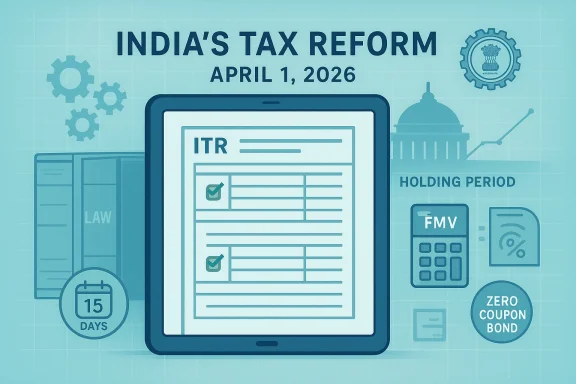 Background / Overview
The draft Income‑tax Rules, 2026 are the subordinate rules needed to operationalise the new Income‑tax Act, 2025, which the government intends to bring into force from April 1, 2026. The CBDT has placed the draft rules and the corresponding forms in the public domain specifically to solicit comments and make the rule‑making process more participative. The consultation period is explicitly short — 15 days — ending on February 22, 2026, which means stakeholders have a limited window to flag drafting problems and request clarifications. This redesign sits against a broader policy backdrop: the new Act aims to modernise language, consolidate scattered provisions, and reduce needless cross‑referencing. The draft rules follow the same philosophy — plain language, fewer forms and rules, and more formulaic presentation for technical computations. The CBDT has also indicated that it has built technology features into the new filing system to support pre‑fills and automated reconciliation. Early commentary from tax professionals points out that the shift is both a genuine long‑term simplification and a significant short‑term migration challenge for payroll systems, tax software vendors, and compliance teams.
What changed in scale: rules, forms and nomenclature
One of the clearest headline changes in the draft is the scale of delegated legislation. The currently applicable Income‑tax Rules, 1962 contain 511 rules and nearly 399 forms. The draft framework reduces that footprint substantially — the initial drafts list 333 rules and 190 forms. That reduction is achieved by consolidation, removal of redundant provisions and by redesigning forms so common information is standardised rather than duplicated across multiple schedules. For taxpayers and vendors this reduces the surface area that needs to be maintained, but it also means that long‑standing procedural nuances will be relocated and may be harder to find without careful indexing.Why this matters in practice:
- Reduced rule count should lower interpretive contradictions and make legal references easier for advisers.
- Renumbered rules and renamed forms will break backward compatibility with existing e‑filing exports, software templates and corporate compliance checklists.
- Organisations should assume a migration exercise is required: mapping legacy rule numbers and form fields to the new serial‑numbered forms (1–190) and the new rule numbering.
Major substantive changes taxpayers must know
Below are the most consequential items called out in the draft rules and early reporting. Each item is followed by practical implications and immediate actions taxpayers or advisers should consider.1) Simplified Income Tax Return (ITR) forms, pre‑fill and automated reconciliation
The CBDT emphasises that the new ITR forms are simplified, have clarified wording and are built for technology‑enabled prefill and reconciliation. The intent is to standardise common fields across forms and reduce duplication — an approach expected to cut manual entry errors and speed up the return filing process. Taxpayer‑facing features mentioned in early press briefings include two new platform services — a Taxpayer’s Navigator and a Compliance Navigator — designed to guide taxpayers through form selection and common compliance steps.Practical implication:
- Salaried individuals should expect clearer, prefilled salary and TDS data; however they should verify employer TDS entries carefully during the first filing cycle under the new forms.
- Tax software vendors and payroll teams must prioritise integration testing with the CBDT’s prefill schema and ensure mappings for Form‑level changes before April 1, 2026.
2) Holding period of capital assets — clarified computations (Draft Rule 6)
The drafts include explicit provisions on how to determine the period of holding of capital assets in certain scenarios. This is a technical, but critical, element because holding period affects whether a gain is categorised as short‑term or long‑term — and therefore the tax rate and indexation benefits that apply. The draft rule enumerates cases and formulae for computing holding periods, aiming to remove ambiguity that had led to litigation in the earlier framework.Practical implication:
- Investors, private equity funds and taxpayers who transact in immovable property, jewellery or securities should recalculate expected capital gains under the new holding‑period formulations once the final text is notified.
- Where transitional rules apply to assets acquired under the old law, taxpayers must keep clear documentation to support whatever regime they rely upon for the assessment year.
3) Fair market value (FMV) methodology — Draft Rule 57
The draft rules propose a formalised method to compute the fair market value (FMV) of assets like jewellery and immovable property for tax purposes. Given that FMV underpins capital gains and certain deemed income provisions, the clarity offered by Rule 57 is intended to reduce valuation disputes and provide formulaic guidance where formerly ad‑hoc assessments prevailed.Practical implication:
- Estate planners, high‑net‑worth individuals, and taxpayers with physical asset inventories should review the proposed FMV methodology with their valuers; inconsistencies between valuation approaches and the Rule’s formulae should be highlighted in public comments.
4) Scheme for zero‑coupon bonds and infrastructure‑related entities
The draft rules explicitly contain a scheme for zero‑coupon bonds and set out a regime for applications made by infrastructure‑related entities (including how certain infrastructure debt vehicles will be treated). This is an operationally important item for infrastructure financing because zero‑coupon instruments have different accrual mechanics and traditional valuation/tax timing consequences. The CBDT’s move is consistent with earlier amendments and clarifications that have allowed infrastructure funds and other notified entities to use such instruments under defined conditions.Practical implication:
- Infrastructure project financiers, investment managers and debt funds should review the application procedures and timing rules in the draft; they may need to alter documentation, sinking‑fund undertakings or trustee certificates to comply with the proposed disclosure and investment conditions.
- If you manage or hold such instruments, assess whether income accrues on an effective yield basis (as draft rules may require) or remains reckoned only at redemption — that choice will affect periodic tax accounting.
5) Consolidation of procedural rules — fewer special‑case provisions
Several scattered procedural rules (for TDS, withholding, returns and assessment timelines) have been consolidated into grouped sections. The practical effect is more predictable reading and easier internal cross‑referencing. However, consolidation also renumbers sections and relocates previously familiar clauses, which creates a transitional search cost for practitioners during early implementation.Practical implication:
- Tax teams should run a triage to identify which legacy rule numbers and form fields are material to ongoing compliance and map them to the new rule identifiers.
- Audit trails, compliance calendars and internal SOPs must be updated; do not rely on memory or legacy numbering once the new rules are finalised.
How the public consultation works — deadlines and best practice
The CBDT has given a 15‑day window for comments, closing on February 22, 2026. Given the short timeline, stakeholders should prioritise high‑impact, technical issues (for example, holding‑period computations, valuation formulas, zero‑coupon bond treatments and TDS re‑design). Submit detailed, worked examples wherever possible — concrete numerical examples accelerate administrative review and reduce the risk that a textual clarification will be interpreted differently by the department.Recommended steps for effective submissions:
- Identify the draft rules or form numbers (or the text snippets) that you propose to change.
- Provide precise alternative drafting or a worked example showing the issue and the proposed wording.
- Quantify the operational impact where possible (e.g., number of affected taxpayers, software changes, compliance cost estimates).
- Request a reasoned response if your submission depends on policy interpretation rather than drafting clarity.
Transition and implementation risks — what could go wrong
A large structural rewrite always carries operational and legal risk. Expect the following challenges during the 2026 transition:- Software and payroll mismatch: Tax return schemas, payroll engines and TDS reporting systems must be updated. Vendors will need test vectors and early access to the CBDT prefill interface to certify compatibility. Failure to synchronise will cause incorrect TDS entries and reconciliation mismatches in the first filing cycle.
- Parallel law complexity: For a period, legacy matters created under the Income‑tax Rules, 1962 and the older Act will still exist in pending assessments and litigation. Practitioners must manage both regimes and maintain legacy compatibility in filings and responses.
- Interpretation disputes: Formulaic rules reduce ambiguity, but they also create new micro disputes where taxpayers’ facts do not fit neatly into tables. Items like part‑disposals, complex repo structures and cross‑border hybrid instruments will be test cases.
- Short consultation window: Fifteen days for feedback is short for industry associations, fund managers and software vendors to mobilise and submit comprehensive technical comments. This raises the risk of drafting oversights that will only be discovered after notification.
What taxpayers and advisers should do now — a practical checklist
- For Employers / Payroll:
- Start mapping current payroll TDS logic to the new ITR and rule schema.
- Validate monthly take‑home estimates once the final standard deduction/slab clarifications are notified.
- Communicate expected changes to staff well ahead of the FY‑end.
- For Individual Taxpayers:
- Wait for the final forms before making irrevocable regime choices, but run parallel calculations (old vs new regimes) for FY 2026‑27.
- Keep scanned copies of receipts and valuations for assets held across the transition year.
- For Investment Managers and Infrastructure Funds:
- Assess zero‑coupon bond drafting in the draft for any new certification, sinking‑fund or investment‑in‑government‑securities requirements and adjust documentation.
- Test holding‑period rules against sample transactions and flag edge cases in public comments.
- For Tax Software Vendors:
- Seek early access to the CBDT’s prefill and reconciliation schema.
- Maintain a legacy compatibility layer for accounting periods and pending disputes under the previous rules.
- For Tax Practitioners and Associations:
- Collate high‑impact drafting errors, sample factual matrices that the draft may not handle, and provide suggested alternative wording or worked examples to the CBDT during the comment window.
Strengths, risks and editorial assessment
Strengths:- Clarity and scale reduction. A smaller, more coherent rulebook with formulaic tables will reduce common interpretive frictions and make compliance easier over time. The emphasis on prefill and automated reconciliation is taxpayer‑friendly and can materially reduce avoidable errors.
- Targeted operational features. The introduction of navigator services and the push for machine‑readable prefill demonstrates a modern approach to taxpayer services that can lower compliance costs for small taxpayers.
- Short consultation and operational rush. The 15‑day window risks leaving complex technical issues insufficiently tested. Critical items like holding‑period edge cases and zero‑coupon bond treatment deserve more time and worked examples.
- Transition friction. The practical migration work for enterprise systems, payroll, and tax software is non‑trivial; failure to coordinate could create compliance failures in the first months after implementation.
- Potential for interpretation gaps. Formulaic rules are helpful, but they must be accompanied by detailed examples and administrative guidance to cover non‑standard transactions.
- Some of the specific rule numbers and mechanical details (for example, the exact wording of Rule 6 or Rule 57) are in draft form and may be amended following public comments. Readers should treat draft rule text as tentative and consult the final gazetted rules and the CBDT’s explanatory notes once published. Where a precise legal interpretation is required—for litigation, high‑value transactions or corporate disclosures—seek formal legal advice rather than relying solely on press summaries.
Quick FAQs — answers to common questions
- When do the draft rules come into force?
- The CBDT has stated the draft rules are being prepared for implementation with the Income‑tax Act, 2025 effective from April 1, 2026. Final notification will set the exact effective date for each provision.
- How long is the public comment window?
- Fifteen days; comments are being accepted until February 22, 2026.
- Are the number of rules and forms actually reduced?
- Yes: the draft reduces the number of rules from 511 to 333 and forms from 399 to 190 in the initial drafting. Stakeholders should validate transitional cross‑references before finalisation.
- What is the immediate action for tax teams?
- Map legacy rule numbers and form fields to the new schema, test prefill integration, and prepare communications to affected employees or clients. Prioritise high‑impact technical issues for submission during the consultation window.
Conclusion
The draft Income‑tax Rules, 2026 are an important step in translating a modernised Income‑tax Act into practical compliance instruments. The rules promise genuine long‑term simplification: fewer forms, clarified language, formulaic computation and technology‑enabled prefill. But the devil is in the drafting details. Holding‑period computations, FMV methodologies, zero‑coupon bond mechanics and the relocation of procedural rules all carry the potential for unintended consequences unless clarified through detailed examples and responsive administrative guidance.Given the tight consultation timeline that ends on February 22, 2026, taxpayers, professional bodies, software vendors and financial institutions should prioritise submitting concrete, example‑based feedback now. That participation is the most practical way to reduce transition risk, preserve taxpayer certainty and ensure the new regime delivers on its promise of simplification rather than merely reshuffling complexity.
Source: ET Now New Draft Income Tax Rules 2026 released: What’s changing for taxpayers? All you need to know
