

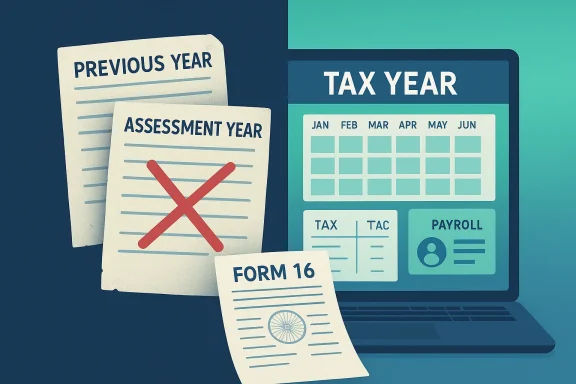
The Narendra Modi government’s sweeping tax rewrite has done away with the familiar pair of terms that generations of Indian taxpayers and accountants learned to dread and love in equal measure — Previous Year and Assessment Year — replacing them with a single, unified concept: the Tax Year. This change, enacted by the Income‑tax Act, 2025 and slated to take effect from April 1, 2026, is more than a lexical tidy‑up; it reorganises how income is framed, assessed and communicated across returns, payroll engines, TDS nonotices and tax software. The aim is clarity and simplicity for individual taxpayers, but the transitionsition carries practical migration work, potential timing mismatches and compliance traps that every salaried person, small business owner, tax professional and payroll team should understand now.
The Income‑tax Act, 1961 — the legal backbone of India’s direct tax system for over six decades — has been replaced by the Income‑tax Act, 2025. The new statute received Presidential assent in August 2025 and is scheduled to come into force for the financial year beginning April 1, 2026. The 2025 Act is designed to be shorter, clearer and more formulaic: it reduces archaic language, consolidates scattered provisions and introduces tabular and formulaic computation formats to reduce reliance on narrative interpretation. The stated intention is to reduce drafting complexity and to modernise procedural language for both taxpayers and administrators. A parallel tax reform trajectory — GST rationalisation and a reworked personal tax regime introduced in the 2025 budget cycle — has magnified the practical stakes. The GST Council approved a movement to two main slabs for most goods and services (5% and 18%), effective from September 22, 2025, and the Budget 2025 changes created a simpler personal tax regime with materially different thresholds. Those reforms interact with the re‑codified income‑tax statute, creating both relief for many taxpayers and considerable operational work for payrolls, ERP systems and tax‑software vendors.
 Background / Overview
The Income‑tax Act, 1961 — the legal backbone of India’s direct tax system for over six decades — has been replaced by the Income‑tax Act, 2025. The new statute received Presidential assent in August 2025 and is scheduled to come into force for the financial year beginning April 1, 2026. The 2025 Act is designed to be shorter, clearer and more formulaic: it reduces archaic language, consolidates scattered provisions and introduces tabular and formulaic computation formats to reduce reliance on narrative interpretation. The stated intention is to reduce drafting complexity and to modernise procedural language for both taxpayers and administrators. A parallel tax reform trajectory — GST rationalisation and a reworked personal tax regime introduced in the 2025 budget cycle — has magnified the practical stakes. The GST Council approved a movement to two main slabs for most goods and services (5% and 18%), effective from September 22, 2025, and the Budget 2025 changes created a simpler personal tax regime with materially different thresholds. Those reforms interact with the re‑codified income‑tax statute, creating both relief for many taxpayers and considerable operational work for payrolls, ERP systems and tax‑software vendors. What is the new “Tax Year” and why it matters
Definition and legal scope
Under the new law, the Tax Year is defined as a period of twelve months contained in a financial year (starting April 1), and this single term replaces earlier notions of Previous Year and Assessment Year. In simple terms, the year in which income is earned is now called the tax year; statutory references to rates, computations and many administrative timelines will refer to this same period. For businesses or income sources that begin mid‑financial year, the tax year can begin at the date it started and end with that financial year, but the overarching concept aligns income and tax terminology to a single, unified period.Why replace “Previous Year” and “Assessment Year”?
The old framework separated the year of earning (the previousus year) from the year of assessment (the assessment year). That distinction often produced confusion in everyday communications: pay slips, employer letters, notices and lay media would use different year labels, causing uncertainty about deadlines, punishment windows and which receipts ing. The new approach eliminates that two‑date mental model: income is now associated with the tax year and its assessment follows the procedures for that same tax year under the re‑codified statute. This is intended to make taxpayer-facing language consistent across forms, notices and portals.How this change will show up in practice
Filing and timelines — what changes for the taxpayer
- Income will be reported against the tax year (the financial year in which it is earned) rather than being described as income of the previo in the assessment year*.
- Form labels, ITR schemas, Income Tax Department (ITD) communications and notices will adopt the new term tax year — expect the e‑filing portal, employer Form 16s/26AS equivalents and third‑party statements to update nomenclature accordingly.
- For the first year of full implementation — returns filed in 2026‑27 covering income earned in FY 2026‑27 — taxpayers will see tices and portal displays. Transitional references to older terminology may persist for pending matters opened under the 1961 Act.
What about assessments and audits?
Although the terms have been consolidated, assessment processes remain — the department still assesses declared income and issues notices where required. The practical change is linguistic and organisational: assessments will be indexed to the tax year rather than split acros year nomenclature. Importantly, the new Act is not broadly retroactive: assessments and pending litigation under the 1961 Act will continue under transitional rules until resolved, which means that for a period both status of different cases. This parallel‑running creates operational complexity for tax officers and practitioners.Immediate impacts taxpayers must know
For salaried individuals
- Payroll and TDS: Employers must update payroll engines to reflect new terminology and any slab/standard deduction changes embedded in recently announcedrs will need to revise month‑by‑month tax computations and communicate the effect on take‑home pay to employees before FY‑end.
- ITR filing: The ITR you file for income earned in a financial year will be labelled and processed for that tax year; filing windows and statutory deadlines will be reworded to adopt the tax‑year concept. Expect initial portal UI/UX inconsistencies during the first tax cycle.
For small businesses and professionals
- Accounting period alignment: Businesses that prepare accounts on a financial‑year basis will find the legal terminology now mirrors acc closely — but they must verify compliance checklists that reference old clause numbers or prior‑year statutory language.
- Compliance tooling: ERP, payroll software and tax‑return packages need updates to cope with consolidated section numbering and the tax‑year nomenclature; early testing and vendor patches will reduce year‑end surprises.
For tax consultants and chartered accountants
- Client advisory: Practitioners must re‑run client simulations using the new regime terminology and ensure that client communications explicitly state which tax year is being discussed to avoid ambiguity.
- Filing templates and precedent letters should be updated immediately; legacy templates using "previous year/assessment year" increase risk of client confusion and should be phased out.
Interaction with Budget 2025 changes and GST rationalisation
The Income‑tax Act 2025’s language change coincides with substantive tax policy changes implemented through the 2025 Budget and the GST Council’s rationalisation.- Personal income tax: The Budget 2025 introduced a simplified “new regime” with a higher zero‑tax threshold in headline measures, including a reported zero tax up to certain thresholds under the new regime and a higher standaried taxpayers that increases effective tax‑free income for many. Taxpayers should recompute liabilities under both the old and new regimes to determine the beneficial choice for their circumstances. These policy changes are reflected in commentary and explanatory materials accompanying the new Act. (Readers should treat specific slab numbers reported in some media as subject to confirmation in statutory Finance Act notifications when finalised.
- GST two-rate reform: The GST Council’s decision to rationalise slabs into primarily 5% and 18% for most items from September 22, 2025 interacts with the income‑tax changes by affecting consumer prices, input costs and business margins — factors that matter when estimating taxable income from business operations, working capital needs and transfer pricing for some firms. Businesses must remap SKUs, update invoicing engines and revalidate input‑tax credit flows.
Risks, trade‑offs and transitional issues
Migration complexity and software risk
The structural reorganisation of the statute (consolidated sections, formulaic tables and new nomenclature) reduces ambiguity long term but creates near‑term migration risk. Tax software, payroll engines, ERP tax masters and filing schemas must be updated and tested well before the first return filing season under the new law. Expect:- Version skew between software vendors that deploy patches at different times.
- Legacy data formats and older e‑filing APIs coexisting with new schemas during the transition window.
- Potential mismatcf payroll and employer reporting are not synchronised to the new tax‑year labels.
State finances and macro risks
GST rate rationalisation that reduced several slabs tgitimate concerns among state governments about near‑term revenue loss. The Centre’s plan to replace the compensation cess via higher excise on tobacco and a targeted cess on pan masala is still subject to parliamentary approval. These fiscal negotiations can change timelines, and media‑reported excise rates or cess reated as provisional until formally enacted. The fiscal dynamics are an important backgrou that depend on stable indirect tax incidence.Equity considerations
Simplicity for many (especially middle‑income salaried taxpayers) is an explicit policy aim. But removing or discouraging deductions can be regressive for certain households — for example, those with significant health or education expenditure that previously used specific deductions. Thied regime may not be uniformly beneficial and could nudge taxpayers into different financial behaviours that are not necessarily optimal when considering risk and insurance. Practitioners should flag clients whose circumstances suggest retention of the old regime remains preferable.Notices, terminology and taxpayer confusion
Early months will likely produce mixed‑terminology notices as legacy systems, legal staff, and older templates are updated. Taxpayers with penr the 1961 Act are particularly vulnerable to confusion if notices reference the old year labels; maintain documentary proof and be prepared to request clarification in writing if demands appear inconsistent.Action checklist — what to do now (practical steps)
For individual taxpayers (short checklist)
- Recompute annual tax using both regimes (if you are eligible to choose) for FY 2026‑27 and FY 2027‑28 to decide optimaldigital copies of salary slips, TDS certificates and supporting documents; ensure employer Form 16/26AS equivalents align with the tax year label.
- Watch for communications from your employer about payroll changes and updated take‑home calculations — ask HR for a year‑on‑year projection under the new definitions.
- If you plan to switch tax regimes in a year, understand any timing or lock‑in rules that may restrict switching; consult a CA for one‑time election impacts.
For accountants, tax professionals and advisers
- Update templates and client letters to reference tax year and remove ambiguous AY/PY language.
- Run parallel simulations for clients and document the rationale for regime selection.
- Validate software vendor patches and confirm e‑filing portal schema changes in client test environments before the filing season.
For employers, payroll and HR teams
- Patch payroll engines to the new law’s slab tables and higher standard deduction treatments (if applicable). Communicate changes to staff with examples showing monthly net pay movement.
- Confirm that TDS certificates, salary registers and reporting to the e‑filing portal will use the tax year term consistently. Test autoclaimed TDS on employee dashboards and rectify mismatches pre‑emptively.
For software vendors and finance teams
- Prioritise compliance updates, version releases and interoperability testing with the income‑tax e‑filing portal. Maintain a legacy compatibility mode for clients who still have pending matters under the 1961 Act.
- Coordinate with clients to schedule downtime or migration windows; run batch tests for TDS returns, ITR exports, and tax computation formulas.
What remains uncertain — claims to treat cautiously
- Exact administrative details for replacement of GST compensation cess with excise/cess measures (for tobacco and pan masala) remain ary passage and Finance Ministry notifications; media reports are informative but provisional. Treat rate and timing reports as indicative until final gazette notifome early media pieces summarising Budget‑linked slab numbers or transitional rules may simplify complex clauses; whenever a precise legal interpretation is required (for litigation, assessment disputes or corporate disclosure) consult the final text of the Income‑tax Act, 2025 or seek direct legal advice.
How the new language can improve taxpayer experience — and where it might fall short
Gains
- Clarity: a single, consistent reference — the tax year — simplifies communications across payslips, notices, and client advice.
- Modern statutory style: formulaic tables and consolidated provisions reduce interpretive cross‑referencing, lowering lawyer and practitioner transaction costs over tird.com](]) [/LIST] [HEADING=1]Limitations[/...t know changes for taxpayers, don’t miss out!
