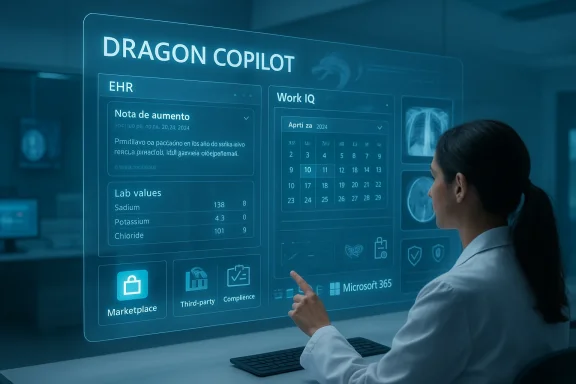
Microsoft’s pitch at HIMSS 2026 was simple and unapologetically ambitious: take the ambient documentation and speech‑recognition heritage of Dragon, fold it tightly into the Microsoft Copilot ecosystem, and move from passive transcription toward an agentic clinical assistant that can act, suggest, and orchestrate tasks across clinical workflows. The company showcased deeper Microsoft 365 Copilot and Work IQ integration, a curated partner Marketplace and agent model, and expanded role‑specific features designed for physicians, nurses, and radiologists—moves meant to push ambient clinical AI from pilots into enterprise operations. ps://www.microsoft.com/en-us/industry/blog/healthcare/2026/03/05/unify-simplify-scale-microsoft-dragon-copilot-meets-the-moment-at-himss-2026/)
Dragon Copilot is the logical heir to two threads of health‑tech work: the high‑accuracy clinical speech recognition lineage of Dragon Medical One and the ambient, multi‑party capture capabilities that evolved from DAX. Microsoft has repositioned those capabilities inside a Copilot architecture—adding fine‑tuned generative models, role‑aware templates, and governance controls—so the assistant can not only draft notes but also suggest coding, surface prior records, and integrate partner agents that automate administrative tasks. Microsoft described these HIMSS enhancements under the three pillars: Unify. Simplify. Scale.
Why this matters now: health systems are still chasing measurable, scalable ways to reduce clinician documentation burden, improve retention, and control costs. Ambient and assistant‑style AI promises to shorten after‑hours charting, accelerate throughpuual insights at point of care—if implemented with robust governance, native workflow embedding, and continuous measurement. HIMSS 2026 framed Microsoft’s answer to that challenge: make Dragon Copilot a single, extensible assistant threaded into the Microsoft productivity stack and the EHR, supported by a partner ecosystem and enterprise controls.
Intermountain Health offers one of the clearest, enterprise‑scale case studies: a July 2025 pilot followed by a rapid scale through embedding Dragon ic, with extensive training and a train‑the‑trainer program. Intermountain reported growth to more than 2,500 active users and internal analytics showing up to a 27% reduction in “time in notes per appointment” for clinicians with high encounter volumes. These figures came from internal Epic Signal analytics and customer materials; they demonstrate the potential for significant operational gains, but they are not a substitute for multi‑site, peer‑reviewed validation. Health systems should plan independent baseline and post‑t.
Academic and independent reporting paint a more mixed picture. Peer‑reviewed pilots of ambient AI show modest reductions in time‑ician groups, while other studies find the gains are sensitive to utilization level, specialty mix, and workflow embedding. The variance underscores that implementation—not the technology alone—determinbi.nlm.nih.gov]
Generative models are fallible. A confidently written but incorrect statement in a clinical note can propagate into orders, coding, or downstream care. Microsoft’s safety features and citation controls are helpful, but responsibility for final clinical judgment—and for designing human‑in‑the‑loop checks—rests with health systems. Robust verificasampling audits remain essential.
Yet the most consequential takeaway is also sober: technology alone does not deliver better clinical outcomes. Success requires rigorous governance, continuous measurement, clinician training, and careful handling o medico‑legal exposure. Vendor‑reported metrics point to large potential gains, but health systems must treat those numbers as signals to be validated through internal metrics and independent studies. In short, Dragon Copilot is ready for production in many settings—but safe, durable value depends on the diligence of the organizations that adopt it.
Source: HIT Consultant Microsoft Upgrades Dragon Copilot to an Agentic Clinical Assistant at HIMSS 2026
Source: Healthcare IT News Microsoft's AI tool unification in Dragon Copilot takes center stage at HIMSS26
 Background / Overview
Dragon Copilot is the logical heir to two threads of health‑tech work: the high‑accuracy clinical speech recognition lineage of Dragon Medical One and the ambient, multi‑party capture capabilities that evolved from DAX. Microsoft has repositioned those capabilities inside a Copilot architecture—adding fine‑tuned generative models, role‑aware templates, and governance controls—so the assistant can not only draft notes but also suggest coding, surface prior records, and integrate partner agents that automate administrative tasks. Microsoft described these HIMSS enhancements under the three pillars: Unify. Simplify. Scale.Why this matters now: health systems are still chasing measurable, scalable ways to reduce clinician documentation burden, improve retention, and control costs. Ambient and assistant‑style AI promises to shorten after‑hours charting, accelerate throughpuual insights at point of care—if implemented with robust governance, native workflow embedding, and continuous measurement. HIMSS 2026 framed Microsoft’s answer to that challenge: make Dragon Copilot a single, extensible assistant threaded into the Microsoft productivity stack and the EHR, supported by a partner ecosystem and enterprise controls.
What Microsoft announced at HIMSS 2026
From ambient scribe to agentic clinical assistant
At HIMSS, Microsoft positioned Dragon Copilot not merely as a documentation tool but as an agentic clinical assistant—a system that can proactively surface suggestions or take low‑risk actions on behalf of clinicians when configured and authorized to do so. This is a qualitative shift: moving from a passive summarizer to an assistant that can initiate recommended workflows, remind teams of follow‑up steps, or prefill administrative forms, while leaving final clinical authority with the human user. Trade reporting and Microsoft’s own industry blog both emphasized that the public preview coincided with HIMSS activities and that these capabilities are rolling out in stages.Deep Copilot + Work IQ integration
A central technical theme was tighter integration with Microsoft 365 Copilot and Work IQ. Work IQ supplies Copilot with relevance signals derived from calendars, messages, and files, enabling Dragon Copilot to ground suggestions in both patient context and the clinician’s work context (team messages, schedules, department policies). Microsoft’s blog and HIMSS demos highlighted use cases where Copilot pulls a scheduling conflict or a recent team conversation into the clinical note or a recommended task. This fusion of clinical facts and workplace context is intended to reduce context switching and make Copilot responses more actionable.Partner Marketplace and extensibility (agents and apps)
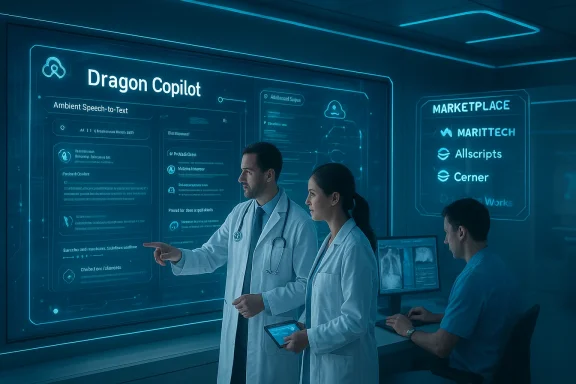
Microsoft emphasized a curated Marketplace for partner apps and agents that can be surfaced inside Dragon Copilot. Early partners cited include Canary Speech, Humata Health, Optum, and Regard; partner agents promise to cover diagnostics, revenue cycle tasks (like prior authorization), and specialty decision support. The key architectural pitch: let health systems buy modular, certified AI extensions and run them inside an enterprise‑governed Copilot experience rather than cobbling disparate point tools. Marketplace extensibility is presented as a way to extend Dragon Copilot beyond documentation into operational automation. ([healps://www.healthcareitnews.com/news/microsoft-dragon-copilot-intros-new-ai-capabilities-clinicians)Role‑aware experiences: physicians, nurses, radiologists
Microsoft explicitly broadened Dragon Copilot’s target: not just physicians but nurses and radiologists as well. The nursing capabilities focus on ambient capture that maps to structured flowsheet entries and bedside documentation in mobile apps like Epic Rover; nursing features include pause/preview controls and organizational “cheat sheets” to speed accurate capture. Radiology preview integrations (notably with PowerScribe One) aim to automate repetitive steps—summarizing priors, essions, and surfacing relevant prior studies—so radiologists can focus on interpretation rather than administrative assembly. These previews are in U.S. preview as Microsoft iterates on specialty tuning.Documentation automation, coding assistance, and multilingual capture
HIMSS announcements also highlighted practical productivity features: proactive ICD‑10 specificity suggestions, reusable clinical templates, pull‑forward of prior notes, and multilingual conversation capture (Microsoft states support for capture across dozens of languages, writing the encou’s primary language). Microsoft says it uses instruments such as the Provider Documentation Summarization Quality Instrument (PDSQI‑9) to evaluate generated note quality, signaling a move toward measurable quality frameworks for AI‑generated documentation.Real‑world traction and evidence: what’s verified, what’s vendor‑reported
Microsoft and several large health systems now report broad operational use of Dragon Copilot. The company and customer materials indicate deployments in major systems (Intermountain Health, Mount Sinai, Vail, and others)n Copilot touches more than 100,000 clinicians and has documented tens of millions of encounters in recent reporting periods. Those numbers are meaningful indicators of scale but are vendor‑reported metrics and should be treated as operational signals rather than peer‑reviewed evidence. Independent studies on ambient AI exist but are still limited in scope and generalizability.Intermountain Health offers one of the clearest, enterprise‑scale case studies: a July 2025 pilot followed by a rapid scale through embedding Dragon ic, with extensive training and a train‑the‑trainer program. Intermountain reported growth to more than 2,500 active users and internal analytics showing up to a 27% reduction in “time in notes per appointment” for clinicians with high encounter volumes. These figures came from internal Epic Signal analytics and customer materials; they demonstrate the potential for significant operational gains, but they are not a substitute for multi‑site, peer‑reviewed validation. Health systems should plan independent baseline and post‑t.
Academic and independent reporting paint a more mixed picture. Peer‑reviewed pilots of ambient AI show modest reductions in time‑ician groups, while other studies find the gains are sensitive to utilization level, specialty mix, and workflow embedding. The variance underscores that implementation—not the technology alone—determinbi.nlm.nih.gov]
Strengths: why Dragon Copilot could matter
- Native workflow embedding: Putting the assistant inside the EHR (native Epic embedding where available) minimizes context switching, which is a major usability win and correlates with higher adoption in early deployments. Microsoft and customer story materials repeatedly emphasize this as a central success factor.
- **Enterprise gover Customers already using Microsoft 365 and Azure can leverage existing compliance, identity, and device policies—lowering friction for enterprise rollout and enabling centralized controls over data access and DLP.
- Partner practical value: Marketplace partners let health systems add narrow, high‑value agents (e.g., prior‑auth automation, voice‑based diagnostics) without building them in‑house. This modularity can shorten time‑to‑value.
- Role‑specific extensions broaden impact: Nurses and radiologists have different documentation burdens than physicians. Features targeted to flowsheets, structured bedside capture, and radioexpand the assistant’s utility across care teams.
- Multilingual and specialty tuning: Support for multilingual capture and specialty‑aware templates improves equity and reduces the need for ad‑hoc clinician editing in diverse clinical populations.
Risks, unknowns, and governance imperatives
Microsoft’s feature list is powerful, but the operational and clinical risks are real and require explicit mitigahallucination, and clinical safetyGenerative models are fallible. A confidently written but incorrect statement in a clinical note can propagate into orders, coding, or downstream care. Microsoft’s safety features and citation controls are helpful, but responsibility for final clinical judgment—and for designing human‑in‑the‑loop checks—rests with health systems. Robust verificasampling audits remain essential.
Billing, coding, and medico‑legal exposure
Automated ICD‑10 suggestions accelerate documentation but can introduce specificity errors if not verified. Health systems must ensure audit trails, provenance of documentation (audio → draft → clinician edit), and clinician attestation policies are in place. Vendors’ coding suggestions should be treated as decision support, not automated authorizations.Consent and privacy with ambient capture
Recording multi‑party conversations raises consent and retention questions. Organizations must operationalize consent workflows (visible recording indicators, opt‑in defaults where appropriate), and enforce retention and deletion policies that meet legal requirements. Microsoft can provide administrative controls, but operational compliance is the provider’s duty.Evidence gap and vendor‑reported metrics
Many headline performance numbers—time savings, adoption counts, encounter volumes—are sourced from vendor or customer analytics. Independent, multi‑site, peer‑reviewed studies measuring clinical accuracy, patient outcomes, and long‑term workforce effects are still needed. Health systems should design rigorous internal evaluation plans and publish outcomes when feasible.Vendor lock‑in and platform concentration
Embedding an assistant deeply within Microsoft’s productivity suite increases efficiency but concentrates operational risk. Health systems should demand open APIs, data portability guarantees, and contractu model behavior, data residency, and exit paths to prevent future migration friction.A pragmatic rollout playbook for health systems
The difference between a successful Dragon Copilot deployment and a cautionary tale often comes down to careful sequencing and governance. Below is ae playbook distilled from early adopters and Microsoft guidance.- Pilot selection and scope
- Choose a narrow pilot population (primary care, hospital medicine, or a single surgical specialty).
- Define measurable outcomes: time‑in‑note, after‑hours charting, note completion, coder exceptions, and clinician satisfaction.
- Technical design and integration
- Prefer native EHR embedding where feasible to reduce context switching.
- Configure identity mapping and DLP settings, and confirm data residency and retention with the vendor.
- Governance and policy
- Stand up an AI oversight committee including clinicians, compliance, privacy, and IT.
ification rules and a clear attestation workflow for signed notes. - Training and enablement
- Invest in hands‑on training and train‑the‑trainer models.
- Provide at‑the‑elbow support during go‑live and rapid feedback loops to refine templates and prompts.
- Monitoring and QA
- Instrument objective metrics (Epic Signal, time stamps, after‑hours metrics) and clinician‑reported outcomes.
- Audit samples of audio vs. generated notes regularly and publish error rates and remediation actions.
- Scale and iterate
- Use pilot data to refine specialty templates and agent selection.
- Integrate Marketplace partners in waves and treat each as a new integration requiring validation.
What to watch next (technical and market signals)
- Model choice and latency: Microsoft’s multi‑model Copilot approach (including will shape where instant vs. deep reasoning models are used. Enterprises must formalize model selection as a governance parameter.
- Marketplace maturation: The quality and safety posture of third‑party agents will determine how many institutions are comfortable surfacing vendor agents inside clinical workflows. Expect tighter certification and testing requirements.
- Independent evidence: Look for multi‑site peer‑reviewed studies measuring safety, diagnostic accuracy, and clinician well‑being; early adopters should commit to publishing outcomes. (pmc.ncbi.nlm.nih.gov)
- Regulatory scrutiny and payer posture: Regulators and payers will pay attention to how AI‑assisted notes influence billing and clinical decision‑making—prepare for scrutiny on provenance and audibility.
Final analysis — balance of promise and responsibility
HIMSS 2026 confirmed that Dragon Copilot has evolved from an ambient documentation product into a broader, agent‑capable clinical assistant that Microsoft intends to embed deeply inside enterprise workflows. The technical advances—tight Microsoft 365 Copilot and Work IQ integration, agentized Marketplace extensibility, and role‑specific features for nurses and radiologists—are practical responses to the hard problems health systems face: documentatiang clinical support. Microsoft’s own materials and trade coverage show the product is being used at scale in meaningful customer deployments, and the Intermountain case provides a concrete example of how significant operational gains can be realized with disciplined implementation.Yet the most consequential takeaway is also sober: technology alone does not deliver better clinical outcomes. Success requires rigorous governance, continuous measurement, clinician training, and careful handling o medico‑legal exposure. Vendor‑reported metrics point to large potential gains, but health systems must treat those numbers as signals to be validated through internal metrics and independent studies. In short, Dragon Copilot is ready for production in many settings—but safe, durable value depends on the diligence of the organizations that adopt it.
Quick checklist for health IT leaders considering Dragon Copilot now
- Confirm the integration model (native EHR embedding vs. connector) and map how notes flow from audio → draft → clinician attestation.
- Insist on explicit contractual terms for data portability, model behavior transparency, and SLAs for high‑value features.
- Require pilot KPIs and a measurement plan that includes objective signals (Epic Signal), audit sampling, and clinician surveys.
- Establish consent and retention policies for ambient audio, and provide visible recording controls in the UI.
- Treat third‑party Marketplace agents as new integrations—validate them against privacy, safety, and clinical governance requirements before production use.
Source: HIT Consultant Microsoft Upgrades Dragon Copilot to an Agentic Clinical Assistant at HIMSS 2026
Source: Healthcare IT News Microsoft's AI tool unification in Dragon Copilot takes center stage at HIMSS26