

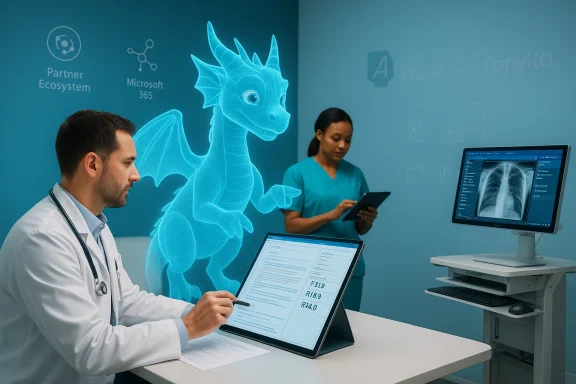
Microsoft’s pitch at HIMSS 2026 was blunt and unambiguous: unify fragmented clinical data, simplify the work clinicians actually do, and scale those gains across roles and geographies—using one integrated AI assistant built on Azure and threaded into the Microsoft productivity stack. The new Dragon Copilot announcements showcased deeper Microsoft 365 Copilot integration (via Work IQ), a curated set of partner AI apps and agents in Microsoft Marketplace, expanded role‑based experiences for physicians, nurses, and radiologists, and a set of productivity features—proactive coding suggestions, reusable clinical templates, and multilingual ambient capture—designed to push ambient clinical AI from pilot projects into enterprise operations. These are meaningful steps for a technology that, according to Microsoft and multiple independent reports, already touches more than 100,000 clinicians and has been used to document millions of patient encounters.
Healthcare has a long record of innovation followed by slow operational adoption—electronic health records (EHRs) are a prime example. Over the last decade the technical foundations for voice, ambient capture, and clinical natural language processing matured in industry products such as Dragon Medical One and the Dragon Ambient eXperience (DAX). Microsoft’s acquisition and integration of those capabilities into a broader Copilot strategy created Dragon Copilot, a healthcare‑specific AI assistant that combines high‑quality clinical speech recognition, ambient multi‑party capture, and fine‑tuned generative models to produce draft notes, orders, summaries, and other artifacts inside clinicians’ workflows. Microsoft has been public about the product’s commercial rollout since early 2025 and has been iterating on capability, EHR integrations, and partner ecosystems since.
Why this matters now: health systems are desperate for scalable ways to reduce documentation burden, improve clinician retention, and contain costs while preserving (or improving) clinical quality. Ambient and assistant‑style AI promises to reduce after‑hours charting, accelerate throughput, and surface contextual insights at the point of care—if and only if implementation is done with strong governance, workflow integration, and measurement. The HIMSS 2026 announcements are Microsoft’s answer to that challenge: package the capabilities, make them extensible through partners, and embed them into Microsoft 365 where enterprise governance and identity already exist.
That said, the work ahead for health systems is nontrivial. Organizations must pair vendor capabilities with rigorous governance, independent measurement, and clear clinician accountability. Early adoption metrics and customer stories (e.g., Intermountain and Mount Sinai) are heartening and indicate operational viability, but they do not remove the need for independent validation and careful, specialty‑aware implementation.
For health IT leaders, the practical takeaway is this: Dragon Copilot and similar tools have moved beyond proof‑of‑concept into production‑grade offerings with significant adoption. The strategic question is no longer if to evaluate ambient AI, but how to operationalize it safely, measure its true impact, and protect patients and institutions from the new categories of risk it introduces. Done well, these assistants can restore time and presence to clinicians; done poorly, they will create new administrative and safety headaches. HIMSS 2026 showed Microsoft doubling down on the former—now the hard work of safe, evidence‑based deployment belongs to health systems and their clinical leadership teams.
Source: Microsoft Unify. Simplify. Scale: Microsoft Dragon Copilot meets the moment at HIMSS 2026 - Microsoft Industry Blogs
 Background / Overview
Healthcare has a long record of innovation followed by slow operational adoption—electronic health records (EHRs) are a prime example. Over the last decade the technical foundations for voice, ambient capture, and clinical natural language processing matured in industry products such as Dragon Medical One and the Dragon Ambient eXperience (DAX). Microsoft’s acquisition and integration of those capabilities into a broader Copilot strategy created Dragon Copilot, a healthcare‑specific AI assistant that combines high‑quality clinical speech recognition, ambient multi‑party capture, and fine‑tuned generative models to produce draft notes, orders, summaries, and other artifacts inside clinicians’ workflows. Microsoft has been public about the product’s commercial rollout since early 2025 and has been iterating on capability, EHR integrations, and partner ecosystems since.Why this matters now: health systems are desperate for scalable ways to reduce documentation burden, improve clinician retention, and contain costs while preserving (or improving) clinical quality. Ambient and assistant‑style AI promises to reduce after‑hours charting, accelerate throughput, and surface contextual insights at the point of care—if and only if implementation is done with strong governance, workflow integration, and measurement. The HIMSS 2026 announcements are Microsoft’s answer to that challenge: package the capabilities, make them extensible through partners, and embed them into Microsoft 365 where enterprise governance and identity already exist.
What Microsoft announced at HIMSS 2026 — the key additions
Microsoft framed the announcements around three themes: Unify. Simplify. Scale. The concrete capabilities revealed at HIMSS include:- Closer integration with Microsoft 365 Copilot and Work IQ so clinicians can surface work context (messages, files, meetings) alongside patient data without leaving the workflow. This ties Copilot’s collaboration signals to clinical context to produce more relevant, context‑aware responses.
- Availability of partner-built AI apps and agents through Microsoft Marketplace, enabling vendor specialty solutions (diagnostics, revenue cycle, prior authorization, decision support) to be purchased and surfaced inside Dragon Copilot. Microsoft listed an early cohort including Canary Speech, Humata Health, Optum, and Regard. This extends Dragon Copilot beyond documentation to modular clinical and operational capabilities.
- Expanded role‑based experiences for physicians, nurses, and radiologists, delivered across mobile, web, and desktop with EHR integration options. For example:
- Physician workflows: EHR‑embedded documentation, mobile apps, and the ability to invoke Copilot by highlighting text in place.
- Nursing workflows: ambient capture converted into structured flowsheet entries and coverage for med‑surg flowsheets and LDAWs (lines, drains, airways).
- Radiology workflows: integration with PowerScribe One for report creation, prior‑study summaries, and AI‑assisted interpretation (radiology preview).
- Documentation and automation features:
- Proactive ICD‑10 specificity suggestions during note review to help reduce coding ambiguity.
- Reusable custom clinical documents generated from prompts or examples and managed as templates.
- Pull‑forward support to reuse prior notes as a starting point.
- Multilingual conversation capture—Microsoft says the capability captures conversations in 58 languages and writes the encounter in the primary language for the clinician’s country.
- Seamless migration from Dragon Medical One, preserving existing vocabularies, templates, and AutoTexts for customers moving to Dragon Copilot.
The technical foundations: ambient capture, EHR embedding, and Azure scale
Dragon Copilot combines several distinct technical layers:- Speech and ambient capture: high‑accuracy clinical speech recognition (the legacy of Dragon Medical One) plus ambient multi‑party capture (DAX lineage) to record clinic encounters or capture in‑room conversations without manual note taking. This is what allows automatic extraction of orders, problems, and history.
- Generative summarization and task automation: fine‑tuned models convert transcripts into specialty‑specific note drafts, referral letters, after‑visit summaries, and coding suggestions. Microsoft says document quality is evaluated using the Provider Documentation Summarization Quality Instrument (PDSQI‑9), an instrument developed to assess LLM‑generated clinical summaries. That evaluation framework is publicly documented in recent academic work and was explicitly referenced by Microsoft.
- Contextual grounding via Microsoft 365 Copilot + Work IQ: Work IQ provides a relevance signal derived from collaboration patterns (emails, files, meetings, chats), so Copilot can surface work context—schedules, messages, or department policies—alongside patient facts. This reduces the need to hunt in separate apps when making operational decisions (e.g., confirming a follow‑up plan or pulling team schedules).
- EHR and application embedding: there are two integration models—native embedding in supported EHRs (e.g., Epic) or use via standalone web/mobile/desktop apps with connectors. Microsoft stresses native embedding reduces context switching and increases adoption. Evidence from deployments that integrated Dragon Copilot directly into Epic shows faster clinician uptake and better workflow alignment, though those results come from customer reports rather than independent trials.
- Cloud scale and governance: Dragon Copilot is built on Microsoft Azure, benefiting from enterprise identity, compliance, and security controls that many health systems already use. Microsoft emphasizes responsible AI guardrails, customer data isolation, and backend controls; those are necessary, but by themselves not sufficient to eliminate operational risk. Health systems must still architect their own governance and monitoring.
Adoption, evidence, and real‑world outcomes: what the numbers say (and what they don’t)
Microsoft and public reporting now place Dragon Copilot in a serious adoption band:- Microsoft and multiple independent publications reported that Dragon Copilot is used by more than 100,000 clinicians and that the technology documented 21 million patient encounters in a recent quarter (a claimed 3x year‑over‑year increase). These figures were cited by Microsoft executives on earnings and in press briefings and then reported widely in the trade press. Readers should treat vendor‑reported adoption and activity metrics as meaningful indicators of scale, but distinct from independent clinical outcome trials.
- System‑level case studies: health systems such as Intermountain Health, Mount Sinai, Vail Health, and others have publicly documented pilot and rollouts. Intermountain’s internal analytics—presented in customer materials—showed rapid scaling to thousands of users and reported reductions in “time in notes per appointment” (a cited 27% reduction for certain clinician cohorts). Those figures are encouraging but were derived from internal Epic Signal and vendor/customer analytics; health systems evaluating similar deployments should plan independent pre/post measurements and peer‑reviewed validation where possible.
- Quality measurement: Microsoft says it uses PDSQI‑9 (Provider Documentation Summarization Quality Instrument) to evaluate generated note quality. PDSQI‑9 and other instruments (e.g., the PDQI‑9 adaptation) have been published recently in academic circles to measure AI‑generated documentation quality. Those evaluation instruments are a step forward, but more independent, specialty‑specific research is needed to confirm safety, accuracy, and the downstream impacts on billing, coding, and clinical decision‑making.
Strengths: where Dragon Copilot looks promising
- Workflow integration reduces context switching. Embedding documentation and Copilot prompts inside EHR templates or delivering contextual work signals from Work IQ cuts the toggling clinicians currently face. That alone is a high‑value usability improvement.
- Enterprise governance and identity are built into the platform. For customers already using Microsoft 365 and Azure, the ability to leverage existing compliance, identity, and device management reduces integration friction and aligns with IT security expectations. This is a real distribution advantage for Microsoft.
- Partner ecosystem accelerates practical use cases. Marketplace partners (Canary Speech, Humata Health, Optum, Regard, and others) enable specialized workflows—screening, prior authorization automation, revenue cycle improvements—without every health system having to build those capabilities themselves. That modularity can accelerate value delivery.
- Multilingual and role‑specific support expands reach. Multilingual capture and role‑tailored experiences for nurses and radiologists extend potential benefits beyond English‑speaking physicians and into bedside nursing and diagnostic imaging workflows. If the language quality and specialty tuning hold up, this is a meaningful equity and access win.
- Operational scale demonstrated in large deployments. Early enterprise adoptions (e.g., Mount Sinai, Intermountain) and the scale signals Microsoft cites (100k clinicians, millions of encounters) indicate the product is not an academic prototype but a production service being used at scale. That operational experience matters for enterprise risk tolerance.
Risks and open questions — what leaders must not ignore
- Quality and hallucination risk. Generative models can produce confident but incorrect statements. In clinical settings, an erroneous recommendation or mis‑extracted fact can cascade into inappropriate orders or incorrect coding. Organizations must adopt robust human‑in‑the‑loop workflows, verification checkpoints, and auditing to catch model errors before they affect patient care. Microsoft’s safety pathways and citation features help, but governance is still primarily the provider’s responsibility.
- Billing, coding, and legal exposure. Proactive ICD‑10 suggestions and auto‑generated documentation can speed reimbursement—and inadvertently introduce specificity errors or unsupported claims if not carefully verified. Audit trails, documentation provenance, and clinician sign‑off policies should be non‑negotiable. Vendors’ coding suggestions should be treated as decision support, not automated authorizations.
- Data privacy and ambient capture consent. Ambient recording in multi‑party encounters raises consent, recording‑notice, and data‑retention policy questions. Health systems must ensure patients (and visitors) provide appropriate consents where required and that recordings are stored, accessed, and deleted in compliance with local privacy law and institutional policy. Microsoft documents administrative controls, but health systems must operationalize them.
- Vendor lock‑in and distribution risk. Embedding AI deeply in one vendor’s productivity suite can increase efficiency—but it also concentrates operational risk. Organizations should evaluate portability strategies, interoperability expectations, and contractual protections around data portability and model behavior.
- Evidence gap. Many headline numbers are vendor or customer reported. The community needs independent, peer‑reviewed studies measuring clinical accuracy, patient outcomes, and clinician burnout metrics across specialties and settings. Until then, claims of large outcomes should be considered promising but preliminary.
Practical rollout playbook for health systems (a pragmatic, step‑by‑step guide)
Healthcare technology projects succeed or fail in the details. Below is a pragmatic rollout sequence health IT and clinical leaders should consider if they evaluate Dragon Copilot or similar ambient AI tools.- Pilot selection and clinical scope
- Choose a narrow, specialty‑specific pilot (e.g., primary care, hospital medicine, or one surgical specialty).
- Define measurable outcomes: time‑in‑note, after‑hours charting, note completion rate, coder exceptions, clinician satisfaction.
- Technical integration
- Decide embedding model: native EHR integration (recommended where possible) vs. web/mobile app.
- Establish secure connectors, identity mapping, and data residency constraints with the vendor.
- Governance and policy
- Create approval pathways and a data governance committee that includes clinical leaders, compliance, privacy, and IT.
- Define clinician verification rules (what must be sign‑off vs. what can be auto‑populated).
- Training and enablement
- Invest in hands‑on, specialty‑aware training and train‑the‑trainer programs.
- Provide at‑the‑elbow support during go‑live and a mechanism for rapid feedback to the vendor.
- Evaluation and monitoring
- Instrument objective metrics (Epic Signal, time stamps, after‑hours metrics) and clinician‑reported outcomes.
- Run periodic audits of generated notes for safety, coding accuracy, and liability exposure.
- Scale and iteration
- Use pilot data to refine prompts, templates, and specialty tuning before wider rollout.
- Integrate partner Marketplace apps in defined waves, prioritizing high‑value tasks like prior auth automation or revenue cycle insights.
Marketplace ecosystem: partner apps and what they bring
One of Microsoft’s HIMSS messages was that Dragon Copilot should not be a monolith; partner apps curated via Marketplace expand practical utility. Notable partner areas:- Clinical insights and decision support (Regard, Elsevier, Wolters Kluwer UpToDate integrations) — surface diagnoses, comorbidities, and credible reference content within the note.
- Speech and diagnostics (Canary Speech) — add ambient screening and voice‑based diagnostics overlaid on captured encounters.
- Revenue cycle and prior authorization (Optum, Cohere Health) — automate prior auth paperwork, capture coding‑relevant facts, and flag revenue opportunities.
- Documentation optimization and integrity (Regard, Humata Health) — surface documentation gaps and improve revenue integrity.
Role snapshots: what physicians, nurses, and radiologists should expect
Physicians
Physicians will see AI‑assisted note drafting, in‑place editing by highlighting text, and proactive coding suggestions. Mobile and EHR‑embedded experiences aim to let physicians finish notes faster or offload more of the drafting burden while retaining control of final sign‑off. Outcomes reported by early adopters indicate time savings, but individual results depend heavily on specialty templates and clinician editing habits.Nurses
Nursing value is often under‑measured. Dragon Copilot’s nursing features—ambiently captured structured flowsheet entries and broader med‑surg template coverage—target a major pain point: after‑shift charting. Early user testimonials reported reduced cognitive load and more bedside time, but as with physicians, robust operational metrics should be collected during pilots.Radiologists
Radiology is a natural fit for Copilot assistants because much of the work is report synthesis, comparison with priors, and extraction of exam context. The Dragon Copilot + PowerScribe One preview aims to reduce repetitive tasks (reviewing priors, data lookups) and provide smart text generation that radiologists can edit. This is promising, but radiology leaders should watch for subtle errors in clinical context extraction that can materially alter reports.Conclusions — what HIMSS 2026 means for AI in healthcare
HIMSS 2026’s Dragon Copilot announcements reinforce a simple, consequential thesis: ambient AI becomes useful when it’s integrated into clinicians’ native workflows, governed by enterprise controls, and extended through a partner ecosystem that solves narrow, high‑value problems. Microsoft’s strategy—tie Dragon Copilot to Microsoft 365 Copilot and Work IQ, certify partner apps in Marketplace, and deliver role‑aware experiences—capitalizes on an existing enterprise software stack and addresses many adoption barriers.That said, the work ahead for health systems is nontrivial. Organizations must pair vendor capabilities with rigorous governance, independent measurement, and clear clinician accountability. Early adoption metrics and customer stories (e.g., Intermountain and Mount Sinai) are heartening and indicate operational viability, but they do not remove the need for independent validation and careful, specialty‑aware implementation.
For health IT leaders, the practical takeaway is this: Dragon Copilot and similar tools have moved beyond proof‑of‑concept into production‑grade offerings with significant adoption. The strategic question is no longer if to evaluate ambient AI, but how to operationalize it safely, measure its true impact, and protect patients and institutions from the new categories of risk it introduces. Done well, these assistants can restore time and presence to clinicians; done poorly, they will create new administrative and safety headaches. HIMSS 2026 showed Microsoft doubling down on the former—now the hard work of safe, evidence‑based deployment belongs to health systems and their clinical leadership teams.
Source: Microsoft Unify. Simplify. Scale: Microsoft Dragon Copilot meets the moment at HIMSS 2026 - Microsoft Industry Blogs
