

Dreamspace’s launch is a notable signal that blockchain app development is moving further up the abstraction stack, and that Microsoft’s venture ecosystem is still willing to back ambitious web3 tooling when it is wrapped in familiar enterprise-grade cloud infrastructure. The big idea is simple enough to grasp quickly: users describe what they want in natural language, and the platform turns that into a deployable app with smart contract logic. But the strategic meaning goes well beyond prompt-based coding; it is about lowering the cost of experimentation, broadening who can build onchain software, and giving Microsoft another foothold in the infrastructure layer of the crypto economy. The reporting also says beta users have already created more than 34,000 apps, which suggests the appetite for low-friction creation tools is real, not hypothetical.
The Dreamspace story sits at the intersection of three fast-moving trends: the mainstreaming of AI-assisted software creation, the continued push to simplify blockchain development, and Microsoft’s steady expansion of its presence in the tooling layer around both. That combination matters because the hardest part of web3 has never been the marketing. It has been the engineering complexity, security burden, and fragmented environment that developers face before they can ship anything useful. By putting a prompt interface on top of that mess, Dreamspace is trying to turn a specialist workflow into something closer to a guided conversation.
The claim that the project is backed by M12, Microsoft’s venture arm, gives the announcement extra weight. M12 previously led a $20 million investment in Space and Time, which makes Dreamspace feel less like a random startup and more like the next step in a longer platform bet. Microsoft’s own Azure AI materials also emphasize that Azure OpenAI is meant to be used alongside other Azure AI services to build more advanced solutions, which fits Dreamspace’s described stack of Azure AI Foundry, Azure OpenAI, and Base.
That said, the most interesting thing about Dreamspace is not that it uses prompts. Plenty of tools do that now. The interesting part is the promise that the generated code remains auditable, and that the platform sits on top of Space and Time’s verifiable data infrastructure. In blockchain, those two concepts are not optional extras; they are the entire trust proposition. A prompt-based builder that cannot explain, inspect, or verify what it produced would simply be a faster way to create risk.
The early adoption claims are also worth treating carefully, but they are still meaningful if accurate. The reported figure of 34,000 apps suggests that Dreamspace has already found a user base that is willing to experiment at scale. The mention of schools in Indonesia using the platform in curriculum settings hints at a different kind of ambition: not just helping professionals ship apps faster, but helping train the next generation of builders through a more approachable interface.
The timing also matters because blockchain developers are still split between power-user tools and mass-market onboarding flows. Existing dev stacks are often powerful but intimidating. Dreamspace appears to be betting that a conversational interface can compress the learning curve without eliminating the underlying rigor. That is precisely the kind of promise that gets attention from both founders and investors.
Microsoft’s Azure OpenAI materials emphasize that the service is designed to work with the broader Azure AI portfolio. That supports the idea that a company like Dreamspace can build an integrated system rather than a single-purpose generator. In practical terms, that means the builder can use language models for intent translation, Azure services for workflow support, and chain infrastructure for the final application layer.
Base is also an important piece of the story. Base’s own developer documentation positions it as a low-cost Ethereum Layer 2 and provides tooling for appchains, smart wallet flows, and onchain app development. That makes it a logical foundation for a product trying to simplify blockchain creation without abandoning Ethereum compatibility or developer ecosystem benefits. Dreamspace can therefore present itself as easier without being isolated from the broader onchain world.
Auditability also gives Dreamspace a better answer to one of the biggest criticisms of prompt-based development: that it produces demo-ready output but not production-grade systems. If users can trace what was generated, why it was generated, and how it maps to onchain behavior, then the tool becomes much more than a novelty. It becomes a workflow accelerator with governance built in.
That approach makes sense for Microsoft because it lets the company benefit whether the market grows through enterprise experimentation, startup adoption, or educational use. If Dreamspace becomes a preferred way to build onchain apps, Microsoft’s ecosystem gains another point of gravity. If it does not, Microsoft still benefits from visibility into a fast-evolving developer category. Either way, the company is positioned near the center of the conversation.
The M12 connection also helps normalize the idea that blockchain tooling can coexist with enterprise AI tooling. That is not a trivial message. For years, many companies treated crypto and enterprise cloud as culturally separate markets. Dreamspace suggests the opposite: that the same cloud primitives, model tooling, and developer experience principles can power both traditional AI applications and onchain products.
It also means the market will likely interpret Dreamspace through a credibility lens. Microsoft-backed products tend to get a different kind of attention than anonymous web3 tools because buyers assume, fairly or not, that enterprise-grade support and cloud discipline are part of the package. That assumption is helpful for adoption, but it also raises expectations.
But there is a subtle and important distinction between convenience and competence. Prompting a system to create code does not automatically make the result safe, maintainable, or economically sensible. The best prompt-based builders do not pretend that friction should disappear completely; they shift friction to the places where it is actually useful, such as review, validation, and deployment controls. Dreamspace appears to be aiming for that more mature model.
That matters because blockchain development is notoriously unforgiving. Smart contracts often control assets or enforce immutable business logic, which means a small mistake can have outsized consequences. Dreamspace’s value proposition is therefore not that it removes responsibility from the builder, but that it lowers the skill threshold while preserving traceability. That is a better and more defensible pitch than “just prompt your way to a dapp.”
That compression could be especially valuable for startups and internal innovation teams. Many promising concepts die not because they are bad, but because the team cannot justify the time and cost of building a proof of concept. If Dreamspace can reliably generate working applications, more ideas may survive long enough to be tested in the market.
That said, any system that generates code from natural language still has to solve for edge cases, malformed intent, and ambiguous user requirements. Prompting is inherently probabilistic, which means the same request can yield different outcomes depending on the model behavior and surrounding context. In a consumer app, that might be annoying. In a blockchain app, it can be dangerous.
Dreamspace’s use of Space and Time’s verifiable infrastructure is therefore strategically important. If the underlying data layer is trustworthy and the generated application logic can be inspected, users are less likely to mistake speed for safety. That doesn’t eliminate risk, but it does create a more serious foundation than the usual “AI-generated app” demo.
The upside is that auditable generation gives developers and reviewers a fighting chance. Instead of trying to reverse-engineer opaque output, they can evaluate the result against known standards. That is a substantial improvement over many consumer-facing AI builders, and it is probably one of the reasons Dreamspace sounds more credible than the average no-code hype cycle.
Education is also a smart distribution channel. A platform that shows up in curricula can build familiarity long before students enter the labor market. Over time, that can create a pipeline of users who are comfortable with the interface and more willing to try it professionally. The reported figure of more than 140,000 future innovators is therefore less a hard metric than a signal of potential scale.
Still, classroom adoption should not be overread. Schools often pilot new tools for a limited audience, and educational enthusiasm does not always translate into enterprise usage. But even a modest educational footprint can matter because it normalizes the idea that blockchain development is something you can learn through guided building rather than years of specialized study.
Educational use also tests whether the platform is genuinely approachable. A product that can support beginners without constant hand-holding is often a product that has strong product-market fit. If the interface only works for power users, classroom adoption will expose that quickly.
The competition is not just among blockchain startups. It also includes no-code platforms, AI app builders, and cloud vendors that are trying to own more of the development workflow. Dreamspace’s advantage is that it narrows the gap between idea and auditable onchain deployment, which is still a difficult niche to serve well. If it succeeds, rivals will have to answer not only with better prompts, but with stronger trust guarantees.
There is also a broader market implication: Dreamspace could help validate the thesis that blockchain development is becoming a design problem as much as a coding problem. That may sound abstract, but it is actually a major shift. The best tools in this space will likely be the ones that let people think in terms of outcomes and constraints rather than low-level contract syntax.
This does not mean the market will consolidate overnight. It means differentiation will increasingly depend on workflow confidence, not just generation quality. Users will care about whether the tool can produce something useful, understandable, and deployable without endless manual cleanup.
It also has several clear opportunities if the product matures as described. The company could expand into education, startup prototyping, internal innovation, and even enterprise workflow automation around blockchain. The more the platform can reduce onboarding friction without sacrificing transparency, the more use cases become viable.
There is also the risk of overreading the adoption numbers and educational rollout. Thousands of generated apps do not automatically translate into durable production usage, and classroom pilots do not guarantee market traction. Dreamspace will need to prove that its ease of use holds up beyond the demo phase.
The next phase to watch is whether the platform can convert early excitement into repeatable, secure production workflows. That will depend on how well it handles code review, deployment confidence, and chain-specific complexity under real-world pressure. It will also depend on whether Microsoft’s ecosystem support remains visible enough to reassure serious buyers without making the product feel overly corporate.
What to watch next:
Source: CCN.com Space and Time Team Launches Microsoft-Backed Dreamspace, Streamlining Blockchain App Development with Prompt-Based Interface
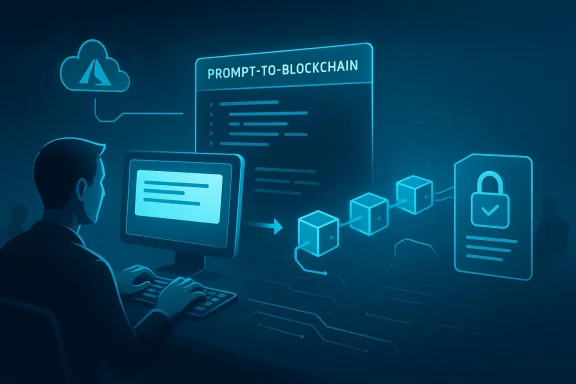 Overview
The Dreamspace story sits at the intersection of three fast-moving trends: the mainstreaming of AI-assisted software creation, the continued push to simplify blockchain development, and Microsoft’s steady expansion of its presence in the tooling layer around both. That combination matters because the hardest part of web3 has never been the marketing. It has been the engineering complexity, security burden, and fragmented environment that developers face before they can ship anything useful. By putting a prompt interface on top of that mess, Dreamspace is trying to turn a specialist workflow into something closer to a guided conversation.The claim that the project is backed by M12, Microsoft’s venture arm, gives the announcement extra weight. M12 previously led a $20 million investment in Space and Time, which makes Dreamspace feel less like a random startup and more like the next step in a longer platform bet. Microsoft’s own Azure AI materials also emphasize that Azure OpenAI is meant to be used alongside other Azure AI services to build more advanced solutions, which fits Dreamspace’s described stack of Azure AI Foundry, Azure OpenAI, and Base.
That said, the most interesting thing about Dreamspace is not that it uses prompts. Plenty of tools do that now. The interesting part is the promise that the generated code remains auditable, and that the platform sits on top of Space and Time’s verifiable data infrastructure. In blockchain, those two concepts are not optional extras; they are the entire trust proposition. A prompt-based builder that cannot explain, inspect, or verify what it produced would simply be a faster way to create risk.
The early adoption claims are also worth treating carefully, but they are still meaningful if accurate. The reported figure of 34,000 apps suggests that Dreamspace has already found a user base that is willing to experiment at scale. The mention of schools in Indonesia using the platform in curriculum settings hints at a different kind of ambition: not just helping professionals ship apps faster, but helping train the next generation of builders through a more approachable interface.
Why the timing matters
Prompt-based building is arriving at the exact moment when both AI software generation and onchain application development are becoming more normalized. That does not mean the problems are solved. It does mean the market is more willing to entertain the idea that software can be assembled from intent, not hand-written from scratch. Dreamspace is arriving into that moment with a clearer enterprise pedigree than many of its rivals.The timing also matters because blockchain developers are still split between power-user tools and mass-market onboarding flows. Existing dev stacks are often powerful but intimidating. Dreamspace appears to be betting that a conversational interface can compress the learning curve without eliminating the underlying rigor. That is precisely the kind of promise that gets attention from both founders and investors.
- Prompt-first creation reduces the intimidation factor for new builders.
- Auditable output helps preserve trust in generated code.
- Microsoft backing may accelerate enterprise credibility.
- Educational adoption could broaden the talent pipeline.
- A familiar cloud stack lowers integration friction.
The Technology Stack
Dreamspace’s reported stack is important because it suggests the platform is not simply a front end for text generation. Instead, it appears to combine Microsoft Azure AI Foundry, Azure OpenAI, and Base into a workflow that can generate, validate, and deploy blockchain applications. That matters because a prompt interface by itself does not solve the hardest parts of software creation. The value comes from the layers underneath it: model access, orchestration, data verification, and chain deployment.Microsoft’s Azure OpenAI materials emphasize that the service is designed to work with the broader Azure AI portfolio. That supports the idea that a company like Dreamspace can build an integrated system rather than a single-purpose generator. In practical terms, that means the builder can use language models for intent translation, Azure services for workflow support, and chain infrastructure for the final application layer.
Base is also an important piece of the story. Base’s own developer documentation positions it as a low-cost Ethereum Layer 2 and provides tooling for appchains, smart wallet flows, and onchain app development. That makes it a logical foundation for a product trying to simplify blockchain creation without abandoning Ethereum compatibility or developer ecosystem benefits. Dreamspace can therefore present itself as easier without being isolated from the broader onchain world.
Why “auditable” matters
The word auditable does a lot of work here. It means the generated code is not meant to be a mysterious black box that users must trust blindly. In blockchain environments, that distinction is critical because users, auditors, and developers often need to inspect logic before funds or state are put at risk. A prompt builder that cannot expose its output for review would quickly become a liability.Auditability also gives Dreamspace a better answer to one of the biggest criticisms of prompt-based development: that it produces demo-ready output but not production-grade systems. If users can trace what was generated, why it was generated, and how it maps to onchain behavior, then the tool becomes much more than a novelty. It becomes a workflow accelerator with governance built in.
- The model layer converts intent into structured application logic.
- The cloud layer provides orchestration and scalability.
- The chain layer handles deployment and execution.
- The verification layer helps reduce blind trust in generated output.
- The audit trail supports compliance and debugging.
Microsoft’s Strategic Role
Microsoft’s role in this story is bigger than a simple investment label. M12 backing signals that the company sees strategic value in the tooling layer around blockchain, not just in the infrastructure that hosts it. That fits a broader pattern we have seen across Microsoft’s cloud and AI portfolio: support the platform stack, then let startups build the user-facing experiences on top of it.That approach makes sense for Microsoft because it lets the company benefit whether the market grows through enterprise experimentation, startup adoption, or educational use. If Dreamspace becomes a preferred way to build onchain apps, Microsoft’s ecosystem gains another point of gravity. If it does not, Microsoft still benefits from visibility into a fast-evolving developer category. Either way, the company is positioned near the center of the conversation.
The M12 connection also helps normalize the idea that blockchain tooling can coexist with enterprise AI tooling. That is not a trivial message. For years, many companies treated crypto and enterprise cloud as culturally separate markets. Dreamspace suggests the opposite: that the same cloud primitives, model tooling, and developer experience principles can power both traditional AI applications and onchain products.
The significance of the M12 history
The earlier $20 million Space and Time investment matters because it establishes continuity. Dreamspace is not a one-off experiment by a team dabbling in buzzwords. It comes from a group that already convinced Microsoft’s venture arm to bet on verifiable data infrastructure for blockchain and AI applications. That prior relationship makes the current launch feel more like an expansion of a strategy than a disconnected startup announcement.It also means the market will likely interpret Dreamspace through a credibility lens. Microsoft-backed products tend to get a different kind of attention than anonymous web3 tools because buyers assume, fairly or not, that enterprise-grade support and cloud discipline are part of the package. That assumption is helpful for adoption, but it also raises expectations.
- Microsoft brings enterprise credibility.
- M12 creates continuity with the Space and Time ecosystem.
- Azure integration strengthens the infrastructure story.
- Developer trust improves when toolchains feel supported.
- Corporate backing can make pilot programs easier to approve.
Prompt-Based Building
The central promise of Dreamspace is that natural language becomes the primary interface for blockchain app creation. That is powerful because it replaces a stack of technical steps with a user goal. Instead of learning the syntax, environment, and contract structure first, users begin by describing what they want the application to do. That changes the psychological barrier to entry immediately.But there is a subtle and important distinction between convenience and competence. Prompting a system to create code does not automatically make the result safe, maintainable, or economically sensible. The best prompt-based builders do not pretend that friction should disappear completely; they shift friction to the places where it is actually useful, such as review, validation, and deployment controls. Dreamspace appears to be aiming for that more mature model.
That matters because blockchain development is notoriously unforgiving. Smart contracts often control assets or enforce immutable business logic, which means a small mistake can have outsized consequences. Dreamspace’s value proposition is therefore not that it removes responsibility from the builder, but that it lowers the skill threshold while preserving traceability. That is a better and more defensible pitch than “just prompt your way to a dapp.”
From idea to deployable app
One reason the product is likely drawing attention is that it promises a relatively direct path from idea to deployment. In the traditional model, a user might need to write smart contracts, configure infrastructure, understand chain-specific requirements, and then launch a front end. Dreamspace collapses much of that into a single conversational flow. The result is a much shorter distance between inspiration and product.That compression could be especially valuable for startups and internal innovation teams. Many promising concepts die not because they are bad, but because the team cannot justify the time and cost of building a proof of concept. If Dreamspace can reliably generate working applications, more ideas may survive long enough to be tested in the market.
- Lower setup overhead.
- Faster proof-of-concept creation.
- Less dependence on scarce blockchain specialists.
- Better accessibility for non-technical founders.
- More experimentation within constrained budgets.
The Security Question
Security is where Dreamspace will be judged most harshly, and that is appropriate. The blockchain sector has seen too many tools that make development easier by making it less accountable. A prompt interface can be wonderful for prototyping, but it can also become a fast lane to insecure contracts if the generation and validation layers are not strong enough. Dreamspace is trying to preempt that critique by emphasizing auditability and verifiable infrastructure.That said, any system that generates code from natural language still has to solve for edge cases, malformed intent, and ambiguous user requirements. Prompting is inherently probabilistic, which means the same request can yield different outcomes depending on the model behavior and surrounding context. In a consumer app, that might be annoying. In a blockchain app, it can be dangerous.
Dreamspace’s use of Space and Time’s verifiable infrastructure is therefore strategically important. If the underlying data layer is trustworthy and the generated application logic can be inspected, users are less likely to mistake speed for safety. That doesn’t eliminate risk, but it does create a more serious foundation than the usual “AI-generated app” demo.
Auditable does not mean safe by default
It is tempting to assume that if code is auditable, it must also be secure. That is not true. Auditability merely means the output can be inspected. Security still depends on whether the generated logic is correct, whether assumptions are stated clearly, and whether the system protects users from bad inputs or dangerous defaults.The upside is that auditable generation gives developers and reviewers a fighting chance. Instead of trying to reverse-engineer opaque output, they can evaluate the result against known standards. That is a substantial improvement over many consumer-facing AI builders, and it is probably one of the reasons Dreamspace sounds more credible than the average no-code hype cycle.
- Generated code still needs human review.
- Smart contract bugs remain high-impact.
- Prompt ambiguity can create unexpected behavior.
- Auditability improves inspection, not immunity.
- Verifiable data layers strengthen trust, but do not replace testing.
Education and Adoption
The reported rollout into schools in Indonesia is perhaps the most intriguing part of the story because it suggests Dreamspace could become a learning platform, not just a production tool. If the company is being used in classrooms, then it is helping students understand blockchain app logic through creation rather than lecture. That is a meaningful shift, especially for emerging markets where practical tooling often matters more than formal theory.Education is also a smart distribution channel. A platform that shows up in curricula can build familiarity long before students enter the labor market. Over time, that can create a pipeline of users who are comfortable with the interface and more willing to try it professionally. The reported figure of more than 140,000 future innovators is therefore less a hard metric than a signal of potential scale.
Still, classroom adoption should not be overread. Schools often pilot new tools for a limited audience, and educational enthusiasm does not always translate into enterprise usage. But even a modest educational footprint can matter because it normalizes the idea that blockchain development is something you can learn through guided building rather than years of specialized study.
Why education could become a moat
If Dreamspace becomes part of how students first encounter onchain development, that could evolve into a moat of familiarity. Users tend to return to the tools they learned with, especially when those tools reduce cognitive load. In that sense, education is not just public good branding; it can be a very practical growth strategy.Educational use also tests whether the platform is genuinely approachable. A product that can support beginners without constant hand-holding is often a product that has strong product-market fit. If the interface only works for power users, classroom adoption will expose that quickly.
- Classroom use builds early familiarity.
- Student adoption can seed long-term professional usage.
- Education validates usability under simpler conditions.
- Curriculum integration can boost credibility.
- Early exposure may widen the pool of blockchain builders.
Competitive Implications
Dreamspace is entering a crowded and competitive space where many vendors are trying to make software creation feel more conversational. But most products in that category are not backed by a combination of Microsoft cloud infrastructure, blockchain-native verification, and a team already associated with Space and Time. That differentiation may matter more than raw feature count.The competition is not just among blockchain startups. It also includes no-code platforms, AI app builders, and cloud vendors that are trying to own more of the development workflow. Dreamspace’s advantage is that it narrows the gap between idea and auditable onchain deployment, which is still a difficult niche to serve well. If it succeeds, rivals will have to answer not only with better prompts, but with stronger trust guarantees.
There is also a broader market implication: Dreamspace could help validate the thesis that blockchain development is becoming a design problem as much as a coding problem. That may sound abstract, but it is actually a major shift. The best tools in this space will likely be the ones that let people think in terms of outcomes and constraints rather than low-level contract syntax.
Who is most exposed
The most exposed competitors are likely the ones that rely on complexity as a moat. If a product is difficult to use but technically powerful, a prompt-first interface with credible security controls can be very disruptive. Conversely, products that are already simplifying onchain workflows may need to move faster to keep pace with the UX expectations Dreamspace could create.This does not mean the market will consolidate overnight. It means differentiation will increasingly depend on workflow confidence, not just generation quality. Users will care about whether the tool can produce something useful, understandable, and deployable without endless manual cleanup.
- No-code builders face pressure on blockchain-specific trust.
- Smart contract tooling must become more approachable.
- Enterprise buyers will expect verification, not just speed.
- Education-focused platforms may gain early mindshare.
- Developer ecosystems that integrate with major clouds may win trust faster.
Strengths and Opportunities
Dreamspace’s biggest strengths are its combination of simplicity, credibility, and infrastructure depth. It does not present itself as a toy generator; it presents itself as a way to build serious onchain applications faster. That positioning gives it room to appeal to beginners, educators, and professional teams at the same time.It also has several clear opportunities if the product matures as described. The company could expand into education, startup prototyping, internal innovation, and even enterprise workflow automation around blockchain. The more the platform can reduce onboarding friction without sacrificing transparency, the more use cases become viable.
- Strong Microsoft ecosystem association
- Clear educational adoption pathway
- Lower barriers for non-technical founders
- Faster prototyping for web3 teams
- Auditable output supports trust and review
- Verifiable data layer improves credibility
- Potential to become a standard entry point for onchain development
Risks and Concerns
The biggest risk is that the platform promises more than its validation pipeline can reliably deliver. Prompt-based systems are only as useful as their guardrails, and blockchain makes the consequences of mistakes unusually severe. If users create code they cannot fully understand or safely deploy, trust could evaporate quickly.There is also the risk of overreading the adoption numbers and educational rollout. Thousands of generated apps do not automatically translate into durable production usage, and classroom pilots do not guarantee market traction. Dreamspace will need to prove that its ease of use holds up beyond the demo phase.
- Generated apps may still require substantial manual correction
- Security issues could undermine confidence
- Education pilots may not scale into real adoption
- Microsoft association raises expectations
- Competitive responses could arrive quickly
- Blockchain fragmentation remains a persistent integration challenge
- Prompt ambiguity may create inconsistent outputs
Looking Ahead
If Dreamspace succeeds, the most important change may not be that more people build blockchain apps. It may be that the definition of who counts as a blockchain developer changes. Natural language interfaces can bring in founders, students, product managers, and analysts who would otherwise never touch smart contract tooling. That broadening of the builder base could be more important than any single feature.The next phase to watch is whether the platform can convert early excitement into repeatable, secure production workflows. That will depend on how well it handles code review, deployment confidence, and chain-specific complexity under real-world pressure. It will also depend on whether Microsoft’s ecosystem support remains visible enough to reassure serious buyers without making the product feel overly corporate.
What to watch next:
- Whether Dreamspace expands beyond beta-scale experimentation
- Whether schools and training programs keep adopting it
- Whether the platform publishes more details on auditability and security controls
- Whether Space and Time positions Dreamspace as part of a larger product suite
- Whether rival no-code and web3 tools respond with similar prompt-based builders
Source: CCN.com Space and Time Team Launches Microsoft-Backed Dreamspace, Streamlining Blockchain App Development with Prompt-Based Interface
