

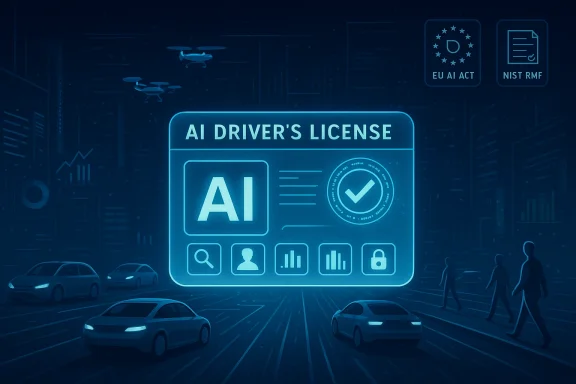
PressReader's recent republication of a Santa Fe New Mexican piece framing the idea of a “driver’s license for AI” has crystallized a deceptively simple question into a policy battleground: what would it mean — technically, legally, and socially — to credential artificial intelligence systems or their operators the way we credential human drivers?
The metaphor of a driver’s license for AI is powerful because it compresses several policy goals into a familiar image: establish standards, verify competence, enable enforcement, and tie legal responsibility to a credential. But AI systems today are not people and they are not cars; they are software artifacts that can be updated hourly, composed of third‑party models and data, and shipped across borders in milliseconds. Translating a licensing metaphor into practical governance requires careful parsing of the functions people intend to achieve.
Policymakers and standards bodies are already grappling with related problems. The European Union’s AI Act creates a tiered regulatory approach that requires high‑risk AI systems to undergo conformity assessments and registry listing before market placement, while applying transparency obligations to many generative systems. This is not a license in the driver’s‑license sense, but it does require third‑party assessment and ongoing oversight for classed systems.
In the United States, standardization and voluntary frameworks are the primary tools so far. The National Institute of Standards and Technology (NIST) published the AI Risk Management Framework (AI RMF) to guide organizations on how to identify, assess, and manage AI risk. The RMF emphasizes a risk‑based, voluntary path to trustworthy AI — a building block for any future certification or mandatory program.
On the private sector side, companies and vendors have begun marketing validation services and certification programs that use the “driver’s‑license” metaphor to signal real‑world credibility — for example, an autonomous‑vehicle data company pitching an APEX evaluation as a “Driver’s License for AI” to validate autonomy stacks against billions of miles of ground‑truth data. Training vendors likewise sell “AI Driver’s License” certificates as compliance aids for EU AI Act obligations. These commercial offerings foreshadow what a formal credentialing ecosystem might look like: testbeds, audits, certificates, and ongoing monitoring.
We already have pieces of the infrastructure needed: the EU’s legal scaffolding for high‑risk AI, NIST’s AI RMF for risk‑based governance, provenance technologies like C2PA and vendor watermarking, and industry testbeds for mobility and other domains. The challenge now is to stitch these elements into interoperable, proportionate systems that protect the public without suffocating innovation.
For IT leaders and vendors, the prudent course is to prepare today: document, test, and instrument. For policymakers, the road ahead should be paved with proportionality, accredited capacity, and international alignment. Done right, credentialing can raise the floor for safety and trust; done wrong, it risks producing the worst of both worlds — expensive barriers to entry and hollow seals of approval that lull the public into complacency.
The metaphor will remain useful if we remember that, ultimately, the goal is not a license itself but a reliable system that ensures AI systems and their operators can be trusted when the stakes are high.
Source: PressReader PressReader.com - Digital Newspaper & Magazine Subscriptions
 Background / Overview
The metaphor of a driver’s license for AI is powerful because it compresses several policy goals into a familiar image: establish standards, verify competence, enable enforcement, and tie legal responsibility to a credential. But AI systems today are not people and they are not cars; they are software artifacts that can be updated hourly, composed of third‑party models and data, and shipped across borders in milliseconds. Translating a licensing metaphor into practical governance requires careful parsing of the functions people intend to achieve.Policymakers and standards bodies are already grappling with related problems. The European Union’s AI Act creates a tiered regulatory approach that requires high‑risk AI systems to undergo conformity assessments and registry listing before market placement, while applying transparency obligations to many generative systems. This is not a license in the driver’s‑license sense, but it does require third‑party assessment and ongoing oversight for classed systems.
In the United States, standardization and voluntary frameworks are the primary tools so far. The National Institute of Standards and Technology (NIST) published the AI Risk Management Framework (AI RMF) to guide organizations on how to identify, assess, and manage AI risk. The RMF emphasizes a risk‑based, voluntary path to trustworthy AI — a building block for any future certification or mandatory program.
On the private sector side, companies and vendors have begun marketing validation services and certification programs that use the “driver’s‑license” metaphor to signal real‑world credibility — for example, an autonomous‑vehicle data company pitching an APEX evaluation as a “Driver’s License for AI” to validate autonomy stacks against billions of miles of ground‑truth data. Training vendors likewise sell “AI Driver’s License” certificates as compliance aids for EU AI Act obligations. These commercial offerings foreshadow what a formal credentialing ecosystem might look like: testbeds, audits, certificates, and ongoing monitoring.
What people mean by a “driver’s license for AI”
The headline metaphor collapses at least four distinct regulatory constructs that could each be developed independently:- Model certification (conformity assessment): a formal audit and approval that an AI model meets defined safety, robustness, and transparency standards before it is deployed in specific contexts. This resembles product conformity checks in regulated industries and is already present in the EU AI Act for high‑risk systems.
- Operator licensing: credentialing the individuals or organizations that run or supervise AI systems. This would be similar to requiring a licensed driver or a certified technician to operate certain vehicles or medical devices.
- Provenance and content credentials: attaching verifiable metadata or digital signatures to AI outputs to prove their origin and development path — the “passport” or “ID card” for outputs. Technologies such as C2PA and vendor watermarking (for example, Google’s SynthID plus C2PA content credentials) are early industry responses to provenance demands.
- Ongoing monitoring and recertification: a license is not a one‑time event. A meaningful AI credential would require continuous oversight, audits, telemetry collection, and the ability to revoke or suspend certification as risk profiles change.
Why regulators and companies are converging on credentialing
There are three strong drivers pushing governments and industry toward credentials, registries, and formal assessments.- Risk containment and public trust. As AI systems move into safety‑critical domains—healthcare, transportation, employment decisions, border control—regulators see the need to reduce harms through pre‑market evaluation and post‑market surveillance. The EU AI Act already treats many such systems as “high‑risk” and requires assessment.
- Operational transparency and accountability. Provenance metadata and content credentials make outputs traceable and support redress. Governments and large platforms are under pressure to ensure that deepfakes, disinformation, and biased decisions can be attributed and audited. Industry tools that embed content credentials are practical, if partial, solutions.
- Market differentiation and liability management. Vendors want a way to signal product quality and limit liability. A certification framework — whether voluntary or mandated — becomes a marketable attribute. At the same time, firms and insurers increasingly require demonstrable compliance steps (testing, documentation, monitoring) to underwrite AI deployments.
How a credible credentialing system could be built: a pragmatic, risk‑based design
If policymakers decide to pursue an AI credentialing regime, the system should be engineered around four principles: risk‑based scope, technical verifiability, scalability, and proportionality.1) Tiered, risk‑based scope
Not every model or use case must be licensed. Use‑case risk should determine the level of scrutiny.- Low‑risk, consumer‑facing chatbots: transparency and labeling obligations may suffice.
- Medium‑risk systems (financial lending decisions, workplace monitoring): independent audits and vendor attestations would be appropriate.
- High‑risk systems (autonomy in public roads, medical diagnostics, law enforcement): full conformity assessment, public registry entry, and ongoing TEVV (testing, evaluation, verification, validation) must apply. The EU AI Act already follows this pattern and provides machinery for conformity checks in high‑risk categories.
2) Technical verifiability: testbeds, benchmarks, and real‑world validation
Licensing should rest on verifiable technical evidence, not on hand‑waving paperwork.- Standardized test suites and benchmarks for known failure modes (robustness to distribution shift, adversarial examples, bias metrics).
- Real‑world validation using representative field data and scenario testing. Private initiatives such as large driving‑data testbeds show how vendors can operationalize this for autonomy stacks.
- Transparency dossiers: standardized documentation packages describing model architecture, training data provenance, evaluation results, and operational safety measures.
3) Continuous monitoring and telemetry
Because AI models change during updates or through fine‑tuning, certifications must be dynamic.- Versioned certification: each materially different model version receives its own assessment.
- Continuous monitoring: telemetry and incident reporting feed a regulator or a third‑party monitor to detect drift, new biases, or safety regressions.
- Revocation and remediation: clear authority and processes to suspend or revoke certification and require corrective actions.
4) Distributed audit ecosystem
Centralized testing alone cannot scale. A hybrid approach is needed:- Accredited auditing labs: independent conformity assessors, accredited by a central authority, perform technical audits.
- Open‑source and community testing: encourage reproducible, third‑party challenges to surface blind spots.
- Regulatory sandboxes: controlled environments for novel AI services to be trialed under supervision.
Benefits: what a properly designed credential can deliver
- Safer deployments: Robust pre‑deployment testing reduces catastrophic failures in high‑risk domains.
- Clearer liability lines: Certification clarifies due diligence and can simplify legal responsibility assessment between vendors, integrators, and operators.
- Market trust: Verified credentials become signals that reduce buyer uncertainty and enable procurement standards.
- Auditability and forensic capacity: Provenance systems and registries make it easier to investigate incidents and enforce remediation.
- International compatibility: Shared frameworks (e.g., NIST AI RMF) facilitate cross‑border recognition if aligned with other jurisdictions’ regimes.
Risks and failure modes: why a license could be worse than none
While the benefits are real, poorly designed licensing regimes can create perverse and dangerous outcomes.- Regulatory capture and vendor lock‑in. If licensing criteria are shaped by dominant vendors (or if accredited test labs are vendor‑aligned), new entrants and open‑source projects can be locked out of markets — reducing competition and increasing systemic risk.
- False sense of security. A certification is only as good as its tests. Static certificates that don’t reflect operational drift can mislead buyers and regulators into over‑reliance on an outdated stamp of approval.
- Gaming and adversarial behavior. Developers might train models to perform well on known test suites while remaining vulnerable in the wild — the classic “teaching to the test” problem that plagues many regulated testing regimes.
- Enforcement complexity. Software distribution is global; enforcing a national license against cross‑border model providers is legally and technically fraught.
- Privacy and trade secrecy tensions. Effective audits require access to training data and model internals — information vendors may legitimately guard for IP or privacy reasons. Reconciling transparency with proprietary protection is non‑trivial.
- Cost and scalability. High‑quality, continuous TEVV is expensive. Applying heavy certification burdens across the board risks choking innovation and excluding small players.
Implementation challenges: technical and legal specifics
Certification scope and thresholds
Defining what gets certified — the model, the pipeline, the service, or the organization — is foundational. Certifying models alone ignores operational context; certifying organizations ignores model performance variance. A pragmatic approach layers model certification with operational attestations.Standardization of metrics
Regulators must decide which technical metrics matter and how to measure them reproducibly: fairness definitions, distributional robustness, falsification tests, throughput/latency constraints for safety‑critical applications. The NIST AI RMF provides a conceptual scaffold but does not prescribe a single metric set; that gap must be filled by standards bodies and sectoral regulators.Data access for audits
Independent audits need access to representative training and evaluation data. Frameworks for trusted data sharing (secure enclaves, privacy‑protecting computation, synthetic proxies) will be necessary to balance provenance with IP and privacy.Cross‑border recognition and equivalence
If the EU requires conformity and the U.S. relies on voluntary frameworks, companies will face duplicative regimes. Harmonization mechanisms — mutual recognition agreements and shared standards — are essential to avoid fragmentation.Whose license? People, models, or platforms?
Licensing a human operator (like a driver) is easier to conceptualize than licensing a model that is constantly updated by a third party. A hybrid regime that licenses platform operators (companies deploying systems in public roles) while requiring model suppliers to publish provenance and pass technical evaluations may be a practical compromise.A phased roadmap: how to avoid the worst outcomes
- Start with high‑risk sectors. Require conformity assessments for AI systems used in transportation, healthcare, law enforcement, and critical infrastructure — following the EU’s lead — rather than a blanket licensing regime.
- Build robust voluntary standards and testbeds. Fund and standardize TEVV testbeds and benchmarks (publicly accessible, reproducible) guided by NIST and international partners to create a level playing field.
- Accredit independent auditors. Establish an accreditation body to accredit labs and auditors who can perform technical conformity checks and sustain continuous monitoring.
- Deploy provenance systems early. Mandate machine‑readable provenance and content credentials for channels where authenticity matters (e.g., public information channels, critical decision support). Industry solutions are emerging now; regulators should set minimum metadata expectations and verification norms.
- Create registries and incident reporting. Maintain public registries for certified high‑risk systems, and require standardized incident reporting to enable post‑market surveillance and lessons learned.
- Pilot operator licensing where necessary. In contexts where human control matters — e.g., remote supervisors of robo‑taxis, or clinicians using AI diagnostics — pilot operator credentialing programs that emphasize training, recertification, and accountability.
- Preserve innovation pathways. Use regulatory sandboxes, exemptions for research, and proportional fees so small innovators can participate without being priced out.
Analogies and lessons from regulated industries
- Automotive safety testing combines lab crash tests, in‑field inspections, and manufacturer self‑certification; it demonstrates the need for multiple assessment modalities rather than a single stamp.
- Medical device regulation uses a risk‑class approach, pre‑market approval for high‑risk devices, and post‑market surveillance — an instructive parallel for life‑impacting AI.
- Financial regulation shows the importance of disclosure, independent audits, and stress testing, but also the cost and complexity of enforcement across international markets.
Practical recommendations for IT leaders, vendors, and policymakers
- IT leaders should adopt the NIST AI RMF practices now: document risk assessments, maintain audit trails, and build telemetry pipelines that can support audits and incident response. NIST’s RMF resources and playbooks are immediately actionable tools.
- Vendors should invest in reproducible testing artifacts and provenance tooling: versioned model cards, training‑data manifests, and signed content credentials will become procurement requirements quickly.
- Policymakers should prefer tiered obligations over one‑size‑fits‑all licensing, focus first on high‑impact domains, and enable accredited third‑party testing infrastructure rather than building monolithic state testing labs.
- Civil society and researchers must be funded to run independent tests and to participate in the accreditation ecosystem as an integrity check against industry capture.
The verdict: a license is plausible — but only with careful engineering
The idea of a driver’s license for AI captures a legitimate appetite for safety, accountability, and public assurance. However, the metaphor is also a trap if taken too literally: AI is not a single, constant entity you can test once and forget. A credible credentialing regime must be dynamic, risk‑based, and technically rigorous, combining pre‑market conformity assessment, continuous monitoring, credible provenance, and accessible redress.We already have pieces of the infrastructure needed: the EU’s legal scaffolding for high‑risk AI, NIST’s AI RMF for risk‑based governance, provenance technologies like C2PA and vendor watermarking, and industry testbeds for mobility and other domains. The challenge now is to stitch these elements into interoperable, proportionate systems that protect the public without suffocating innovation.
Conclusion
A “driver’s license for AI” is an evocative shorthand for a complex governance architecture that must balance safety, transparency, competition, and innovation. Policymakers can use the metaphor to sell audiences on the need for rules, but they must avoid the simplicity the phrase implies. The future of AI governance will not be a single card or database; it will be an ecosystem of standards, accredited auditors, registries, provenance signals, and continuous oversight — all operating on a risk‑based logic.For IT leaders and vendors, the prudent course is to prepare today: document, test, and instrument. For policymakers, the road ahead should be paved with proportionality, accredited capacity, and international alignment. Done right, credentialing can raise the floor for safety and trust; done wrong, it risks producing the worst of both worlds — expensive barriers to entry and hollow seals of approval that lull the public into complacency.
The metaphor will remain useful if we remember that, ultimately, the goal is not a license itself but a reliable system that ensures AI systems and their operators can be trusted when the stakes are high.
Source: PressReader PressReader.com - Digital Newspaper & Magazine Subscriptions
