

Durham University’s recent move to permit staff to explore generative AI tools in summative marking has accelerated a debate that universities across the UK are only just beginning to have in public: can algorithmic assistants improve consistency and efficiency in assessment without eroding academic judgement, fairness, or regulatory compliance? The announcement—reported by student paper Palatinate and reflected in Durham’s own guidance on generative AI—signals a pragmatic, risk-aware institutional approach that empowers departments to adapt locally while remaining accountable to sector-wide rules and the requirements of regulators.
The change arrives at a time when universities are under intense pressure to both grow research income and cut costs, and when the UK Government has positioned regions such as the North East as AI growth hubs—an ecosystem-level shift that makes institutional engagement with AI more than an academic question. Durham’s own research investments, notably the Leverhulme Centre for Algorithmic Life (CAL), underline how institutional ambition for AI research and regional economic participation can interact with operational adoption across teaching and administration.
If departments adopt these safeguards, Durham can become a model for how research‑led institutions integrate AI into assessment responsibly—delivering efficiencies where appropriate while keeping academic standards and student trust firmly intact.
Source: palatinate.org.uk Durham University staff permitted to use GenAI in summative marking - Palatinate
 Background
What changed at Durham, and why it matters
Durham’s internal policy framework now explicitly allows staff to explore using generative AI as a support tool in marking—as long as it does not replace academic judgement and its use is transparent to students. This aligns with a growing consensus among research-intensive universities that managed, explainable use of AI is preferable to outright bans, particularly as the technology becomes embedded in workplace practice. Durham’s approach emphasizes local departmental discretion, requiring departments to produce clear, assignment-level guidance for students so expectations remain consistent.The change arrives at a time when universities are under intense pressure to both grow research income and cut costs, and when the UK Government has positioned regions such as the North East as AI growth hubs—an ecosystem-level shift that makes institutional engagement with AI more than an academic question. Durham’s own research investments, notably the Leverhulme Centre for Algorithmic Life (CAL), underline how institutional ambition for AI research and regional economic participation can interact with operational adoption across teaching and administration.
Overview: the policy landscape Durham is navigating
National regulation and regulator expectations
The UK regulator Ofqual has been clear that AI cannot serve as the sole or primary marker for regulated, high‑stakes qualifications: human academic judgement remains a regulatory cornerstone. Working papers and guidance from government highlight that AI can play roles in quality assurance, trainee marker support, or to flag atypical responses, but not to replace trained assessors. Any move to incorporate AI into summative marking must therefore ensure transparency, traceability, and robust human oversight.Sector principles and institutional alignment
Durham’s policy language echoes the Russell Group principles on generative AI in education—principles that call for improving AI literacy, adapting teaching and assessment practices, and upholding academic rigour. Those principles are now widely referenced across UK universities as the baseline ethical framework for integrating AI. By encouraging departments to develop local rules based on a university-wide framework, Durham intends to square sector-level aspirations with program-level realities.Durham’s research and strategic context
Durham has invested heavily in scholarly study of algorithmic life and AI governance through CAL and related initiatives, reinforcing the message that the university sees both the promise and the societal risks of algorithmic systems as legitimate objects of institutional stewardship. The university has publicly framed AI as a lever to transform research, teaching, and operational efficiency while stressing the need for governance and annual review of its policy framework. That research capacity can be a strength, but it also raises expectations that the university will apply best-practice safeguards when piloting AI in assessment and other high-stakes processes.What Durham’s permissive stance actually permits — and what it forbids
Explicit permissions and limits
- Staff may explore the potential of generative AI to assist marking workflows; they may not delegate the final academic judgement to a model. This is the fundamental line Durham draws between support and replacement.
- Departments retain responsibility to develop local, course- or assignment-specific policies that explain to students what kinds of AI use are permitted and how any AI contribution will be recorded and assessed. This means variation across the institution is expected and allowed.
Where the red lines lie
- Using AI as the primary marker for regulated, high-stakes outcomes would run counter to Ofqual guidance and Durham’s own framework; any use of algorithmic outputs must be audited and accompanied by human validation.
- Any adoption must respect data protection and privacy obligations—especially when staff upload student work into third‑party services. Microsoft’s enterprise Copilot claims “enterprise data protection” and says tenant (Entra ID) users’ content is not used to train its public models, but this does not eliminate all privacy, contractual, or governance liabilities for universities and staff. Institutional IT and legal teams must still set clear guardrails.
How this will play out in practice: departmental variation and the operational pipework
Why departments will diverge
Durham’s framework intentionally gives departments authority to set local rules because assessment tasks differ dramatically by discipline. A seminar‑style, discursive essay in Philosophy involves different learning outcomes and cheating risks than a numeric problem set in Accounting, or an interpretive assignment in Geography. That is likely why some departments reportedly permit AI-assisted marking while others have banned it outright. Local autonomy increases pedagogical fit, but it also raises fairness and communication challenges across students and staff.Practical controls departments should adopt
- Define scope: specify which assessments and which parts of the marking workflow may use AI.
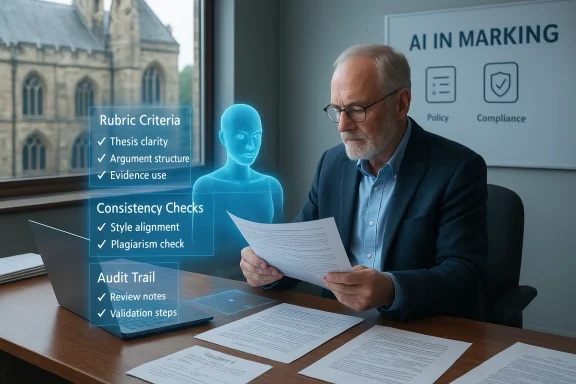
- Disclosure: require markers to log what tools they used, when, and how outputs were validated.
- Training: provide staff with AI‑literacy sessions and vendor‑specific guidance (e.g., Microsoft Copilot data protections and limitations).
- Audit trails: maintain records of prompts, model outputs, and human adjustments to allow post‑hoc review.
- Student communication: publish assignment‑level rules and explain how AI inputs will affect marking and feedback.
The benefits Durham and its departments are explicitly chasing
- Improved consistency: AI can standardize routine scoring elements and flag outliers for moderator attention. This could reduce intra‑marker variability on tasks with objective criteria.
- Efficiency gains: administrative pilots of Microsoft Copilot in public bodies have reported measurable time savings; universities hope similar gains can free up staff time for pedagogy and research. Those potential savings are politically attractive in a climate of financial pressure.
- Enhanced training and QA: AI can serve as a training aid for junior markers, offering suggested rationales or highlighting examples during standardisation exercises. This is a lower‑risk entry point than automated marking.
The risks — technical, ethical and regulatory
Hallucinations and capability unpredictability
Large language models can produce fluent but inaccurate outputs—so‑called hallucinations—and their capabilities can be unpredictable in ways that are hard to foresee until a tool is run at scale on real inputs. For marking, a hallucination could mean that an AI suggests a rationale or cites a source that does not exist, which could mislead a marker or introduce an unjustified uplift or penalty in a student’s grade. Robust human review is therefore essential; treating AI outputs as probabilistic suggestions rather than authoritative judgements is non‑negotiable.Fairness, bias and equality of access
AI systems inherit biases from training data and retrieval sources; they may differentially affect the assessment of students from under‑represented backgrounds or whose responses fall outside the majority training distribution. Departments must evaluate whether AI‑assisted marking amplifies existing inequities and ensure that adjustments or calibrations are inspected for disparate impacts. This is not only ethical practice but an institutional legal obligation under equality and non‑discrimination frameworks.Data protection, contracts and outsourcing risk
Even where enterprise Copilot configurations say tenant data will not be used to train public models, uploading student coursework to third‑party services creates a surface for accidental leakage, retention, or exposure. Universities are data controllers in respect of student information and must ensure vendor agreements, retention policies, and technical controls are robust. Microsoft’s privacy documentation explains the conditions under which enterprise data is excluded from training, but operational mistakes (misconfigured tenants, accidental sign‑ins with non‑enterprise accounts) can still expose data.Reputational and pedagogic risk
If students come to believe that their work is being judged primarily by machines, trust in the assessment system may erode. If AI is used poorly and produces inconsistent outcomes, the university risks grade inflation, student complaints, and a loss of public confidence—an especially important risk for research‑intensive institutions that trade on academic credibility. Clear, student‑facing communication and transparent governance are essential mitigations.Regulatory non‑compliance risk
For regulated vocational and professional qualifications, Ofqual and other regulators currently require human‑based academic judgement in marking decisions. Universities must therefore ensure that any AI use in summative assessment for such qualifications conforms to regulator guidance and that audit evidence proving human oversight is available for inspection. Failure here could invalidate awarding processes or invite sanctions.A practical checklist for Durham departments considering AI-assisted marking
- Confirm scope: is the assessment regulated or high-stakes? If yes, do not use AI as primary marker.
- Consult IT and legal: validate vendor data protections, contract terms, and retention windows before any data uploads.
- Pilot transparently: run small, well-documented pilots focused on efficiency, QA, or training roles—never full substitution.
- Publish student guidance: tell students what is and is not allowed and how AI was used in marking.
- Maintain audit trails: preserve prompts, AI outputs, and human corrections for at least the retention period required by university policy.
- Monitor equity outcomes: collect data to check for adverse impacts across student demographics and adjust practice if biases appear.
Where the evidence is strong — and where it’s thin
Supported by multiple, independent sources
- The regulatory principle that AI should not act as the sole or primary marker for high‑stakes qualifications is well established in Ofqual’s work and government papers.
- Microsoft’s enterprise Copilot documentation does state that organizational Entra ID users’ content is excluded from model training, and it provides controls for data governance; but that does not eliminate operational risk.
- The Russell Group’s education principles provide a sectoral consensus supporting AI literacy, adaptation of assessment, and academic integrity.
Areas to treat with caution or as unverified
- Reports that Copilot Chat is already made fully available to every Durham user were made in reporting seen in the student press; however, institution‑level IT bulletins or formal Durham communications with full technical rollout and license details should be checked before relying on that as a fact. Where university communications conflict with press coverage, the institutional IT policy and announcements should be treated as authoritative. I was unable to locate an official Durham IT notice that exactly matches some of the press claims about immediate, universal access to Copilot Chat; departments and staff should therefore verify the service and licence terms directly with central IT.
The staff-costs question: automation vs. academic labour
One part of the university’s strategic calculus is explicit: Durham has identified financial pressures and a need for higher research income, and it sees AI as a productivity lever that can help achieve those institutional targets. While productivity tools may legitimately free academic time from routine administration, there is a clear labour‑market and pedagogic trade-off: over‑reliance on automation risks deskilling, reduces opportunities for marker apprenticeship, and may compress the human mentorship component of assessment that underpins disciplinary norms. Any efficiency gains should therefore be reinvested into quality assurance, staff development, and student support rather than simply being counted as headcount reductions.Four scenarios Durham should plan for
- Conservative adoption: AI used only for non‑binding QA checks and marker training; no student‑facing change. Low efficiency gain, low risk.
- Targeted augmentation: AI assists in drafting feedback templates, ranks submissions for moderation, or flags anomalies; humans retain final marks. Medium gains, medium risk—good for scaling without regulatory exposure.
- Hybrid automation: AI handles first‑pass marking for clearly‑defined, low‑stakes components (e.g., formulaic questions); human moderation is the norm. Higher gains, higher governance needs.
- Overreach: AI used as primary marker on summative assessments. This would likely contravene regulator expectations and is therefore not a safe option today.
Recommendations — what Durham (and similar universities) should do next
- Strengthen governance: central guidance must require departmental policies to include audit trails, equality monitoring, and IT‑approved vendor terms.
- Invest in literacy: mandatory, role‑specific AI training for markers and module convenors so staff understand hallucination, bias, prompt engineering, and vendor guarantees.
- Run rigorous pilots with independent evaluation: design pilots that compare outcomes, marker time, and fairness metrics against control cohorts; publish results.
- Preserve human apprenticeship: use efficiency gains to expand marker training programmes, not just reduce costs. This preserves academic expertise and mitigates long‑term risk.
Conclusion
Durham University’s policy shift to permit staff to explore generative AI in summative marking is realistic and forward‑looking—but it is not an invitation to automation without oversight. The balance Durham seeks—between leveraging productivity tools like Microsoft Copilot and protecting academic judgement, fairness, and regulatory compliance—is the same delicate trade‑off every university must manage in 2026. The institutional strengths Durham brings to this task—investment in interdisciplinary AI research through CAL, clear university‑level frameworks, and an intention to review policy annually—are valuable assets. But success will depend on disciplined, transparent pilots; robust data governance; systematic equity monitoring; and, above all, preserving the human expertise that remains central to credible university assessment.If departments adopt these safeguards, Durham can become a model for how research‑led institutions integrate AI into assessment responsibly—delivering efficiencies where appropriate while keeping academic standards and student trust firmly intact.
Source: palatinate.org.uk Durham University staff permitted to use GenAI in summative marking - Palatinate
