

The Dutch public is now far more familiar with generative AI assistants than a year ago, with ChatGPT remaining the top-known name while Google’s Gemini shows the fastest awareness growth — a pattern Telecompaper’s Dutch Consumer AI Monitor (Q4 2025) captures in a detailed, demographic-fractured snapshot that matters for companies, IT teams, regulators and educators.
Telecompaper’s Consumer AI Monitor for Q4 2025 surveys Dutch adults (ages 16–80) during October and November to measure awareness, actual use, paid subscriptions and frequency for six named AI tools: ChatGPT, Microsoft Copilot, Google Gemini, Claude (Anthropic), Perplexity and LeChat (Mistral). The report drills deeper into ChatGPT, Copilot and Gemini — reporting not just familiarity but active usage, subscription behaviour and demographic splits by gender, age, education and work situation (including company size).
This report is valuable because awareness is an upstream signal for adoption and habit formation, but Telecompaper is careful: awareness does not equal active use or enterprise penetration. The survey summary highlights headline recognition figures while also noting that where base sizes are small (for less-used tools) the results must be treated with caution.
Source: Telecompaper Telecompaper
 Background
Telecompaper’s Consumer AI Monitor for Q4 2025 surveys Dutch adults (ages 16–80) during October and November to measure awareness, actual use, paid subscriptions and frequency for six named AI tools: ChatGPT, Microsoft Copilot, Google Gemini, Claude (Anthropic), Perplexity and LeChat (Mistral). The report drills deeper into ChatGPT, Copilot and Gemini — reporting not just familiarity but active usage, subscription behaviour and demographic splits by gender, age, education and work situation (including company size).This report is valuable because awareness is an upstream signal for adoption and habit formation, but Telecompaper is careful: awareness does not equal active use or enterprise penetration. The survey summary highlights headline recognition figures while also noting that where base sizes are small (for less-used tools) the results must be treated with caution.
Overview: what the Dutch snapshot shows
- ChatGPT remains the most widely recognised assistant among Dutch respondents, with a clear awareness lead across many demographic slices.
- Google Gemini is the fastest-growing name in awareness between mid-2025 and Q4 2025, driven by distribution and in-product integration.
- Microsoft Copilot has significant workplace traction, owing to deep embedding in Microsoft 365 and Windows — a different adoption vector compared with consumer‑first apps.
- Smaller or specialist assistants (Claude, Perplexity, LeChat) show far lower raw awareness but play niche roles: research-first, privacy/enterprise-aware, or multimodal specialist tools.
Familiarity and demographic divides
Key awareness figures and growth
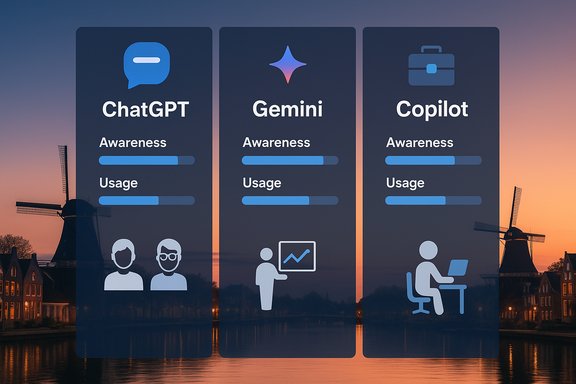
Telecompaper’s summary reports the clear ranking: ChatGPT leads in awareness, with Gemini and Copilot following — the report highlights roughly ChatGPT ~65%, Gemini ~32%, and Copilot ~28% familiarity among Dutch adults in Q4 2025. These headline numbers are directional: they shine a light on the name-recognition landscape that precedes trial and habitual use.Who knows what — demographic patterns
- Age: Younger cohorts show notably higher awareness and active use; older adults and pension-age groups lag significantly. This suggests the diffusion curve for assistants is still concentrated among digitally engaged generations.
- Education: Higher-educated respondents report greater familiarity and subscription rates, implying early commercial uptake among knowledge workers and students.
- Work situation & company size: Larger companies and users on Microsoft 365/Google Workspace platforms report more Copilot or Gemini interactions, respectively — the platform footprint matters for in‑work adoption.
Actual use: who uses ChatGPT, Copilot and Gemini — and how often
Telecompaper separates awareness from active usage. For the three leading names it examines frequency (daily/weekly/monthly), paid subscriptions, and primary use cases.ChatGPT: the generalist habit
- ChatGPT continues to be the most commonly recognised and used assistant in consumer contexts, prized for drafting, ideation, coding help and long-form writing tasks. Telecompaper’s snapshot places ChatGPT at the top for awareness and widespread consumer trial.
- Frequency: a sizable subset of ChatGPT-aware users report weekly or daily use; paid tiers (Plus/Pro/business) attract power users and professionals who need higher throughput or enterprise controls.
Google Gemini: rapid growth through distribution
- Gemini’s awareness is the fastest-growing, largely because Google surfaces Gemini inside Search, Gmail, Docs, Drive and Android surfaces — in‑product hooks that make trial frictionless and frequent. The Telecompaper monitor underscores distribution as Gemini’s primary growth engine.
- Frequency and subscriptions: Gemini converts many trials into short, frequent interactions (search-side assistance, quick image edits). Premium bundles like Google One AI/Gemini Advanced are commonly positioned at consumer price points comparable to rival premium assistants.
Microsoft Copilot: enterprise-first adoption
- Copilot’s adoption path is distinct: deep embed in Windows, Edge and Microsoft 365 drives enterprise and workplace usage rather than pure consumer mindshare. Telecompaper’s data show Copilot awareness skewed toward people working in organisations that use Microsoft’s ecosystem, and adoption increases with company size.
- Frequency: Copilot’s daily/weekly use is meaningful inside workplaces that permit it; subscription and commercial licensing often sit under organisational purchases rather than direct consumer payments.
What people use AI for — common use cases
Telecompaper’s monitor and corroborating industry snapshots reveal a consistent set of consumer and worker tasks where assistants are now routine:- Quick research and information gathering — the most frequent task in consumer-facing surveys.
- Writing, editing and drafting emails, reports and social posts — an everyday productivity boost for many users.
- Creative ideation and brainstorming — prompts, story starters and visual editing tasks.
- Translation and language assistance — though specialist tools like DeepL remain popular for professional-grade translation.
- Research-backed answers and citation-aware tasks — where tools like Perplexity and enterprise-grade modes add value through source attribution.
Why some Dutch respondents still do not use AI
Telecompaper explicitly explores non-user reasons; the common themes align with broader international findings:- Trust and reliability concerns: fear of hallucinations, factual errors and misleading guidance discourages use for important decisions. Independent audits in 2025 (consumer tests and newsroom reviews) documented a non-trivial rate of significant errors across assistants, reinforcing this worry.
- Privacy and data use worries: uncertainty about whether prompts are used to train models, data retention practices, and contractual guarantees pushes privacy-sensitive users away from public assistants. Enterprise addenda and non-training guarantees are frequent negotiation points for organisations.
- Perceived lack of need or complexity: some users find assistants unnecessary or intimidating; uptake remains lower among older cohorts and those with lower digital engagement.
How workplace platform ties shape adoption (Microsoft 365 vs Google Workspace)
The Telecompaper report underlines an ecosystem effect: where a platform is the default for work, the corresponding assistant gains ground.- Organisations using Microsoft 365 are far more likely to surface Copilot for employees via Office and Windows integrations; this drives in-work daily interactions even if Copilot lacks ChatGPT’s consumer mindshare.
- Organisations and individuals on Google Workspace encounter Gemini within Docs, Gmail and search, creating short, embedded interactions that compound into habit.
Critical analysis — strengths, limits and verification
Strengths of the Telecompaper snapshot
- Local focus and demographic granularity: the report’s segmentation by age, education, gender and company size is useful for targeted policy and marketing.
- Timely windowing: the Q4 2025 snapshot captures the market in a high-velocity period where product rollouts and distribution moves (e.g., Gemini in search and Google One bundles) were reshaping awareness.
Limitations and risks — read these before acting
- Awareness ≠ active usage: brand recognition is upstream of habitual, productive use; telemetry and admin logs provide a different picture of where time and organisational value accrue. Telecompaper itself warns that awareness metrics should not be conflated with market share.
- Methodology transparency: the public summary does not publish the full questionnaire, weighting, or margin-of-error details in its summary release; decisions requiring precision should request the methodology appendix.
- Rapidly moving market: product feature rollouts and subscription packaging change fast; a quarterly snapshot can be outdated within months. Cross-checks with telemetry and vendor disclosures are necessary.
Corroboration with independent audits and trackers
Telecompaper’s directional claims — ChatGPT most known, Gemini growing fastest, Copilot strong in enterprise contexts — align with independent audits and market trackers summarized in industry reporting. Consumer and newsroom audits in 2025 revealed real accuracy and sourcing gaps across assistants, reinforcing Telecompaper’s caution about reliability; independent traffic and vendor announcements also corroborate the distribution-driven momentum for Gemini and the workplace strength of Copilot.Practical implications and recommendations
For consumers
- Use multiple assistants for different task classes (creative drafting vs research vs in-document automation). Keep sensitive personal or medical data out of consumer-tier chats unless a non‑training, enterprise-grade contract is in place.
For IT and Windows administrators
- Catalogue assistant touchpoints across endpoints and cloud services (Search side-panels, Gmail/Docs, Outlook/Word add-ins).
- Implement DLP, Purview and conditional access policies for assistant integrations.
- Pilot with measurable KPIs: task time saved, error rates, incidence of hallucinations in outputs.
- Require enterprise contract clauses for non-training, data residency and indemnities when using assistants for regulated data.
For product teams and marketers
- Focus on integration friction: distribution (search, mail, docs) converts awareness to habit. Messaging should address trust (source attribution, provenance) and privacy defaults transparently. Gemini’s growth story in the Netherlands is a distribution case study.
For policymakers and educators
- Target digital literacy programs at older and lower-education cohorts to reduce adoption gaps. Prioritise guidelines for provenance, consumer protections against misleading AI advice, and transparency requirements for in-product assistant behaviour. Independent audits showing repeated factual errors make the regulatory case stronger for provenance and auditability.
Where Telecompaper’s findings should be handled with care
- Any high-stakes procurement or regulatory decision should not rely exclusively on Telecompaper’s awareness percentages without the full methodology and cross-checks. Telemetry from vendor admin portals, DLP logs, and independent web/app analytics offers the necessary operational data for governance and purchasing.
- Some absolute numbers (e.g., vendor-reported monthly or weekly active users across global products) are not strictly comparable because vendors measure differently (weekly vs monthly, consumer vs aggregated family of products). Telecompaper emphasises awareness; independent vendor statistics must be interpreted with measurement context.
- The report flags small base sizes for niche tools — where sample counts are limited, interpret percentages as directional and avoid overfitting to minute differences across tools.
Looking ahead: what to watch in 2026
- Retention vs trial: Gemini’s rapid trial growth will only change the competitive landscape if it converts trial into daily habit. Watch monthly active user retention and session depth metrics.
- Enterprise contract standardisation: non‑training guarantees, data residency clauses and provenance metadata may become procurement norms. Organisations should shop for contractual certainty, not just model quality.
- Independent benchmarking and audits: repeated findings from consumer and newsroom audits in 2025 mean independent reliability and provenance tests will be central to trust. Policymakers may press for stronger provenance and content credentials.
Conclusion
Telecompaper’s Dutch Consumer AI Monitor (Q4 2025) offers a timely, demographic-rich picture of how Dutch adults recognise and start using consumer AI assistants: ChatGPT leads awareness, Gemini grows fastest, and Copilot secures workplace ground. These findings align with broader 2025 trends captured in independent audits and telemetry: distribution and platform embedding are now decisive forces, and adoption gaps persist along age and education lines. Telecompaper’s data are an important directional input for marketers, IT teams and regulators, but they must be combined with telemetry, contractual reviews and independent audits before high‑stakes decisions are made.Source: Telecompaper Telecompaper
