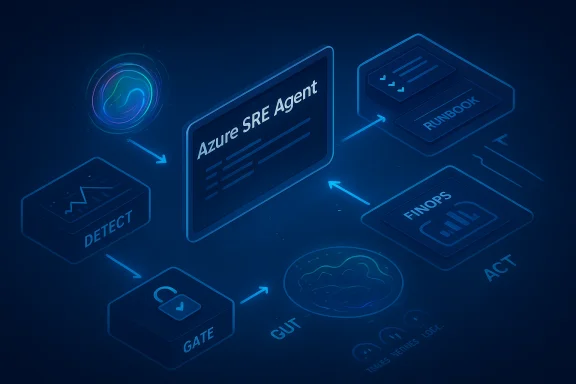
Dynatrace’s native integration with Microsoft’s Azure SRE Agent shifts observability from passive monitoring toward agentic operations, promising faster root-cause analysis, gated automated remediation, and continuous optimization for AI-heavy Azure estates — but the move also raises material questions about cost, governance, and how enterprises should pilot agent-driven automation at scale.
Dynatrace announced a purpose-built cloud operations preview for Microsoft Azure and a direct integration that surfaces Dynatrace’s causal AI diagnostics inside the Azure SRE Agent experience. The vendor positions this as the first observability platform to integrate natively with Microsoft’s portal-native reliability assistant, enabling remediation hints and runbook automation to be presented and, when permitted, executed from within the Azure control plane. The preview is available now; Dynatrace has signaled broader availability targeted for early 2026. This announcement lands amid surging enterprise AI investment. Gartner forecasts worldwide AI spending to approach nearly $1.5 trillion in 2025, a macro tailwind vendors cite to explain urgency for operational automation and observability that can handle high-volume, complex AI workloads. That market context makes these platform integrations strategically important for customers running large-scale AI services on Azure.
The net effect is a bi-directional exchange: Dynatrace brings high-fidelity, causally inferred context; Azure provides identity, approval gates, and auditable agentic actions inside the portal. This avoids the usual console-hopping between third-party observability dashboards and native cloud controls during incidents.
Source: CXOToday.com Dynatrace and Microsoft Team Up to Simplify Scaling amid Complex AI Growth
 Background / Overview
Dynatrace announced a purpose-built cloud operations preview for Microsoft Azure and a direct integration that surfaces Dynatrace’s causal AI diagnostics inside the Azure SRE Agent experience. The vendor positions this as the first observability platform to integrate natively with Microsoft’s portal-native reliability assistant, enabling remediation hints and runbook automation to be presented and, when permitted, executed from within the Azure control plane. The preview is available now; Dynatrace has signaled broader availability targeted for early 2026. This announcement lands amid surging enterprise AI investment. Gartner forecasts worldwide AI spending to approach nearly $1.5 trillion in 2025, a macro tailwind vendors cite to explain urgency for operational automation and observability that can handle high-volume, complex AI workloads. That market context makes these platform integrations strategically important for customers running large-scale AI services on Azure. What Dynatrace and Microsoft Announced
Headline capabilities
- Portal-native remediation hints: Dynatrace will surface its causal root-cause analysis and remediation guidance directly in the Azure SRE Agent UI so operators can review suggested fixes without switching consoles.
- Automated runbook execution (gated): The integration enables runbook steps packaged by Dynatrace to be invoked by Azure SRE Agent, with human-in-the-loop approvals and policy gating for higher-risk actions.
- Expanded Azure telemetry ingestion: Dynatrace intensifies ingestion of Azure Monitor traces, metrics, logs, and service metadata to feed its causal models and boost diagnostic fidelity.
- Continuous optimization and FinOps signals: Built-in rightsizing suggestions and idle-resource cleanup recommendations are surfaced as part of operational workflows to help control AI-related cloud spend.
Availability & positioning
Dynatrace published a formal press release describing the integration and its Azure cloud operations preview in mid-November, confirming the preview stage and a general availability target in early 2026. Microsoft’s Azure SRE Agent pages and documentation list the service as available in preview and describe the agentic controls and billing model. Enterprises should treat the timeline and “first-to-integrate” positioning as vendor statements to validate during procurement.How the Integration Works (Technical Overview)
Telemetry, causality, and the action surface
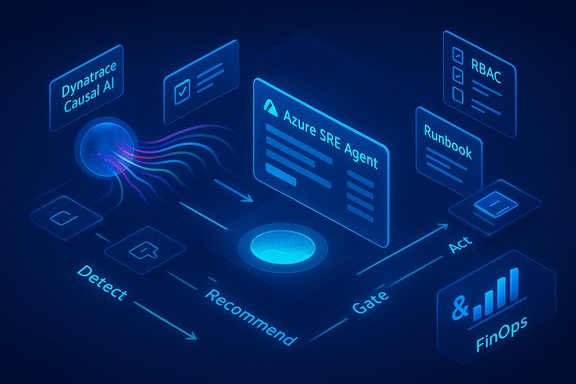
Dynatrace’s platform correlates traces, metrics, logs, and business telemetry in its lakehouse and causal engine to produce ranked root-cause hypotheses with confidence scores. The integration maps these causal artifacts into the Azure SRE Agent’s investigative UI as remediation hints — contextual payloads that include implicated resources, trace snippets, timestamps, and a recommended runbook step. Azure SRE Agent then acts as the governance and execution plane: presenting the hint, applying configured policy checks, and (where allowed) executing idempotent, low-risk automation steps.The net effect is a bi-directional exchange: Dynatrace brings high-fidelity, causally inferred context; Azure provides identity, approval gates, and auditable agentic actions inside the portal. This avoids the usual console-hopping between third-party observability dashboards and native cloud controls during incidents.
Automation primitives and safety controls
The vendors emphasize a staged automation model:- Detect — continuous monitoring and early-warning signals from combined real-time and historical telemetry.
- Recommend — causal root-cause analysis produces high-confidence remediation hints.
- Gate — approval policies, role-based access control (RBAC), and runbook validation guard higher-risk actions.
- Act — Azure SRE Agent executes pre-approved, idempotent steps (cache clears, targeted restarts, scale adjustments), with full audit logs and billing traces for accountability.
Verified Facts and Cross-Checks
- Dynatrace publicly announced the Azure-focused cloud operations preview and the integration with Azure SRE Agent; the press release confirms the preview stage and the stated integration details.
- Microsoft documents Azure SRE Agent as a portal-native reliability assistant and specifies an Azure Agent Unit (AAU) billing model: 4 AAUs per agent per hour baseline plus 0.25 AAUs per second for active tasks — facts published on Microsoft’s product and billing pages. Enterprises must model AAU usage when estimating costs.
- Gartner’s public forecasts place worldwide AI spending near $1.5 trillion in 2025, a widely cited analyst data point that vendors use to justify investment in operational automation. This macro figure helps explain vendor urgency but does not validate specific product ROI for any customer.
- Independent industry commentary and preview coverage corroborate the integration’s core claims and emphasize the preview status and vendor positioning; they also advise caution on vendor “first” claims and recommend validation in procurement.
Business Implications: Benefits and Immediate Opportunities
Faster Mean Time to Repair (MTTR)
By feeding causally derived, high-confidence diagnostics into the Azure control plane, the integration reduces time wasted triaging noisy alerts and reconstructing contextual traces across multiple consoles. SREs can see implicated resources and remediation hints within the portal, approving or running low-risk fixes quickly. Early pilots should measure MTTR delta against existing incident workflows.Reduced Operational Toil and Higher SRE Leverage
Automating repeatable runbooks (with human gating) frees SREs from routine remediation and lets teams focus on architecture, reliability engineering, and platform improvements. For organizations scaling AI workloads — which often increase telemetry volume and operational surface area — this can be a tangible productivity multiplier.FinOps and Cost Optimization
The combined stack delivers continuous rightsizing and idle-resource reclamation recommendations integrated into operational workflows. Given the steep infrastructure costs for AI (GPUs, inference clusters), operational recommendations wired into the control plane can accelerate savings when paired with FinOps governance. However, cost modeling must include AAU consumption for the SRE Agent.Single-pane workflows for Azure-first shops
For organizations heavily invested in Azure, surfacing observability-driven remediation inside the Azure portal reduces context switching and simplifies compliance, audit, and approval workflows — an important productivity and governance gain for platform teams.Risks, Trade-offs, and What Could Go Wrong
1) Billing surprises from agentic operations
Azure SRE Agent billing uses Azure Agent Units (AAUs): a baseline always-on cost and incremental charges while the agent executes tasks. Active remediation, investigative chat responses, and generated reports all consume AAUs. Organizations that enable broad or aggressive automation without run-rate modeling risk materially higher monthly costs. Treat AAU cost estimates as first-class planning artifacts.2) Over-reliance on probabilistic AI signals
Causal AI produces ranked hypotheses with confidence scores — not guaranteed fixes. Misapplied or poorly validated runbooks based on incorrect causal inferences can escalate incidents. Guardrails like manual approvals for non-idempotent actions, synthetic validation of runbooks, and safe defaults are essential. Independent validation of remediation accuracy in production-like environments is necessary before scaling automation.3) Governance, audit, and compliance complexity
When observability systems gain the ability to actuate changes in the control plane, identity controls, RBAC, approval workflows, and audit logging must be airtight. Enterprises handling regulated workloads must map these new operational pathways into existing compliance frameworks and ensure runbooks are auditable and reversible.4) Vendor positioning vs. procurement reality
Marketing claims such as “first to integrate” are useful for vendor differentiation but should not substitute for technical validation. Confirm the integration scope: which telemetry types are exported, how confidence scores are calculated, whether remediation actions are idempotent, and how incident context flows to third-party tooling (PagerDuty, ServiceNow). Procurement should require a proof-of-concept with measurable SLAs and runbook safety tests.5) Agentic AI maturity and "agent washing"
Analysts warn that many agentic AI projects will be scrapped or under-deliver without clear business value and disciplined governance. Agentic features can be over-marketed; buyers should ensure automation is solving validated pain points rather than being driven by hype. Pilot projects should include explicit success criteria and sunset triggers.Practical Implementation Guidance — A Six-Step Pilot Plan
- Inventory and prioritize: Map critical services (AKS clusters, VMs, Functions, AI Foundry resources) and identify high-frequency, low-risk operational tasks suitable for automation (cache clears, pod restarts, autoscale policy adjustments).
- Cost modeling: Estimate AAU consumption using Microsoft’s AAU billing model and consider worst-case active-flow scenarios. Include AAU spend in FinOps runway planning.
- Runbooks as code & testing: Express runbooks in code, commit to CI pipelines, and validate behavior in a staging environment. Use idempotent actions where possible and require human approvals for anything with material availability impact.
- Human-in-the-loop gating: Start with recommended actions surfaced in the portal; enable automatic execution only for thoroughly tested, low-risk runbooks. Track approvals and outcomes to refine automation confidence thresholds.
- Telemetry cost control: Ensure telemetry ingestion is optimized and sustainable. High-fidelity causal inference needs long-term context, but unbounded telemetry egress can spike costs — balance fidelity and retention with measurable ROI.
- Measure and iterate: Define KPIs (MTTR reduction, incident volume, AAU cost per incident, SRE time reclaimed) and extend automation only when confidence and outcomes justify it. Maintain an automation kill-switch and periodic revalidation cadence.
Security and Data-Privacy Considerations
- Identity and access: Ensure Azure Entra (or equivalent IAM) policies restrict who can approve or override automated remediations. Map SRE Agent actions to principals and require multi-party approvals for sensitive changes.
- Data residency and telemetry export: Confirm what telemetry leaves your tenant and how it is stored; align retention policies with regulatory requirements.
- Auditability: Enable comprehensive logging of suggested actions, approvals, and automated executions. Export logs to secure storage for long-term retention where compliance demands it.
- Third-party connectors: If incident data flows to external incident management systems, ensure connectors preserve context without exposing sensitive payloads.
Competitive Context and Market Dynamics
Observability vendors are rapidly expanding beyond diagnostics into automation and actionability. The Dynatrace–Azure SRE Agent integration is notable because it places causal signals directly into a hyperscaler’s portal-native agentic surface, simplifying operations for Azure-first customers. Market dynamics — accelerated AI spending and hyperscaler investments in agentic tooling — will continue to push vendors toward tighter control-plane integrations and more auditable automation. However, buyers should compare approaches across vendors and avoid presuming exclusivity based solely on marketing claims; integration styles (API-level export, co-engineered runbook templates, marketplace-managed services) vary and matter in procurement.Executive Takeaways
- The Dynatrace–Microsoft integration creates a practical pathway from causal observability to portal-native, gated remediation inside Azure, aligning with enterprise needs to scale AI workloads with predictable operations. The preview is actionable for platform teams that wish to reduce toil and decrease MTTR.
- This integration is not a plug‑and‑play panacea. Organizations must plan for AAU consumption, validate causal accuracy, implement strong governance, and pilot conservatively before broad automation.
- Operational success depends less on the novelty of agentic features and more on disciplined implementation: runbooks as code, synthetic testing, RBAC, auditability, and clear KPIs to measure whether automation improves reliability without increasing risk.
Conclusion
The native connection between Dynatrace’s causal AI and Microsoft’s Azure SRE Agent represents an important step in making observability actionable in the cloud provider’s control plane: it reduces friction between detection and remediation, offers direct FinOps levers for AI workloads, and advances the promise of agentic operations. At the same time, it brings new responsibilities — cost modeling for Azure Agent Units, rigorous governance for actions taken by agents, and careful validation of AI-derived remediation. For enterprises pursuing large-scale AI deployments, the integration is a meaningful operational toolset; for SRE leaders and FinOps teams, the imperative is clear: pilot conservatively, measure comprehensively, and treat automation as a program requiring the same discipline as secure production software.Source: CXOToday.com Dynatrace and Microsoft Team Up to Simplify Scaling amid Complex AI Growth