

Dynatrace’s new Azure-focused cloud operations preview pushes observability from “explain what happened” toward “recommend—and, where safe, act on it,” by routing Dynatrace’s causal AI signals directly into Microsoft’s portal-native Azure SRE Agent and adding deeper Azure Monitor ingestion, automated remediation workflows, and continuous cost-optimization capabilities for AI and cloud-native workloads.
Dynatrace has long marketed itself as an AI-first observability platform built around two core technologies: the Davis causal AI engine for automated root‑cause inference, and GRAIL, a telemetry lakehouse designed to keep observability data in context for long-term analysis. The company’s recent announcement describes a purpose‑built Cloud Operations experience for Microsoft Azure that is available in preview and ties Dynatrace telemetry into Microsoft’s new Azure SRE Agent to create a portal‑native remediation surface. Microsoft’s Azure SRE Agent is a preview service that acts as a portal‑embedded, “agentic” reliability assistant. It continuously monitors resources, offers a conversational investigative surface in the Azure portal, and — under defined governance and approval gates — can execute mitigation steps. Azure bills SRE Agent activity using a new consumption metric called Azure Agent Units (AAUs): a baseline always‑on cost per agent and additional usage‑based AAUs for active tasks. Microsoft’s public pages show a baseline of 4 AAUs per agent per hour and 0.25 AAUs per second for active tasks. Why this matters now: enterprises are scaling AI initiatives and running GPU‑heavy, distributed workloads in cloud environments. Analysts project large increases in AI spending — Gartner forecasts nearly $1.5 trillion in global AI spending for 2025 — creating both urgency and scale requirements for observability that can feed automation safely into operational workflows. The Dynatrace + Azure SRE Agent announcement positions observability as the data plane that informs agentic operations in the cloud control plane.
Key, actionable recommendations:
Source: ERP Today Dynatrace Expands AI Cloud Operations With Microsoft Azure Integration
 Background / Overview
Dynatrace has long marketed itself as an AI-first observability platform built around two core technologies: the Davis causal AI engine for automated root‑cause inference, and GRAIL, a telemetry lakehouse designed to keep observability data in context for long-term analysis. The company’s recent announcement describes a purpose‑built Cloud Operations experience for Microsoft Azure that is available in preview and ties Dynatrace telemetry into Microsoft’s new Azure SRE Agent to create a portal‑native remediation surface. Microsoft’s Azure SRE Agent is a preview service that acts as a portal‑embedded, “agentic” reliability assistant. It continuously monitors resources, offers a conversational investigative surface in the Azure portal, and — under defined governance and approval gates — can execute mitigation steps. Azure bills SRE Agent activity using a new consumption metric called Azure Agent Units (AAUs): a baseline always‑on cost per agent and additional usage‑based AAUs for active tasks. Microsoft’s public pages show a baseline of 4 AAUs per agent per hour and 0.25 AAUs per second for active tasks. Why this matters now: enterprises are scaling AI initiatives and running GPU‑heavy, distributed workloads in cloud environments. Analysts project large increases in AI spending — Gartner forecasts nearly $1.5 trillion in global AI spending for 2025 — creating both urgency and scale requirements for observability that can feed automation safely into operational workflows. The Dynatrace + Azure SRE Agent announcement positions observability as the data plane that informs agentic operations in the cloud control plane. What Dynatrace announced
Headline features (vendor summary)
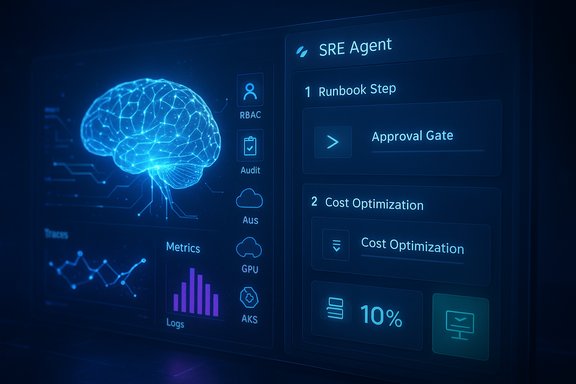
- Portal‑native remediation hints: Dynatrace will surface causal root‑cause analysis and remediation guidance inside the Azure SRE Agent UI so operators can review suggested fixes without switching consoles.
- Expanded Azure telemetry ingestion: Dynatrace intensifies ingestion of Azure Monitor metrics, traces and logs to enrich topology mapping and causal models in GRAIL.
- Auto‑Prevention: Early warning signals and risk scoring designed to detect emerging problems before they become incidents.
- Auto‑Remediation: Runbook templates and automated workflows that can be executed in Azure SRE Agent under human approval or, for low‑risk steps, automatically.
- Auto‑Optimization (FinOps): Continuous rightsizing, idle‑resource detection, and cost‑control suggestions for AI workloads, including GPU and accelerator usage.
How the technical integration works (high level)
- Dynatrace expands ingestion of Azure Monitor telemetry and enriches it with traces, logs, topology and historical context in GRAIL.
- Davis causal AI processes the enriched telemetry to produce ranked root‑cause hypotheses, confidence scores, and remediation hints.
- These diagnostics are packaged into a consumable format that the Azure SRE Agent displays in the portal’s investigative surface, along with runbook steps and approval options.
- The Azure SRE Agent enforces identity, RBAC, audit trails and the AAU‑based billing model; actions executed through the agent incur baseline + usage AAU charges.
Independent verification: what’s confirmed and what to treat cautiously
- Confirmed: Dynatrace has publicly announced a preview integration between its platform and Microsoft’s Azure SRE Agent and is showcasing it at events such as Microsoft Ignite; the preview stage and the GA target window (early 2026) are stated in Dynatrace’s press materials.
- Confirmed: Microsoft documents Azure SRE Agent pricing and the AAU billing model (4 AAUs per agent per hour baseline; 0.25 AAU per second per active task) in its pricing and billing pages. That billing model is in preview and subject to change.
- Confirmed (industry coverage): Multiple independent news outlets and community threads have summarized the announcement and its implications, corroborating the vendor messaging about observability-to‑action integration.
Strengths and strategic value
1) Converts signals into actions inside the cloud control plane
By routing causal diagnostics into the Azure portal via SRE Agent, Dynatrace reduces console‑hopping and places remediation where operators already work. This can materially shorten incident response loops and make remediation workflows more auditable under Azure governance.- Benefit: faster MTTR and fewer manual steps during escalations.
- Operational win: time saved during cross‑tool diagnosis and runbook execution.
2) High‑fidelity telemetry + causal AI improves actionability
Dynatrace’s combination of Davis and GRAIL is designed to provide higher‑confidence root‑cause hypotheses by correlating traces, metrics, logs and topology. Better confidence scores translate to safer automated remediation candidates and fewer false positives.- Benefit: fewer noisy alerts and higher trust in suggested runbook steps.
- Evidence: Dynatrace materials describe enriched ingestion of Azure Monitor and context packing for the SRE Agent.
3) FinOps integration is timely for AI workloads
AI workloads drive GPU/accelerator costs and persistent resource allocation. Continuous rightsizing and idle‑resource cleanup integrated into operational workflows help FinOps teams and SREs reduce waste and show ROI from automation.- Benefit: recurring cost savings, clearer chargeback and showback reporting.
- Practicality: rightsizing suggestions surfaced at the point of operational decision-making reduces friction for actioning savings.
4) Safety primitives and governance are built into the model
The integration emphasizes a staged automation lifecycle: detect → recommend → gate → act. Azure SRE Agent’s identity and RBAC controls, audit trails, and approval gates provide the enforcement plane to keep automation safe and accountable.- Benefit: preserves human oversight for higher‑risk actions, reduces blast radius risk.
- Note: these controls are necessary but require organizational discipline to enforce.
Risks, open questions, and areas requiring close scrutiny
Cost complexity — AAUs and telemetry ingestion
The Azure SRE Agent introduces a new metering construct (AAUs). While the always‑on baseline (4 AAUs/hr per agent) provides continuous monitoring, active remediation tasks are billed per-second at 0.25 AAU/sec; both are preview metrics and will translate into direct operational expense. Additionally, expanded ingestion of Azure Monitor telemetry into Dynatrace increases observability data volume and potential ingestion costs.- Risk: telemetry and AAU billing together can create non‑linear costs during incident storms or high automation activity.
- Mitigation: model AAU and telemetry run‑rates during a pilot and place budgets/alerts on AAU consumption. Microsoft documents AAU billing and suggests using the pricing calculator.
Automation governance and human‑in‑the‑loop discipline
Automated remediation is powerful but dangerous if not governed. Two failure modes to watch for: (a) false positives triggering automated changes, and (b) chained automations causing change cascades.- Risk: runaway automated remediation during complex incidents can increase outage scope.
- Mitigation: require human approval for non‑idempotent or high‑impact actions, maintain runbooks-as‑code with CI validation, and enforce strict RBAC and escalation policies.
Integration surface and vendor lock‑in
Tight coupling into Azure’s portal can be a double‑edged sword. While it improves operations for Azure‑first shops, it creates a stronger dependency on a single cloud and on the vendor stack for cross‑cloud incident workflows.- Risk: operational lock‑in or reduced flexibility in multi‑cloud setups.
- Mitigation: design the pilot so third‑party incident management tools (PagerDuty, ServiceNow) still receive consolidated context; keep runbooks portable as code.
Claims vs. real‑world efficacy
Vendor demos and previews can overstate automation maturity. The quality of causal inference in noisy, production environments depends on signal quality, topology accuracy, and historical context.- Risk: suggested remediation hints may have lower precision in edge cases, leading SREs to distrust automation.
- Mitigation: start with low‑risk automations (cache clears, targeted restarts), validate accuracy metrics, and expand scope only after measured success.
Practical implementation guidance for platform teams
A phased pilot roadmap (recommended)
- Discovery & Baseline (Weeks 0–2)
- Inventory target Azure subscriptions, critical applications, AKS clusters and AI Foundry workloads.
- Benchmark current MTTR, alert noise, and telemetry costs.
- Sandbox & Integration (Weeks 2–6)
- Enable Dynatrace Azure preview in a non‑production tenant.
- Integrate with Azure SRE Agent in a dedicated test subscription and set SRE Agent policy to read‑only for initial runs.
- Ingest representative telemetry; validate topology mapping in GRAIL.
- Validate Diagnostics (Weeks 6–10)
- Compare Dynatrace causal outputs against human post‑mortems for a sample of incidents.
- Track precision, recall, and confidence calibration of remediation hints.
- Low‑risk Automation (Weeks 10–16)
- Enable gated automation for idempotent, low‑impact steps (cache clears, service restarts).
- Monitor AAU consumption and telemetry ingestion; set budgets and alerts.
- Expand & Optimize (Post 16 weeks)
- Extend to rightsizing and FinOps workflows.
- Codify runbooks as code and add CI tests.
- Gradually widen automation scope based on measured ROI and reliability.
KPIs to measure
- Mean Time to Detect (MTTD) and Mean Time to Repair (MTTR) before vs. after integration.
- Confidence score correlation: % of automation suggestions accepted vs. rejected by SREs.
- AAU consumption rate and AAU cost per incident.
- Telemetry ingestion growth and cost per telemetry unit.
- Number of manual escalations avoided and SRE hours reclaimed.
Governance checklist
- Runbooks-as‑code in version control with automated tests.
- RBAC policies that restrict automated actions to least privilege.
- Audit logging enabled for all SRE Agent actions and Dynatrace‑triggered events.
- Approval gates for non‑idempotent or destructive automation.
- Cost monitoring alerts for both AAUs and telemetry ingestion.
Security, compliance, and operational controls
- Identity & Access: tie all automated actions to Azure Entra identities; require approval workflows that map to existing change control policies.
- Auditability: ensure Dynatrace diagnostics and SRE Agent actions are logged centrally (SIEM) and correlated to incident tickets.
- Data residency & telemetry retention: review GRAIL retention policies and ensure observability data handling meets regulatory requirements for sensitive environments.
- Testing & rollback: every automated remediation must have a tested rollback plan; automations must be idempotent where possible.
Vendor and procurement considerations
- Validate the integration depth: request a technical runbook that shows how Dynatrace artifacts are mapped into SRE Agent flows (payload formats, confidence metadata, implicated resources).
- Ask for AAU burn‑rate projections for your environment and test scenarios where incident storms inflate AAU usage.
- Confirm SLAs for the integration and clarify support channels for cross‑vendor issues (where a remediation executed through Azure SRE Agent but triggered by Dynatrace causes unexpected behavior).
- Negotiate pilot terms that include telemetry ingestion limits and AAU credits or trial allowances to avoid surprise billing during evaluation.
A realistic ROI view
The value proposition is immediate in three buckets: reduced incident handling time, reclaimed SRE effort for higher‑value work, and continuous cost savings from rightsizing. But ROI is conditional:- Small wins are most likely from reducing console‑hopping and automating repetitive, low‑risk tasks.
- Material cost savings from FinOps signals require operational change to act on recommendations.
- Large automation scope that reduces significant SRE headcount is possible but requires rigorous validation, governance, and cultural change.
Industry context and competitive landscape
Observability vendors and cloud providers are racing to make monitoring systems actionable. The Dynatrace + Azure SRE Agent integration is a prominent example of this trend — marrying a third‑party causal engine with a cloud provider’s portal‑native agentic surface. The strategy follows a broader industry pattern: high‑fidelity telemetry + causal inference + cloud control‑plane execution = faster, safer operations. Multiple independent outlets and community threads have framed the Dynatrace announcement as a meaningful step in that direction, while cautioning that execution quality and governance will determine real value.Final assessment and recommendations
The Dynatrace preview for Azure Cloud Operations and its integration with Azure SRE Agent represent a strategic and pragmatic step toward agentic observability: observability that not only explains incidents but helps drive safe, auditable action inside the cloud control plane. When implemented with conservative pilots, strict governance, and clear cost modeling, the combined offering offers tangible operational and FinOps benefits.Key, actionable recommendations:
- Run a bounded pilot that focuses on low‑risk automations and explicit AAU/telemetry cost modeling.
- Treat automation as a program: involve SRE, platform engineering, security, finance, and compliance from day one.
- Codify runbooks as code, add CI tests, and require human approval for non‑idempotent actions.
- Monitor AAU consumption closely and set automatic spending guards during pilot and early production rollouts.
- Validate the precision of causal recommendations against historical incident post‑mortems before broadening automation.
Source: ERP Today Dynatrace Expands AI Cloud Operations With Microsoft Azure Integration
