

Dynatrace’s announced integration with Microsoft’s Azure SRE Agent promises to move observability from passive diagnostics to agentic operations — surfacing causal insights inside the Azure control plane and enabling gated, auditable remediation — a shift positioned by both vendors as a major accelerator for enterprise AI and cloud operations.
Dynatrace has positioned itself as an AI-first observability platform built on causal analysis and a unified telemetry lakehouse; Microsoft has been productizing portal-native, agentic reliability tooling in Azure. The recent announcement frames the Dynatrace–Azure SRE Agent link as a tighter, bi-directional integration that maps high-fidelity application and infrastructure telemetry into Azure’s agentic surface to produce remediation hints and, where permitted, execute automated runbook steps.
This news arrives amid a macro environment of rapid enterprise AI investment. Vendors cite analyst estimates placing worldwide AI-related spending near $1.5 trillion in 2025; the vendors position integrated observability and governed automation as a necessary operational layer beneath large-scale AI deployments. Those market signals help explain why observability and cloud vendors are racing to turn insights into safely executed actions.
Source: Menafn.com Dynatrace And Microsoft Partner To Scale Enterprise Customer AI Initiatives
 Background
Dynatrace has positioned itself as an AI-first observability platform built on causal analysis and a unified telemetry lakehouse; Microsoft has been productizing portal-native, agentic reliability tooling in Azure. The recent announcement frames the Dynatrace–Azure SRE Agent link as a tighter, bi-directional integration that maps high-fidelity application and infrastructure telemetry into Azure’s agentic surface to produce remediation hints and, where permitted, execute automated runbook steps.This news arrives amid a macro environment of rapid enterprise AI investment. Vendors cite analyst estimates placing worldwide AI-related spending near $1.5 trillion in 2025; the vendors position integrated observability and governed automation as a necessary operational layer beneath large-scale AI deployments. Those market signals help explain why observability and cloud vendors are racing to turn insights into safely executed actions.
What the integration claims to deliver
The vendor messaging lists three technical and business thrusts:- Smarter detection and remediation — Dynatrace’s causal root-cause analysis correlated with Azure telemetry to reduce noisy, surface-level alerts and produce higher-precision diagnostics.
- Automated operations — remediation hints and runbook actions surfaced in the Azure SRE Agent, with human-in-the-loop or policy-gated execution to reduce mean time to repair (MTTR).
- Proactive reliability and cost optimization — continuous analysis of real-time and historical signals to identify leading indicators of failure and recommend rightsizing or idle-resource reclamation.
How the integration works (technical overview)
Telemetry and causal context
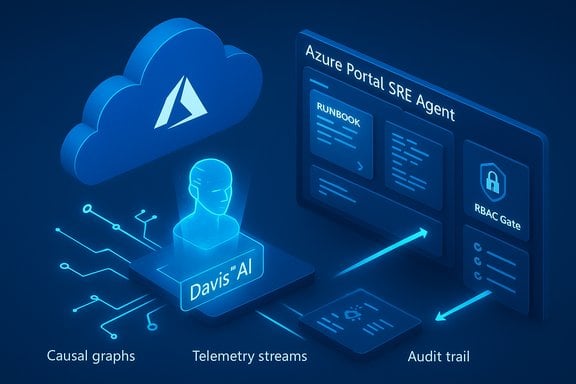
Dynatrace expands ingestion of Azure Monitor telemetry and maps correlated traces, logs, metrics, and topology into causal models (its Davis engine and Grail lakehouse are cited by the vendor). That enriched causal context is packaged as remediation hints and diagnostic payloads consumable by Azure SRE Agent incident workflows. The explicit objective is to replace noisy alerts with action-oriented, high-confidence suggestions.Action surface: Azure SRE Agent
Azure SRE Agent is built as a portal-native reliability assistant that can continuously monitor resources, display a conversational diagnostics surface, and — under configured governance and approval gates — propose or perform mitigations. The integration routes Dynatrace’s causal signals into that surface so remediation hints appear inside Azure’s control plane and can be translated into runbook steps or scripted actions. The Agent uses a consumption model built on Azure Agent Units (AAUs); public descriptions in vendor materials indicate both a baseline always-on AAU cost and usage-based increments for active mitigation tasks.Automation, gating, and auditability
The joint workflow emphasizes three operational primitives:- Human-in-the-loop gates — default safety models require approvals for higher-risk actions.
- Runbook-as-code and automated playbooks — remediation hints are packaged so they can be validated as code and wired into CI/CD for runbook testing.
- Audit trails and RBAC — actions are tied to Azure identity and governance so teams can trace who approved or executed a change.
Why this matters to enterprise SRE and cloud teams
Cloud-native environments have ballooned in complexity: ephemeral container orchestration, serverless functions, and specialized AI clusters create high-cardinality telemetry and triage challenges. The combined promise of Dynatrace’s causal analysis and Azure’s agentic control plane is to reduce the operational surface area that humans must manually triage. In practice, this can mean:- Faster root-cause identification in multi-tier failures.
- Fewer manual escalations and handoffs, lowering MTTR when automation is validated.
- Continuous cost controls through rightsizing recommendations surfaced directly in the cloud control plane.
Strengths and notable positives
- Tighter telemetry-to-action loop — The integration addresses a well-known gap: observability often surfaces “what happened” but not an auditable, controlled way to act on it from within the cloud provider portal. The native control-plane surface reduces friction for Azure-first teams.
- Causal AI feeding agentic controls — When causal signals are high-fidelity, remediation hints are more actionable and less likely to result in false positives or unsafe actions. Dynatrace’s causal analysis combined with Azure’s portal gating is designed to reduce that risk.
- Operational economics and FinOps alignment — The integration calls out continuous rightsizing and idle-resource cleanup as part of an optimization loop that can be surfaced as showback/chargeback to engineering teams. For organizations facing rising AI workload costs, this can be commercially meaningful.
- Vendor ecosystem momentum — The integration strengthens Dynatrace’s position in the Azure ecosystem and gives Microsoft a partner-provided data surface for safer agentic automation. Partnerships that reduce integration friction can accelerate production deployments when interoperability is deep and well-documented.
Risks, limitations, and governance concerns
- Vendor claims vs. verifiable outcomes — Dynatrace’s statement that it is “the first observability platform to integrate with Azure SRE Agent” is a vendor claim; procurement teams should verify integration depth (telemetry export vs. bi-directional runbook execution) and ask for demonstrable pilot metrics. Treat press claims as a starting point, not a contractually guaranteed outcome.
- Over-automation hazards — Poorly scoped automation can cascade changes across complex estates. The integration’s value depends on guarded runbooks, careful approval flows, and tested rollback plans. Unchecked automation introduces systemic risk.
- Cost and billing complexity — Azure SRE Agent’s consumption model uses Azure Agent Units; vendor materials indicate baseline AAU charges plus incremental costs for active tasks. Without modeled AAU forecasts and Dynatrace ingestion/retention estimates, organizations risk surprise bills. Financial modeling must be part of any pilot.
- Data residency and regulatory controls — Telemetry and model outputs may include sensitive metadata; customers must confirm region availability and residency guarantees for both the SRE Agent and Dynatrace ingestion policies during preview and GA phases.
- Multi-cloud and heterogeneity problems — The integration is Azure-native. Organizations with multi-cloud strategies must either accept heterogenous tooling or validate equivalent capabilities on other clouds; migration or portability clauses should be explicit in procurement contracts.
Procurement and pilot checklist
Enterprises should treat the Dynatrace–Azure SRE Agent integration as a platform capability to evaluate through controlled pilots. Recommended procurement checks:- Confirm integration depth: telemetry export only, API-level enrichment, or fully bi-directional runbook execution.
- Request proof-of-value metrics from vendor-led pilots: historic MTTR, false-positive automation rate, and realized cost savings.
- Model AAU consumption: obtain sample AAU traces for baseline plus expected active mitigation flows.
- Validate runbook management tooling: CI/CD for runbook tests, sandboxed rehearsals, rollback rehearsals.
- Confirm regional availability and telemetry residency controls for preview vs. planned GA.
- Insist on named customer references with similar scale/workload patterns (AKS, Functions, GPU/AI clusters).
Implementation playbook: step-by-step pilot approach
- Start in read-only mode: ingest telemetry and surface remediation hints in the Azure portal without enabling automated actions. Collect operator feedback.
- Validate remediation suggestions against test runbooks and CI-backed runbook unit tests. Treat runbooks as code.
- Enable gated low-risk automations with human approval (tagging resources, non-disruptive restarts, scale adjustments). Measure false-positive rates.
- Expand scope incrementally to higher-risk actions only after statistical confidence is established and rollback patterns are tested.
- Institutionalize governance: enforce RBAC, maintain audit trails, integrate automation approvals into change control processes.
FinOps considerations
The integration explicitly ties to cost-optimization workflows. Two operational cost buckets must be analyzed:- Dynatrace telemetry ingestion and retention — increased telemetry ingestion to improve causal fidelity will affect Dynatrace costs and storage/compute pricing; request concrete ingestion estimates for pilot scope.
- Azure Agent Units (AAUs) — the SRE Agent billing model includes baseline and active mitigation AAUs; vendors indicate a baseline consumption metric and incremental AAUs for active tasks. Build AAU forecasts into runbook ROI analysis.
Security and compliance checklist
- Ensure telemetry does not leak regulated data; apply redaction and field-level controls in telemetry pipelines.
- Confirm how model outputs (remediation hints) are stored, versioned, and audited. Capture rationale and prompt versions for any generative/agentic decisions.
- Validate RBAC mappings between Dynatrace signals and Azure identities; avoid granting broad privileges to automated agents.
Validation and vendor accountability
Enterprises should require measurable SLAs and acceptance criteria in any pilot agreement:- Baseline MTTR (historical) and target MTTR after pilot.
- False-positive automated action rate threshold.
- Sample billing statements (AAU and Dynatrace ingestion) for pilot timeframe.
- Named customer references and a joint runbook validation checklist.
Where claims should be treated with caution
The announcement contains forward-looking and vendor-forwarded language about accelerating “autonomous operations” and being “first” to integrate with the Azure SRE Agent. Those are important positioning statements but require independent verification:- Confirm whether the vendor’s “first” claim has been validated against competing observability offerings and whether the integration supports the specific execution patterns your runbooks require.
- If any timeline (preview availability, GA date) is cited, validate the dates and feature lists against formal product documentation and support channels — preview regions and GA schedules often change. Vendor materials cite preview availability and targeted general availability windows; treat those as vendor plans, not guaranteed delivery schedules.
Practical takeaway for engineering leaders and WindowsForum readers
This integration is a meaningful step in the evolution of cloud operations: observability that can advise and, under policy, act within the cloud provider’s control plane. For Azure-first organizations, the combination of Dynatrace’s causal signals and Azure SRE Agent’s portal-native governance can shorten incident cycles and surface continuous optimization opportunities. At the same time, the pragmatic path to value requires conservative, instrumented pilots, accurate FinOps modeling (AAU + telemetry ingestion), strict runbook testing, and robust identity and audit controls. Measured rollout, governed automation, and explicit acceptance criteria will turn vendor promise into repeatable operational improvements.Conclusion
The Dynatrace–Microsoft integration crystallizes a wider industry shift: observability platforms are moving from passive insight providers to agentic operational partners that can advise and act when governed properly. The technical promise is compelling — higher-fidelity causal analysis delivered into a portal-native execution surface — but the operational reality depends on strong governance, careful pilots, and transparent commercial modeling. Organizations that institutionalize runbooks-as-code, measure AAU and ingestion costs, and require demonstrable proof-of-value will be best placed to capture the upside while managing the risk. The announcement is a notable commercial and technical signal for Azure-first enterprises, but turning it into durable production value will be an engineering and procurement exercise as much as a product deployment.Source: Menafn.com Dynatrace And Microsoft Partner To Scale Enterprise Customer AI Initiatives
