

Apple is reportedly preparing refreshed iPad Pro models and an updated entry-level 14-inch MacBook Pro for the first half of 2027, with Bloomberg’s Mark Gurman pointing to spring iPad launches and an M6 MacBook Pro tied to Apple’s broader touchscreen Mac roadmap. The rumor matters less as a shopping-calendar footnote than as evidence of a more deliberate Apple hardware cadence. Cupertino appears to be turning the first half of the year into a second holiday season for pro devices, while using chip timing, display technology, and thermal design to separate “new” from meaningfully new.
For years, Apple trained buyers to expect its most important hardware moments in the fall. The iPhone owned September, Macs often clustered around October, and spring was left for education pricing, iPad odds and ends, or a product that needed breathing room outside the iPhone blast radius. That old rhythm is now less useful for understanding Apple’s hardware business.
The reported first-half 2027 window for iPad Pro and MacBook Pro updates fits a newer pattern: Apple spreading major launches across the calendar to smooth revenue, manage component availability, and keep each product line from cannibalizing the attention of another. That is not just marketing choreography. It is supply-chain risk management dressed up as keynote strategy.
The timing also reflects the reality of Apple Silicon. Once the company moved Macs and iPads onto related M-series chips, the product calendar became more dependent on silicon availability than on the old Intel-era logic of laptop refreshes. If a chip generation is ready, Apple can refresh a product family quickly; if it is not, the company can hold a redesign back and sell a familiar chassis with a faster processor.
That is what makes the rumored 2027 lineup interesting. The iPad Pro is not merely waiting for another processor bump. The MacBook Pro is not merely waiting for another processor bump either. Both products are becoming test cases for how Apple defines “Pro” when performance, portability, thermals, and interface expectations are all moving at once.
That ambiguity could become sharper in 2027. Gurman’s latest reporting, as summarized by PCMag, suggests the base 14-inch model is expected to receive an M6 upgrade that is “in line with what Apple is preparing” for the long-rumored touchscreen MacBook. But the most radical version of that touchscreen Mac story has centered on OLED panels, a Dynamic Island-style camera cutout, and a redesigned interface approach that makes macOS more touch-friendly without turning it into iPadOS.
If Apple ships an M6 entry-level MacBook Pro in the same broad era as a more ambitious touchscreen MacBook Pro, the company will have to manage a familiar tension: the cheap Pro cannot be too good, but it cannot feel stale either. Apple has long used chip tiers, display technology, and port selection to separate similar-looking machines. In the Apple Silicon era, that segmentation has become cleaner but also more visible.
The base MacBook Pro is therefore likely to remain a carefully constrained product. It may inherit the next-generation silicon story without inheriting every part of the next-generation design story. That would let Apple advertise progress while preserving room above it for higher-margin models with OLED, touch, thinner industrial design, and potentially more expensive configurations.
The risk is that buyers notice. Apple customers have become much more fluent in the company’s segmentation language. They know when a machine has the new chip but not the new display, the new chassis but not the best ports, or the Pro name without the Pro performance envelope. The entry-level MacBook Pro succeeds when it feels like a gateway to the professional line; it struggles when it feels like a MacBook Air in a heavier suit.
The world changed around it. Windows laptops normalized touch, even if many users treat it as a convenience rather than a primary input method. iPad Pro hardware became powerful enough to embarrass many laptops, while iPadOS remained constrained for some workflows. Meanwhile, Apple added more iOS-like interface elements to macOS and more Mac-like accessories to iPadOS, blurring the philosophical purity it once defended.
A touchscreen MacBook Pro would not necessarily mean Apple has surrendered to the 2-in-1 laptop crowd. The more likely move is subtler: a Mac that remains keyboard-and-trackpad-first but supports touch for scrolling, zooming, drawing quick interactions, and manipulating media when it feels natural. That is why the phrase touch-friendly, not touch-first matters.
The rumored Dynamic Island-like cutout also signals how Apple may try to make the redesign feel like an Apple idea rather than a concession to PC trends. The notch on current MacBook Pros was functional but visually awkward. A camera cutout that borrows from the iPhone’s interface language could turn a display compromise into a branded interaction zone, assuming Apple gives it useful macOS behavior rather than treating it as decorative camouflage.
OLED is the other half of the story. A touch-enabled MacBook Pro with OLED would not simply add finger input; it would reposition the display as the machine’s most visible premium feature. Better contrast, faster pixel response, thinner panels, and richer HDR presentation all matter to the audience Apple courts with the MacBook Pro. Touch may get the headlines, but OLED may be what justifies the price.
That is why the reported vapor chamber testing matters. If Apple adds a vapor chamber to the iPad Pro, it would be acknowledging that the tablet’s performance ceiling is not just about peak benchmark numbers. Sustained performance matters when users edit video, render assets, run complex creative projects, or push AI-assisted workflows on-device.
Ultra-thin tablets have less thermal headroom than laptops. A chip can be powerful on paper and still throttle under prolonged load if heat cannot be moved away efficiently. Apple’s M-series iPads have generally been fast, but the Pro branding becomes harder to defend if heavy users cannot count on consistent performance under pressure.
A vapor chamber would also fit the company’s broader direction. Apple has been emphasizing on-device AI, media creation, and professional workflows across its hardware lineup. Those workloads are bursty at times, but they can also become sustained. The more Apple wants the iPad Pro to be taken seriously as a workstation-class tablet, the more it needs thermal design that supports that claim.
The iPad Pro’s reported 11-inch and 13-inch sizes suggest Apple is not preparing a dramatic form-factor reset for spring 2027. Instead, the change appears to be internal: chip, cooling, and perhaps the kind of incremental display and wireless improvements that make the device more reliable without making it look radically different. That may disappoint gadget-watchers, but it is exactly where the iPad Pro needs attention.
That is a dangerous combination. A $200 or $300 increase changes the emotional math of a purchase, especially for buyers who keep machines for five or six years. The more expensive the product, the more customers expect visible, durable improvements: a better screen, a redesigned body, more base memory, better thermals, longer battery life, or a new input method that changes daily use.
Apple knows this. That is why it tends to pair major price movement with either industrial design changes or performance claims that sound generational rather than iterative. But memory-driven pricing is less glamorous than a new display or a new chip. No customer feels joy because DRAM markets tightened.
For enterprise buyers, the concern is different. Price increases complicate fleet planning and refresh cycles. A business can absorb a modest bump on a handful of developer machines, but across hundreds or thousands of Macs and iPads, even small increases become budget events. Apple’s expanding hardware cadence may help procurement teams by offering more predictable windows, but higher prices make timing decisions more consequential.
The broader Apple strategy seems clear: maintain a wide ladder from budget iPhone and consumer MacBook lines up through increasingly premium Pro devices, then use launch timing to keep revenue from peaking too sharply in one quarter. That may be smart finance. It also means customers are being asked to navigate a product matrix where the “right” time to buy is less obvious than ever.
The iPad gained keyboards, trackpads, external display support, desktop-class chips, and professional apps. The Mac gained iPhone-style control centers, iPad-like app design conventions, and continuity features that make it part of a broader device mesh. A touchscreen MacBook would be the most obvious borrowing yet, but it would not necessarily collapse the distinction between the two.
In fact, Apple may be using touch on the Mac to protect the Mac from the iPad rather than to merge them. If the iPad Pro keeps becoming more expensive and more powerful, some users will naturally ask why macOS is not available on it. A touch-capable MacBook Pro gives Apple another answer: if you want macOS with a richer input palette, buy the Mac; if you want the tablet-first experience, buy the iPad.
That sounds cynical, but it is consistent with Apple’s history. The company often resolves overlap not by eliminating a product, but by sharpening the purchasing logic around each one. The iPad Pro can become the best tablet Apple makes. The MacBook Pro can become a more flexible laptop without becoming a detachable. The difference is less philosophical than commercial.
The challenge is software. Touch on macOS cannot feel like a checkbox feature. Buttons, window controls, menus, and app interfaces must tolerate fingers without making the entire system look inflated. Apple has the advantage of controlling the whole stack, but it also has decades of Mac muscle memory to respect.
Microsoft and its OEM partners spent years exploring convertibles, detachables, pen-first tablets, foldables, dual-screen experiments, and conventional laptops with touch panels. The market’s verdict was mixed but practical: touch is useful, even if it does not replace the keyboard and trackpad. Users do not need to touch the screen constantly for the feature to justify its existence.
Apple’s likely version will arrive with the confidence of a company that waited until the technology, software, and marketing story aligned. That does not make it more innovative in the historical sense. It makes it more Apple. The company often enters late, strips away configurations it dislikes, and presents a narrower version of an existing idea as the one that finally makes sense.
That will irritate PC veterans, but it should not surprise them. Apple did not invent the MP3 player, the smartphone, the smartwatch, or wireless earbuds. Its skill is packaging hardware, software, and services into a product that feels coherent enough to reset consumer expectations. A touchscreen MacBook Pro would be judged by that standard, not by who shipped touch first.
The Windows world should watch closely anyway. If Apple makes touch feel natural on a premium laptop without compromising the traditional desktop interface, it will put pressure on PC makers to refine their own touch experiences. If Apple stumbles, it will validate years of skepticism from users who always believed touch on laptops was nice in theory and clumsy in practice.
The logic is straightforward. Apple has become too large to depend on one dominant launch season. Services revenue helps smooth the business, but hardware still drives ecosystem entry and upgrade momentum. By distributing launches, Apple can create more frequent buying moments without forcing every product to fight the iPhone for oxygen.
Chip timing also favors staggered releases. M-series generations do not always align neatly across the Mac, iPad, and desktop families. Apple can ship a base chip in one product, hold Pro and Max variants for another window, and let Ultra-class systems follow their own slower logic. That may frustrate buyers who want a clean annual upgrade map, but it gives Apple flexibility.
There is also a media strategy at work. A spring iPad Pro with vapor chamber cooling is a story. An entry-level MacBook Pro with M6 is a story. A touchscreen OLED MacBook Pro is a bigger story. If all of those arrive too close together, one consumes the others. Apple’s launch calendar is a way of rationing attention.
For customers, the practical advice is less thrilling: rumors now matter because Apple’s product intervals have become uneven. Buying the current iPad Pro or MacBook Pro may still make sense for people who need a device now. But anyone shopping at the high end should be aware that Apple appears to be lining up a more consequential round of changes in 2027 than a simple chip bump.
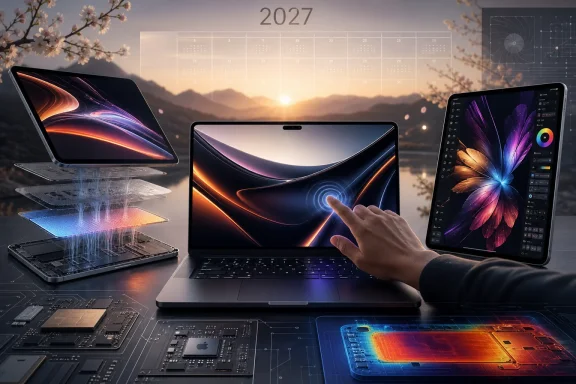 Apple Turns Spring Into a Pro Hardware Season
For years, Apple trained buyers to expect its most important hardware moments in the fall. The iPhone owned September, Macs often clustered around October, and spring was left for education pricing, iPad odds and ends, or a product that needed breathing room outside the iPhone blast radius. That old rhythm is now less useful for understanding Apple’s hardware business.The reported first-half 2027 window for iPad Pro and MacBook Pro updates fits a newer pattern: Apple spreading major launches across the calendar to smooth revenue, manage component availability, and keep each product line from cannibalizing the attention of another. That is not just marketing choreography. It is supply-chain risk management dressed up as keynote strategy.
The timing also reflects the reality of Apple Silicon. Once the company moved Macs and iPads onto related M-series chips, the product calendar became more dependent on silicon availability than on the old Intel-era logic of laptop refreshes. If a chip generation is ready, Apple can refresh a product family quickly; if it is not, the company can hold a redesign back and sell a familiar chassis with a faster processor.
That is what makes the rumored 2027 lineup interesting. The iPad Pro is not merely waiting for another processor bump. The MacBook Pro is not merely waiting for another processor bump either. Both products are becoming test cases for how Apple defines “Pro” when performance, portability, thermals, and interface expectations are all moving at once.
The Entry-Level MacBook Pro Is Becoming Apple’s Most Awkward Mac
The entry-level 14-inch MacBook Pro has always been a slightly strange machine. It wears the Pro badge, uses the Pro chassis, and offers a nicer display and better ports than the MacBook Air, but it typically sits apart from the higher-end Pro and Max models that creative professionals actually mean when they say “MacBook Pro.” It is the Mac for people who want the premium enclosure without necessarily needing the premium silicon.That ambiguity could become sharper in 2027. Gurman’s latest reporting, as summarized by PCMag, suggests the base 14-inch model is expected to receive an M6 upgrade that is “in line with what Apple is preparing” for the long-rumored touchscreen MacBook. But the most radical version of that touchscreen Mac story has centered on OLED panels, a Dynamic Island-style camera cutout, and a redesigned interface approach that makes macOS more touch-friendly without turning it into iPadOS.
If Apple ships an M6 entry-level MacBook Pro in the same broad era as a more ambitious touchscreen MacBook Pro, the company will have to manage a familiar tension: the cheap Pro cannot be too good, but it cannot feel stale either. Apple has long used chip tiers, display technology, and port selection to separate similar-looking machines. In the Apple Silicon era, that segmentation has become cleaner but also more visible.
The base MacBook Pro is therefore likely to remain a carefully constrained product. It may inherit the next-generation silicon story without inheriting every part of the next-generation design story. That would let Apple advertise progress while preserving room above it for higher-margin models with OLED, touch, thinner industrial design, and potentially more expensive configurations.
The risk is that buyers notice. Apple customers have become much more fluent in the company’s segmentation language. They know when a machine has the new chip but not the new display, the new chassis but not the best ports, or the Pro name without the Pro performance envelope. The entry-level MacBook Pro succeeds when it feels like a gateway to the professional line; it struggles when it feels like a MacBook Air in a heavier suit.
Touch on the Mac Is No Longer a Heresy
For more than a decade, Apple’s public line was that touch belonged on the iPad and pointer-driven productivity belonged on the Mac. The company mocked or ignored the Windows laptop industry’s fascination with touchscreens, arguing that vertical touch surfaces were ergonomically awkward and that a laptop should not ask users to jab at the display all day. That argument was not absurd. It was just incomplete.The world changed around it. Windows laptops normalized touch, even if many users treat it as a convenience rather than a primary input method. iPad Pro hardware became powerful enough to embarrass many laptops, while iPadOS remained constrained for some workflows. Meanwhile, Apple added more iOS-like interface elements to macOS and more Mac-like accessories to iPadOS, blurring the philosophical purity it once defended.
A touchscreen MacBook Pro would not necessarily mean Apple has surrendered to the 2-in-1 laptop crowd. The more likely move is subtler: a Mac that remains keyboard-and-trackpad-first but supports touch for scrolling, zooming, drawing quick interactions, and manipulating media when it feels natural. That is why the phrase touch-friendly, not touch-first matters.
The rumored Dynamic Island-like cutout also signals how Apple may try to make the redesign feel like an Apple idea rather than a concession to PC trends. The notch on current MacBook Pros was functional but visually awkward. A camera cutout that borrows from the iPhone’s interface language could turn a display compromise into a branded interaction zone, assuming Apple gives it useful macOS behavior rather than treating it as decorative camouflage.
OLED is the other half of the story. A touch-enabled MacBook Pro with OLED would not simply add finger input; it would reposition the display as the machine’s most visible premium feature. Better contrast, faster pixel response, thinner panels, and richer HDR presentation all matter to the audience Apple courts with the MacBook Pro. Touch may get the headlines, but OLED may be what justifies the price.
The iPad Pro Needs Cooling More Than It Needs Another Speed Claim
The iPad Pro has had an odd problem since Apple started putting Mac-class chips inside it: the hardware is often more capable than the software story can fully exploit. Apple can advertise desktop-class performance, but many professional users still run into iPadOS limitations around multitasking, external displays, file handling, background tasks, development workflows, and pro app parity. A faster chip alone does not solve that.That is why the reported vapor chamber testing matters. If Apple adds a vapor chamber to the iPad Pro, it would be acknowledging that the tablet’s performance ceiling is not just about peak benchmark numbers. Sustained performance matters when users edit video, render assets, run complex creative projects, or push AI-assisted workflows on-device.
Ultra-thin tablets have less thermal headroom than laptops. A chip can be powerful on paper and still throttle under prolonged load if heat cannot be moved away efficiently. Apple’s M-series iPads have generally been fast, but the Pro branding becomes harder to defend if heavy users cannot count on consistent performance under pressure.
A vapor chamber would also fit the company’s broader direction. Apple has been emphasizing on-device AI, media creation, and professional workflows across its hardware lineup. Those workloads are bursty at times, but they can also become sustained. The more Apple wants the iPad Pro to be taken seriously as a workstation-class tablet, the more it needs thermal design that supports that claim.
The iPad Pro’s reported 11-inch and 13-inch sizes suggest Apple is not preparing a dramatic form-factor reset for spring 2027. Instead, the change appears to be internal: chip, cooling, and perhaps the kind of incremental display and wireless improvements that make the device more reliable without making it look radically different. That may disappoint gadget-watchers, but it is exactly where the iPad Pro needs attention.
Apple’s Product Ladder Is Getting More Expensive and More Deliberate
The PCMag summary notes recent price increases, including higher prices for MacBook Pro and iPad Pro models reportedly tied to rising memory costs. Whether every dollar of those hikes can be traced directly to component inflation is beside the point for buyers. The lived reality is that Apple’s premium devices keep becoming more expensive at the same time that Apple is asking users to distinguish between increasingly fine product tiers.That is a dangerous combination. A $200 or $300 increase changes the emotional math of a purchase, especially for buyers who keep machines for five or six years. The more expensive the product, the more customers expect visible, durable improvements: a better screen, a redesigned body, more base memory, better thermals, longer battery life, or a new input method that changes daily use.
Apple knows this. That is why it tends to pair major price movement with either industrial design changes or performance claims that sound generational rather than iterative. But memory-driven pricing is less glamorous than a new display or a new chip. No customer feels joy because DRAM markets tightened.
For enterprise buyers, the concern is different. Price increases complicate fleet planning and refresh cycles. A business can absorb a modest bump on a handful of developer machines, but across hundreds or thousands of Macs and iPads, even small increases become budget events. Apple’s expanding hardware cadence may help procurement teams by offering more predictable windows, but higher prices make timing decisions more consequential.
The broader Apple strategy seems clear: maintain a wide ladder from budget iPhone and consumer MacBook lines up through increasingly premium Pro devices, then use launch timing to keep revenue from peaking too sharply in one quarter. That may be smart finance. It also means customers are being asked to navigate a product matrix where the “right” time to buy is less obvious than ever.
The Mac and iPad Are Still Converging, Just Not the Way People Expected
The old prediction was simple: Apple would eventually merge the Mac and iPad. That has not happened, and it may never happen in the literal sense. Instead, Apple has spent years letting the two platforms borrow selectively from each other while preserving enough difference to sell both.The iPad gained keyboards, trackpads, external display support, desktop-class chips, and professional apps. The Mac gained iPhone-style control centers, iPad-like app design conventions, and continuity features that make it part of a broader device mesh. A touchscreen MacBook would be the most obvious borrowing yet, but it would not necessarily collapse the distinction between the two.
In fact, Apple may be using touch on the Mac to protect the Mac from the iPad rather than to merge them. If the iPad Pro keeps becoming more expensive and more powerful, some users will naturally ask why macOS is not available on it. A touch-capable MacBook Pro gives Apple another answer: if you want macOS with a richer input palette, buy the Mac; if you want the tablet-first experience, buy the iPad.
That sounds cynical, but it is consistent with Apple’s history. The company often resolves overlap not by eliminating a product, but by sharpening the purchasing logic around each one. The iPad Pro can become the best tablet Apple makes. The MacBook Pro can become a more flexible laptop without becoming a detachable. The difference is less philosophical than commercial.
The challenge is software. Touch on macOS cannot feel like a checkbox feature. Buttons, window controls, menus, and app interfaces must tolerate fingers without making the entire system look inflated. Apple has the advantage of controlling the whole stack, but it also has decades of Mac muscle memory to respect.
Windows OEMs Won the Touchscreen Argument Before Apple Joined It
For WindowsForum readers, the most amusing part of the touchscreen MacBook rumor is that the Windows ecosystem has been living with touch laptops for ages. Some implementations have been excellent. Others have been forgettable. But the category itself is no longer exotic.Microsoft and its OEM partners spent years exploring convertibles, detachables, pen-first tablets, foldables, dual-screen experiments, and conventional laptops with touch panels. The market’s verdict was mixed but practical: touch is useful, even if it does not replace the keyboard and trackpad. Users do not need to touch the screen constantly for the feature to justify its existence.
Apple’s likely version will arrive with the confidence of a company that waited until the technology, software, and marketing story aligned. That does not make it more innovative in the historical sense. It makes it more Apple. The company often enters late, strips away configurations it dislikes, and presents a narrower version of an existing idea as the one that finally makes sense.
That will irritate PC veterans, but it should not surprise them. Apple did not invent the MP3 player, the smartphone, the smartwatch, or wireless earbuds. Its skill is packaging hardware, software, and services into a product that feels coherent enough to reset consumer expectations. A touchscreen MacBook Pro would be judged by that standard, not by who shipped touch first.
The Windows world should watch closely anyway. If Apple makes touch feel natural on a premium laptop without compromising the traditional desktop interface, it will put pressure on PC makers to refine their own touch experiences. If Apple stumbles, it will validate years of skepticism from users who always believed touch on laptops was nice in theory and clumsy in practice.
The Early 2027 Window Is Really About Inventory, Chips, and Attention
Apple’s rumored early 2027 slate is crowded. The company is also expected to use that part of the year for other product launches, including lower-cost iPhone models and additional Mac updates. That is a lot of hardware to place outside the traditional September iPhone spotlight.The logic is straightforward. Apple has become too large to depend on one dominant launch season. Services revenue helps smooth the business, but hardware still drives ecosystem entry and upgrade momentum. By distributing launches, Apple can create more frequent buying moments without forcing every product to fight the iPhone for oxygen.
Chip timing also favors staggered releases. M-series generations do not always align neatly across the Mac, iPad, and desktop families. Apple can ship a base chip in one product, hold Pro and Max variants for another window, and let Ultra-class systems follow their own slower logic. That may frustrate buyers who want a clean annual upgrade map, but it gives Apple flexibility.
There is also a media strategy at work. A spring iPad Pro with vapor chamber cooling is a story. An entry-level MacBook Pro with M6 is a story. A touchscreen OLED MacBook Pro is a bigger story. If all of those arrive too close together, one consumes the others. Apple’s launch calendar is a way of rationing attention.
For customers, the practical advice is less thrilling: rumors now matter because Apple’s product intervals have become uneven. Buying the current iPad Pro or MacBook Pro may still make sense for people who need a device now. But anyone shopping at the high end should be aware that Apple appears to be lining up a more consequential round of changes in 2027 than a simple chip bump.
The Upgrade Math Is About to Get Personal
The most concrete lesson from the latest reports is that Apple’s next wave of Pro hardware will not affect every buyer equally. Some users should care deeply about vapor chambers, OLED, touch, and M6 timing. Others should ignore the rumor cycle and buy the machine that solves today’s problem.- Buyers who need a MacBook Pro immediately should not treat an early 2027 rumor as a reason to pause mission-critical work.
- Users considering the entry-level 14-inch MacBook Pro should watch whether the M6 model receives only a chip upgrade or also inherits meaningful design changes.
- iPad Pro owners who push sustained creative workloads may benefit more from improved cooling than from another peak-performance benchmark.
- Enterprise IT teams should plan for higher Apple hardware costs and avoid assuming that last year’s refresh budget will map cleanly onto next year’s models.
- Windows users should take Apple’s touchscreen Mac seriously, not because it is first, but because Apple may reset expectations for how touch should behave on a premium laptop.
References
- Primary source: PCMag
Published: 2026-07-02T14:52:09.889903
Apple's Next iPad Pro, MacBook Pro Upgrades Tipped for Early 2027 Launch | PCMag
The upgraded iPad Pros will arrive in spring, while the redesigned M6 MacBook Pro will arrive in the first half of 2027, Bloomberg reports.www.pcmag.com - Related coverage: tomshardware.com
Apple will skip its high-end M6 Mac chips and fast-track an AI-focused M7 generation for 2027, report claims — may release a base M6 chip for entry-level Macs this year | Tom's Hardware
Pro, Max, and Ultra tiers move to the M7 line as Apple chases memory bandwidth for on-device AI.www.tomshardware.com - Related coverage: techradar.com
More MacBook misery? Apple’s rumored M-series chip roadmap could bring a frustrating delay for Pro users | TechRadar
This is getting very complicatedwww.techradar.com - Related coverage: tomsguide.com
The touchscreen MacBook is real — and it will have three 'firsts' for Apple | Tom's Guide
New rumors reveal when the Touch MacBook could arrive and have at least three new features.www.tomsguide.com - Related coverage: bloomberg.com
- Related coverage: macrumors.com
MacBook Pro With OLED Touch Screen Launching as Soon as 2026
Apple is working on a new version of the MacBook Pro with an OLED display, a hole punch camera, and touch screen functionality, Bloomberg's Mark Gurman said today. The updated MacBook Pro is set to launch sometime between late 2026 and early 2027. Apple hasn't redesigned the MacBook...www.macrumors.com
- Related coverage: macworld.com
New iPad Pros and entry-level MacBook Pro coming in the first half of 2027 | Macworld
A new report details some of the new devices Apple expects to ship in the first half of next year.www.macworld.com - Related coverage: 9to5mac.com
Report: OLED MacBook Pro redesign may be exclusive to M6 Pro and M6 Max models - 9to5Mac
In today’s edition of the Power On newsletter, Mark Gurman of Bloomberg reported a new key detail for the launch...9to5mac.com - Related coverage: livemint.com
Apple's next MacBook Pro to feature OLED display, exclusive to M6 Pro and M6 Max: Mark Gurman | Mint
Apple is reportedly planning a major MacBook Pro redesign featuring OLED displays, touch support, and a slimmer design. Expected in late 2026 or early 2027, the upgrade may be exclusive to the M6 Pro and M6 Max models, marking Apple’s first major revamp since 2021. www.livemint.com
- Related coverage: techrepublic.com
Report: Apple to Add Touchscreen, OLED to MacBook Pro Lineup
A Bloomberg report says Apple may launch an M6 MacBook Pro in late 2026 with an OLED touchscreen, Dynamic Island, and touch-friendly macOS updates.www.techrepublic.com
