

Earnest Yuen, a Microsoft gaming veteran whose credits span Windows 95-era work, Xbox publishing, Killer Instinct, and the modern Age of Empires revival, announced on June 19, 2026, that he is retiring after 31 years at Microsoft. His exit is not the kind of executive churn that usually dominates gaming headlines. It is more revealing than that. Yuen’s retirement marks the quiet end of a Microsoft era in which institutional memory, patient stewardship, and PC-first strategy could matter as much as blockbuster budgets.
The quote that will travel furthest is the sentimental one: “I leave feeling grateful, proud, and excited.” But the more important story is what his career says about Microsoft’s games business. Yuen joined in 1994, before Xbox existed, before Steam reshaped PC distribution, before live-service economies became the default aspiration, and before Microsoft had to prove that a 1990s real-time strategy series could still matter in the 2020s.
Gaming companies love to talk about franchises as if they are machines. Put in a budget, attach a brand, hire a partner studio, schedule a showcase, and out comes nostalgia with a new coat of pixels. The Age of Empires comeback showed how false that view can be.
Yuen was not the original inventor of Age of Empires, and the franchise’s modern revival was never a one-person act. But his repeated executive and production roles across the Definitive Edition era made him one of the people who translated Microsoft’s archive into a living product line. That work is less glamorous than greenlighting a new tentpole, and it is often more delicate.
The old Age games were not dead because players stopped caring. They were dormant because the business around them had moved on. Ensemble Studios had closed, RTS had fallen from its late-1990s commercial peak, and Microsoft’s gaming identity had become increasingly console-shaped after Xbox. Bringing Age back required more than nostalgia; it required a production model that treated old code, old expectations, and old communities as assets rather than liabilities.
That is the kind of work long-tenured producers do when companies let them. They know which promises are cheap and which ones become support nightmares. They know when “modernization” risks sanding off the very friction that kept a community loyal. And they know that a franchise with a quarter-century of player habits cannot be relaunched as if it were a new intellectual property with a marketing beat and a patch roadmap.
That sequence was not merely a remaster campaign. It was Microsoft rebuilding a PC strategy ecosystem one title at a time, while much of the industry chased battle passes, cinematic action games, extraction shooters, and forever-platform dreams. Age of Empires remained stubbornly itself: base building, villager economies, scouting, build orders, readable terrain, and the delicious panic of hearing the attack horn before your walls are ready.
Microsoft also made a structural choice that mattered. World’s Edge, the studio organization responsible for the franchise, has operated less like a traditional single-game developer and more like a steward, coordinating with partner studios and maintaining a long-term franchise strategy. That model is easy to criticize because it diffuses authorship. It is also one reason Age could receive multiple Definitive Editions, expansions, console adaptations, and ongoing balance support without depending on a single monolithic studio pipeline.
Yuen’s public role in that system made him a bridge between several Microsofts. There was the old Microsoft of boxed PC software and CD-ROM strategy games. There was the Xbox Microsoft of publishing relationships and portfolio management. And there is the current Microsoft, which must justify gaming investments across PC, console, cloud, Game Pass, Steam, PlayStation releases, and a sprawling first-party empire.
In 1994, Windows 95 had not yet shipped. Microsoft was still fighting to define the consumer PC as a mainstream entertainment device. Online multiplayer was primitive, retail boxes mattered, and “games on Windows” was not yet a settled cultural category. Over the next three decades, Microsoft would help normalize PC gaming, stumble through Games for Windows branding, launch Xbox, close and acquire studios, absorb Mojang, buy ZeniMax, buy Activision Blizzard, and turn Game Pass into the strategic center of its gaming story.
A career spanning that entire arc is rare. The games industry is famous for burnout, layoffs, studio closures, and reinvention under duress. Many people leave because the work becomes unsustainable. Others are pushed out when a strategy changes, a project fails, or a merger makes their role redundant. A voluntary retirement after 31 years is therefore not just a personal milestone; it is an institutional one.
It also lands at a complicated moment for Microsoft Gaming. The company has spent years arguing that scale will let it serve more players across more devices. Yet the wider industry has been marked by layoffs, canceled projects, and questions about whether subscription economics can support the creative breadth they promise. Against that backdrop, a veteran producer leaving on affectionate terms is a gentler story, but it still underlines the same pressure: Microsoft’s gaming future will increasingly be run by people who did not grow up inside the original PC software culture that made franchises like Age possible.
Age of Empires II is the clearest example. The 1999 original never really disappeared; it survived through competitive communities, modders, fan sites, LAN memories, and a long tail of players who knew exactly how the game was supposed to feel. A careless remaster could have alienated that base instantly. Instead, the Definitive Edition became a foundation for new expansions, esports activity, and a larger public identity for a game that might otherwise have been treated as museumware.
That success matters because Microsoft owns a vast catalog of dormant or underused games. Some of them deserve revival; many probably do not. The lesson from Age is not that every old franchise needs a remaster. The lesson is that a revival works when the company understands the culture around the game as deeply as the asset value of the brand.
This is where veterans like Yuen become hard to replace. A spreadsheet can identify a franchise with recognition. A producer with context can identify what must not be broken. In strategy games, those are often small things: unit responsiveness, readable silhouettes, hotkey expectations, pathfinding tolerances, lobby behavior, and the cadence of balance updates. Players may argue about all of them forever, but the arguments themselves are evidence of a living community.
Yuen’s farewell message was notable because it acknowledged the social fabric of the work: trust, partnership, support, friendship. That may sound like retirement-card language, but in a franchise like Age of Empires it is operationally meaningful. The modern series depends on coordination among internal Microsoft teams, external developers, community managers, localization groups, platform teams, tournament organizers, and players who often know the games at a forensic level.
The Age revival also had to manage a rare combination of audiences. There were players who wanted a childhood memory preserved. There were competitive players who wanted rigor and balance. There were new Game Pass users discovering the genre. There were console players encountering a traditionally mouse-and-keyboard RTS through controller adaptations. Each group wanted a slightly different version of authenticity.
That is why the “production meetings” joke in Yuen’s farewell lands so well. The romantic version of game development imagines inspiration. The real version is calendars, dependencies, builds, certification, patch notes, platform requirements, community messaging, and the endless negotiation between ambition and ship date. If Yuen is looking forward to playing games without meetings attached, it is because he spent decades helping turn other people’s play into a product Microsoft could actually support.
Microsoft now controls one of the largest catalogs in gaming. It owns properties associated with PC strategy, console shooters, Western RPGs, immersive sims, platformers, racing games, survival games, and mobile megafranchises. The challenge is not merely owning them. The challenge is knowing when to revive, when to preserve, when to reboot, and when to leave a thing alone.
Age of Empires offers one template: respect the existing community, modernize the access points, and build a durable pipeline around updates and expansions. But even that template depends on judgment. The same approach that works for Age may not work for Hexen, Banjo-Kazooie, MechAssault, Freelancer, or any number of names fans routinely summon whenever Microsoft talks about its back catalog.
The company’s biggest risk is assuming that brand recognition can substitute for stewardship. It cannot. The older the franchise, the more players carry a private version of it in their heads. A successful revival does not perfectly match all of those memories, but it shows that the people making decisions understand why the memories formed in the first place.
That matters because Microsoft’s gaming identity has often seemed split between Windows and Xbox. Xbox gave Microsoft a living-room brand and a hardware platform. Windows gave it the open-ended ecosystem where strategy games, mods, custom scenarios, LAN parties, and weird input habits could flourish. Age of Empires sits firmly in that second tradition, even as it has expanded onto consoles.
The Definitive Edition era helped reconcile those identities. The games appeared through Microsoft’s modern publishing infrastructure while still feeling fundamentally PC-native. Their availability on Steam was especially important, because it signaled that Microsoft understood where PC strategy players actually lived. Game Pass mattered too, but Steam mattered culturally.
This is one reason the Age revival became a quiet credibility win. Microsoft was not simply asking PC players to enter its ecosystem on Microsoft’s terms. It was meeting them in the places where they already had libraries, friends lists, habits, and expectations. For a company with Microsoft’s long history of trying to shape platforms around itself, that was a meaningful concession to reality.
That is an unusually healthy position for a franchise born in 1997. Many games from that era survive as nostalgia objects, speedrun curiosities, or entries in subscription catalogs. Age survived as a playable ecosystem. It is old enough to be intergenerational and current enough to still receive meaningful development.
The credit for that belongs to many teams, including Forgotten Empires, Relic, Tantalus, World’s Edge, Xbox publishing, and the community that refused to let the series become a memory. But Yuen’s departure is a reminder that continuity has faces. When players say “Microsoft brought Age back,” what they often mean is that enough people inside Microsoft cared long enough to make the revival coherent.
That care is not guaranteed. Corporate priorities shift. Executives leave. Metrics change. A franchise can be healthy in one planning cycle and expendable in another. The best thing Microsoft can do now is prove that the Age revival was not dependent on one generation of internal champions.
World’s Edge now has to show that Age of Empires has matured into a durable Microsoft institution rather than a successful revival campaign. That means continuing to support older titles without letting them cannibalize one another. It means treating console expansion as an addition, not a redesign mandate. It means resisting the urge to turn every community into a monetization surface just because the broader industry has trained executives to see recurring engagement everywhere.
It also means developing new leaders who can speak to players with credibility. Age fans are not passive consumers of brand content. They parse patch notes, compare unit frame data, debate civilization bonuses, maintain mods, and remember every broken promise. The franchise’s relationship with its audience is not always easy, but it is unusually knowledgeable.
Yuen’s farewell was gracious because he could afford to be. He leaves behind a series that is visibly alive. The harder question belongs to Microsoft: can it keep the same patience when the people who helped rebuild the bridge are no longer walking across it every day?
The quote that will travel furthest is the sentimental one: “I leave feeling grateful, proud, and excited.” But the more important story is what his career says about Microsoft’s games business. Yuen joined in 1994, before Xbox existed, before Steam reshaped PC distribution, before live-service economies became the default aspiration, and before Microsoft had to prove that a 1990s real-time strategy series could still matter in the 2020s.
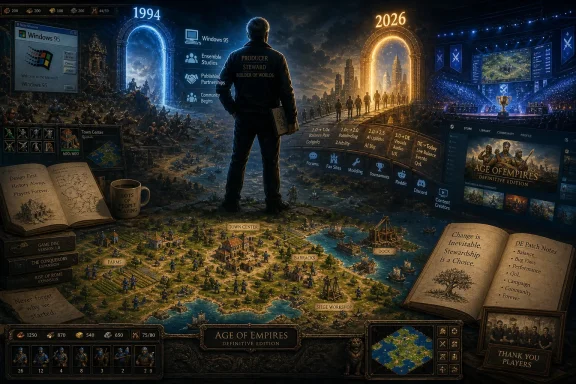 Microsoft Loses a Custodian, Not Just a Credit in the Scroll
Gaming companies love to talk about franchises as if they are machines. Put in a budget, attach a brand, hire a partner studio, schedule a showcase, and out comes nostalgia with a new coat of pixels. The Age of Empires comeback showed how false that view can be.Yuen was not the original inventor of Age of Empires, and the franchise’s modern revival was never a one-person act. But his repeated executive and production roles across the Definitive Edition era made him one of the people who translated Microsoft’s archive into a living product line. That work is less glamorous than greenlighting a new tentpole, and it is often more delicate.
The old Age games were not dead because players stopped caring. They were dormant because the business around them had moved on. Ensemble Studios had closed, RTS had fallen from its late-1990s commercial peak, and Microsoft’s gaming identity had become increasingly console-shaped after Xbox. Bringing Age back required more than nostalgia; it required a production model that treated old code, old expectations, and old communities as assets rather than liabilities.
That is the kind of work long-tenured producers do when companies let them. They know which promises are cheap and which ones become support nightmares. They know when “modernization” risks sanding off the very friction that kept a community loyal. And they know that a franchise with a quarter-century of player habits cannot be relaunched as if it were a new intellectual property with a marketing beat and a patch roadmap.
The Age of Empires Revival Was a Bet Against Industry Fashion
The modern Age of Empires run looks obvious only in hindsight. Age of Empires: Definitive Edition arrived in 2018, followed by Age of Empires II: Definitive Edition in 2019, Age of Empires III: Definitive Edition in 2020, and Age of Empires IV in 2021. Age of Mythology: Retold followed in 2024, extending the restoration playbook beyond the mainline historical series.That sequence was not merely a remaster campaign. It was Microsoft rebuilding a PC strategy ecosystem one title at a time, while much of the industry chased battle passes, cinematic action games, extraction shooters, and forever-platform dreams. Age of Empires remained stubbornly itself: base building, villager economies, scouting, build orders, readable terrain, and the delicious panic of hearing the attack horn before your walls are ready.
Microsoft also made a structural choice that mattered. World’s Edge, the studio organization responsible for the franchise, has operated less like a traditional single-game developer and more like a steward, coordinating with partner studios and maintaining a long-term franchise strategy. That model is easy to criticize because it diffuses authorship. It is also one reason Age could receive multiple Definitive Editions, expansions, console adaptations, and ongoing balance support without depending on a single monolithic studio pipeline.
Yuen’s public role in that system made him a bridge between several Microsofts. There was the old Microsoft of boxed PC software and CD-ROM strategy games. There was the Xbox Microsoft of publishing relationships and portfolio management. And there is the current Microsoft, which must justify gaming investments across PC, console, cloud, Game Pass, Steam, PlayStation releases, and a sprawling first-party empire.
Thirty-One Years Is a Long Time in an Industry That Forgets Quickly
Yuen’s retirement post framed his career with warmth rather than corporate mythology. He said that when he joined Microsoft in 1994, the internet was still finding its feet and game development looked very different. That line is almost comically understated.In 1994, Windows 95 had not yet shipped. Microsoft was still fighting to define the consumer PC as a mainstream entertainment device. Online multiplayer was primitive, retail boxes mattered, and “games on Windows” was not yet a settled cultural category. Over the next three decades, Microsoft would help normalize PC gaming, stumble through Games for Windows branding, launch Xbox, close and acquire studios, absorb Mojang, buy ZeniMax, buy Activision Blizzard, and turn Game Pass into the strategic center of its gaming story.
A career spanning that entire arc is rare. The games industry is famous for burnout, layoffs, studio closures, and reinvention under duress. Many people leave because the work becomes unsustainable. Others are pushed out when a strategy changes, a project fails, or a merger makes their role redundant. A voluntary retirement after 31 years is therefore not just a personal milestone; it is an institutional one.
It also lands at a complicated moment for Microsoft Gaming. The company has spent years arguing that scale will let it serve more players across more devices. Yet the wider industry has been marked by layoffs, canceled projects, and questions about whether subscription economics can support the creative breadth they promise. Against that backdrop, a veteran producer leaving on affectionate terms is a gentler story, but it still underlines the same pressure: Microsoft’s gaming future will increasingly be run by people who did not grow up inside the original PC software culture that made franchises like Age possible.
Age of Empires Became Microsoft’s Unlikely Proof of Patience
The most interesting thing about the Age resurgence is that it did not follow the normal revival script. Microsoft did not simply slap a beloved logo on a modern genre template. It rebuilt the classic games with enough fidelity to satisfy old players while making them accessible to new ones through improved visuals, quality-of-life changes, matchmaking, modern storefronts, and, eventually, console controls.Age of Empires II is the clearest example. The 1999 original never really disappeared; it survived through competitive communities, modders, fan sites, LAN memories, and a long tail of players who knew exactly how the game was supposed to feel. A careless remaster could have alienated that base instantly. Instead, the Definitive Edition became a foundation for new expansions, esports activity, and a larger public identity for a game that might otherwise have been treated as museumware.
That success matters because Microsoft owns a vast catalog of dormant or underused games. Some of them deserve revival; many probably do not. The lesson from Age is not that every old franchise needs a remaster. The lesson is that a revival works when the company understands the culture around the game as deeply as the asset value of the brand.
This is where veterans like Yuen become hard to replace. A spreadsheet can identify a franchise with recognition. A producer with context can identify what must not be broken. In strategy games, those are often small things: unit responsiveness, readable silhouettes, hotkey expectations, pathfinding tolerances, lobby behavior, and the cadence of balance updates. Players may argue about all of them forever, but the arguments themselves are evidence of a living community.
The Human Part of Production Is Usually Invisible Until Someone Leaves
Game production is a strange discipline because, when it works, it is often invisible. Players remember designers, directors, composers, streamers, and studios. Producers tend to appear in credits, interviews, anniversary streams, and crisis moments. Their fingerprints are everywhere and nowhere.Yuen’s farewell message was notable because it acknowledged the social fabric of the work: trust, partnership, support, friendship. That may sound like retirement-card language, but in a franchise like Age of Empires it is operationally meaningful. The modern series depends on coordination among internal Microsoft teams, external developers, community managers, localization groups, platform teams, tournament organizers, and players who often know the games at a forensic level.
The Age revival also had to manage a rare combination of audiences. There were players who wanted a childhood memory preserved. There were competitive players who wanted rigor and balance. There were new Game Pass users discovering the genre. There were console players encountering a traditionally mouse-and-keyboard RTS through controller adaptations. Each group wanted a slightly different version of authenticity.
That is why the “production meetings” joke in Yuen’s farewell lands so well. The romantic version of game development imagines inspiration. The real version is calendars, dependencies, builds, certification, patch notes, platform requirements, community messaging, and the endless negotiation between ambition and ship date. If Yuen is looking forward to playing games without meetings attached, it is because he spent decades helping turn other people’s play into a product Microsoft could actually support.
Microsoft’s Gaming Memory Is Becoming a Strategic Asset
There is a temptation to treat retirements like Yuen’s as purely sentimental. Long career, beloved franchise, nice farewell, on to the next news cycle. That misses the bigger industry pattern. As publishers consolidate and portfolios grow, the ability to remember why old games worked becomes a competitive advantage.Microsoft now controls one of the largest catalogs in gaming. It owns properties associated with PC strategy, console shooters, Western RPGs, immersive sims, platformers, racing games, survival games, and mobile megafranchises. The challenge is not merely owning them. The challenge is knowing when to revive, when to preserve, when to reboot, and when to leave a thing alone.
Age of Empires offers one template: respect the existing community, modernize the access points, and build a durable pipeline around updates and expansions. But even that template depends on judgment. The same approach that works for Age may not work for Hexen, Banjo-Kazooie, MechAssault, Freelancer, or any number of names fans routinely summon whenever Microsoft talks about its back catalog.
The company’s biggest risk is assuming that brand recognition can substitute for stewardship. It cannot. The older the franchise, the more players carry a private version of it in their heads. A successful revival does not perfectly match all of those memories, but it shows that the people making decisions understand why the memories formed in the first place.
The Windows Story Was Always Part of the Games Story
For WindowsForum readers, Yuen’s retirement has a second resonance. Age of Empires is not just an Xbox Game Studios property; it is part of the Windows gaming lineage. It belongs to the era when the family PC was the game machine, the homework machine, the dial-up machine, and the thing in the front room that everyone fought over.That matters because Microsoft’s gaming identity has often seemed split between Windows and Xbox. Xbox gave Microsoft a living-room brand and a hardware platform. Windows gave it the open-ended ecosystem where strategy games, mods, custom scenarios, LAN parties, and weird input habits could flourish. Age of Empires sits firmly in that second tradition, even as it has expanded onto consoles.
The Definitive Edition era helped reconcile those identities. The games appeared through Microsoft’s modern publishing infrastructure while still feeling fundamentally PC-native. Their availability on Steam was especially important, because it signaled that Microsoft understood where PC strategy players actually lived. Game Pass mattered too, but Steam mattered culturally.
This is one reason the Age revival became a quiet credibility win. Microsoft was not simply asking PC players to enter its ecosystem on Microsoft’s terms. It was meeting them in the places where they already had libraries, friends lists, habits, and expectations. For a company with Microsoft’s long history of trying to shape platforms around itself, that was a meaningful concession to reality.
The Franchise Yuen Leaves Behind Is Stronger Than the One He Inherited
Yuen leaves at a moment when Age of Empires is not merely remembered; it is active. Age of Empires IV gave the series a new mainline entry. The Definitive Editions continue to serve distinct communities rather than collapsing everything into one product. Age of Mythology: Retold widened the revival to a sibling series with its own mythology, mechanics, and fan expectations.That is an unusually healthy position for a franchise born in 1997. Many games from that era survive as nostalgia objects, speedrun curiosities, or entries in subscription catalogs. Age survived as a playable ecosystem. It is old enough to be intergenerational and current enough to still receive meaningful development.
The credit for that belongs to many teams, including Forgotten Empires, Relic, Tantalus, World’s Edge, Xbox publishing, and the community that refused to let the series become a memory. But Yuen’s departure is a reminder that continuity has faces. When players say “Microsoft brought Age back,” what they often mean is that enough people inside Microsoft cared long enough to make the revival coherent.
That care is not guaranteed. Corporate priorities shift. Executives leave. Metrics change. A franchise can be healthy in one planning cycle and expendable in another. The best thing Microsoft can do now is prove that the Age revival was not dependent on one generation of internal champions.
The Next Test Is Whether Stewardship Survives Succession
Retirements are succession stories whether companies frame them that way or not. If the systems are strong, the work continues. If the systems were really a handful of experienced people holding complexity together by force of memory, the cracks appear later.World’s Edge now has to show that Age of Empires has matured into a durable Microsoft institution rather than a successful revival campaign. That means continuing to support older titles without letting them cannibalize one another. It means treating console expansion as an addition, not a redesign mandate. It means resisting the urge to turn every community into a monetization surface just because the broader industry has trained executives to see recurring engagement everywhere.
It also means developing new leaders who can speak to players with credibility. Age fans are not passive consumers of brand content. They parse patch notes, compare unit frame data, debate civilization bonuses, maintain mods, and remember every broken promise. The franchise’s relationship with its audience is not always easy, but it is unusually knowledgeable.
Yuen’s farewell was gracious because he could afford to be. He leaves behind a series that is visibly alive. The harder question belongs to Microsoft: can it keep the same patience when the people who helped rebuild the bridge are no longer walking across it every day?
The Empire Yuen Helped Rebuild Now Has to Govern Itself
Yuen’s retirement is not a crisis for Age of Empires, and treating it as one would overstate the role of any single producer. But it is a useful moment to separate what is concrete from what is merely sentimental. The franchise is stronger than it was a decade ago, and Microsoft’s next obligation is to prove that strength is institutional.- Earnest Yuen announced his retirement from Microsoft on June 19, 2026, after a 31-year career that began in 1994.
- His public Microsoft gaming legacy is closely tied to the Age of Empires revival, including the Definitive Edition era and the broader work of World’s Edge.
- The Age resurgence succeeded because Microsoft treated the games as living communities rather than disposable nostalgia brands.
- Yuen’s departure comes at a time when Microsoft’s gaming business is larger, more complex, and more dependent on long-term portfolio discipline than ever.
- The next phase for Age of Empires will test whether Microsoft can preserve the patience and PC credibility that made the revival work.
References
- Primary source: Windows Central
Published: 2026-06-20T13:48:08.394521
"I leave feeling grateful, proud, and excited": After 31 years, Age of Empires veteran Earnest Yuen retires | Windows Central
After contributing to over 50 products and guiding a massive RTS strategy resurgence, a legendary Microsoft gaming figure steps down.www.windowscentral.com - Related coverage: mobygames.com
Age of Empires II: Definitive Edition credits (Windows, 2019) - MobyGames
The official game credits for Age of Empires II: Definitive Edition released on Windows in 2019. The credits include 1,319 people.www.mobygames.com
- Related coverage: ageofempires.com
A new age begins - A letter to the community from Earnest Yuen - Age of Empires - World's Edge Studio
To our amazing players around the world, prostagma!www.ageofempires.com - Related coverage: igdb.com
Age of Empires: Definitive Edition - Credits
Age of Empires, the pivotal RTS that launched a 20-year legacy returns in definitive form for Windows 10 PCs. Bringing together all of the officially...www.igdb.com
- Related coverage: linkedin.com
- Related coverage: gamespot.com
Age of Empires - GameSpot
This is not quite the game you hoped for. Even worse, it has some definite problems.www.gamespot.com
- Related coverage: museumofplay.org
