

NASA and Microsoft have moved Earth science one step closer to everyday use by finalizing a production-grade version of Earth Copilot, an AI-driven, multi-agent tool designed to make massive hydrology and geospatial datasets — including the new NLDAS-3 land data assimilation stream — accessible to non‑specialists across government, industry, and communities.
Earth Copilot began as a prototype between NASA and Microsoft to simplify interaction with NASA’s Earth science data stores. The project’s two headline goals are straightforward: (1) turn complex geospatial and hydrologic data into actionable, human-friendly answers, and (2) provide those answers in reproducible maps, charts, and plain-language explanations rather than in raw binary data formats that require specialist tools.
The partnership builds on three complementary capabilities:
These features matter because water managers and emergency planners need spatially granular, historically consistent datasets to detect trends, simulate scenarios, and operationalize responses. A 1‑km grid can capture watershed variability and local terrain influence in a way that coarse (~12 km) grids cannot.
Why this is important: Earth Copilot’s value depends on the trustworthiness of the data it references. High‑resolution, assimilation‑informed products like NLDAS‑3 enable the copilot to answer both “what happened?” and “what might happen next?” with better spatial fidelity.
This hybrid approach — LLM for interpretation + deterministic data calls for values and visual evidence — is critical to reduce hallucinations and produce defensible, reproducible answers.
Confirmed, independently verifiable items:
Key considerations:
Notable strengths:
For IT leaders, data stewards, and Windows‑platform developers in government and civic organizations, the immediate task is pragmatic: treat Earth Copilot as a decision‑support tool, not as a fully autonomous decision‑maker. Demand reproducible outputs, insist on provenance and uncertainty disclosures, and integrate human review where consequence warrants.
When these guardrails are in place, Earth Copilot could materially shorten the time between raw observation and actionable insight — from days or weeks to minutes — and in doing so help communities, agencies, and companies prepare for and respond to an increasingly water‑constrained world.
Source: Nextgov/FCW NASA and Microsoft finalize tool to track Earth’s water changes
 Background
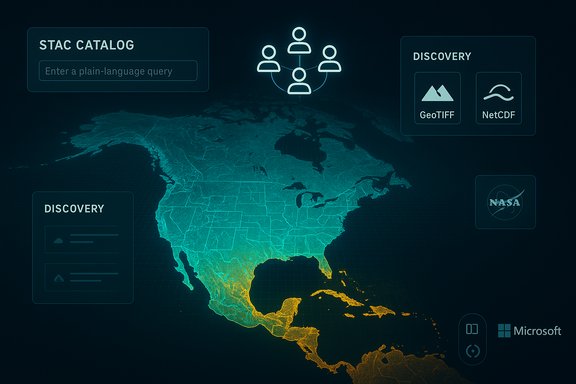
Earth Copilot began as a prototype between NASA and Microsoft to simplify interaction with NASA’s Earth science data stores. The project’s two headline goals are straightforward: (1) turn complex geospatial and hydrologic data into actionable, human-friendly answers, and (2) provide those answers in reproducible maps, charts, and plain-language explanations rather than in raw binary data formats that require specialist tools.The partnership builds on three complementary capabilities:
- NASA’s vast repository of Earth observations and next‑generation land modeling data, most notably NLDAS‑3 (North American Land Data Assimilation System, Version 3), which is designed to provide high-resolution hydrology variables useful for drought monitoring, water‑resources planning, and flood forecasting.
- Microsoft Azure’s cloud, AI, and geospatial engineering stack — including the Azure OpenAI service and Azure’s government-ready clouds — used to host models, agent orchestration, and secure environments for federal workloads.
- Developer tooling and open projects, including a public Microsoft Earth-Copilot codebase that demonstrates a multi‑agent architecture, STAC-enabled geospatial discovery, and containerized microservices for production deployments.
What NLDAS‑3 brings to the table
A faster, higher‑resolution hydrology baseline
NLDAS‑3 is positioned as a substantial upgrade over prior NLDAS phases. The project goal is to deliver nearly 1‑km resolution, expanded geographic coverage across North America and parts of Central America and the Caribbean, and richer hydrologic outputs than earlier runs. Expected variables include soil moisture, water table depth, streamflow, flood fraction, surface water elevation, and terrestrial water storage.These features matter because water managers and emergency planners need spatially granular, historically consistent datasets to detect trends, simulate scenarios, and operationalize responses. A 1‑km grid can capture watershed variability and local terrain influence in a way that coarse (~12 km) grids cannot.
Near‑real‑time and retrospective utility
NLDAS‑3 is being developed to support both retrospective analysis (long historical records for trend detection and model training) and near‑real‑time products (for operational response). The intent is to blend satellite assimilation, modeled forcing, and ground‑truth inputs so that the candidate dataset is both scientifically robust and operationally useful.Why this is important: Earth Copilot’s value depends on the trustworthiness of the data it references. High‑resolution, assimilation‑informed products like NLDAS‑3 enable the copilot to answer both “what happened?” and “what might happen next?” with better spatial fidelity.
How Earth Copilot works — technical architecture (high level)
Multi‑agent orchestration
The production design moves beyond a single chatbot. Earth Copilot is described as a multi‑AI agent system: discrete agents handle query interpretation, dataset discovery, STAC translation, geospatial querying, visualization rendering, and narrative generation. That agentization has three practical benefits:- Separation of concerns — each agent has a narrowly defined role (e.g., an extraction agent that maps a plain‑language query to a set of hydrologic variables).
- Traceability — agents can log which dataset, time range, and model outputs they used, creating an audit trail for results.
- Scalability — agents can be scaled or replaced independently (e.g., swap a model that interprets queries without changing the visualization stack).
Language models and grounding
Earth Copilot uses large language models (LLMs) for intent parsing and natural‑language generation, but that alone would be insufficient. The production system couples LLM outputs with authoritative data calls — the agent either executes geospatial queries or retrieves precomputed metrics — then synthesizes the result into an explanation and visualization. The system is therefore grounded in authoritative datasets rather than relying on the model’s memorized text alone.This hybrid approach — LLM for interpretation + deterministic data calls for values and visual evidence — is critical to reduce hallucinations and produce defensible, reproducible answers.
Data formats and delivery
Outputs are not limited to text: Earth Copilot delivers maps, charts, and downloadable data formats (GeoTIFF, NetCDF, CSV) so recipients can verify or feed the same outputs into their own GIS or modeling workflows. The tool also automates STAC query generation for spatio‑temporal asset discovery and supports hybrid queries across public and private catalogs.What Microsoft and NASA are promising — and what’s been confirmed
Both agencies emphasize democratization of Earth science data and operational use cases such as disaster response, water resources planning, and environmental monitoring. Microsoft frames the collaboration as a way to convert petabytes of satellite and modeled data into practical answers for non‑technical stakeholders.Confirmed, independently verifiable items:
- NASA’s NLDAS‑3 initiative aims for higher resolution and expanded coverage with a richer set of hydrologic outputs, and is intended for real‑time and retrospective use.
- Microsoft’s Azure OpenAI services and Azure AI infrastructure are being used to host AI models and agent orchestration for geospatial workloads; Microsoft’s public development materials and cloud documentation corroborate the use of Azure AI and STAC flows in Earth Copilot prototypes.
- A public Microsoft Earth‑Copilot repository demonstrates multi‑agent patterns, STAC discovery, and mapping integrations — useful artifacts that show the architecture and produceable outputs teams are building toward.
- Exact access posture for the final production release (which federal tenants, whether Azure Government or commercial Azure, or any classified boundary) may be governed by agency agreements and accreditation processes. While Azure OpenAI has FedRAMP High and other government authorizations in relevant clouds, the specific tenancy and data sharing arrangements for Earth Copilot with federal customers are implementation details that are not fully public.
- Roadmap and release timing statements sometimes vary between prototype documentation, marketing posts, and program statements. Public materials confirm active prototyping and demonstrators; rigid production schedules and broad deployment timelines should be read as targets rather than immutable commitments.
Security, compliance, and governance — what agencies and IT teams must evaluate
Large AI-enabled services built on cloud platforms introduce a set of intertwined technical, legal, and governance considerations. For federal and critical‑infrastructure producers, the checklist is robust.Key considerations:
- Data provenance and traceability. Every answer must carry provenance metadata: which dataset (and version), date range, spatial bounds, assimilation/processing pipeline, and uncertainty or error estimates. The multi‑agent design allows provenance to be collected, but agencies must enforce it.
- Access control and tenancy. Federal use should run in appropriately accredited clouds. Microsoft’s Azure Government environments and FedRAMP High / DoD Impact Level authorizations are relevant for controlled unclassified and sensitive workloads. Agencies need to ensure Earth Copilot instances are deployed in the correct tenancy and comply with agency ATO (Authorization to Operate) processes.
- Model governance and explainability. LLMs can misinterpret ambiguous queries or generate plausible‑sounding but incorrect statements. Operational deployments must include human‑in‑the‑loop review for high‑consequence outputs, model cards, and clear labels for uncertainty.
- Data sensitivity and privacy. While hydrology data is largely non‑personal, layering datasets (e.g., critical infrastructure overlays, localized usage data) can create sensitive operational patterns. Data minimization and strict role-based access control are required.
- Supply chain and third‑party risk. Use of container images, open‑source agent frameworks, and third‑party STAC catalogs must be subject to software supply chain verification, SBOMs, and patch management.
- Continuous monitoring and drift detection. Hydrology models and assimilation inputs evolve. The copilot must include monitoring to detect when underlying datasets or model updates materially change outputs and to trigger revalidation.
Risks and limitations
Earth Copilot is a powerful tool, but it is not a magic oracle. The primary risks include:- Model hallucination and overconfidence. Even with grounding, the natural‑language front end can present outputs with confident prose that downplays uncertainty. Users may mistake narrative clarity for scientific certainty.
- Misinterpretation by non‑experts. Plain‑language UX widens access but can also lead to decisions made without appropriate domain oversight — for example, water managers choosing an operational action based solely on an AI summary without cross‑checking local sensor networks.
- Latency and operational readiness. Near‑real‑time hydrology depends on ingest latency, satellite revisit times, and assimilation cycles. Users must understand whether a given answer is based on near‑real‑time data or on retrospective reanalysis.
- Vendor lock‑in and architectural coupling. Earth Copilot prototypes run on Azure and use Azure AI services. Agencies must weigh benefits of an integrated stack against the long‑term costs of vendor lock‑in and ensure data portability.
- Regulatory and ethical challenges. Federal deployments require careful mapping to policy directives on AI use in government, data governance, and national security boundaries.
Practical implications for government IT teams and Windows‑platform administrators
For IT pros and architects who run or integrate with government systems, Earth Copilot creates immediate, practical workstreams:- Prepare to host or federate Earth Copilot copies in accredited cloud tenants (Azure Government, FedRAMP High or equivalent) when working with controlled datasets.
- Plan for identity and access management integration (Azure AD, role‑based access control), including least privilege for agent tokens and dataset query keys.
- Incorporate audit logging and SIEM ingestion for all agent actions and data requests, so analysts can trace what data fed each answer.
- Treat the UI and conversational layer as a decision‑support interface rather than an authoritative, stand‑alone decision engine. Integrate outputs into workflows that include human review and domain‑expert sign‑off.
- Adopt reproducible output packaging: require Earth Copilot to produce the exact STAC query or API call that generated each visualization so downstream analysts can reproduce results with local tools (ArcGIS, QGIS, or command‑line STAC clients).
How to evaluate and integrate Earth Copilot: a practical 7‑step checklist
- Define use cases and risk tolerance. Rank use cases by consequence (e.g., emergency flood response vs. public education) and decide where automated answers are allowed without human validation.
- Select the tenancy and controls. Choose Azure commercial, Azure Government, or specialized IL6/secret boundaries based on data classification and mission needs.
- Verify dataset versions and provenance controls. Insist the copilot return dataset IDs, processing version, and uncertainty metrics with every answer.
- Set human‑in‑the‑loop gates. For high‑impact decisions, require domain expert sign‑off and store human review metadata in audit logs.
- Integrate with SIEM and compliance tooling. Forward agent logs, API calls, and output artifacts to your monitoring and evidence collection pipeline.
- Test with red‑team and data‑validation exercises. Evaluate hallucination risk by challenging the system with ambiguous queries and cross‑checking results against independent data sources.
- Operationalize reproducibility. Require that Earth Copilot generate a machine‑readable query (STAC/GeoJSON/NetCDF request) and that outputs be exportable for downstream modeling and persistence.
Opportunities for researchers, municipalities, and Windows developers
Earth Copilot democratizes access in ways that create practical opportunities:- Local governments and water utilities can ask plain‑language questions about historical drought severity, watershed trends, or post‑fire runoff risk and receive both visualizations and the raw numbers to feed existing dashboards.
- Researchers and students can use the copilot as a discovery layer to find candidate datasets for deeper analysis, then export analysis-ready files for desktop processing in common tools on Windows (R, Python, ArcGIS Pro).
- Windows app and GIS developers can build thin clients that invoke Earth Copilot APIs for rapid situational dashboards — for example, a desktop plugin that takes a watershed polygon, runs an Earth Copilot query, and ingests the resultant streamflow timeseries into local analyses.
- Integrators and system builders can wrap Earth Copilot outputs into policy automation and alerting systems, provided proper review gates exist for high‑risk actions.
Governance and policy: what agencies should demand
Agencies procuring Earth Copilot instances or similar AI‑enabled geospatial copilots should insist on explicit contract language that covers:- Provenance and reproducibility clauses (every produced narrative must include data origin, model version, and query).
- Right to audit and inspect the model pipeline, agent code, and container images.
- Service level commitments for data latency, uptime, and throughput in disaster response scenarios.
- Data portability to ensure outputs and data remain usable if the agency switches vendors or cloud tenants.
- Security baselines (FedRAMP/FISMA mappings, supply chain SBOMs, and vulnerability remediation SLAs).
Balance of promise and caution — critical analysis
Earth Copilot represents a pragmatic, well‑scoped use of generative AI: using LLMs for intent parsing and narrative synthesis, while coupling them with authoritative geospatial datasets for numeric answers and maps. The hybrid architecture addresses one of the biggest shortcomings of conversational AI in scientific domains — the tendency to generate ungrounded claims.Notable strengths:
- Lowered barriers to entry. Non‑technical users gain faster access to complex datasets, which can accelerate decisions in emergency response and planning.
- Traceability potential. Multi‑agent logging and STAC‑based discovery create an opportunity for reproducible answers if implemented rigorously.
- Cloud scale and integration. Running on Azure enables on‑demand computation, containerized services, and direct integration with a mature enterprise security stack.
- Overreliance on cloud vendor stack. Tight coupling to one vendor’s managed services increases long‑term lock‑in risk unless portability is engineered from the outset.
- Residual hallucination and confidence signalling. Even grounded systems must calibrate how they present uncertainty; a friendly narrative voice can unintentionally understate risk or error bounds.
- Operational accreditation is nontrivial. For federal adoption, agencies must still complete authorization processes, verify tenancy configurations, and satisfy unique mission constraints. The presence of FedRAMP‑authorized Azure services eases the path, but does not remove the need for agency ATOs and continuous monitoring.
- Public materials confirm prototypes and demonstrators, but the exact scope of the “final” product being pushed to all U.S. government agencies — including timelines, tenant boundaries, and service levels — depends on agency agreements and accreditation that are not fully public. Treat deployment headlines as credible signals of capability rather than firm SLAs until formal contract and accreditation documents are available.
What WindowsForum readers should watch next
- How agencies incorporate Earth Copilot into existing incident management workflows, and whether they mandate human verification thresholds for automated insights.
- Whether Microsoft and NASA publish machine‑readable provenance outputs by default (STAC queries, dataset version IDs, and error/uncertainty fields) or only provide human‑readable summaries.
- Whether the Earth Copilot architecture remains tied to Azure‑native services, or whether modular, portable deployments (e.g., Kubernetes + open LLMs + Planetary Computer STAC) appear that provide alternatives to organizations seeking vendor-agnostic stacks.
- Publication of independent validation tests and red‑team results demonstrating how the copilot performs on ambiguous queries and its error rates in real‑world hydrologic scenarios.
Conclusion
Earth Copilot is an important example of applied AI meeting applied science: it blends natural‑language fluency with hydrology and geospatial modeling so users without domain expertise can ask relevant, operational questions about water on our planet. The technical foundation — a multi‑agent orchestration layer, STAC‑driven discovery, and a high‑resolution hydrology backbone like NLDAS‑3 — addresses many of the classic obstacles to turning remote sensing into decisions.For IT leaders, data stewards, and Windows‑platform developers in government and civic organizations, the immediate task is pragmatic: treat Earth Copilot as a decision‑support tool, not as a fully autonomous decision‑maker. Demand reproducible outputs, insist on provenance and uncertainty disclosures, and integrate human review where consequence warrants.
When these guardrails are in place, Earth Copilot could materially shorten the time between raw observation and actionable insight — from days or weeks to minutes — and in doing so help communities, agencies, and companies prepare for and respond to an increasingly water‑constrained world.
Source: Nextgov/FCW NASA and Microsoft finalize tool to track Earth’s water changes
