

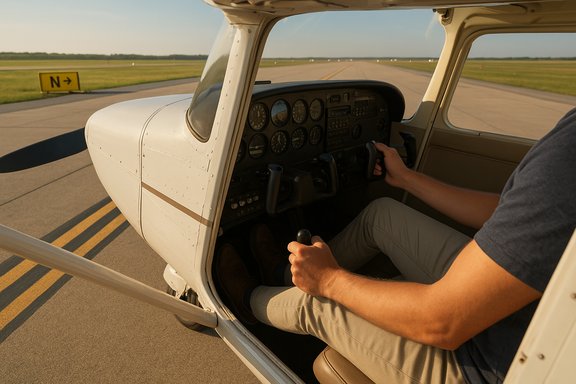
When you’re taxiing, the small choices you make with your feet matter almost as much as the decisions you make with your hands — and one persistent pilot habit, riding the brakes, quietly costs safety, money, and control. AOPA’s recent training tip — “Easy on the brakes” — is a concise, practical reminder for pilots and instructors: keep your heels on the floor, steer with the rudder, use the throttle to regulate speed, and avoid simultaneous throttle-and-brake conflict. That simple guidance hides a long list of technical consequences and human-factor traps that merit a deeper look if instructors and pilots want to reduce wear, avoid ground damage, and maintain positive control on the movement area.
Background
What AOPA told pilots
AOPA’s “Heels down for the win” tip frames the problem as a common behavioral habit: pilots who are nervous about speed habitually slide their feet up and apply gentle pressure to the toe brakes while nudging power — effectively trying to control speed with both power and brakes at once. The article recommends a feeling-based approach to taxi speed (not a fixed number), suggests a single-engine piston rough target of up to about 10 knots in a straight, dry, calm taxi, and emphasizes reducing speed before turns, slowing further in wet or icy conditions, and deliberately practicing the “heels on the floor” technique until it becomes instinctive. The piece also includes a CFI tip: teach proper taxi technique from the first lesson to avoid bad habits.Why this deserves attention
Taxi operations are low-altitude, crowded, and high-attention tasks. The movement area is where propellers, wingtips, fuel trucks, ground personnel, and other aircraft converge. Poor taxi technique increases the probability of:- Runway or taxiway incursions
- Propeller or ground-object strikes
- Tire or wheel failures from sudden high side loads
- Excessive brake heat and wear, potentially degrading braking effectiveness later in flight operations
- Masking of rudder inputs, resulting in poorer directional control
The mechanics: why “riding the brakes” is a technical problem
Heat, glazing, and brake fade
Brakes are friction devices designed to absorb kinetic energy. Continuous light pressure — the classic definition of brake riding — generates heat without giving the system the cooling and friction regime needed to reach stable operating conditions. Modern high-performance materials (including carbon brakes on larger turboprops and airliners) actually require a positive initial application to come up to effective temperature. Repeated light snubbing or holding a few pounds of pressure during taxi converts pads and rotors to heat and dust, accelerates lining wear, and can lead to glazing of the friction surface. That glazing reduces friction coefficient and can hide the true braking response until a more aggressive brake application is needed. Airline/aircraft operators explicitly warn crews to avoid brake riding and to manage taxi speed with thrust or idle settings rather than the toe brakes.Masked steering and degraded directional control
Brake pressure applied unintentionally masks true rudder inputs. In tricycle-gear airplanes the rudder is the primary directional control during taxi — the pedals connect to rudder surfaces and, on many models, to nosewheel steering. If your toes rest on the brake portion of the rudder pedals, small inadvertent pressures will cause differential braking or slow, unpredictable steering responses. The result is a twitchy, over-controlled taxi that discourages smooth rudder-only steering and increases the chance of an overly-tight turn (with high side loads) or an uncontrolled swerve. The FAA recommends initial foot placement with heels on the cockpit floor and the ball of the foot on the rudder pedals; slide the foot up only when intentional braking is required.Tire, wheel, and hub stress on tight turns
Attempting a sharp turn at too-high taxi speed — especially when aided with brakes to tighten the radius — puts lateral loads on wheels and hubs that were not designed for dynamic cornering at speed. Low tire pressure or worn tires increase the chance of a tire rolling off its bead during a hard taxi turn. Several training briefs and safety articles highlight that “don’t taxi faster than a brisk walk” remains a practical rule of thumb for many light singles; faster taxiing can develop wing lift, reduce wheel loads, and compromise steering and braking.How to taxi: practical, repeatable technique
The airmanship fundamentals (short checklist)
- Heels on the floor. Rest heels firmly on the cockpit floor; the balls of the feet are positioned to steer via rudder and nosewheel steering. Slide the heel up only to make intentional brake applications.
- Throttle for speed; brakes for stopping. Use small power changes to regulate taxi speed; reduce power before applying brakes. Never hold throttle and brakes together as a speed control method.
- Anticipate turns. Reduce speed before corners; expect tighter radii and slow to a walking pace for sharp turns.
- Test brakes immediately. When you first start to taxi, apply a brief brake test to confirm operation. If braking action feels unusual, shut down and troubleshoot.
- Be defensive in poor surface conditions. Wet, icy, or contaminated taxiways require even lower speeds and greater margins; braking effectiveness drops quickly.
Numeric guidance — context, not a mandate
AOPA’s practical “rough guide” for a light single suggests up to about 10 knots in a straight, dry, calm taxi, reducing to walking speed for turns or constrained areas. That number is intentionally a feeling reference — not a universal limit — because aircraft type, wind, runway/taxiway condition, and operator SOPs differ. The FAA cautions that it is difficult to set a safe taxi speed rule applicable to all situations; the safe speed is that at which the airplane will stop promptly when power is closed. For turboprops and airliners, operator manuals may allow higher taxi speeds in some segments (airline materials sometimes reference taxi speed limits up to 30 knots in specific operational guidance), but the underlying principle — control first — is universal. Treat the “10-knot guideline” as an instructional anchor for small piston airplanes, not a legal or technical mandate.The CFI’s playbook: prevent the habit early
Law of primacy: teach it right the first time
Instructional psychology is clear: habits form fast. Demonstrate correct foot placement and throttle/brake sequencing on the very first taxi lesson. Let students experience the difference between rudder-only steering and brake-assisted steering. Explain the maintenance and safety consequences of brake riding — it reinforces the behavioral rationale behind technique and makes the habit stick. AOPA explicitly recommends these early demonstrations as a top priority for instructors, and the Air Safety Institute’s Flight Instructor Refresher Course (eFIRC) collects scenario-based modules that focus on real-world technique reinforcement.Training drills instructors can use (practical sequence)
- Demonstration taxi: instructor controls; student watches and notes foot position.
- Student taxi straightaway: maintain a steady target speed (feel-based) using throttle only; practice stopping by closing the throttle and using a single deliberate brake application.
- Slow-turn drill: taxi to a preselected point, slow to walking pace, and execute an intentional 90° turn using rudder and, if necessary, one firm brake application.
- Surprise stop: while taxiing straight at slow speed, student practices bringing the plane to a smooth full stop using deliberate heel-lift braking only.
- Debrief with tactile contrast: let student feel brake-side vs. heel-down foot positioning. Repeat until heel-on-floor becomes automatic.
Aircraft-specific considerations
Tailwheel airplanes
Tailwheel (conventional gear) airplanes often require differential braking to taxi at very low speeds because the rudder is ineffective until there’s airflow. That means some brake use is unavoidable; the difference is how the brakes are used. The FAA and training literature advise finesse: apply small, positive brake inputs for tight, low-speed maneuvers and anticipate the airplane’s tendency to “weathervane.” Over-application can cause rapid directional changes or even a nose-over if exaggerated.Turboprops and jets
Large turboprops and jets have different brake materials (often carbon) and steering characteristics. Operating manuals and airline training materials sound a consistent theme: avoid light, continuous brake pressure, and manage taxi speed primarily with power settings and (on some types) autobrake or system-specific taxi modes. On some transport-category aircraft, higher taxi speeds are acceptable within SOP limits (e.g., up to 30 knots in some contexts), but the procedural entry criteria and runway/taxiway layout define whether that speed is safe. For these aircraft, the operator’s manual is the authoritative source.Maintenance and cost impact
Wear cycles and life expectancy
Brake life is a function of the number and severity of applications and the temperature at which pads operate. Continuous light applications accelerate pad wear and can reduce the intervals between maintenance events. On high-value braking systems (carbon composites on airliners and turboprops), improper taxi braking can shorten component life and increase overhaul costs. For general aviation aircraft, premature brake wear means more frequent pad changes and potentially costly inspections if overheating causes wheel or seal damage.Hidden hazards: fluid boil and vapor lock
If brakes are held lightly for extended periods, heat buildup can eventually elevate brake-fluid temperature, risking local vaporization. Vapor in the hydraulic lines reduces braking effectiveness and can create spongy pedal feel when a full stop is needed — exactly when you want crisp, positive braking. Modern training materials caution pilots that heavy braking during taxi, especially when brakes are cold then rapidly heated, can cause inconsistent brake performance.Human factors: why pilots do it and how to fix it
The anxiety reflex
Taxiing is often a mentally busy phase: checklists, ATC calls, passenger movement, and environmental scanning all compete for attention. When pilots feel they’re going too fast, the immediate, intuitive reaction is to apply a toe to the brakes — it feels like instant comfort. Unfortunately, that reflex becomes a self-reinforcing loop: brake-riding makes smooth rudder steering harder, which increases pilot anxiety and leads to more braking.Build confidence with measurable exercises
Replace the reflex with an evidence-based motor program:- Use a stopwatch over a measured taxi segment: practice maintaining a consistent throttle setting that produces a repeatable, comfortable ground speed.
- Use visual references (airport signs, taxiway centerline markings) to judge speed and stopping distance.
- Practice “idle-and-stop” drills: ease to idle, close the throttle, then use a single, deliberate brake application to stop. Repeat until the pilot trusts that closing the throttle alone will arrest motion.
When things go wrong: corrective actions and emergency cues
- If steering feels mushy or brakes don’t respond as expected during the brake test, stop and investigate. A suspected brake system malfunction on the ground is an immediate safety issue.
- If surface contamination (ice, slush, fuel) reduces braking effectiveness, use very conservative taxi speeds and avoid abrupt turns. Reduce speed well before intersections or personnel areas.
- If you experience sudden, unexpected acceleration while taxiing, close the throttle immediately, apply firm braking as required, and call for assistance if the aircraft will not stop. Don’t attempt to maintain speed with combined throttle-and-light-brake pressure.
A sample pre-taxi mnemonic pilots can use
- H: Heels down (setup)
- A: Apply small power for movement only
- R: Rudder-centered steering; look outside for hazards
- D: Decrease power before braking
- S: Stop-and-reset if unsure
Risks not to ignore
- Runway/taxiway incursions: higher taxi speeds and poor situational awareness shorten reaction time to ATC calls and other traffic.
- Tire and hub damage: tight, brake-assisted turns at speed increase lateral loads, raising the chance of tire roll-off or wheel damage.
- Brake overheating: repeated light applications cause heat buildup and glazing, shortening component life and risking degraded stopping power later when it’s needed.
- Masked control inputs: inadvertent toe pressure reduces effective steering precision, making evasive maneuvers harder.
Conclusion: small habit, big payoff
Taxi technique is a compact skill set with outsized returns. The simple discipline of heels on the floor, throttle-first speed control, and deliberate braking not only saves brake pads and maintenance dollars — it reduces the likelihood of ground damage and increases the pilot’s margin for safe decision-making in a crowded, dynamic environment. For instructors, the payoff comes from primacy: teach it correctly on lesson one and the bad habit never forms.Remember the practical mantra from AOPA: power or brakes — not both. If in doubt, idle the throttle, come to a controlled stop, set your feet consciously with heels down, and start again with measured power. That small discipline preserves aircraft systems, prevents incidents, and builds the kind of smooth, confident taxi that becomes indistinguishable from expert airmanship.
Key references used to verify guidance and technical points: FAA Airplane Flying Handbook for taxi fundamentals and foot positioning; Cirrus flight operations and POH guidance regarding brake heat and taxi RPM limits; Q400 and turboprop operator guidance on carbon brake behavior and the need to avoid brake riding; and AOPA’s Training & Safety Tip “Easy on the brakes” for the instructional framing and practical CFI tip.
Source: AOPA Training and Safety Tip: Easy on the brakes
