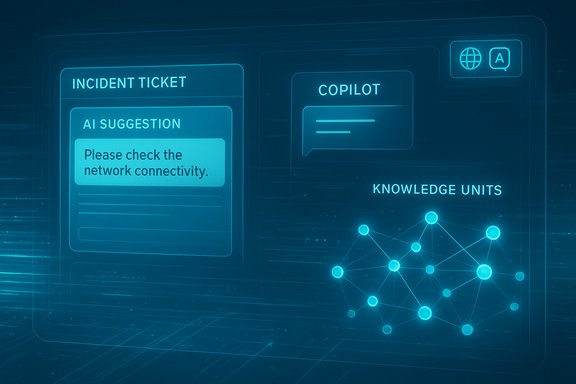
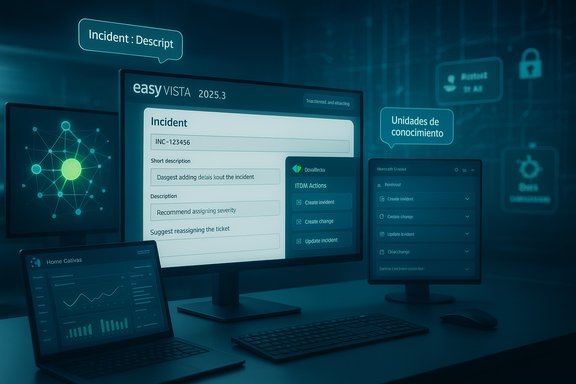
EasyVista’s 2025.3 platform release lands as the year’s capstone update, positioning the EasyVista ITSM Platform as a more tightly data-governed foundation for AI-driven service management while embedding practical AI features—automated ticket summarization with translation, AI suggestions in incident workflows, a Microsoft Copilot chatbot, a node-based knowledge model, and expanded agent workspace customization.
EasyVista has steadily pursued a vision of “everyday AI” for IT service management throughout 2025, shipping multiple releases that layer intelligence into routine workflows while emphasizing operational stability and data quality. The 2025.3 update, announced as the third and final release of the year, claims to complete that roadmap by hardening the platform’s data and knowledge foundations so AI can make reliable recommendations—and, eventually, act—with less risk.
This release arrives against a market backdrop in which many organizations are accelerating AI and automation plans but lack mature ITSM practices. Vendor research cited with the release highlights a persistent readiness gap: automation and AI are top priorities for many IT organizations even where only a small fraction report mature ITSM frameworks. The gap between ambition and foundation is the central problem EasyVista says 2025.3 aims to address.
However, the reliability of suggestions will directly depend on:
That said, Copilot integrations introduce important considerations:
The release’s signal is clear: making AI genuinely useful in ITSM demands attention to the plumbing—schemas, knowledge modularity, and governance—just as much as it demands sophisticated models. Organizations that pair the new capabilities with disciplined process improvement, governance, and measurement stand to gain productivity and speed. Those that expect AI features alone to transform immature ITSM practices will likely be disappointed.
For enterprises weighing EasyVista 2025.3, the practical path forward is to adopt selectively, pilot broadly, and institutionalize the human controls that keep recommendation-driven automation safe, compliant, and trustworthy. The platform provides the tools; realizing the promised AI-driven gains depends on process maturity, governance, and ongoing operational discipline.
Source: The AI Journal EasyVista Introduces 2025.3 Platform Release, Advancing a Reliable Data Backbone for AI-Powered ITSM | The AI Journal
 Background
EasyVista has steadily pursued a vision of “everyday AI” for IT service management throughout 2025, shipping multiple releases that layer intelligence into routine workflows while emphasizing operational stability and data quality. The 2025.3 update, announced as the third and final release of the year, claims to complete that roadmap by hardening the platform’s data and knowledge foundations so AI can make reliable recommendations—and, eventually, act—with less risk.This release arrives against a market backdrop in which many organizations are accelerating AI and automation plans but lack mature ITSM practices. Vendor research cited with the release highlights a persistent readiness gap: automation and AI are top priorities for many IT organizations even where only a small fraction report mature ITSM frameworks. The gap between ambition and foundation is the central problem EasyVista says 2025.3 aims to address.
What’s in 2025.3: Feature breakdown
AI suggestions inside incident workflows
- EV Pulse AI Suggestions are surfaced directly within incident screens to provide contextual next steps for agents.
- The feature is framed to reduce time-to-resolution by giving agents targeted actions—knowledge articles, probable causes, and remediation steps—based on incident context.
- The delivery model emphasizes inline, actionable suggestions rather than an external “insights” dashboard.
Automated ticket summarization and built-in translation
- The platform now offers automated ticket summarization, producing concise incident synopses intended for faster triage and handoff.
- Summaries include built-in translation, enabling global teams to work across languages without manual conversion.
- This feature targets multi-regional support operations and aims to speed SLA adherence when tickets move between language boundaries.
EV chatbot for Microsoft Copilot
- EasyVista introduces an EV chatbot integration for Microsoft Copilot, enabling ticket creation, updates, and simple incident management directly from Copilot chat.
- The integration reflects the industry-wide push to make Copilot a central conversational surface that can call into enterprise systems.
- This capability is intended to let agents and knowledge workers interact with ITSM functions without switching context from their Copilot-enabled workspace.
Node‑based, AI‑optimized knowledge model
- A new node-based knowledge model (referred to in EasyVista materials as “Knowledge Units” or similar) restructures knowledge into modular, machine-friendly components.
- These nodes are designed for recomposition by AI: smaller, validated knowledge pieces that can be stitched together into context-specific answers.
- The model is explicitly optimized for AI consumption—improving retrieval relevance and reducing brittle long-form article mismatch with AI prompts.
Expanded Home Canvas for agent workspaces
- Home Canvas is EasyVista’s customizable agent workspace; the 2025.3 release expands its configurability and widget library.
- The update emphasizes personalized agent views, letting teams place the most relevant AI suggestions, SLAs, dashboards, and ticket lists front and center.
Technical and product analysis
A “data backbone” for AI: what it means
EasyVista frames 2025.3 as more than a collection of features; it positions the release as a data and knowledge foundation for trustworthy AI. In practical terms, this encompasses:- Data standardization: harmonizing ticket, CI, and asset schemas to reduce noise for AI models.
- Knowledge curation workflows: tools to validate, version, and break down articles into nodes that AI can safely consume.
- Operational stability: incremental improvements to logging, concurrency handling, and API robustness that matter when automation acts on live systems.
AI within workflows vs. “AI elsewhere”
Embedding AI suggestions directly inside incident and agent screens is a smart usability decision. Where many vendors present AI findings in separate dashboards, inline suggestions reduce cognitive load and context switching. The new approach should accelerate adoption by making AI part of the agent’s routine, not an optional extra.However, the reliability of suggestions will directly depend on:
- the quality of the node decomposition,
- the precision of retrieval and ranking,
- guardrails for hallucination and outdated knowledge.
Copilot integration: opportunity and complexity
Integrating with Microsoft Copilot is strategically valuable. Copilot is rapidly becoming the default conversational assistant for knowledge workers, and connecting ITSM actions to that conversational surface reduces friction for users who prefer chat-based interactions.That said, Copilot integrations introduce important considerations:
- Security and governance: what identities and privileges are exposed through the Copilot-to-ITSM channel?
- Auditability: are Copilot-driven ticket updates fully auditable and traceable to human approvals where needed?
- Latency and reliability: connecting through multiple cloud services increases points of failure.
Strengths: where 2025.3 shines
- Practical AI features — Automated summarization, translation, and inline suggestions are immediately useful and likely to reduce repetitive tasks.
- Focus on knowledge quality — A node-based model is a pragmatic way to make knowledge assets machine-friendly, enabling better retrieval and avoiding brittle long-form document issues.
- Plugging into Microsoft’s ecosystem — Copilot integration and Teams application updates meet users where they already work, increasing the chance of real adoption.
- Customization for agents — Expanded Home Canvas gives teams the flexibility to design agent experiences that reflect operational realities.
- Operational stability emphasis — Making AI useful isn’t just about models; it’s about stable APIs, quality data, and predictable behavior. EasyVista’s narrative and engineering emphasis align with that reality.
Risks and caveats
Vendor claims vs. independent validation
Several marketing claims in the release—leadership statements, “more than 100 features this year,” and similar promotional phrases—are typical vendor messaging. These assertions should be treated as vendor-provided; independent validation of every quantitative claim will require customer references, release notes, or third-party testing in production environments.AI hallucination and incorrect actions
Any system that suggests or automates actions risks incorrect recommendations. Summarization and translation reduce friction but do not eliminate the chance that AI synthesizes inaccurate root causes or prescriptive steps. The node model mitigates this by making knowledge modular, but rigorous review, approval workflows, and confidence thresholds must be in place.Data privacy and compliance
- Automated summarization and translation imply cross-border data movement in multi-national deployments. Organizations must confirm that translation pipelines and AI inference comply with data residency and regulatory requirements.
- Integration with Copilot introduces additional governance boundaries; organizations must know where conversational logs are stored and who can access them.
Integration complexity and lock‑in
While Copilot integration is attractive, such tight coupling can create dependencies on third-party platforms and connectors. Enterprises should balance the productivity gains against long-term flexibility and potential vendor lock-in.Maturity gap remains
The vendor cites that a small percentage of organizations have mature ITSM frameworks. Even with improved tooling, organizations lacking mature processes and accountable knowledge workflows will struggle to realize the promised AI benefits. Tools can accelerate outcomes—but do not substitute for governance, process maturity, and training.Market context and adoption readiness
AI and automation are top priorities for many IT leaders, but practical readiness varies widely across organizations. The vendor’s research highlights a readiness gap—ambition outpacing process maturity. This dynamic is visible across the industry:- Many enterprises are piloting conversational assistants and automated workflows, but far fewer have mature, audited knowledge bases or consistent incident taxonomies.
- Knowledge quality is the single most important predictor of successful AI deployments in ITSM; modular, validated knowledge units are therefore a step in the right direction.
- Language coverage is a business imperative for global support teams—embedded translation is not just convenience but an operational multiplier for multinational support.
Deployment and operational checklist
For IT leaders evaluating 2025.3, the following checklist translates product claims into operational steps:- Inventory knowledge assets and assess fragmentation: identify candidate articles for node decomposition.
- Establish knowledge governance: assign owners, define validation and review cadence, and set deprecation rules.
- Define AI confidence thresholds: set rules for when suggestions can be auto-applied, when they require approval, and when they must be human-reviewed.
- Map Copilot permissions: document the actions Copilot will be allowed to perform and implement least-privilege RBAC for chat-driven automation.
- Validate translation and residency: confirm where translation/inference occurs and whether it meets compliance requirements for regulated data.
- Pilot in bounded scope: run a controlled pilot with selected teams and measure time-to-resolution, suggestion acceptance rates, and incidence of incorrect suggestions.
- Monitor and iterate: instrument logging, feedback loops, and analytics to surface suggestion precision, knowledge freshness, and operational impact.
Real-world use cases and ROI pathways
- Faster global triage: automated summaries + translation reduce handoff time for tickets moved across regional teams; useful in 24/7 global support centers.
- Onboarding acceleration: inline AI suggestions coach newer agents while they build domain knowledge, reducing ramp time.
- Knowledge lifecycle automation: node-based units enable automated recomposition of up-to-date answers for emergent incidents, improving self-service and reducing repeat incidents.
- Contextual Copilot actions: business users can open a ticket, check status, or add relevant attachments to an incident from Copilot without interrupting their workflow.
- Reduced noise in escalations: summarization helps L2/L3 engineers quickly understand the ticket context, reducing time wasted on redundant troubleshooting.
Competitive perspective
EasyVista’s moves must be viewed alongside the larger ITSM field where established players are also racing to embed AI:- Larger incumbents have invested heavily in conversational AI, AIOps, and knowledge management. The differentiator for EasyVista is the explicit focus on modular knowledge designed for AI consumption and deep Microsoft ecosystem integration.
- Niche innovators emphasize specific automations or specialized connectors. EasyVista’s approach leans into a unified platform that combines ITSM, monitoring, remote support, and automation into one product—an advantage for organizations that favor consolidation.
Governance, security, and trust considerations
- Audit trails: every AI suggestion and Copilot-initiated action must be auditable with clear provenance.
- Human-in-the-loop: define scenarios where human approval is mandatory; these include changes to critical systems, privilege escalations, and mass updates.
- Data minimization: ensure that summarization and translation processes avoid spilling sensitive data into external inference services.
- Model transparency: aim for visibility into the retrieval & ranking logic that surfaces suggestions so operators can diagnose low-accuracy cases.
Unverifiable and marketing claims — flagged
Several statements from the vendor are promotional or require independent validation:- Phrases such as “leader in AI‑Powered IT Service Management” are marketing claims and should be weighed against independent analyst reports and customer references.
- Quantitative claims like “more than 100 features delivered this year” are vendor statements; customers evaluating upgrades should review the detailed release notes and changelogs to validate which features impact their environment.
- The promise of “agentic automation”—AI that not only recommends but acts autonomously across the IT ecosystem—is aspirational. Realizing safe, effective agentic automation will require rigorous governance, extensive testing, and clear boundaries for autonomy.
Recommendations for IT leaders
- Treat 2025.3 as a readiness accelerator, not a silver bullet. Use the release to harden knowledge governance and simplify agent workflows.
- Start with low-risk pilots (e.g., summarization and translation in a regional support queue) before exposing Copilot-driven actions to production-critical scopes.
- Prioritize instrumentation: track suggestion acceptance, correction rates, and any incidents tied to automated recommendations.
- Review contractual and compliance implications for Copilot and translation services, especially if handling regulated data or personally identifiable information.
- Engage change management early: agents must be trained on how to interpret suggestions, correct nodes, and feed back knowledge updates.
Conclusion
EasyVista 2025.3 is a pragmatic step toward operationalizing AI in ITSM: it combines useful, immediately actionable features with platform-level changes—node-based knowledge and stronger data hygiene—that are necessary to scale AI without multiplying risk. The explicit focus on inline suggestions, automated summarization with translation, and Microsoft Copilot integration reflects an understanding of where agents and knowledge workers spend their time.The release’s signal is clear: making AI genuinely useful in ITSM demands attention to the plumbing—schemas, knowledge modularity, and governance—just as much as it demands sophisticated models. Organizations that pair the new capabilities with disciplined process improvement, governance, and measurement stand to gain productivity and speed. Those that expect AI features alone to transform immature ITSM practices will likely be disappointed.
For enterprises weighing EasyVista 2025.3, the practical path forward is to adopt selectively, pilot broadly, and institutionalize the human controls that keep recommendation-driven automation safe, compliant, and trustworthy. The platform provides the tools; realizing the promised AI-driven gains depends on process maturity, governance, and ongoing operational discipline.
Source: The AI Journal EasyVista Introduces 2025.3 Platform Release, Advancing a Reliable Data Backbone for AI-Powered ITSM | The AI Journal