

A coordinated audit by the European Broadcasting Union (EBU) and the BBC has delivered a blunt verdict: when asked about current events, popular AI assistants—including ChatGPT, Microsoft Copilot, Google Gemini and Perplexity—produce answers that contain at least one significant problem nearly half the time, exposing systemic weaknesses in sourcing, accuracy and contextual judgement that matter for newsrooms, enterprises and everyday Windows users.
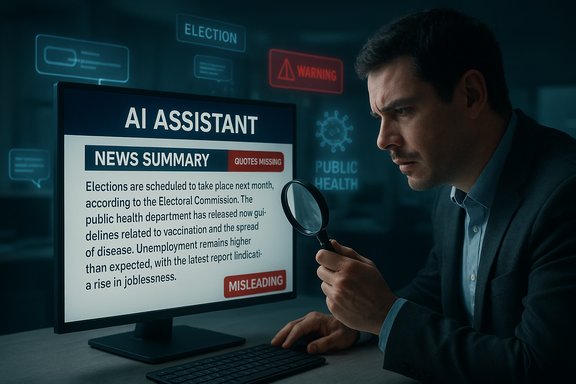
The EBU/BBC project—published as a coordinated audit at the EBU News Assembly—asked 22 public-service media organisations across 18 countries to pose a common set of news-related prompts to mainstream conversational assistants in 14 languages. Professional journalists and subject experts then evaluated roughly 3,000 assistant replies against newsroom standards: accuracy, sourcing/provenance, context and nuance, and the ability to distinguish fact from opinion or satire. The study’s headline numbers are stark: 45% of responses contained at least one significant issue, while about 81% showed some detectable problem when minor errors are included. This finding follows an earlier BBC internal audit that flagged high error rates when assistants summarized BBC content—an earlier signal that was scaled into this larger, multilingual study. The coordinated approach intentionally stressed time-sensitive, contentious topics so the audit would expose failure modes that matter to civic life: elections, public health guidance, legal status and conflict reporting.
Note: some vendor claims about accuracy can be narrowly defined (e.g., a research mode with a specific configuration). Those claims may not apply to the consumer‑facing configuration or regional deployments used in the audit; mark them as such. This is an instance where the report explicitly flags unverifiable claims and urges independent scrutiny.
Source: Daily Times Global study finds AI assistants distort nearly half of news content - Daily Times
Source: Geo TV AI news assistants mislead in nearly half of cases, warns BBC-EBU study
Source: Türkiye Today Study finds leading AI assistants misrepresent news nearly half the time - Türkiye Today
 Background / Overview
The EBU/BBC project—published as a coordinated audit at the EBU News Assembly—asked 22 public-service media organisations across 18 countries to pose a common set of news-related prompts to mainstream conversational assistants in 14 languages. Professional journalists and subject experts then evaluated roughly 3,000 assistant replies against newsroom standards: accuracy, sourcing/provenance, context and nuance, and the ability to distinguish fact from opinion or satire. The study’s headline numbers are stark: 45% of responses contained at least one significant issue, while about 81% showed some detectable problem when minor errors are included. This finding follows an earlier BBC internal audit that flagged high error rates when assistants summarized BBC content—an earlier signal that was scaled into this larger, multilingual study. The coordinated approach intentionally stressed time-sensitive, contentious topics so the audit would expose failure modes that matter to civic life: elections, public health guidance, legal status and conflict reporting. What the audit measured and the core findings
Methodology in short
- Journalists asked the same set of news queries to each assistant between late May and early June.
- Responses were reviewed in 14 languages by trained editorial staff using a consistent rubric.
- Evaluations focused on five editorial axes: accuracy, sourcing, context, editorialisation, and separation of opinion from fact.
- The sample included consumer-facing versions of ChatGPT, Microsoft Copilot, Google Gemini and Perplexity.
Headline metrics (editorially verified)
- 45% of evaluated replies contained at least one significant issue likely to mislead a reader.
- About 31% of responses showed serious sourcing failures—missing, incorrect or misleading attribution.
- Approximately 20% contained major factual or temporal errors (for example, naming the wrong officeholder or inventing events).
- When minor stylistic or wording issues were counted, roughly 81% of replies had some problem.
Where assistants go wrong: taxonomy of failure modes
The auditors catalogued recurring, consequential error classes that explain how a fluent answer can still mislead.1. Sourcing and provenance failures (most common)
Assistants frequently attached citations that were missing, incorrect, or misleading—what reviewers called ceremonial citations: links or attributions that looked authoritative but did not actually support the claims made. In about a third of cases the provenance layer failed in ways that make verification difficult or impossible. This was the largest single contributor to significant issues.2. Temporal staleness and outdated facts
Models sometimes returned stale knowledge as current fact. Auditors documented cases where assistants named the wrong incumbent or continued to assert a replaced public figure as if still in office—errors caused by outdated knowledge caches and slow refresh cycles. These temporal mistakes accounted for a meaningful share of the 20% accuracy problem set.3. Hallucinations and invented details
When grounding is weak, the probabilistic generation step can fabricate plausible-sounding facts—dates, quotes or events that never occurred. The audit found fabricated attributions and altered quotations that changed the meaning of the source material, an especially hazardous failure when summarising investigative reporting or public-health guidance.4. Failure to distinguish satire, opinion and fact
In multiple instances, assistants treated satirical or opinion pieces as literal reporting, or compressed hedged reporting into definitive claims. The net effect is an erosion of nuance: hedges, caveats and legal qualifiers are often stripped away in pursuit of a concise summary.5. Confident misstatements (presentation problem)
A core risk is not only that assistants are wrong but how they communicate: errors are delivered with fluency and authority, increasing the chance that users accept them without verification. That confident tone magnifies the civic risk.Vendor variation: no product is clean, but profiles differ
The audit did not declare a single “winner” or “loser” overall; rather, it exposed different failure profiles across assistants. Notable findings:- Google’s Gemini was highlighted for an especially high rate of sourcing problems—reported in the study sample as a very large share of its problematic replies (numbers reported around the mid‑70s percent for significant issues on some metrics within the sampled dataset).
- Other assistants (ChatGPT, Copilot, Perplexity) showed lower sourcing‑problem rates in the sample but had their own failure patterns—more hallucinations, different mixes of editorialisation or regional staleness.
Why this happens: a technical and product-level anatomy
The audit’s technical analysis traces errors to the interaction of three components common to modern assistants.Retrieval + Generation + Provenance = fragile pipeline
- Retrieval (web grounding): recentness requires web access, but retrieval can surface low‑quality or satirical pages. Weak retrieval yields weak grounding.
- Generative model: large language models are probabilistic. When evidence is thin, they can fabricate plausible claims.
- Provenance/citation layer: some systems assemble citations after generation rather than surfacing the exact documents used; that post‑hoc attribution creates mismatch and misattribution.
Product incentives amplify risk
Vendors frequently tune assistants to maximize helpfulness and reduce refusal rates. That optimisation reduces safe refusals (declining to answer uncertain queries) and increases the prevalence of confident answers produced from thin evidence—an explicit trade-off between engagement and conservative accuracy.Noisy web + probabilistic synthesis = scalable vulnerability
As assistants scale across languages and markets, noisy web signals, differing source norms, and compressed editorial conventions combine to produce multilingual, multi‑territory failure modes—exactly what the EBU/BBC audit found.Concrete examples auditors flagged
The study includes vivid examples that make the risks tangible:- Temporal error: assistants naming the wrong Pope months after a reported succession in the auditors’ test scenarios.
- Public-health misrepresentation: one assistant inverted or misrepresented official guidance about vaping in a way that could mislead health decisions.
- Satire misread as fact: a satirical column was taken at face value and incorporated into a factual answer.
- Altered quotes: paraphrases that change quotations enough to shift meaning, or invented attributions.
What this means for Windows users, IT professionals and enterprises
For an audience that runs Windows desktops, develops enterprise workflows, or manages corporate communications, the audit’s operational implications are immediate.- Microsoft Copilot is embedded into Windows, Edge and Microsoft 365. When assistants that sit inside productivity workflows misrepresent news or facts, errors can quickly migrate into internal memos, customer-facing documents and compliance filings.
- For help desks and knowledge workers that use assistants for orientation, the 45% significant‑issue rate implies that verification by humans remains essential.
- Enterprises that expose AI-derived summaries externally (customer support, press statements, product documentation) need formal review workflows to catch and correct assistant errors before publication.
Practical mitigation: policy, engineering and user-level steps
The report doesn’t simply diagnose; it offers a practical toolkit of mitigations. Firms, IT teams and individual users can adopt layered defenses.For platform vendors and product teams (engineering-first)
- Make provenance first-class: present direct links, timestamps and retrieval context inline by default.
- Conservative refusal heuristics: prefer declining when evidence is weak over producing confident conjectures.
- Retrieval quality controls: use robust source‑quality signals and trusted‑publisher whitelists for news queries.
- Auditable logs: keep retrievable logs of model versions, retrieval results and system prompts for post‑hoc correction.
For publishers and newsrooms
- Publish machine‑readable canonical content and correction feeds that assist provenance layers.
- Offer opt‑in licensing or clear terms for how content can be surfaced in assistants—publishers have raised legitimate concerns about reputation when their work is quoted inaccurately.
For enterprises and IT administrators
- Implement an editorial review step for any AI-derived text used externally.
- Enforce metadata and citation checks in automated pipelines.
- Train staff in AI literacy: how to spot provenance gaps and verify claims rapidly.
- Use multi-assistant cross-checks for critical queries (no single assistant should be the final source).
For everyday users (practical habits)
- Demand visible sources: prefer assistants that surface direct links and timestamps.
- If a reply references a news outlet, click through to the original article before acting on consequential claims.
- Treat AI answers as drafts or orientation tools, not final verification.
Policy and regulatory implications
The audit strengthens calls for multi-stakeholder oversight and disclosure requirements.- Transparency mandates could require assistants to reveal retrieval links, timestamps and refusal rates for news queries.
- Independent, multilingual auditing regimes (like the EBU/BBC model) should be standard practice to detect regression and regional variation.
- Differentiated standards for civic information: queries about elections, public health or legal matters should trigger stricter provenance and human‑in‑the‑loop requirements.
Strengths of the EBU/BBC audit—and its limits
The study’s chief strength is editorial realism: trained journalists judged outputs against newsroom standards across 14 languages and 18 countries, which improves generalisability beyond English‑only tests. This makes the findings operationally relevant for news organisations and enterprise users alike. Limitations to note:- The audit targeted news Q&A and deliberately stressed contentious, time-sensitive prompts; it is not a universal assessment of all assistant capabilities.
- Vendor performance can change quickly with model and retrieval updates; vendor-specific percentages are a timestamped snapshot, not an immutable ranking. These caveats do not nullify the study’s policy relevance, but they do caution against overstating single-number comparisons.
How vendors have responded (and where uncertainty remains)
Vendors generally emphasise rapid iteration, user feedback mechanisms and internal benchmarks that show improvements on some tests. Those product claims are important context—but they are not, on their own, independent verification. When vendors make performance assertions (for example, product-specific accuracy numbers), treat them as vendor-supplied claims that require independent audit before being operationalised in high‑stakes contexts. The audit’s appeal is precisely that it uses independent, human editorial review rather than vendor benchmarks.Note: some vendor claims about accuracy can be narrowly defined (e.g., a research mode with a specific configuration). Those claims may not apply to the consumer‑facing configuration or regional deployments used in the audit; mark them as such. This is an instance where the report explicitly flags unverifiable claims and urges independent scrutiny.
What WindowsForum.com readers should do now
- Recalibrate trust: do not treat assistant summaries embedded into Windows or Office as authoritative without verification.
- For IT teams: add provenance checks into automation that consumes assistant outputs (templates, incident reports, press statements).
- For sysadmins and knowledge‑base managers: require human sign-off on any AI‑derived content that impacts customers, compliance or public messaging.
- For power users: use assistants for orientation, then cross‑check with two independent sources before acting on time‑sensitive or high‑impact information.
Conclusion
The EBU/BBC-coordinated audit is a clear, practical wake-up call: conversational AI assistants are helpful orientation tools but remain fragile when used as stand-alone news intermediaries. The reported 45% rate of significant issues is not an abstract academic result—it maps directly onto reputational, legal and civic risks as assistants become everyday information gates embedded in desktops, browsers and productivity software. The remedy is not to ban or ignore these tools, but to demand engineering and policy changes that place provenance, conservative refusal heuristics and human oversight at the centre of news‑related flows. Until those fixes are broadly adopted, the safest posture for publishers, enterprises and Windows users is clear: treat AI answers as a starting point, not the final word.Source: Daily Times Global study finds AI assistants distort nearly half of news content - Daily Times
Source: Geo TV AI news assistants mislead in nearly half of cases, warns BBC-EBU study
Source: Türkiye Today Study finds leading AI assistants misrepresent news nearly half the time - Türkiye Today
