

Moonlight Kids’ time-loop metroidvania Echo Weaver is targeting an October 8 release for PC and current-generation consoles, placing a new spin on a familiar exploration formula: instead of collecting increasingly elaborate combat upgrades, players are expected to treat time itself as currency and knowledge as the most meaningful form of progression.
The release window matters because Echo Weaver is not merely using time travel as a story hook. Its central design is built around repeated runs through a ruined world, with every reset intended to reveal new routes, new information, and new ways to turn a seemingly unwinnable loop into a route toward escape. An updated Steam demo is already available, giving Windows PC players a chance to assess whether that ambitious pitch translates into satisfying hands-on play.
Scheduled for PlayStation 5, Xbox Series X|S, Switch 2, and PC, Echo Weaver arrives in a crowded metroidvania market with a concept that could distinguish it from conventional ability-gated adventures. Its success will depend on whether its loop mechanics feel like discovery rather than repetition—and whether a game built around optimization can remain inviting to players who value exploration at their own pace.
At a glance, Echo Weaver looks recognizably rooted in the modern 2D metroidvania tradition. Players move through an interconnected world, encounter environmental barriers, search for hidden pathways, solve puzzles, and gradually uncover a larger narrative. The setting, a fallen society called Provenance, provides the game’s mystery-laden backdrop.
The crucial difference is that the game describes itself as a knowledge-based metroidvania, sometimes called a “metroidbrainia.” The idea is simple but demanding: the player’s character may already possess the essential movement options or latent capabilities needed to advance, but the player does not yet know the correct use, route, timing, or environmental interaction.
That approach changes the usual reward structure.
In a standard metroidvania, a player might find a double jump, a wall-climb tool, a new weapon, or a keycard. In Echo Weaver, the lasting reward is expected to be understanding:
For Windows PC players accustomed to games that reward extensive stat management and equipment comparison, that can be refreshing. It also places a high burden on level design. Every important discovery must feel fair, memorable, and meaningful enough that players want to use it on subsequent runs.
That has significant implications for the game’s moment-to-moment rhythm.
Rather than treating every loop as a total loss, players are expected to use each cycle to gather information and gradually form a more effective plan. Time can reportedly be extended through pickups, while the available supply can also be spent to support actions such as healing, opening paths, or making exchanges. The player is therefore constantly making a calculation: preserve time for a distant objective, spend it now to survive, or invest it in access to a potentially valuable secret.
This could create a strong sense of route mastery. A path that first takes several minutes to navigate might eventually become a fluid sequence of jumps, glides, discoveries, and precisely timed interactions. That kind of improvement can be deeply satisfying because the player sees practical evidence of their own growing skill.
It also gives Echo Weaver a potentially distinctive identity among recent indie action games. The goal is not necessarily to become stronger through accumulation. It is to become more efficient, more observant, and more confident.
The game will need to strike a careful balance between urgency and freedom. A well-designed time loop should push players to learn without making them feel punished for being curious. Environmental clues, route shortcuts, readable maps, and forgiving early-game pacing will be especially important.
The updated demo is therefore more than a promotional sample. It is an opportunity to see whether Echo Weaver’s central time economy feels like an elegant strategic system or an obstacle that discourages the very exploration the game promises.
The player’s task is not framed as a simple escape mission. The loop contains a wider conspiracy, fragmented histories, and other characters caught in the same repeating reality. Uncovering what happened to Provenance appears inseparable from discovering how to break free.
This is a sensible fit for the gameplay structure. Time-loop stories naturally thrive on revelation because repeated encounters can change meaning as the player learns more. An object ignored early in the game can become vital later. A character who seems unimportant during one loop can become a source of context, guidance, or manipulation after a key discovery.
This can give the game’s world an unusual density. Rather than continually moving to new locations, players may revisit familiar spaces with new knowledge and new objectives. The level design must make those revisits feel different enough to justify the structure.
If Moonlight Kids succeeds, Provenance could become more than an attractive ruin. It could feel like a place gradually decoded by the player: part puzzle box, part platforming arena, and part archaeological record.
The writing will need to avoid overexplaining the mystery too soon. At the same time, it cannot rely on vagueness alone. A compelling conspiracy needs concrete stakes, recognizable personalities, and revelations that alter the player’s understanding of the world rather than simply adding more lore terminology.
The best outcome would be a story where the mechanics and narrative reinforce one another: each breakthrough not only opens a path but also changes the player’s understanding of who the Weavers were, what Provenance sought to become, and why the loop exists.
That emphasis on movement is essential. A game asking players to repeat routes needs controls that remain enjoyable after dozens of attempts. If the player is meant to perfect a sequence, the character must feel responsive, readable, and consistent.
The key is ensuring that failure teaches something.
A poorly signposted hazard or inconsistent jump arc can make a reset feel arbitrary. By contrast, a well-designed challenge gives the player an immediate sense of what went wrong: they chose the wrong route, reacted too slowly, spent too much time earlier in the run, or misunderstood a puzzle condition.
This distinction will matter greatly for PC players using different input methods. Echo Weaver supports controller play, but keyboard controls should receive equal attention. A precision-focused 2D platformer cannot afford to feel secondary on a keyboard, especially when it is launching on Steam alongside console platforms.
Players need to recognize platforms, hazards, interactable objects, timed mechanisms, and shortcuts instantly. The more Echo Weaver asks users to optimize routes under pressure, the more visual clarity becomes a gameplay feature rather than a cosmetic concern.
Accessibility options will also be important. Subtitle customization, color alternatives, camera comfort settings, volume controls, and flexible input support can make a complex game more approachable without compromising its intended challenge.
Those are modest requirements by current standards, and they align with the game’s 2D presentation. Players should not assume, however, that a low storage footprint automatically guarantees flawless performance. A fast-moving platformer with frequent resets depends heavily on consistent frame pacing, prompt loading, clean controller detection, and reliable cloud saves.
Indie games sometimes overlook these details, even when their core design is strong. For Echo Weaver, technical polish matters because every reset needs to feel immediate. Long loads, lost input focus, poorly scaled menus, or inconsistent performance would disrupt the very flow that its time-loop design relies upon.
Echo Weaver has several meaningful advantages.
First, its time-as-currency system gives the game a clear mechanical identity. This is not simply a metroidvania with a time-loop plot pasted over it. The loop appears intended to affect the player’s movement, survival, planning, and access to the world.
Second, its knowledge-driven progression could create genuine moments of insight. A powerful discovery that changes how players read the entire map can be more memorable than acquiring another stat boost.
Third, its focus on optimized routes and repeatable mastery could foster a strong enthusiast community. Players who enjoy speedrunning, secrets, challenge modes, or dissecting level design may find substantial depth in the game’s systems.
Finally, the setting has room for emotional and thematic weight. A broken utopia trapped in repetitive collapse is fertile ground for a story about memory, agency, failure, and the cost of trying to engineer paradise.
The game must also avoid becoming too dependent on perfect execution. Precision platforming can be rewarding, but a narrative exploration game needs to accommodate players whose interest lies more in mystery-solving than flawless movement. Smart difficulty settings, accessibility features, optional assists, and thoughtful checkpoint behavior could make a substantial difference.
Another concern is the potential for repetition fatigue. Time loops work best when each cycle introduces a meaningful difference: a new destination, a new clue, a route improvement, a changed relationship, or a new understanding of the world. If too many loops are spent merely replaying familiar ground, the core premise could lose momentum.
The launch platform list also raises expectations. Releasing across PC, PS5, Xbox Series X|S, and Switch 2 could give Echo Weaver a broad audience, but it also increases the importance of a polished, consistent release. Cross-platform parity in controls, performance, display options, and save behavior will matter.
That concept gives Moonlight Kids an opportunity to make a game where each reset feels less like a setback and more like an investment in mastery. The player may begin trapped by the loop, but the loop gradually becomes a tool—one that exposes shortcuts, secrets, connections, and eventually a path out of Provenance.
With its October 8 launch target, an updated Steam demo, low PC hardware requirements, and an unusually focused mechanical premise, Echo Weaver has the ingredients for a memorable Windows PC release. Its ultimate impact will come down to execution: clear puzzles, crisp movement, meaningful discoveries, and a time-loop structure that makes every return feel like progress rather than repetition.
The release window matters because Echo Weaver is not merely using time travel as a story hook. Its central design is built around repeated runs through a ruined world, with every reset intended to reveal new routes, new information, and new ways to turn a seemingly unwinnable loop into a route toward escape. An updated Steam demo is already available, giving Windows PC players a chance to assess whether that ambitious pitch translates into satisfying hands-on play.
Scheduled for PlayStation 5, Xbox Series X|S, Switch 2, and PC, Echo Weaver arrives in a crowded metroidvania market with a concept that could distinguish it from conventional ability-gated adventures. Its success will depend on whether its loop mechanics feel like discovery rather than repetition—and whether a game built around optimization can remain inviting to players who value exploration at their own pace.
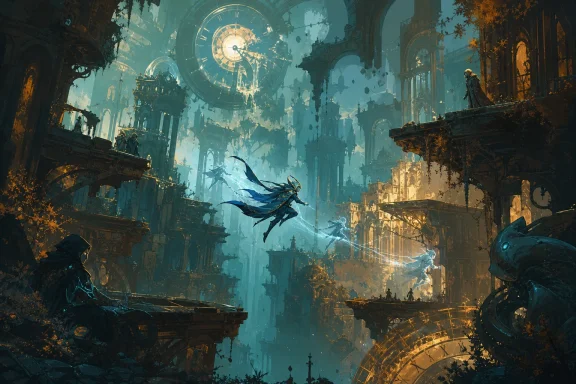 A Metroidvania Where Knowledge Replaces Loot
At a glance, Echo Weaver looks recognizably rooted in the modern 2D metroidvania tradition. Players move through an interconnected world, encounter environmental barriers, search for hidden pathways, solve puzzles, and gradually uncover a larger narrative. The setting, a fallen society called Provenance, provides the game’s mystery-laden backdrop.The crucial difference is that the game describes itself as a knowledge-based metroidvania, sometimes called a “metroidbrainia.” The idea is simple but demanding: the player’s character may already possess the essential movement options or latent capabilities needed to advance, but the player does not yet know the correct use, route, timing, or environmental interaction.
That approach changes the usual reward structure.
In a standard metroidvania, a player might find a double jump, a wall-climb tool, a new weapon, or a keycard. In Echo Weaver, the lasting reward is expected to be understanding:
- Learning that a suspicious wall can be crossed under specific conditions.
- Discovering how an anomaly affects the world state.
- Identifying an alternate route that avoids a major obstacle.
- Realizing that a character, object, or location has a hidden role in the larger loop.
- Refining a route until actions that once seemed impossible become routine.
For Windows PC players accustomed to games that reward extensive stat management and equipment comparison, that can be refreshing. It also places a high burden on level design. Every important discovery must feel fair, memorable, and meaningful enough that players want to use it on subsequent runs.
Time Is Not Just a Countdown
The most important mechanic in Echo Weaver is its treatment of time as a consumable resource. The protagonist is trapped in a glitching loop, and the clock is not simply an external failure condition. It appears to be woven into traversal, health management, trading, progression, and access to new areas.That has significant implications for the game’s moment-to-moment rhythm.
Rather than treating every loop as a total loss, players are expected to use each cycle to gather information and gradually form a more effective plan. Time can reportedly be extended through pickups, while the available supply can also be spent to support actions such as healing, opening paths, or making exchanges. The player is therefore constantly making a calculation: preserve time for a distant objective, spend it now to survive, or invest it in access to a potentially valuable secret.
A System Built on Risk and Route Planning
The strongest version of this system would make every choice feel connected. Taking damage would have a cost beyond a reduced health bar. Detouring to explore a suspicious room could put a time-sensitive plan at risk. Spending time to access a shortcut might improve all future attempts.This could create a strong sense of route mastery. A path that first takes several minutes to navigate might eventually become a fluid sequence of jumps, glides, discoveries, and precisely timed interactions. That kind of improvement can be deeply satisfying because the player sees practical evidence of their own growing skill.
It also gives Echo Weaver a potentially distinctive identity among recent indie action games. The goal is not necessarily to become stronger through accumulation. It is to become more efficient, more observant, and more confident.
The Danger of Turning Curiosity Into Pressure
There is, however, an obvious risk. Timers can make exploration feel stressful, particularly in a genre whose appeal often rests on wandering through mysterious environments without a rigid schedule. If every pause threatens a reset, players may avoid experimentation rather than embrace it.The game will need to strike a careful balance between urgency and freedom. A well-designed time loop should push players to learn without making them feel punished for being curious. Environmental clues, route shortcuts, readable maps, and forgiving early-game pacing will be especially important.
The updated demo is therefore more than a promotional sample. It is an opportunity to see whether Echo Weaver’s central time economy feels like an elegant strategic system or an obstacle that discourages the very exploration the game promises.
Provenance, the Weavers, and a Broken Utopia
The narrative premise places players in the role of the last Weaver, a survivor—or remnant—of a ruined civilization trapped in an ongoing temporal disaster. Provenance is presented as the remains of an ambitious society whose apparent utopian project ended in collapse.The player’s task is not framed as a simple escape mission. The loop contains a wider conspiracy, fragmented histories, and other characters caught in the same repeating reality. Uncovering what happened to Provenance appears inseparable from discovering how to break free.
This is a sensible fit for the gameplay structure. Time-loop stories naturally thrive on revelation because repeated encounters can change meaning as the player learns more. An object ignored early in the game can become vital later. A character who seems unimportant during one loop can become a source of context, guidance, or manipulation after a key discovery.
A World Designed for Recontextualization
The strongest time-loop narratives are not built solely on surprise. They use repetition to make the player reassess what they have already seen. Echo Weaver appears positioned to do just that, with each return to Provenance intended to deliver additional clues about the society’s collapse and the player character’s place in it.This can give the game’s world an unusual density. Rather than continually moving to new locations, players may revisit familiar spaces with new knowledge and new objectives. The level design must make those revisits feel different enough to justify the structure.
If Moonlight Kids succeeds, Provenance could become more than an attractive ruin. It could feel like a place gradually decoded by the player: part puzzle box, part platforming arena, and part archaeological record.
Character Writing Will Carry Part of the Weight
The premise also includes a cast of survivors and strange figures living within the loop. That is promising because time-loop stories need emotional anchors. Mechanical discovery is satisfying, but players need reasons to care about what their discoveries mean.The writing will need to avoid overexplaining the mystery too soon. At the same time, it cannot rely on vagueness alone. A compelling conspiracy needs concrete stakes, recognizable personalities, and revelations that alter the player’s understanding of the world rather than simply adding more lore terminology.
The best outcome would be a story where the mechanics and narrative reinforce one another: each breakthrough not only opens a path but also changes the player’s understanding of who the Weavers were, what Provenance sought to become, and why the loop exists.
Stylish 2D Art Meets Precision Movement
Echo Weaver is built around hand-drawn 2D visuals, environmental puzzles, and agile traversal. The movement toolkit includes jumping, gliding, and fast traversal through an unstable world that may rewind at any time.That emphasis on movement is essential. A game asking players to repeat routes needs controls that remain enjoyable after dozens of attempts. If the player is meant to perfect a sequence, the character must feel responsive, readable, and consistent.
Repetition Requires Excellent Feel
Precision platforming has a natural place in a time-loop metroidvania. As players gain knowledge, they should be able to turn that knowledge into faster and cleaner execution. A difficult crossing may begin as a source of frustration but become a satisfying routine once the right technique is understood.The key is ensuring that failure teaches something.
A poorly signposted hazard or inconsistent jump arc can make a reset feel arbitrary. By contrast, a well-designed challenge gives the player an immediate sense of what went wrong: they chose the wrong route, reacted too slowly, spent too much time earlier in the run, or misunderstood a puzzle condition.
This distinction will matter greatly for PC players using different input methods. Echo Weaver supports controller play, but keyboard controls should receive equal attention. A precision-focused 2D platformer cannot afford to feel secondary on a keyboard, especially when it is launching on Steam alongside console platforms.
Visual Clarity Matters as Much as Style
The hand-drawn presentation has the potential to make Provenance memorable, especially if its ruined civilization is communicated through distinctive architecture, environmental storytelling, and strong color contrast. Yet striking art alone is not enough for a game built around speed and repeated traversal.Players need to recognize platforms, hazards, interactable objects, timed mechanisms, and shortcuts instantly. The more Echo Weaver asks users to optimize routes under pressure, the more visual clarity becomes a gameplay feature rather than a cosmetic concern.
Accessibility options will also be important. Subtitle customization, color alternatives, camera comfort settings, volume controls, and flexible input support can make a complex game more approachable without compromising its intended challenge.
What the PC Version Needs to Get Right
The listed minimum requirements suggest that Echo Weaver should be accessible to a wide range of Windows gaming PCs. The baseline calls for Windows 10 or later, a Core i3-9300T or AMD FX 8350 processor, 4 GB of RAM, an NVIDIA GTX 660 or AMD R7 260X graphics card, and 4 GB of available storage.Those are modest requirements by current standards, and they align with the game’s 2D presentation. Players should not assume, however, that a low storage footprint automatically guarantees flawless performance. A fast-moving platformer with frequent resets depends heavily on consistent frame pacing, prompt loading, clean controller detection, and reliable cloud saves.
Steam Features Add Practical Value
The PC release is expected to include several Steam-facing features that suit the game’s structure:- Steam Achievements for milestones and hidden discoveries.
- Steam Cloud support for preserving progress across systems.
- Steam Leaderboards, which could become relevant if the game leans into route optimization and time trials.
- Full controller support for Xbox and PlayStation controllers.
- Subtitles and multiple interface languages for broader accessibility.
The Windows Compatibility Question
For the Windows community, the modest requirements are encouraging. A game with a 4 GB storage target and older GPU support should be viable on many desktops, compact PCs, and handheld Windows devices. The bigger question is whether the final build will scale well across refresh rates, ultrawide displays, high-DPI laptops, and hybrid controller-plus-keyboard setups.Indie games sometimes overlook these details, even when their core design is strong. For Echo Weaver, technical polish matters because every reset needs to feel immediate. Long loads, lost input focus, poorly scaled menus, or inconsistent performance would disrupt the very flow that its time-loop design relies upon.
Why Echo Weaver Could Stand Out
The indie metroidvania genre remains popular because it provides a flexible framework for exploration, combat, platforming, and storytelling. It is also difficult to stand out within. New releases often need more than attractive art and a large map to command attention.Echo Weaver has several meaningful advantages.
First, its time-as-currency system gives the game a clear mechanical identity. This is not simply a metroidvania with a time-loop plot pasted over it. The loop appears intended to affect the player’s movement, survival, planning, and access to the world.
Second, its knowledge-driven progression could create genuine moments of insight. A powerful discovery that changes how players read the entire map can be more memorable than acquiring another stat boost.
Third, its focus on optimized routes and repeatable mastery could foster a strong enthusiast community. Players who enjoy speedrunning, secrets, challenge modes, or dissecting level design may find substantial depth in the game’s systems.
Finally, the setting has room for emotional and thematic weight. A broken utopia trapped in repetitive collapse is fertile ground for a story about memory, agency, failure, and the cost of trying to engineer paradise.
The Biggest Risks Ahead of Release
Ambition is also where Echo Weaver faces its largest challenges. Knowledge-based games can be extraordinary when their puzzles are intuitive in retrospect, but frustrating when their intended logic remains obscure. The line between a rewarding revelation and an opaque roadblock is thin.The game must also avoid becoming too dependent on perfect execution. Precision platforming can be rewarding, but a narrative exploration game needs to accommodate players whose interest lies more in mystery-solving than flawless movement. Smart difficulty settings, accessibility features, optional assists, and thoughtful checkpoint behavior could make a substantial difference.
Another concern is the potential for repetition fatigue. Time loops work best when each cycle introduces a meaningful difference: a new destination, a new clue, a route improvement, a changed relationship, or a new understanding of the world. If too many loops are spent merely replaying familiar ground, the core premise could lose momentum.
The launch platform list also raises expectations. Releasing across PC, PS5, Xbox Series X|S, and Switch 2 could give Echo Weaver a broad audience, but it also increases the importance of a polished, consistent release. Cross-platform parity in controls, performance, display options, and save behavior will matter.
An Autumn Release Worth Watching
Echo Weaver is shaping up as a potentially thoughtful addition to the modern metroidvania landscape. Its major idea is compelling: when trapped in a broken world, the player’s most valuable resource is not a weapon, a skill tree, or a larger health bar, but the ability to understand the systems around them.That concept gives Moonlight Kids an opportunity to make a game where each reset feels less like a setback and more like an investment in mastery. The player may begin trapped by the loop, but the loop gradually becomes a tool—one that exposes shortcuts, secrets, connections, and eventually a path out of Provenance.
With its October 8 launch target, an updated Steam demo, low PC hardware requirements, and an unusually focused mechanical premise, Echo Weaver has the ingredients for a memorable Windows PC release. Its ultimate impact will come down to execution: clear puzzles, crisp movement, meaningful discoveries, and a time-loop structure that makes every return feel like progress rather than repetition.