EcoVadis’ latest recognition by Microsoft — winning the Local Partner Award FY25 in the AI Transformation — Scale category — marks a notable milestone for sustainability software vendors deploying generative AI at enterprise scale and brings renewed attention to how procurement teams will use AI to embed sustainability into everyday buying decisions.
EcoVadis is a long-established sustainability intelligence platform that rates suppliers across environmental, social, and governance (ESG) dimensions and sells tools to procurement, sustainability and risk teams to manage supplier performance. Over the past several years the company has shifted from being primarily a ratings provider to a data- and AI-driven platform vendor that aims to operationalize sustainability signals inside procurement workflows.
The Microsoft Local Partner Award recognizes regional partners that demonstrate exceptional innovation, measurable customer impact, and close technical partnership with Microsoft technologies. EcoVadis’ award was bestowed specifically for the scale-stage use of AI — an endorsement of both their product maturity and the depth of their integration with Azure services, including Azure AI and the Azure OpenAI Service.
This article summarizes the announcement, verifies key technical claims about the solution and the partnership, analyzes the business and technical implications, and outlines practical recommendations and risks for IT and procurement leaders evaluating similar AI-powered sustainability tools.
The EcoVadis approach promises the following operational benefits:
For procurement leaders: the announcement offers a credible vendor to evaluate when your objective is operationalizing sustainability intelligence across global supplier networks, particularly if your organization already uses Azure. For CIOs and security teams: it’s a reminder to insist on governance, logging, and red-team validation before embedding LLM outputs into contractual or compliance workflows.
The next practical step for buyers is a tightly scoped pilot with measurable KPIs, contractual assurances around data and model governance, and an exit strategy that prevents undue lock-in. If executed carefully, AI assistants like EcoVadis’ can transition procurement from reactive compliance to proactive, sustainability-driven sourcing — a transformation that promises real business and societal value, provided the technological and governance challenges are addressed head-on.
The Microsoft award recognizes the capability and momentum behind EcoVadis’ AI roadmap; the real test will be whether the assistant can consistently produce accurate, auditable, and bias‑aware recommendations in live procurement environments and whether customers can translate those outputs into measurable reductions in risk, emissions and human-rights exposure across complex global supply chains.
Source: Business Wire https://www.businesswire.com/news/h...d-FY25-in-AI-Transformation---Scale-Category/
 Background
EcoVadis is a long-established sustainability intelligence platform that rates suppliers across environmental, social, and governance (ESG) dimensions and sells tools to procurement, sustainability and risk teams to manage supplier performance. Over the past several years the company has shifted from being primarily a ratings provider to a data- and AI-driven platform vendor that aims to operationalize sustainability signals inside procurement workflows.The Microsoft Local Partner Award recognizes regional partners that demonstrate exceptional innovation, measurable customer impact, and close technical partnership with Microsoft technologies. EcoVadis’ award was bestowed specifically for the scale-stage use of AI — an endorsement of both their product maturity and the depth of their integration with Azure services, including Azure AI and the Azure OpenAI Service.
This article summarizes the announcement, verifies key technical claims about the solution and the partnership, analyzes the business and technical implications, and outlines practical recommendations and risks for IT and procurement leaders evaluating similar AI-powered sustainability tools.
What the announcement says — quick summary
- EcoVadis won Microsoft’s Local Partner Award FY25 in the AI Transformation — Scale category for its work applying Azure AI to sustainability and procurement.
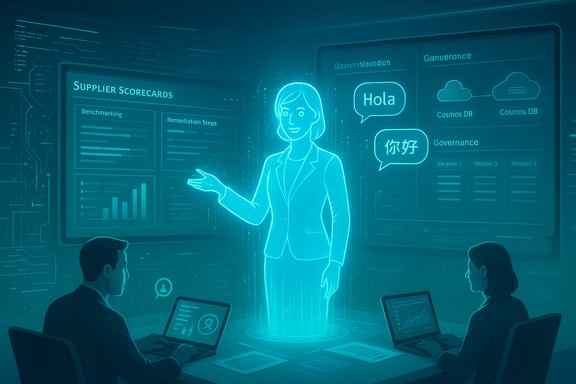
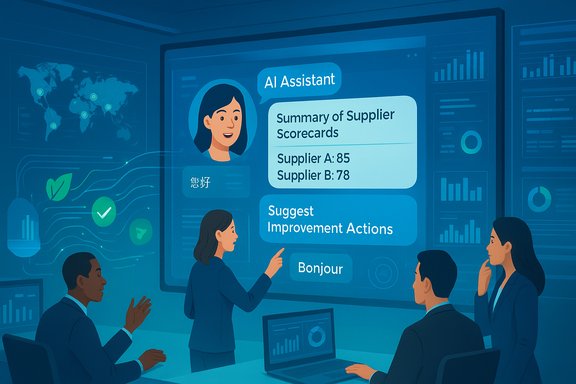
- The company highlighted a multilingual AI Assistant for procurement teams that synthesizes supplier scorecards, answers questions conversationally, benchmarks suppliers and generates targeted improvement recommendations.
- The assistant is built on Microsoft Azure services — notably the Azure OpenAI Service and Azure Machine Learning — and leverages EcoVadis’ proprietary sustainability data to produce insights at scale.
- EcoVadis framed the win as a validation of a long-running partnership with Microsoft that began years earlier and now includes production-scale AI models and end-to-end Azure tooling.
- The announcement also reiterated EcoVadis’ product expansion moves, including the 2024 acquisition of Ulula (a worker-voice platform) to strengthen human-rights due diligence and on-the-ground worker feedback.
Overview: the technology stack and product capabilities
Core architecture (as disclosed)
EcoVadis’ production architecture combines the following components and capabilities:- Azure OpenAI Service for conversational AI and textual summarization. Public materials indicate EcoVadis uses models in the GPT‑4‑family lineage (noted as GPT‑4o and GPT‑4o‑mini in Microsoft’s case write-up), tuned and orchestrated for procurement queries.
- Azure Machine Learning to manage model lifecycle, training, experimentation and deployment. This supports traceability and versioning for models that touch regulated decision-making.
- Azure AI Search and document indexing for fast retrieval of supplier records, scorecards and supporting documents.
- Azure Data Services (Data Lake, Cosmos DB, Databricks) for storing structured and semi-structured supply chain data at scale.
- Integration of proprietary EcoVadis ratings data, supplier assessments and the Ulula worker-voice dataset to enrich context and make recommendations actionable across multiple locales and languages.
Key features of the Multilingual AI Assistant
- Interactive inquiries: Buyers can ask natural-language questions about a supplier’s sustainability performance over time and receive synthesized answers and improvement recommendations.
- Scorecard synthesis: The assistant digests long supplier reports and highlights risks, trends and priority actions without manual review.
- Benchmarking and network insights: Procurement teams can benchmark a supplier against peers in the same buyer network or industry segment.
- Multilingual support: The assistant is designed to operate across many languages to serve global procurement operations. EcoVadis materials emphasize broad language support to reach procurement users worldwide.
- Actionable recommendations: Instead of simply surfacing scores, the assistant proposes targeted next steps (e.g., remediation actions, compliance documentation requests, or supplier engagement paths).
Why this matters: the practical impact on procurement
Procurement teams historically manage a high volume of supplier information from disparate sources — questionnaires, audits, certifications, third-party ratings and, increasingly, worker feedback. Turning that data into procurement decisions is time-consuming and error-prone.The EcoVadis approach promises the following operational benefits:
- Faster decision cycles: Automated summarization moves teams from hours of manual review to near-real-time insight extraction, accelerating sourcing and supplier-risk triage.
- Integrated sustainability in procurement workflows: Embedding AI answers and recommendations inside procurement systems can shift responsibility for sustainability from a peripheral audit activity to a core purchasing criterion.
- Global scalability: Multilingual capabilities reduce friction when working with suppliers and procurement teams across geographies, lowering the cost to scale sustainability programs.
- Better evidence for regulatory compliance: By combining ratings with worker-voice data and searchable document trails, procurement teams gain more defensible records for due-diligence obligations.
Verifying the technical and company claims
Key technical and corporate assertions were validated against multiple public sources:- The use of Azure OpenAI Service and additional Azure components for production AI at EcoVadis is confirmed in Microsoft’s public customer case materials and in EcoVadis’ product pages describing their AI Assistant.
- EcoVadis’ acquisition of Ulula in 2024 is documented in EcoVadis’ press materials and third‑party news outlets, and Ulula’s worker-voice capabilities are repeatedly referenced as a strategic complement to EcoVadis’ ratings data.
- The award recognition — Microsoft Local Partner Award, AI Transformation — Scale — is corroborated by Microsoft region communications and partner posts celebrating Local Partner Award winners, which list EcoVadis in that category.
- Customer counts and coverage: EcoVadis corporate messaging has alternately cited figures such as “130,000+” and “150,000+” businesses, and reports use varying counts of rated companies and industries (e.g., tens of thousands of rated entities vs. broader counts of users in buyer networks). These discrepancies appear to reflect differences in metric definitions (rated suppliers vs. platform users vs. buyer participants). The variance is noteworthy and should be treated as a reporting inconsistency rather than a contradiction of core capability.
- Precise productivity metrics: Public materials assert time savings and “significant” productivity gains but do not disclose standardized, auditable measurements (for instance, mean percentage reduction in manual review time across customers). Those claims are plausible but currently lack a transparent, independent benchmark in the public domain.
Strengths: what EcoVadis brings to the table
- Proprietary data moat: EcoVadis’ core advantage is a large, industry-indexed repository of supplier sustainability assessments and templates of remediation actions. This dataset is non-trivial to replicate and gives AI models domain-relevant context that generic LLMs lack.
- End-to-end productization on Azure: Using a mature cloud stack (Azure OpenAI Service, Azure ML, data services) for production-grade model management addresses two perennial enterprise concerns: scalability and traceability. That makes the assistant more suitable for large procurement organizations that need governance.
- Integration with worker voice: The Ulula acquisition strengthens the data layer with on-the-ground labor and grievance signals — an important complement to self-reported supplier documentation and third‑party certificates.
- Multilingual, enterprise-ready workflows: Global procurement teams need language support and audit trails; EcoVadis positions its assistant to meet those needs rather than offering a single-language proof-of-concept.
- Microsoft endorsement and ecosystem access: The award and the close Azure relationship increase EcoVadis’ credibility among enterprise buyers who already use Microsoft clouds and value local partner support channels.
Risks and limitations — what procurement and IT leaders must watch for
While the product and partnership present a credible path to scale, the deployment of LLM-based assistants in procurement raises several specific risks:- Model hallucinations and risk of incorrect recommendations. LLMs can invent confident-sounding but incorrect statements. In procurement, a hallucinated compliance claim or a mistaken interpretation of a statute or certification can lead to regulatory exposure. Mitigation requires retrieval-augmented generation (RAG) design, strong citation and source attribution mechanics, and guardrails that prefer conservative answers with clear provenance.
- Data provenance and freshness. Supplier ratings, certificates and worker feedback evolve. If the assistant is not tightly integrated with the authoritative source-of-truth (e.g., the ratings database), recommendations can be stale. Enterprises must verify update cadence, data pipelines and data lineage.
- Privacy and data-sharing concerns. Combining supplier assessments with worker-voice signals risks exposing personally identifiable information (PII) or sensitive supply‑chain details. The vendor must demonstrate compliant handling, anonymization, and GDPR/region-specific safeguards.
- Vendor lock-in and portability. Deep integrations with Azure OpenAI and proprietary datasets create switching costs. Organizations should assess portability of extracted insights and whether benchmarked models or exportable decision logs are available.
- Regulatory and audit scrutiny. If procurement decisions are influenced by AI outputs, organizations may face regulatory expectations to document decision rationale and evidence (especially under evolving due-diligence laws). Solution providers must supply explainability and audit-grade logging.
- Bias in sustainability signals. Ratings and worker feedback can reflect geographic, sectoral or reporting biases. When AI amplifies these signals, buyers may systematically deprioritize suppliers from regions with less formal reporting infrastructure, creating unintended social or economic consequences.
- Operational adoption barriers. Embedding AI into established procurement workflows requires change management, training and clear incentive alignment. Without adoption, even technically strong assistants produce limited value.
Governance and technical controls to demand from vendors
Enterprises should ask vendors to provide concrete evidence and capabilities in the following areas before a full rollout:- Provenance and citations: Answers should link back to the exact source documents, ratings or worker-voice segments used to produce recommendations.
- Versioned model governance: The vendor must maintain model version history, change logs, and an ML Ops strategy so behavior differences over time are explainable.
- Red-team/hallucination testing and safety audits: Vendors should disclose their evaluation against hallucination, bias, and privacy attack vectors.
- Data retention and anonymization policies: Especially for worker feedback, documentation must detail anonymization, consent and retention periods.
- Human-in-the-loop workflows: The assistant’s outputs should feed human approvals for high‑risk actions; automated enforcement should be limited to low-risk, high‑confidence tasks.
- Interoperability: Exportable decision logs, APIs to integrate with ERP/P2P systems, and options to use customer-owned models or private endpoints to reduce lock-in.
- Regulatory reporting modes: Tools to generate compliance evidence packages (reports, timelines, decision rationale) for auditors and regulators.
Competitive and market context
AI in procurement and supply‑chain sustainability is now crowded with several classes of players:- Traditional procurement software vendors that are adding AI assistants to their P2P and SRM platforms.
- Niche sustainability data providers expanding into AI-enabled workflows.
- Enterprise AI consultancies and system integrators building custom Copilot experiences on top of Azure, AWS, or Google Cloud.
- Startups focused on single use-cases (carbon accounting, modern-slavery detection, worker surveys) that may integrate with larger suites.
Practical recommendations for procurement and IT leaders
- Pilot with a narrow, measurable use-case: start with a single commodity or supplier cohort and define KPIs such as time-to-insight, reduction in manual review hours, and number of escalations avoided.
- Request a hands-on security and compliance review: ensure data residency, anonymization, and audit log access meet corporate and regional regulatory expectations.
- Validate model outputs against known baselines: run the assistant and independent human reviewers in parallel during the pilot to quantify agreement and hallucination rates.
- Insist on exportable evidence and explainability: require the vendor to deliver audit-ready reports that trace each recommendation back to source artifacts.
- Prepare change management and training: procurement staff must understand how to interrogate and challenge AI outputs; build internal playbooks for human-in-the-loop workflows.
Strategic implications and long-term outlook
The Microsoft award signals a broader trend: major cloud platform vendors are actively promoting ISV partners that operationalize AI into domain-specific workflows. For sustainability and procurement, this means several long-term shifts:- Mainstreaming of sustainability as a transactional criterion. When AI can instantly quantify supplier risk and remediation costs within procurement platforms, sustainability becomes a line-item in sourcing decisions rather than a separate compliance exercise.
- Acceleration of supply-chain transparency. Combining ratings, worker-voice data and AI summarization makes previously opaque tiers of supply chains more accessible for corporate buyers.
- New expectations for auditability. Regulators and auditors will increasingly demand that AI-assisted decisions produce traceable rationales and evidence — pushing vendors to bake explainability into their products.
- Platform consolidation pressures. Companies are more likely to choose suppliers that offer both rich data and enterprise-grade AI governance, favoring those integrated with hyperscaler tooling for scale, monitoring and security.
Caveats and unverifiable claims
- Several public statements about productivity gains are qualitative or customer-specific and lack a standardized, independently audited metric; these improvements should be treated as indicative rather than definitive until validated in a customer pilot.
- Corporate metrics cited in different EcoVadis communications (for example total businesses in the network) vary across releases; variation likely stems from different definitions (rated suppliers vs. platform users vs. buyer accounts). Procurement teams should request a vendor briefing that clarifies metric definitions relevant to contract terms and licensing.
- While Microsoft and EcoVadis materials describe a production-grade architecture, the precise operational SLAs (latency, uptime, data retention timelines), customer onboarding timelines, and total cost of ownership will depend on each customer implementation and need to be confirmed in procurement negotiations.
Final analysis: why the award matters — and what comes next
EcoVadis winning the Microsoft Local Partner Award in the AI Transformation — Scale category is both a validation and a provocation. It validates EcoVadis’ engineering progress: moving from research pilots to a product that Microsoft deems mature enough to merit regional recognition. It also provokes the market to ask tougher questions about responsible deployment of generative AI in procurement: how to ensure accuracy, traceability, privacy and fairness at commercial scale.For procurement leaders: the announcement offers a credible vendor to evaluate when your objective is operationalizing sustainability intelligence across global supplier networks, particularly if your organization already uses Azure. For CIOs and security teams: it’s a reminder to insist on governance, logging, and red-team validation before embedding LLM outputs into contractual or compliance workflows.
The next practical step for buyers is a tightly scoped pilot with measurable KPIs, contractual assurances around data and model governance, and an exit strategy that prevents undue lock-in. If executed carefully, AI assistants like EcoVadis’ can transition procurement from reactive compliance to proactive, sustainability-driven sourcing — a transformation that promises real business and societal value, provided the technological and governance challenges are addressed head-on.
The Microsoft award recognizes the capability and momentum behind EcoVadis’ AI roadmap; the real test will be whether the assistant can consistently produce accurate, auditable, and bias‑aware recommendations in live procurement environments and whether customers can translate those outputs into measurable reductions in risk, emissions and human-rights exposure across complex global supply chains.
Source: Business Wire https://www.businesswire.com/news/h...d-FY25-in-AI-Transformation---Scale-Category/