

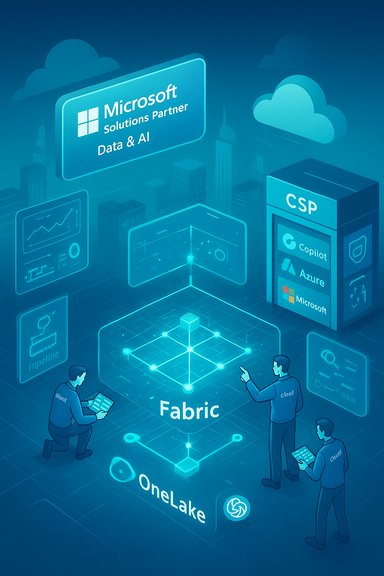
CloudMoyo’s twin announcement — earning the Microsoft Solutions Partner designation in Data & AI and launching a new Microsoft Cloud Solution Provider (CSP) program — signals a deliberate move to convert technical credibility into a single-vendor, end-to-end commercial and delivery offering for customers modernizing data estates and adopting generative AI.
CloudMoyo is a Bellevue, Washington–headquartered digital engineering firm focused on cloud modernization, enterprise AI, and intelligent automation. Its public materials and the company press release state the firm has deep experience across Microsoft Fabric, OneLake, Power BI, Azure OpenAI, and Microsoft 365 ecosystems — a stack that maps directly to Microsoft’s Data & AI solution area. Microsoft’s partner framework now issues measurable Solutions Partner designations (for example Data & AI, Infrastructure, Digital & App Innovation) based on metrics collected in Partner Center across three pillars: Performance (ACR), Skilling (role-based certifications), and Customer Success (deployments and usage growth). To qualify, partners must meet a minimum capability score and register points across distinct metrics. These program mechanics and thresholds are documented by Microsoft. Separately, the CSP channel is Microsoft’s primary route for partners to resell cloud subscriptions (Azure, Microsoft 365, and add-ons such as Copilot), provision and manage tenant configurations, and bundle licensing with managed services. Microsoft has explicitly enabled Copilot purchases through CSP channels, which makes the CSP route materially important for partners selling Copilot-enabled offerings.
Key actions for buyers:
Conclusion
CloudMoyo’s elevation to Microsoft Solutions Partner in Data & AI combined with a CSP program is a pragmatic, market-aligned step that turns capability signals into a transactable service model for modern data and copilot programs. The combination reduces procurement friction, can speed pilots, and aligns with Microsoft’s channel changes that bring Copilot into CSP. The decisive factor for any enterprise buyer will be the partner’s ability to prove delivery through Partner Center evidence, named certifications, reproducible accelerator artifacts, redacted ACR exports, and clear contractual protections for pricing, exit, and data portability. Those proofs — not badges alone — determine whether the partnership will deliver sustainable, enterprise-grade outcomes.
Source: EnterpriseTalk CloudMoyo Achieves Goals to Expand Customer Value
 Background / Overview
CloudMoyo is a Bellevue, Washington–headquartered digital engineering firm focused on cloud modernization, enterprise AI, and intelligent automation. Its public materials and the company press release state the firm has deep experience across Microsoft Fabric, OneLake, Power BI, Azure OpenAI, and Microsoft 365 ecosystems — a stack that maps directly to Microsoft’s Data & AI solution area. Microsoft’s partner framework now issues measurable Solutions Partner designations (for example Data & AI, Infrastructure, Digital & App Innovation) based on metrics collected in Partner Center across three pillars: Performance (ACR), Skilling (role-based certifications), and Customer Success (deployments and usage growth). To qualify, partners must meet a minimum capability score and register points across distinct metrics. These program mechanics and thresholds are documented by Microsoft. Separately, the CSP channel is Microsoft’s primary route for partners to resell cloud subscriptions (Azure, Microsoft 365, and add-ons such as Copilot), provision and manage tenant configurations, and bundle licensing with managed services. Microsoft has explicitly enabled Copilot purchases through CSP channels, which makes the CSP route materially important for partners selling Copilot-enabled offerings. What CloudMoyo Announced — The Essentials
- CloudMoyo has achieved the Microsoft Solutions Partner designation in Data & AI, representing a programmatic validation of capability across Azure analytics and AI engineering.
- CloudMoyo has launched a Microsoft CSP program enabling it to sell, provision, and manage Microsoft Azure, Microsoft 365, and Microsoft Copilot licensing directly to customers while bundling those licenses with CloudMoyo consulting, implementation, and managed services (including productized offerings named CloudMoyo Fabric Accelerator (CFA), CloudMoyo IntelliDoc Analyze (CDA), and CloudMoyo Migration Assistant (CMA).
Why this combination matters to enterprise buyers
Single-vendor procurement and lifecycle accountability
Bundling licensing, implementation, and managed operations under one partner reduces vendor fragmentation. For IT teams, this can simplify procurement approvals, consolidated invoicing, and a single escalation path for issues that span licensing, tenant configuration, and production operations. CloudMoyo’s messaging pitches precisely that convenience.Faster pilots for Copilot and Fabric-based initiatives
Because Microsoft permits Copilot for Microsoft 365 to be purchased through CSP channels, partners can offer smaller pilot bands, promotional pricing, and seat-by-seat rollouts without customers having to manage separate licensing agreements across vendors. This lowers friction for early experiments in departmental copilots or Fabric+RAG pilots. Microsoft’s announcements expanding Copilot availability via CSP channels underpin this capability.Technical alignment with Microsoft’s recommended stack
CloudMoyo’s Data & AI focus aligns with Microsoft’s recommended architecture: Microsoft Fabric + OneLake as the unified data plane, integrated with Azure OpenAI or BYOM (bring-your-own-model) approaches for generative features. That combination supports retrieval-augmented generation (RAG) patterns that are required to ground LLM outputs in enterprise data sources — a fundamental requirement for trustworthy copilot experiences.Technical implications — What to expect from the delivery stack
Microsoft Fabric, OneLake and governance
Fabric and OneLake provide a tenant-level unified data plane that simplifies governance, semantic modeling, and cross-engine analytics. A partner that can deliver reproducible Fabric artifacts (schemas, semantic models, ingestion pipelines) reduces migration risk and accelerates time-to-value. CloudMoyo’s accelerators claim to produce these artifacts to speed adoption. Customers should insist on demonstrable artifacts and IaC templates to confirm reuse.Azure OpenAI, Foundry, and operational ML controls
Production LLM applications require orchestration — model catalogs, routing, telemetry, observability, and guardrails for responsible AI. Microsoft’s Azure OpenAI service, combined with orchestration layers, supports BYOM and enterprise governance patterns. CloudMoyo cites integration with Azure OpenAI; proving operational controls for token management, logging, and incidentability is essential for enterprise deployment.Retrieval-Augmented Generation (RAG) as the practical path
For copilots and question-answering over enterprise data, RAG remains the practical architecture. It demands canonical data mapping, freshness SLAs, provenance metadata, and privacy/redaction controls. Any partner selling a copilot program should show how RAG pipelines are built, tested, and monitored. CloudMoyo positions its accelerators to automate parts of this pipeline — buyers should verify scope and limits.CSP mechanics and Copilot: what procurement teams need to know
- CSP resale scope: CSP partners can transact Microsoft 365, Azure subscriptions, Copilot add-ons, and many marketplace items, but SKU availability and special procurement rules can vary by region and customer segment (government, education). Confirm availability via Partner Center.
- Billing cadence and transparency: CSP invoices may aggregate consumption in ways that complicate internal chargeback or FinOps unless contractually specified. Clarify monthly vs annual billing, how Azure consumption is reported, and how promotions are passed through.
- Copilot via CSP: Microsoft has opened Copilot for Microsoft 365 across sales channels including CSP and removed minimum seat requirements, making pilot deployments easier and more granular. Partners can therefore bundle Copilot seat rollouts with Fabric projects. Validate promotion windows and SKU eligibility.
Strengths in CloudMoyo’s positioning
- Aligned platform expertise: Focusing on Microsoft Fabric, Power BI, and Azure OpenAI matches Microsoft’s Data & AI solution area and corresponding enterprise needs. That alignment improves the odds of producing integrated, supported solutions.
- Commercial convenience: CSP capability combined with productized accelerators can materially shorten procurement cycles and lower pilot friction by combining licensing and services in one contract.
- Programmatic credibility: The Solutions Partner designation is a measurable programmatic signal (ACR, skilling, customer success) that improves discoverability and co-sell eligibility inside Microsoft’s partner ecosystem. Microsoft’s public documentation defines the requirements and demonstrates what the badge certifies.
Risks, limits, and where marketing needs verification
The badge is a signal, not a warranty
A Solutions Partner designation indicates that the partner met measurable program thresholds at a point in time. It is not a contractual guarantee of future delivery quality or a substitute for project-level verification. Procurement should consider the badge a shortlist filter and follow with diligence.Consumption attribution and ACR nuances
Azure Consumed Revenue (ACR) attribution methods (DPOR, PAL, CSP) materially affect partner scoring and co-sell eligibility. Partners sometimes present ACR-derived claims without clarifying attribution methods; buyers should request redacted ACR exports for verification.Promotional dependency and price lock risk
Promotional CSP pricing (Copilot introductory promos, seat discounts) is time‑limited. Contracts that assume perpetual promotions can expose buyers to unexpected price increases post-promotion. Confirm baseline pricing and exit terms.Artifact and reproducibility claims need proof
Claims that accelerators automatically deliver semantic models, OneLake schemas, or IaC should be validated by examining the actual templates, recorded demos, or tenant-level artifacts. Without reproducible artifacts, “accelerator” is marketing shorthand for variable engineering effort.Verification checklist: what to demand before signing
- Provide a Partner Center export or screenshot clearly showing current Solutions Partner – Data & AI status and any active specializations, including award dates.
- Supply a roster of named certified individuals (role and certification IDs) for project-relevant roles (Fabric Data Engineer, Azure Data Engineer) and permission to verify those IDs in Microsoft Learn.
- Share a redacted ACR export for the trailing three months that shows eligible workloads and attribution types (DPOR / PAL / CSP). Confirm how future consumption will be attributed in your procurement model.
- Provide at least three contactable customer references for projects of similar scope and industry, with clearly documented outcomes (time-to-value, measured KPIs).
- Reveal representative artifacts from accelerators: IaC templates (Terraform/ARM/Bicep), pipeline definitions, OneLake schema extracts, and semantic model snapshots — ideally in a sandbox tenant or recorded demo.
- Deliver security and compliance attestations (SOC 2 / ISO 27001), a pen-test executive summary, and a tenant-level security checklist showing Purview/DLP, private endpoints, and managed identity usage.
- Contractual clarity on CSP billing: how promotions are passed through, monthly vs annual invoicing, consumption reporting format for internal chargebacks, and early termination/license portability mechanics.
Practical roadmap for a bounded pilot (60–90 days)
- Discovery (1–2 weeks): map identity architecture, sensitive data locations, and compliance constraints. Document success metrics and rollback criteria.
- Pilot scoping (2–3 weeks): provision a Fabric tenant with OneLake, ingest a representative dataset, and create a small semantic model and RAG pipeline for a controlled doc corpus. Assign cost and token usage targets.
- Technical delivery (3–5 weeks): instrument telemetry (latency, cost-per-query, token consumption), validate provenance, and run user acceptance tests with a departmental cohort using Copilot seats via CSP provisioning.
- Acceptance and handoff (1–2 weeks): capture runbooks, cost-guardrails, incident procedures, and a transition plan for managed services or internal operations. Ensure exportability of tenant artifacts.
Commercial negotiation points to insist on
- Guaranteed pass-through of any CSP promotions for the pilot period and explicit baseline pricing thereafter.
- Clear invoicing format enabling internal chargebacks (line items for Azure consumption, Microsoft 365 seats, Copilot add-ons, and managed services).
- Data portability commitments and an explicit rollback plan removing managed partner entanglement for tenant migration.
- SLAs for incident response, cost-control actions (FinOps guardrails), and a minimum package of security attestations.
How this fits into the broader Microsoft partner landscape
Microsoft has intentionally evolved both the Solutions Partner designations and the CSP channel to accelerate partner-led AI adoption. Solutions Partner badges improve partner discoverability and co-sell eligibility, while CSP enables partners to transact Copilot and other modern SKUs directly — a strategic combination that many Microsoft-aligned SI and ISV partners are now pursuing. The result is a channel dynamic where technical credentials and commercial capabilities must align for partners to deliver turnkey AI programs at scale.Final assessment — strengths, cautions, and buyer action items
CloudMoyo’s announcements are both credible and timely: the Solutions Partner designation is a measurable programmatic achievement, and CSP capability gives the company a direct commercial route to sell and manage Microsoft licensing including Copilot. For enterprises that want a single accountable supplier to design, provision, and run Microsoft Fabric + Copilot programs, this combination is attractive and practical — provided buyers do the required verification.Key actions for buyers:
- Treat the Solutions Partner badge as a starting criterion, not a contract guarantee. Demand Partner Center evidence and named certification rosters.
- Validate accelerator claims with tangible artifacts and recorded tenant demos showing reproducible outputs.
- Lock commercial terms for promotions and billing transparency into the contract to avoid post-pilot price and billing surprises.
Conclusion
CloudMoyo’s elevation to Microsoft Solutions Partner in Data & AI combined with a CSP program is a pragmatic, market-aligned step that turns capability signals into a transactable service model for modern data and copilot programs. The combination reduces procurement friction, can speed pilots, and aligns with Microsoft’s channel changes that bring Copilot into CSP. The decisive factor for any enterprise buyer will be the partner’s ability to prove delivery through Partner Center evidence, named certifications, reproducible accelerator artifacts, redacted ACR exports, and clear contractual protections for pricing, exit, and data portability. Those proofs — not badges alone — determine whether the partnership will deliver sustainable, enterprise-grade outcomes.
Source: EnterpriseTalk CloudMoyo Achieves Goals to Expand Customer Value
