

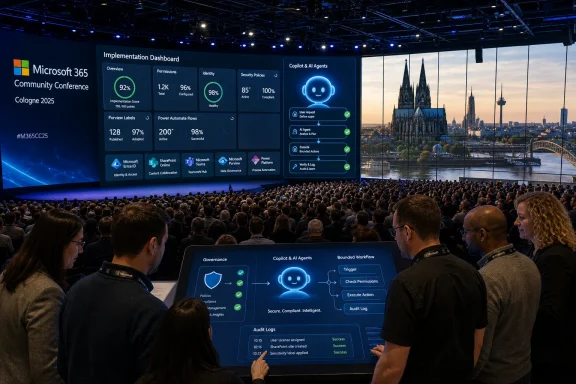
More than 3,000 attendees gathered at the European Collaboration Summit in Cologne, Germany, from May 5 to May 7, 2026, for a Microsoft-focused event where AI implementation, Copilot adoption, governance, security, automation, and modern work dominated the agenda. The important word is not AI; it is implementation. ECS 2026 was less a victory lap for generative technology than a temperature check on whether Microsoft’s partner and customer ecosystem can turn a year of demos into a durable operating model. For Windows admins and Microsoft 365 professionals, that makes the summit a useful signal: the Copilot era is leaving the keynote stage and entering the ticket queue.
The first phase of enterprise AI was theatrical. Vendors showed chat boxes, generated summaries, wrote emails on command, and invited audiences to imagine all the work that would simply evaporate once large language models were woven into familiar productivity suites. That phase is not over, exactly, but ECS 2026 suggests it is no longer enough.
The European Collaboration Summit has long lived in the practical middle of the Microsoft world: SharePoint architects, Teams specialists, Microsoft 365 consultants, Power Platform builders, security leads, MVPs, partners, and admins who are expected to make the roadmap real. When AI dominates an event like this, the conversation inevitably changes shape. Nobody in that crowd needs another reminder that Copilot can summarize a meeting; they need to know what happens when it summarizes the wrong meeting, exposes stale permissions, or becomes one more tool employees are told to love but quietly avoid.
That is why the Cologne event matters beyond its headcount. The summit brought together 275 sessions from 248 speakers, including Microsoft MVPs, regional directors, and Microsoft representatives, but the headline number is not the session count. It is the degree to which AI has become the connective tissue across modern work, Microsoft 365, Azure, Power Platform, security, compliance, and business applications.
In other words, AI is no longer a track. It is the weather system.
For Microsoft, this community is strategically important because Copilot and agents require more than licensing momentum. They require customers to reorganize data, permissions, identity, governance, user training, process design, and security assumptions around software that behaves less like a tool and more like an eager junior employee with broad access. That is consulting work, architecture work, change management work, and sometimes cleanup work after years of collaboration sprawl.
The summit’s scale also points to the way Microsoft’s cloud ecosystem has consolidated. ECS was presented as part of a broader three-summit experience alongside AI and cloud, and business applications programming, reflecting the real shape of enterprise Microsoft deployments. The old boundaries between Microsoft 365, Azure, Power Platform, Fabric, Dynamics, and security were always more convenient for product teams than for customers.
AI has made those boundaries even less useful. A Copilot answer might depend on identity policy, SharePoint content quality, Teams meeting culture, Purview configuration, Graph connectors, Power Automate workflows, and the employee’s actual job role. That reality pushes Microsoft’s partner ecosystem toward a full-stack view of work, where “collaboration” is not a product category but the visible surface of a much deeper information architecture.
Copilot adoption is different because it changes the relationship between users and organizational knowledge. A spreadsheet tool waits for a competent operator. A chat interface invites vague intent. That makes the technology powerful, but it also exposes a brutal truth: many organizations do not know where their knowledge lives, who owns it, whether it is current, or whether employees should have been able to see it in the first place.
The ECS emphasis on real-world use cases is therefore encouraging. It suggests that the Microsoft community is moving past the shallow adoption metric of “how many people opened the app” toward the harder question of where AI genuinely shortens work. Meeting summaries are useful, but they are not a transformation strategy. The better cases are narrower and more disciplined: sales teams preparing account briefs, support groups triaging recurring issues, HR teams navigating policy libraries, project managers extracting risk signals from status noise, and IT teams automating repetitive service operations.
Even then, adoption depends on trust. Employees will abandon Copilot if it feels like a novelty, if its answers are unreliable, or if management frames it as a productivity surveillance device. Administrators will resist it if they inherit the risk without the budget. Legal and compliance teams will slow it down if governance is treated as a postscript rather than a design requirement.
That is why AI agents were an inevitable focus at ECS 2026. In the Microsoft ecosystem, agents sit at the intersection of Copilot Studio, Power Platform, Azure AI, Microsoft 365 data, business applications, and third-party systems. They promise to automate complex workflows, retrieve information, update records, trigger processes, and act across departmental boundaries. They also create a new class of operational risk.
A badly governed chatbot can mislead a user. A badly governed agent can take action. That distinction should concentrate the mind of every admin who has ever discovered that a “temporary” permission exception became permanent, that a service account has more access than anyone remembers, or that a workflow built by a departed power user now runs a business process nobody wants to touch.
The promise of agents is real. Enterprises are full of brittle handoffs, duplicate data entry, ticket routing, status reporting, and approval chains that could benefit from automation with better language understanding. But agentic systems require a discipline many organizations have not yet mastered: clear ownership, bounded authority, auditable behavior, lifecycle management, and a plan for when the automation is confidently wrong.
This is where community conferences become more useful than vendor showcases. The vendor describes the architecture as it should be. Practitioners describe the mess as it is.
Microsoft 365 environments are rarely pristine. They are years of Teams channels, SharePoint sites, OneDrive folders, guest access exceptions, inherited permissions, abandoned groups, migrated file shares, sensitivity labels half-applied, and retention policies nobody wants to revisit. Copilot does not create that mess, but it can make it suddenly visible.
That visibility is politically awkward. An employee who could technically open a file yesterday may never have found it. An AI assistant that can retrieve or summarize it changes the practical meaning of access. This is why security and compliance featured so prominently in the ECS AI conversation: administrators know that Copilot readiness is, in many cases, data readiness by another name.
The uncomfortable lesson is that AI governance is not a separate program. It is identity governance, information governance, device governance, app governance, and workflow governance under a brighter light. Organizations that treated Microsoft 365 as a loosely managed collaboration playground now face a harder task than those that invested early in classification, lifecycle controls, conditional access, and least privilege.
That does not mean only mature enterprises can use AI. It means immature environments need a narrower start. The sensible path is not to freeze adoption until every permission is perfect; it is to align use cases with known data boundaries, monitor outcomes, and fix the highest-risk information architecture problems before expanding the blast radius.
The AI workplace is managed through Microsoft Entra, Intune, Defender, Purview, SharePoint, Teams, Exchange, Power Platform admin centers, Azure controls, and the policies that connect them. Windows devices are part of that estate, but the real action is in the control plane. Who can access what? Which apps can connect? Which data can be indexed? Which prompts and outputs are retained? Which connectors are approved? Which automations can run? Which users get which AI features?
That is not the kind of story that produces a clean product screenshot. It is, however, the story that determines whether AI makes enterprise computing better or merely more chaotic. Microsoft’s advantage is that it already owns much of the productivity and identity substrate. Microsoft’s challenge is that customers now expect the company to make that substrate governable under AI pressure.
For Windows admins, this means the job keeps expanding upward. The endpoint still matters, but the modern admin is increasingly an identity broker, policy designer, data access skeptic, automation reviewer, and AI risk translator. The help desk will still hear “my laptop is slow,” but it will also hear “why did Copilot give my colleague a different answer?” and “why can this agent update that record?”
Those questions do not live neatly inside the old desktop support model. They require IT teams to understand how cloud services, permissions, data quality, user behavior, and AI orchestration interact. ECS 2026’s agenda reflects that convergence.
But enterprise customers do not adopt narratives; they adopt systems. A community event like ECS functions as a reality check because the attendees are close enough to the implementation layer to know where the story bends. They see which Copilot pilots stall, which security blockers recur, which data cleanup projects suddenly become urgent, and which departments find immediate value.
The presence of Microsoft representatives alongside MVPs, regional directors, partners, and independent experts is part of that feedback loop. Microsoft needs its ecosystem to translate product ambition into deployable practice. The ecosystem needs Microsoft to hear where licensing, documentation, admin controls, reporting, and governance features do not yet match customer reality.
That exchange is not always comfortable, but it is healthy. The Microsoft community has historically been strongest when practitioners can challenge the platform without leaving it. SharePoint, Teams, Power Platform, and now Copilot have all benefited from a world of specialists who build around gaps, document pitfalls, and teach administrators how to survive the official roadmap.
ECS 2026 appears to have captured that same dynamic for AI. The discussion was not whether AI matters. That question is settled inside this ecosystem. The discussion was whether organizations can make it useful without losing control.
The event’s breadth also matters. Modern work, Microsoft 365, Copilot, Azure AI, governance, security, automation, and the future of work are not separate conversations anymore. The same customer asking about Copilot adoption may also need help with Purview labels, SharePoint permissions, Power Platform environments, Defender posture, and Azure AI design choices.
That convergence favors large ecosystem gatherings. A narrow product conference can go deep, but AI adoption cuts horizontally across the stack. ECS’s three-summit framing reflects a marketplace where customers increasingly want one answer to a cross-product question: how do we make Microsoft’s cloud estate work as a coherent platform rather than a bundle of subscriptions?
The risk is that “AI everywhere” becomes too diffuse to be useful. If every session is an AI session, the term can lose meaning. The better signal from ECS is the emphasis on implementation rather than spectacle. Adoption, governance, security, automation, and agents are concrete enough to expose whether the conversation is real.
The next edition, scheduled for May 31 to June 2, 2027, in Düsseldorf, will be a useful checkpoint. By then, many organizations will have had another year of Copilot licenses, agent experiments, and governance lessons. The question for 2027 will not be whether AI dominates the agenda again. It will be whether the case studies have become less aspirational and more operational.
If Copilot becomes a normal layer over documents, meetings, chats, emails, records, and workflows, then productivity software is no longer passive. It suggests, summarizes, drafts, prioritizes, retrieves, and eventually acts. That shifts responsibility. Users must learn how to supervise AI output. Managers must decide what good work looks like when first drafts are cheap. IT must decide how much autonomy software should have. Security teams must defend not only systems, but the decisions increasingly mediated by those systems.
The most interesting feature of ECS 2026 may be that it brought these groups into the same orbit. Technical sessions and workshops are where abstract workplace transformation collides with tenant settings, admin centers, compliance requirements, and user impatience. That collision is where the real future of work is made.
For Microsoft, this is both an opportunity and a warning. The company has the distribution, the data graph, the partner ecosystem, and the enterprise relationships to make AI a default part of office work. But default status is not the same as trust. If customers feel pushed into unfinished governance models, unclear licensing value, or tools that amplify existing data problems, adoption will become performative.
For customers, the warning is equally direct. Waiting for perfect clarity from Microsoft is not a strategy. Organizations need to build their own AI operating models now: define acceptable use, clean priority data domains, train users by role, establish review patterns for agents, and measure outcomes beyond novelty.
That work will vary by organization, but the most concrete signals from Cologne point in a consistent direction:
 Microsoft’s AI Story Has Moved From Wonder to Workflow
The first phase of enterprise AI was theatrical. Vendors showed chat boxes, generated summaries, wrote emails on command, and invited audiences to imagine all the work that would simply evaporate once large language models were woven into familiar productivity suites. That phase is not over, exactly, but ECS 2026 suggests it is no longer enough.The European Collaboration Summit has long lived in the practical middle of the Microsoft world: SharePoint architects, Teams specialists, Microsoft 365 consultants, Power Platform builders, security leads, MVPs, partners, and admins who are expected to make the roadmap real. When AI dominates an event like this, the conversation inevitably changes shape. Nobody in that crowd needs another reminder that Copilot can summarize a meeting; they need to know what happens when it summarizes the wrong meeting, exposes stale permissions, or becomes one more tool employees are told to love but quietly avoid.
That is why the Cologne event matters beyond its headcount. The summit brought together 275 sessions from 248 speakers, including Microsoft MVPs, regional directors, and Microsoft representatives, but the headline number is not the session count. It is the degree to which AI has become the connective tissue across modern work, Microsoft 365, Azure, Power Platform, security, compliance, and business applications.
In other words, AI is no longer a track. It is the weather system.
Cologne Became a Mirror for Microsoft’s Partner Economy
ECS 2026 was formally a Microsoft ecosystem gathering, not a Microsoft product launch. That distinction matters. The people filling rooms in Cologne are often the ones customers call after the launch blog post has aged badly and the deployment has become political.For Microsoft, this community is strategically important because Copilot and agents require more than licensing momentum. They require customers to reorganize data, permissions, identity, governance, user training, process design, and security assumptions around software that behaves less like a tool and more like an eager junior employee with broad access. That is consulting work, architecture work, change management work, and sometimes cleanup work after years of collaboration sprawl.
The summit’s scale also points to the way Microsoft’s cloud ecosystem has consolidated. ECS was presented as part of a broader three-summit experience alongside AI and cloud, and business applications programming, reflecting the real shape of enterprise Microsoft deployments. The old boundaries between Microsoft 365, Azure, Power Platform, Fabric, Dynamics, and security were always more convenient for product teams than for customers.
AI has made those boundaries even less useful. A Copilot answer might depend on identity policy, SharePoint content quality, Teams meeting culture, Purview configuration, Graph connectors, Power Automate workflows, and the employee’s actual job role. That reality pushes Microsoft’s partner ecosystem toward a full-stack view of work, where “collaboration” is not a product category but the visible surface of a much deeper information architecture.
Copilot Adoption Is Now a Management Problem Disguised as a Licensing Problem
The great temptation for large organizations is to treat Microsoft 365 Copilot like any other seat-based enterprise software rollout. Buy licenses, assign licenses, send an announcement, host a webinar, measure usage, repeat. That model is comfortable, measurable, and often wrong.Copilot adoption is different because it changes the relationship between users and organizational knowledge. A spreadsheet tool waits for a competent operator. A chat interface invites vague intent. That makes the technology powerful, but it also exposes a brutal truth: many organizations do not know where their knowledge lives, who owns it, whether it is current, or whether employees should have been able to see it in the first place.
The ECS emphasis on real-world use cases is therefore encouraging. It suggests that the Microsoft community is moving past the shallow adoption metric of “how many people opened the app” toward the harder question of where AI genuinely shortens work. Meeting summaries are useful, but they are not a transformation strategy. The better cases are narrower and more disciplined: sales teams preparing account briefs, support groups triaging recurring issues, HR teams navigating policy libraries, project managers extracting risk signals from status noise, and IT teams automating repetitive service operations.
Even then, adoption depends on trust. Employees will abandon Copilot if it feels like a novelty, if its answers are unreliable, or if management frames it as a productivity surveillance device. Administrators will resist it if they inherit the risk without the budget. Legal and compliance teams will slow it down if governance is treated as a postscript rather than a design requirement.
The Agent Conversation Is Where the Stakes Get Higher
Copilot is the friendly face of Microsoft’s AI push. Agents are the sharper edge. The difference is not merely branding; it is the shift from asking software for help to allowing software to pursue goals through connected systems.That is why AI agents were an inevitable focus at ECS 2026. In the Microsoft ecosystem, agents sit at the intersection of Copilot Studio, Power Platform, Azure AI, Microsoft 365 data, business applications, and third-party systems. They promise to automate complex workflows, retrieve information, update records, trigger processes, and act across departmental boundaries. They also create a new class of operational risk.
A badly governed chatbot can mislead a user. A badly governed agent can take action. That distinction should concentrate the mind of every admin who has ever discovered that a “temporary” permission exception became permanent, that a service account has more access than anyone remembers, or that a workflow built by a departed power user now runs a business process nobody wants to touch.
The promise of agents is real. Enterprises are full of brittle handoffs, duplicate data entry, ticket routing, status reporting, and approval chains that could benefit from automation with better language understanding. But agentic systems require a discipline many organizations have not yet mastered: clear ownership, bounded authority, auditable behavior, lifecycle management, and a plan for when the automation is confidently wrong.
This is where community conferences become more useful than vendor showcases. The vendor describes the architecture as it should be. Practitioners describe the mess as it is.
Governance Has Become the Price of Admission
The governance conversation around AI often sounds defensive, as though it exists to slow down innovation. In practice, governance is what makes adoption possible at scale. Without it, every Copilot rollout becomes an argument between enthusiasm and fear.Microsoft 365 environments are rarely pristine. They are years of Teams channels, SharePoint sites, OneDrive folders, guest access exceptions, inherited permissions, abandoned groups, migrated file shares, sensitivity labels half-applied, and retention policies nobody wants to revisit. Copilot does not create that mess, but it can make it suddenly visible.
That visibility is politically awkward. An employee who could technically open a file yesterday may never have found it. An AI assistant that can retrieve or summarize it changes the practical meaning of access. This is why security and compliance featured so prominently in the ECS AI conversation: administrators know that Copilot readiness is, in many cases, data readiness by another name.
The uncomfortable lesson is that AI governance is not a separate program. It is identity governance, information governance, device governance, app governance, and workflow governance under a brighter light. Organizations that treated Microsoft 365 as a loosely managed collaboration playground now face a harder task than those that invested early in classification, lifecycle controls, conditional access, and least privilege.
That does not mean only mature enterprises can use AI. It means immature environments need a narrower start. The sensible path is not to freeze adoption until every permission is perfect; it is to align use cases with known data boundaries, monitor outcomes, and fix the highest-risk information architecture problems before expanding the blast radius.
The Windows Angle Is Not the Desktop, but the Admin Surface
For Windows enthusiasts, the AI story often arrives through the visible layer: Copilot in Windows, Recall controversies, on-device models, NPUs, and the steady repositioning of the PC as an AI endpoint. Those are important, but ECS 2026 points to a less glamorous and arguably more consequential layer: administration.The AI workplace is managed through Microsoft Entra, Intune, Defender, Purview, SharePoint, Teams, Exchange, Power Platform admin centers, Azure controls, and the policies that connect them. Windows devices are part of that estate, but the real action is in the control plane. Who can access what? Which apps can connect? Which data can be indexed? Which prompts and outputs are retained? Which connectors are approved? Which automations can run? Which users get which AI features?
That is not the kind of story that produces a clean product screenshot. It is, however, the story that determines whether AI makes enterprise computing better or merely more chaotic. Microsoft’s advantage is that it already owns much of the productivity and identity substrate. Microsoft’s challenge is that customers now expect the company to make that substrate governable under AI pressure.
For Windows admins, this means the job keeps expanding upward. The endpoint still matters, but the modern admin is increasingly an identity broker, policy designer, data access skeptic, automation reviewer, and AI risk translator. The help desk will still hear “my laptop is slow,” but it will also hear “why did Copilot give my colleague a different answer?” and “why can this agent update that record?”
Those questions do not live neatly inside the old desktop support model. They require IT teams to understand how cloud services, permissions, data quality, user behavior, and AI orchestration interact. ECS 2026’s agenda reflects that convergence.
Community Events Are Becoming the Reality Check Microsoft Needs
Microsoft’s AI messaging is intentionally optimistic. It has to be. The company is asking customers to pay for a new class of productivity software, trust AI inside sensitive workstreams, and accept a roadmap in which agents become increasingly normal.But enterprise customers do not adopt narratives; they adopt systems. A community event like ECS functions as a reality check because the attendees are close enough to the implementation layer to know where the story bends. They see which Copilot pilots stall, which security blockers recur, which data cleanup projects suddenly become urgent, and which departments find immediate value.
The presence of Microsoft representatives alongside MVPs, regional directors, partners, and independent experts is part of that feedback loop. Microsoft needs its ecosystem to translate product ambition into deployable practice. The ecosystem needs Microsoft to hear where licensing, documentation, admin controls, reporting, and governance features do not yet match customer reality.
That exchange is not always comfortable, but it is healthy. The Microsoft community has historically been strongest when practitioners can challenge the platform without leaving it. SharePoint, Teams, Power Platform, and now Copilot have all benefited from a world of specialists who build around gaps, document pitfalls, and teach administrators how to survive the official roadmap.
ECS 2026 appears to have captured that same dynamic for AI. The discussion was not whether AI matters. That question is settled inside this ecosystem. The discussion was whether organizations can make it useful without losing control.
The Summit’s Numbers Tell a Story of Consolidation
The reported figures around ECS 2026 are striking: more than 3,000 attendees, 275 sessions, 248 speakers, 106 Microsoft MVPs, 11 Microsoft regional directors, and 58 Microsoft representatives. Those numbers are conference trivia only if read in isolation. Read together, they show a Microsoft partner and practitioner ecosystem reorganizing around AI as the shared agenda.The event’s breadth also matters. Modern work, Microsoft 365, Copilot, Azure AI, governance, security, automation, and the future of work are not separate conversations anymore. The same customer asking about Copilot adoption may also need help with Purview labels, SharePoint permissions, Power Platform environments, Defender posture, and Azure AI design choices.
That convergence favors large ecosystem gatherings. A narrow product conference can go deep, but AI adoption cuts horizontally across the stack. ECS’s three-summit framing reflects a marketplace where customers increasingly want one answer to a cross-product question: how do we make Microsoft’s cloud estate work as a coherent platform rather than a bundle of subscriptions?
The risk is that “AI everywhere” becomes too diffuse to be useful. If every session is an AI session, the term can lose meaning. The better signal from ECS is the emphasis on implementation rather than spectacle. Adoption, governance, security, automation, and agents are concrete enough to expose whether the conversation is real.
The next edition, scheduled for May 31 to June 2, 2027, in Düsseldorf, will be a useful checkpoint. By then, many organizations will have had another year of Copilot licenses, agent experiments, and governance lessons. The question for 2027 will not be whether AI dominates the agenda again. It will be whether the case studies have become less aspirational and more operational.
The Future of Work Is Being Negotiated by Administrators
The phrase future of work has been abused by enough slide decks to deserve suspicion. Yet ECS 2026 shows why the phrase persists. Work is being renegotiated through the tools people use every day, and Microsoft sits uncomfortably close to the center of that negotiation.If Copilot becomes a normal layer over documents, meetings, chats, emails, records, and workflows, then productivity software is no longer passive. It suggests, summarizes, drafts, prioritizes, retrieves, and eventually acts. That shifts responsibility. Users must learn how to supervise AI output. Managers must decide what good work looks like when first drafts are cheap. IT must decide how much autonomy software should have. Security teams must defend not only systems, but the decisions increasingly mediated by those systems.
The most interesting feature of ECS 2026 may be that it brought these groups into the same orbit. Technical sessions and workshops are where abstract workplace transformation collides with tenant settings, admin centers, compliance requirements, and user impatience. That collision is where the real future of work is made.
For Microsoft, this is both an opportunity and a warning. The company has the distribution, the data graph, the partner ecosystem, and the enterprise relationships to make AI a default part of office work. But default status is not the same as trust. If customers feel pushed into unfinished governance models, unclear licensing value, or tools that amplify existing data problems, adoption will become performative.
For customers, the warning is equally direct. Waiting for perfect clarity from Microsoft is not a strategy. Organizations need to build their own AI operating models now: define acceptable use, clean priority data domains, train users by role, establish review patterns for agents, and measure outcomes beyond novelty.
The Hard Part Starts After the Keynote
ECS 2026’s most useful lesson is that AI adoption is becoming a craft discipline. It is not just prompt engineering, not just licensing, not just security review, and not just executive enthusiasm. It is the work of matching technology capability to business process under real constraints.That work will vary by organization, but the most concrete signals from Cologne point in a consistent direction:
- AI adoption in Microsoft 365 is moving from experimentation toward implementation, with governance and security now central to the conversation.
- Copilot value depends heavily on information architecture, permissions hygiene, user training, and the quality of existing collaboration practices.
- AI agents raise the stakes because they can move from answering questions to taking action across business systems.
- Microsoft’s partner and MVP ecosystem is becoming essential to translating AI roadmaps into deployable customer patterns.
- Windows and Microsoft 365 administrators should expect AI to expand their role into identity, data governance, automation oversight, and risk management.
- The 2027 summit in Düsseldorf will be a practical test of whether today’s AI pilots have matured into repeatable enterprise operating models.
References
- Primary source: Technology Record
Published: 2026-05-20T10:06:08.702772
AI implementation and adoption dominate conversations at...
Over 3,000 attendees from across the globe attended the 2026 European Collaboration Summit (ECS) from the 5-7 May in Cologne, Germany, for three...www.technologyrecord.com
