

Ed Reed’s short, sharp film study of Dallas Cowboys receiver CeeDee Lamb — released as part of the “Blueprint” series and produced with Microsoft Copilot tooling — packages Hall of Fame-level tape study into a mobile-ready, annotated clip that teaches route stems, leverage and finishing technique while also functioning as an explicit demo of Copilot’s on-screen annotation, script-assist, and distribution automation capabilities.
The clip in question is one installment in a short-form series that pairs veteran analysts with AI-assisted production tools to create concise, teachable film-room lessons. The format is deliberately compact: a two- to five-minute breakdown that synchronizes expert narration with pixel-accurate visual callouts and ready-made metadata for social and search distribution. That packaging is a win for fan education — and a demonstration product for Microsoft’s broader NFL partnership and Copilot positioning. On the football side, the episode centers on CeeDee Lamb’s elite route-running, catch-point technique, and ability to create separation at the stem — traits that make him one of the NFL’s most consistent playmakers. Career and season statistics confirm Lamb’s status as a high-volume receiver with multiple 1,000-yard seasons, reinforcing the instructional value of the clip for coaches and fans who want to understand how receivers win at the line of scrimmage and at the catch point.
For fans and coaches, the clip is valuable as an apprenticeship shortcut — a way to see route engineering and catch technique played back in pixel-perfect sync with expert narration. For publishers, Microsoft, and teams, the segment is a commercial demonstration of how Copilot can reduce friction across production pipelines. For IT and procurement, it is a reminder that vendor promises about on-device NPUs and TOPS require independent verification and careful governance.
In short: enjoy the teaching, trust the tape, but verify the numbers — and treat the Copilot overlays as a powerful production tool that still needs human stewardship.
Source: Yardbarker Watch: CeeDee Lamb Film Study with Ed Reed | Blueprint Ep. 7
 Background / Overview
The clip in question is one installment in a short-form series that pairs veteran analysts with AI-assisted production tools to create concise, teachable film-room lessons. The format is deliberately compact: a two- to five-minute breakdown that synchronizes expert narration with pixel-accurate visual callouts and ready-made metadata for social and search distribution. That packaging is a win for fan education — and a demonstration product for Microsoft’s broader NFL partnership and Copilot positioning. On the football side, the episode centers on CeeDee Lamb’s elite route-running, catch-point technique, and ability to create separation at the stem — traits that make him one of the NFL’s most consistent playmakers. Career and season statistics confirm Lamb’s status as a high-volume receiver with multiple 1,000-yard seasons, reinforcing the instructional value of the clip for coaches and fans who want to understand how receivers win at the line of scrimmage and at the catch point. Why this matters: pedagogy meets product demo
The teaching angle: making micro-traits visible
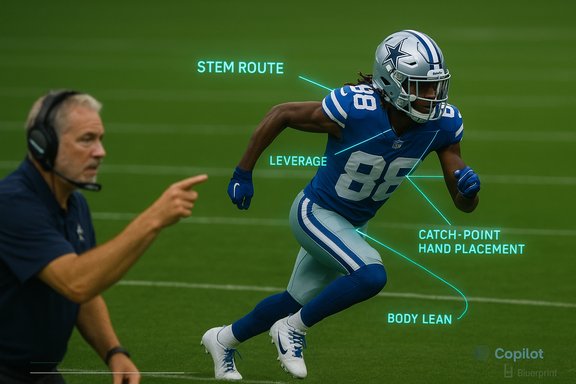
Short film-study pieces like this succeed because they remove the cognitive overhead of long tape sessions. Visual overlays trace route stems, blocking combos, and leverage in exact frame sync with the presenter’s narration, turning implicit film-room language into explicit, scannable lesson points. For a fan, youth coach, or analyst pressed for time, that clarity is the principal benefit.- Visual callouts show where the receiver initiates the stem and how a linebacker’s hesitation creates a YAC corridor.
- Slow-motion freeze frames isolate catch technique — hand placement, elbow control, and body lean — so the mechanics can be practiced.
- The short-form sequence model (field-flipping timing pass + low-variance downhill finish) is repeated as a teachable template rather than a single isolated highlight.
The product angle: Copilot as creative accelerator
What makes the episode notable beyond the on-field lesson is how Microsoft Copilot is used in the production chain: on-screen annotations, scripted voiceover assistance, automatic captions, and SEO metadata generation are all part of the workflow. This reduces editorial friction, speeds turnaround, and produces social-first cuts and thumbnails with less manual labor. The larger NFL–Microsoft expansion announced in 2025 made Copilot a strategic part of game-day and content workflows, positioning the tool as more than an editor’s assistant — as an operational augmentation for clubs and media partners.Technical anatomy: how Copilot is being applied
Visual overlays and alignment
The on-screen callouts are implemented to match Reed’s spoken keys: receiver stems, quarterback timing, protection windows, and second-level pursuit angles. That pixel-level synchronization is the pedagogical core; when Reed says “watch the inside shoulder,” an overlay highlights that shoulder in-frame, reducing interpretation latency for viewers. These overlays are typical of Copilot-assisted visual tooling and are the most visible sign of on-device vision features at work.Script assistance and distribution automation
Generative assistance helps editors compress long-form film-room monologues into tight narration suitable for sub-five-minute videos. Copilot can draft voiceover scripts, auto-generate captions for accessibility, and propose SEO-friendly headlines and tags for publisher CMS, making the clip more discoverable without multiplying editorial headcount. Publishers still need to verify facts (e.g., exact yardage, play-clock context), but the time saved on routine tasks is measurable.Hybrid runtime: on-device spotting + cloud reasoning
Practical deployments use a hybrid model: low-latency visual spotting and overlay placement may run on-device while heavier generative steps (long-form synthesis, distribution packaging) occur in the cloud. Microsoft’s Copilot+ PC messaging emphasizes devices with on-device acceleration (NPUs) to lower latency and preserve privacy-sensitive workstreams; vendor documentation and developer guidance point toward NPU performance targets in the ~40+ TOPS range as a procurement threshold for many Copilot+ experiences. Those hardware numbers are vendor statements and should be verified against OEM datasheets and independent benchmarks before being used to make purchasing decisions.What Ed Reed teaches about CeeDee Lamb (the football lesson)
Route stems and leverage
Reed’s breakdown isolates the micro-trait most responsible for Lamb’s consistent production: route engineering over pure speed. Lamb’s stems manipulate linebacker posture — creating split-second processing conflicts that open narrow alleys for YAC even without large initial separation. The clip shows how a properly executed stem forces a defender to choose between underneath coverage and depth, and how that hesitation becomes exploitable.Catch-point technique and finishing
The film highlights Lamb’s hand placement, body control, and immediate transition to forward progress — the “boring” mechanics that win contested catches. Reed emphasizes contested-catch drills and finishing technique as repeatable traits that coaches can replicate in practice, not one-off athletic spectacles. Those fundamentals explain why Lamb converts contested opportunities into consistent yardage.Protect-to-pass timing concepts
The episode frames the pass as a timing throw enabled by protection clarity. A simplified protection that buys a 3–3.5 second window for the quarterback allows timing concepts to hit reliably; Reed points out how the combination of clean pocket, route-action design, and catch-point execution combine to flip field position with high probability. That two-play cadence (timing pass followed by a low-variance finish) is the repeatable template the clip teaches.Verification: cross-checking claims and numbers
Responsible analysis pairs highlighted clips with objective metrics. When the clip cites yardage or play context, the correct verification step is to consult official play-by-play and box-score data. In this case, Lamb’s career and seasonal output (multiple 1,000-yard seasons, high contested-catch rates) are verifiable across league stat pages and mainstream sports outlets, which corroborate his status as a top-tier route-runner and YAC threat. Use official gamebooks or NFL stat pages for precise yardage checks rather than relying solely on on-screen captions. If a production claims hardware performance or on-device runtime numbers (e.g., “40 TOPS NPU”), treat those as vendor claims until you see OEM datasheets or independent benchmarks that measure the specific SKU under the relevant workload. Independent tech outlets and Microsoft’s developer guidance are good cross-checks before procurement.Strengths: where the Reed + Copilot combo genuinely adds value
- Accessibility to expert insight: Hall of Fame-level perspective becomes consumable for fans, youth coaches, and analysts who lack time for full tape study.
- Pedagogical clarity: Visual callouts synchronize eyes and ears, reducing ambiguity and making complex reads teachable at scale.
- Editorial efficiency: Automated drafting of scripts, captions, and metadata lets publishers scale short explainers while keeping production costs in check.
- Operational lift for clubs and media partners: Microsoft’s NFL partnership is explicitly pitched as a way to speed sideline and scouting workflows, from scouting combines to in-game analytics.
Risks and trade-offs: editorial, privacy, and governance
Selection bias and small-sample inference
Short highlights are explicit selection engines: editors pick moments that best exemplify a narrative. That’s pedagogically useful, but it’s not proof of a season-long trend. Coaches and analysts should pair a highlight with snap-by-snap metrics before treating it as definitive evidence of a player’s or scheme’s superiority. The production notes for these clips explicitly warn against extrapolating systemic claims from single vignettes.Generative risk: hallucination and narrative drift
Generative assistants excel at packaging narratives but can invent context or overstate causality. When Copilot drafts the narration or metadata, editorial sign-off is essential to prevent factual drift — especially where yardage, timing, or personnel claims are concerned. Rigorous human verification remains non-negotiable.Privacy and telemetry on highlight pages
Video-hosting pages are telemetry endpoints: video players, ad tech, and third-party measurement scripts collect signals. Cookie preference centers mitigate but do not eliminate server-side matching or fingerprinting. For privacy-conscious Windows users, practical steps include InPrivate browsing, strict tracking prevention, and selectively disabling targeting cookies when the player allows. The issue is both a consumer privacy problem and an enterprise governance question when teams use Copilot-enabled devices in production.Hardware and procurement risk
Vendor messaging about NPUs and TOPS supports the Copilot+ PC story, but device-level benchmarks vary. Procurement teams should insist on OEM datasheets showing measured NPU throughput for the specific SKU and independent benchmarks under representative workloads. Treat promotional TOPS counts as an initial spec, not a procurement guarantee.Practical guidance: what WindowsForum readers should do
For fans who want to learn (and protect privacy)
- Watch the clip to learn route stems and catch techniques, but treat it as instructional — not definitive proof of a trend.
- Cross-check any numeric claims (yardage, down/distance) against the official gamebook or NFL play-by-play if you plan to reuse the clip in analysis.
- Use an InPrivate window or strict tracking prevention mode when viewing ad-supported highlight pages; disable targeting cookies via the site’s cookie preferences if available.
For content editors and producers
- Use Copilot for draft overlays and captions but require human verification for all factual claims.
- Publish a short methodology note on highlight pages when you cite numbers (e.g., “Yardage verified against official play-by-play”).
- Pilot on-device spotting with minimal privileges and audit all agent actions in production environments.
For IT leaders and procurement teams
- Require DLP, Intune policies, and role-based access before deploying Copilot Vision or agentic features in production pipelines.
- Insist on OEM datasheets and independent benchmarks when a device’s NPU/TOPS claims are material to your workflow, and test devices under representative media workloads.
- Contractualize vendor transparency: require documentation of what processing happens on-device vs. in the cloud and secure audit logs for agentic actions.
Editorial and governance checklist (concise)
- Require human sign-off for Copilot-generated narration and captions.
- Publish verification notes for any play-level numeric claims.
- Use limited-scope pilots to evaluate on-device privacy trade-offs before enterprise-wide rollout.
- Maintain device and network-level logging for all Copilot-assisted production tasks.
Conclusion: a teachable moment and a cautionary one
The CeeDee Lamb film study with Ed Reed is a model of modern sports pedagogy: expert analysis made instantly visible through on-screen annotation, tight narration, and social-ready distribution. It represents what AI can do for audience education and editorial throughput — but it also compresses a set of governance questions into each five-minute clip: editorial selection bias, generative risk, privacy leakage, and procurement complexity.For fans and coaches, the clip is valuable as an apprenticeship shortcut — a way to see route engineering and catch technique played back in pixel-perfect sync with expert narration. For publishers, Microsoft, and teams, the segment is a commercial demonstration of how Copilot can reduce friction across production pipelines. For IT and procurement, it is a reminder that vendor promises about on-device NPUs and TOPS require independent verification and careful governance.
In short: enjoy the teaching, trust the tape, but verify the numbers — and treat the Copilot overlays as a powerful production tool that still needs human stewardship.
Source: Yardbarker Watch: CeeDee Lamb Film Study with Ed Reed | Blueprint Ep. 7
